This post comes three weeks after a walk on New Year’s Day 2023. On the walk, I wanted to use a walking algorithm of turning LLLR at path intersections to reconnect with my local walking range after a hiatus. The walking algorithm helps me attend to the experience rather than concentrating on navigation. After the walk, I wanted to make some thing that said something about the experience. I made a string of words describing the experience of the walk along with a slideshow of images and put up a post.
I wanted to use the words in a way that showed the experience of the walk, the form showing just one thing after another to indicate the experience of walking a linear path, and the content indicating what I saw and thought. A long string of unpunctuated lowercase words describing the thinking and sensing seemed to do this. It was not prose nor was it a poem, it was an impression of the walk in words. I called it LLLR prosepoemwalk. here
On the page, the string of words became a word block, a physical form, something I have worked with before. The words represented a series of encounters with the place I walked through. Each one occurred as the here-and-now experience, but which added up to a sense of time passing as I physically passed through the outdoor space.
One of the things that interests me is the way showing or describing doing, the words and pictures of the experience, never fully express the fullness or completeness or singularity of the experience. This is specially the case if you are intentionally attending in a state of flow.
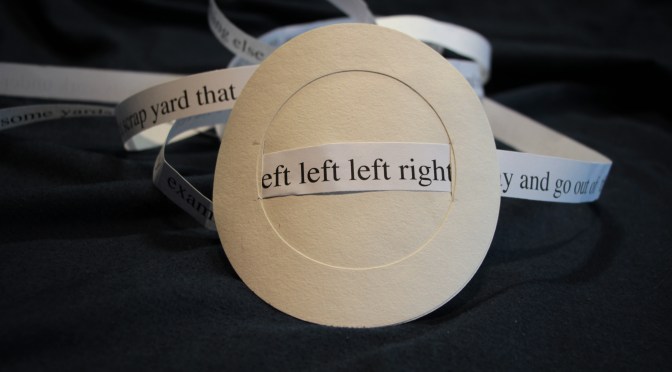
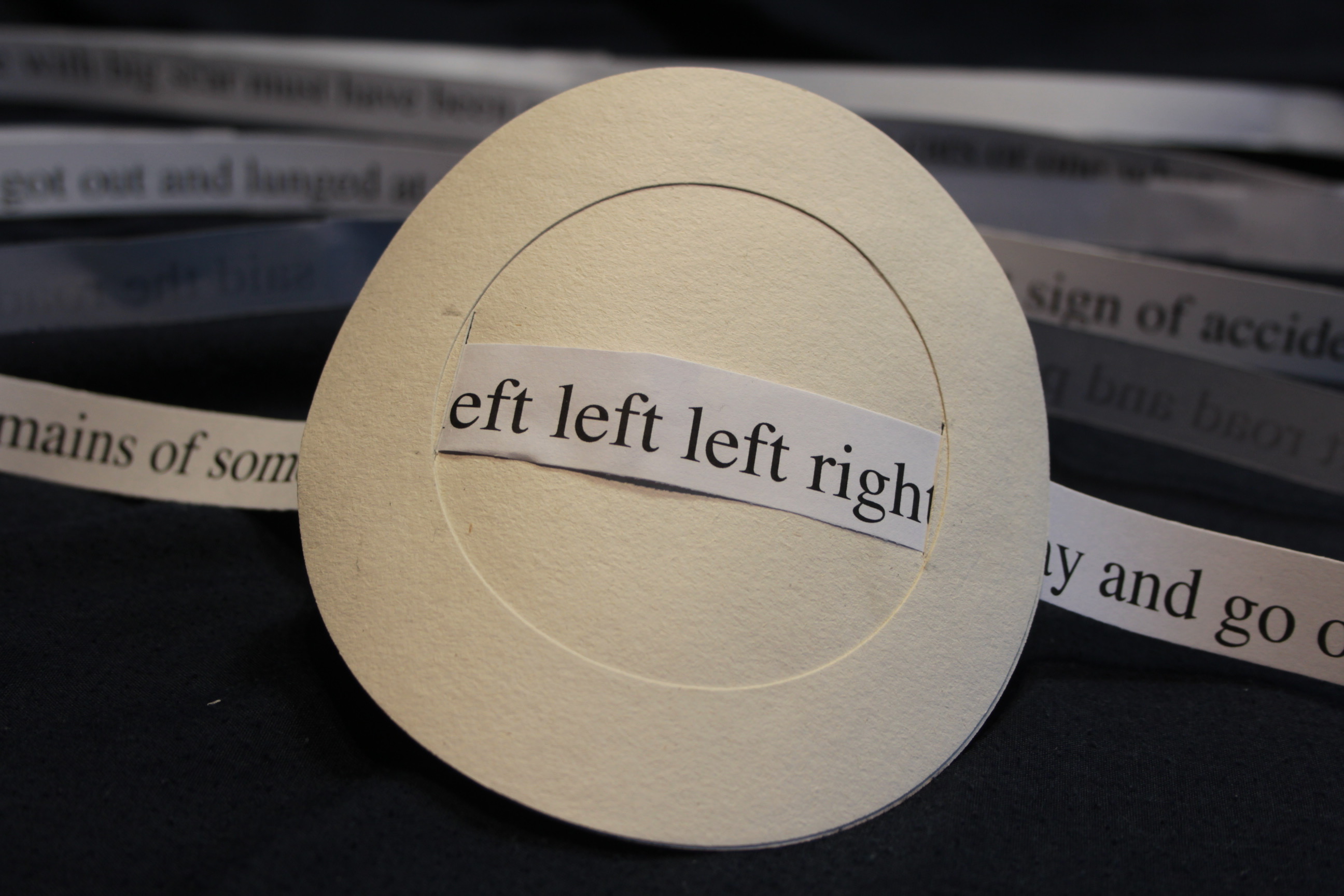
This post has been worked on for three weeks. I made the object shown above and below to try and express the experience frustration of describing doing, and translating experience into words. What writing the post revealed surprised me. I want to bring what it revealed into the post, but first I want to describe the wandering path I took to get to what it showed me.
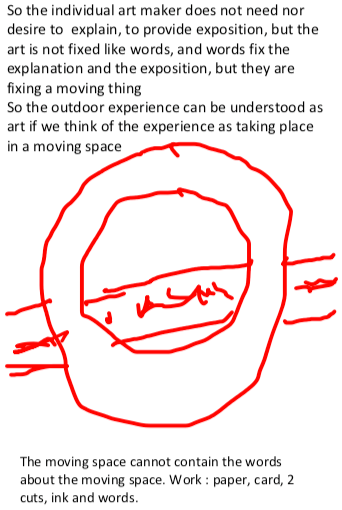
Looking at the words, in unpunctuated lowercase text as a block, I was interested in what would happen if I made the words take on a linear form, rather than the block imposed by the page. A memory of ticker tape experiments in physics came to mind. Then I saw a big string of words describing doing extending way beyond a tight space of a small circle, showing only 2–3 words. I wanted to make this image or idea as a material object, to express the difficulties in using words for describing doing. This was my original sketch, in MS OneNote. I saw the inner circle as my experience within the bigger circle, the space I was walking in. I saw the words as just a little bit of the experience, not really fully describing my experience. They went on and on at length about some shorter succinct experiences. The experience, like the artform, could speak for itself simply without verbosity and verbiage.
In my dramatherapy training and practice and my reading about art as research, the idea of art as a form of material thinking was developed and was very compelling. Can we think, through the experience of making material objects? Can the materiality of art making be research without needing words? I work on this a lot. Some arts practitioners have explored ideas and experiences of material thinking.
Some Ideas about Material Thinking
Two interesting arts practitioners who have worked with theories and practices about material thinking, the capacity for arts materials and practices to act as a way of thinking through doing are Barbara Bolt and Augusto Boal. Each uses different words to describe the experience, but the core phenomena is similar.
In a great piece of writing by Bolt here she says ‘Theorising out of practice, I would argue, involves a very different way of thinking than applying theory to practice. It offers a very specific way of understanding the world, one that is grounded in (to borrow Paul Carter’s term) “material thinking” rather than merely conceptual thinking. Material thinking offers us a way of considering the relations that take place within the very process or tissue of making. In this conception the materials are not just passive objects to be used instrumentally by the artist, but rather the materials and processes of production have their own intelligence that come into play in interaction with the artist’s creative intelligence.’
In ‘Rainbow of Desires’ Boal writes in a different way about ‘Concretisation’ in the experience of artistic or therapeutic performance. He says ‘Concretisation is the putting of ideas or thoughts into concrete form, concretisation being the act of materialisation of these desires’. He uses the word desire as an amalgam of idea and intention. He goes on to say ‘The desire becomes a thing. The verb becomes a palpable noun.’ Then of the artist/performer through the experience of doing, of acting, of action he goes on to say ‘In living the scene, she is trying to concretise a desire, in reliving it, she is reifying it. Her desire… transforms itself into an object which is observable, by herself and others. The desire, having become a thing, can be better be studied, analysed, and (who knows) transformed… Not only what one wants to reify is reified, but sometimes also things that are there but hidden.’ (pg 24 Rainbow of Desires).
Both Bolt and Boal advocate for material thinking. The materiality can be through a physical object, or through performance, an engagement with space. In both cases we make some thing come into existence that previously did not exist. This was called poiesis by the greeks and included art objects and theatre. My proposal is that this is experiential at it’s core and making art as an object or as a performance is a form of experiential learning. We make art and attend to what we make and what happens when we make it. So I did this and am telling you about what happened now. This is what I made as an act of material thinking. The inner circle is the experience. The words, taken from my writing about the experience, take up much more space than the experience.
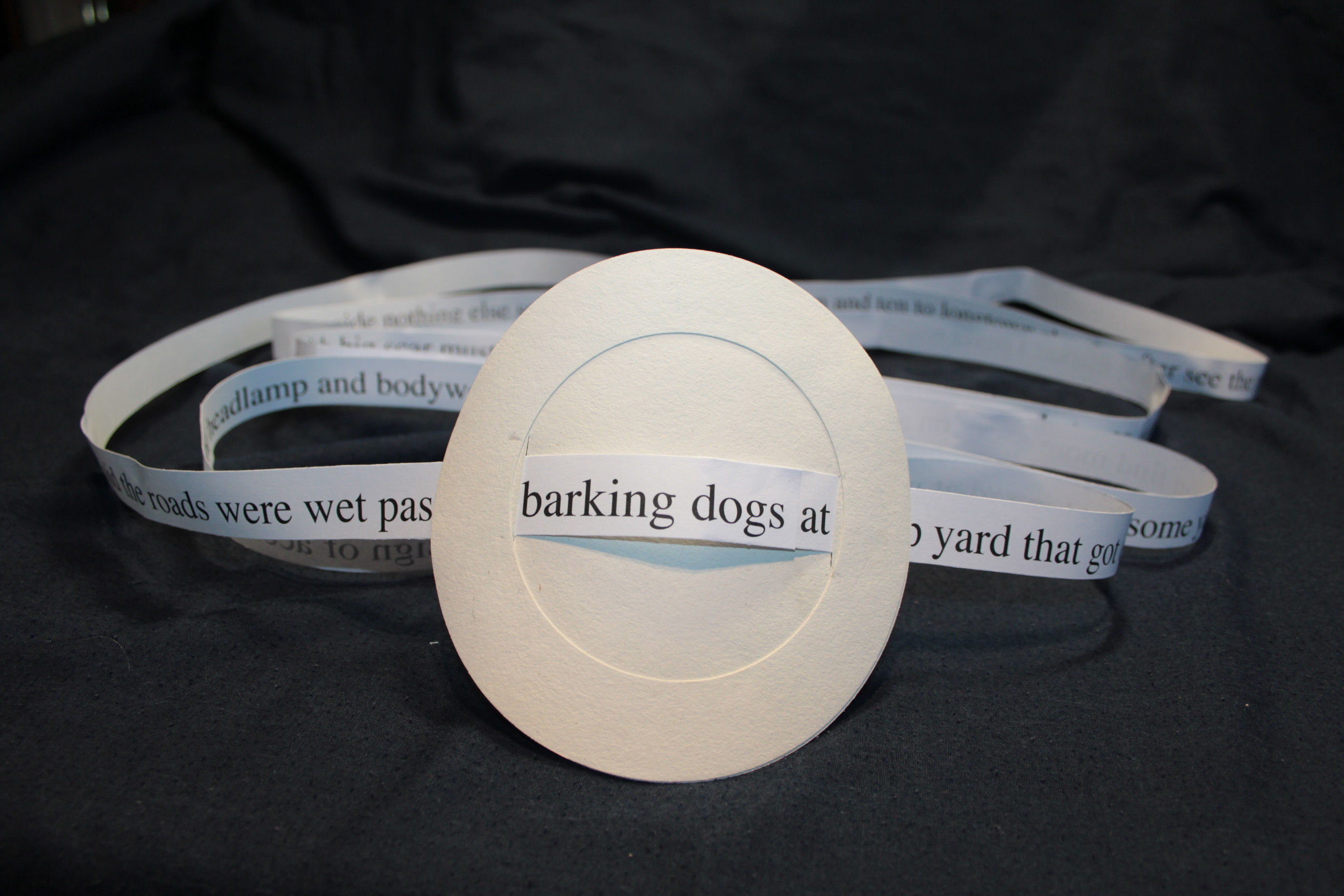
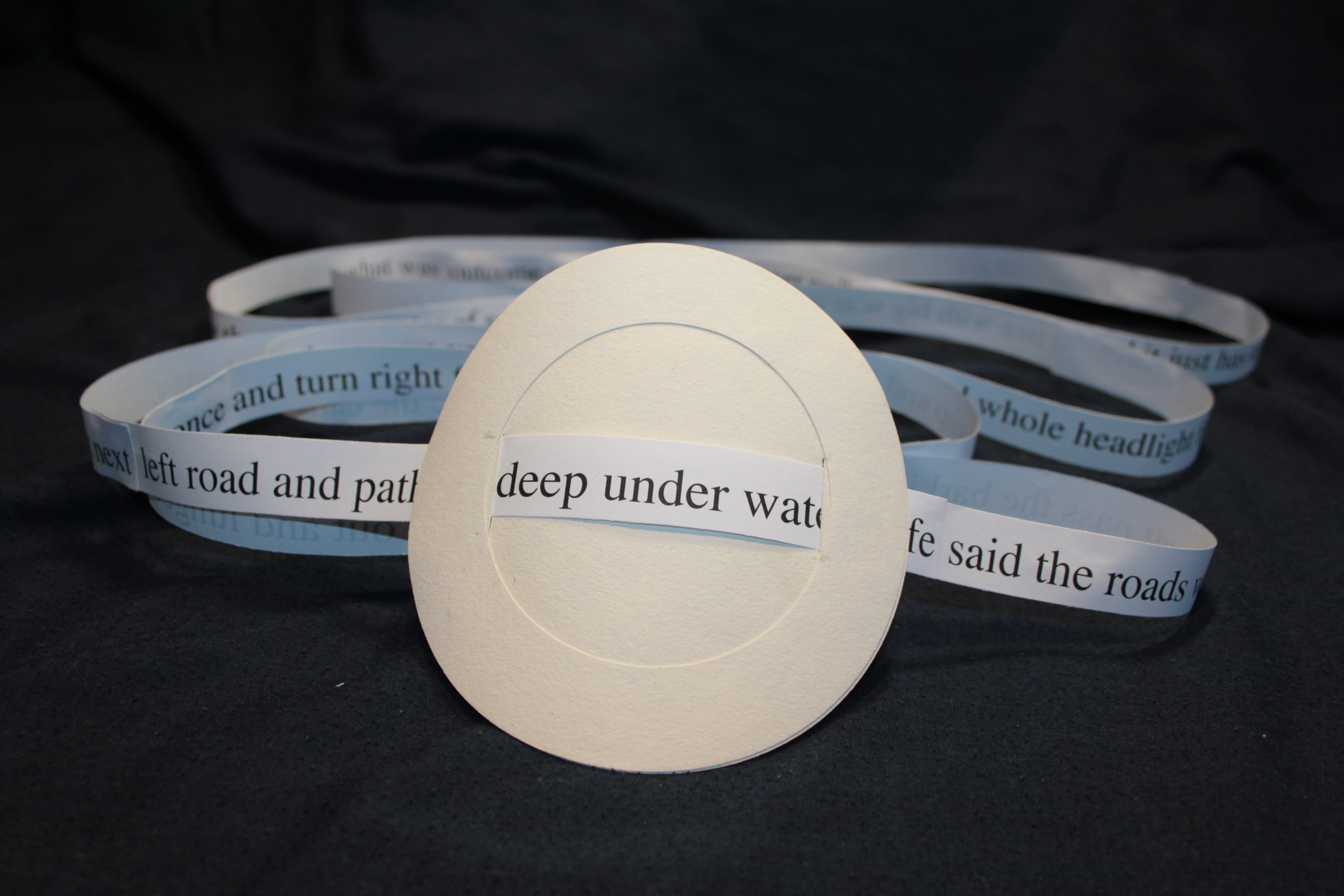
So what does this object have to say?
The Object – A Subjective Reflection
I could find no name for it at the time and still cannot. That it has no name interests me seeing as it is mostly words. The original image I had in my head was of a circular object made of stiff paper with cuts to allow a tape with words on it to pass through it, like a line of text. This was my idea. My intention was to make it and see what it had to say. My preparation was to fiddle about making prototypes and find a form that worked for me. Then I made it.
In my mind was a way that the circular bit would be the singularity of the experience, present in the landscape, and the words would be utterly unable to fit into this. The words in the prosepoem were also made the way they were to represent the line made by walking. So I printed out the whole thing as large text as vertical lines going top to bottom of an A4 sheet. My intention was to do the whole prosepoem and cut it into strips and stick them end to end but it would have been 36m long which would have taken too long to make. I have to go to work some time. This only served to reinforce the idea of the difficulty of describing doing.
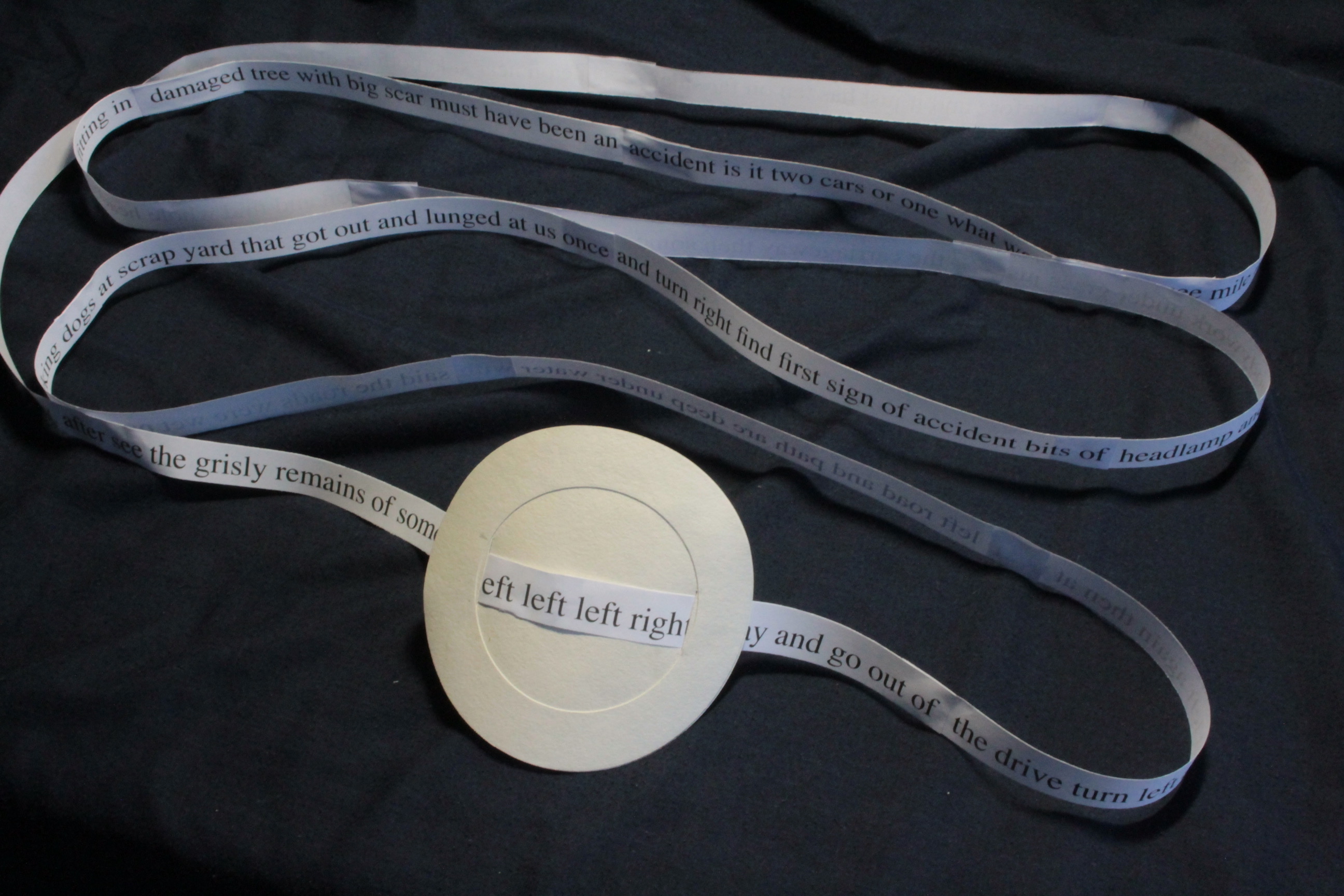
In my prototypes I experimented with circles of card with smaller circles drawn inside them but it did not work for me. So I used some cutting dies used in crafting to make the form which worked nicely for me. The words were constructed as a loop, so I got circles within circles within circles which was pleasing. I played with it, moving the strip back and forth and found the way that it only showed a few words at a time was also pleasing.
An important part of art making is the act of reflection. This is a core element of experiential learning. But the great thing about an object, a material manifestation of your subjective experience is that it persists after the experience. It is like you hold the the experience in your hand to aid reflection. In the action phase of art making there are three elements. Action, the doing, Reflection, the thinking and Incubation, the not doing or thinking. The object helps with this. You can forget it completely, let it sit and come back to it. Some thing happens at an unconscious level. Like when you cannot remember the name of something and then 10 minutes later it pops into your head. Some thing incubates like an egg or a seed, then pops open or sprouts little leaves. The Celts start their day at sunset and their year at the end of autumn on what we call Halloween or All Saints Day. Growth starts in darkness.
In my previous post, King Crimson sings a song about his experience of art making here. The writer Adrian Belew talks about the art object he made.
‘I do remember one thing
It took hours and hours but
By the time I was done with it
I was so involved, I didn’t know what to think
I carried it around with me for days and days
Playing little games
Like not looking at it for a whole day
And then, looking at it to see if I still liked it
I did!
The more I look at it, the more I like it
I do think it’s good
The fact is…
No matter how closely I study it
No matter how I take it apart
No matter how I break it down
It remains consistent
I wish you were here to see it!
I like it!
This is what my unnamed object did. It remained consistent. In contemplating it it became a material objective form expressing my experience, my ideas and words could roll around. The object and the experience of making it became a form of material thinking. And as Barbara Bolt says ‘Material thinking offers us a way of considering the relations that take place within the very process or tissue of making.’ I made the thing out of a desire to better understand describing doing. Of this Boal says ‘The desire, having become a thing, can be better be studied, analysed, and (who knows) transformed… Not only what one wants to reify is reified, but sometimes also things that are there but hidden.’ The last bit is important and links to the image on my home page. Here Art lets you see things from another point of view.
Part of my research surrounding the making of the object was writing. I have a journal and used this and wrote various forms of this blog post. John Baldesarri, here one of the elders of modern art talks about writing thus, ‘Writing helped me understand what I was thinking about.’
I suggest we see writing as performance or a form of material thinking. You have an idea or a desire and in writing it down you see it as words on a page or screen. Your thoughts are materialised. You see them dance onto the screen and deliver the content of your own script. You see your ideas perform like actors on the silver screen like a movie, but on the screen of your PC or Mac.
Rachel Lois Clapham says ‘To call something a performance is to separate it from the world and then present it back to the world as something distinct. This double movement of separation and re-presentation is the writing of the performance, and it is in this writing that performing exceeds doing. Being written gives the performed thing the simultaneous immediacy and distance of language, by which its separation from the world permits the fullness of its expression.’ here.
That ‘..double movement of separation and representation..’ she talks about, is the cyclic form of experiential learning. It is what Performance Studies progenitor Michael Schechner calls ‘Restored Behaviour’. here Viewed through the lens of performance, writing can be seen as experiential learning. In writing I can experience my thoughts as material(ised) thinking about experience. This is writing as doing, a verb, as performance, as well as a noun, the thing I have written, my writing, the thing you read.
In writing this post I cycled through different titles, but like the object I made, I could never settle on a title as a fixed thing. I could not name it. The noun, the linguistic act of fixing a thing with a name eluded me. The act of the noun to name a thing, as opposed to the act of a verb, to denote an action seemed to me to be in opposition. The words on a page describing doing seemed to take the action of the noun and thus seemed to fix the verb, the action of doing the thing, thus rendering it inaccessible to the reader. ‘You had to be there’ you might say when a description of an experience falls short of the experience. One title I tried was ‘The Subjective Object’. On reflection, this seemed to work very well. It has an intrinsically oxymoronic nature, which seemed to express the intrinsically oxymoronic quest to describe doing. An objective description is intrinsically incapable of being congruous with the subjective experience of doing.
My proposal is that we can make art as experiential learning to conduct subjective research to explore and express personal experience, including outdoor experiences. I see this as an adventure, which taken from the Latin adventurus ‘about to happen’, which also makes this an oxymoron. The thing about to happen does not currently exist, and when it comes into existence it is no longer about to happen, so it cannot be what it’s name claims it is. It feels like trying to explain things by giving an explanation of the thing.
I lived with my object for three weeks. I had made it in the form I imagined which fixed it. But I wanted it to move me on. I wanted it to propose a new form and meaning for itself. So I ignored it. I let it incubate. I tried writing about it but the words would not organise themselves, they just circled back round and returned to themselves. I put up this post to express this experience. here
My experience is that all made things will change form and meaning over time. I had to bide my time. I once went to a lecture by an artist and psychotherapist, called Patricia Townsend who wrote ‘Creative States of Mind’ here in part because there were lots of books about the skills needed to make art and about the psychology of named artists and named artworks, but few about the experience or psychology of making art. Lots about art as a noun, but little about art as a verb. Where art as doing was described it was presented as the skills of the oil painter or the jazz pianist or the method actor. Patricia talked about her journey to becoming a skilled artist, exhibiting and selling work and working as an arts therapist. She talked about how she had found her unique way of working after a long journey. She talked with pride about eventually finding her unique artistic vision. But in writing the book she had looked back at her undergraduate work, having ignored it for years. She described her shock at seeing her unique artistic vision in her earliest work, in plain sight. What had changed was not her work, but her capacity to see how she saw. My experience is similar. I look back at my early work and see things there that in my mind are new exciting and current developments in my work. Not looking at things can help you see better the things you are looking at.
Like the man in the King Crimson track, I played games with my subjective object, ‘Not looking at it then looking at it to see if I still liked it…’ and the way I saw it changed. In the original image I only saw the circle with words going through it. In making it, I cut it joined the ends together. The making of it made me make the prosepoem into a shortened edited loop. But the loop moved through the opening. This offered new ways of understanding the object. I played with the materiality of the object and new ways of thinking about the describing the doing became apparent. The material thinking capacity of the object offered new ideas that were there all along, like Patricia’s undergraduate work and my earlier work. What the period of not looking had changed was not the object, but my capacity to see how I saw it.
I photographed the object just after I made it but missed the way the words formed and endless loop. Later I could see that. So I photographed it again to show the word loop.
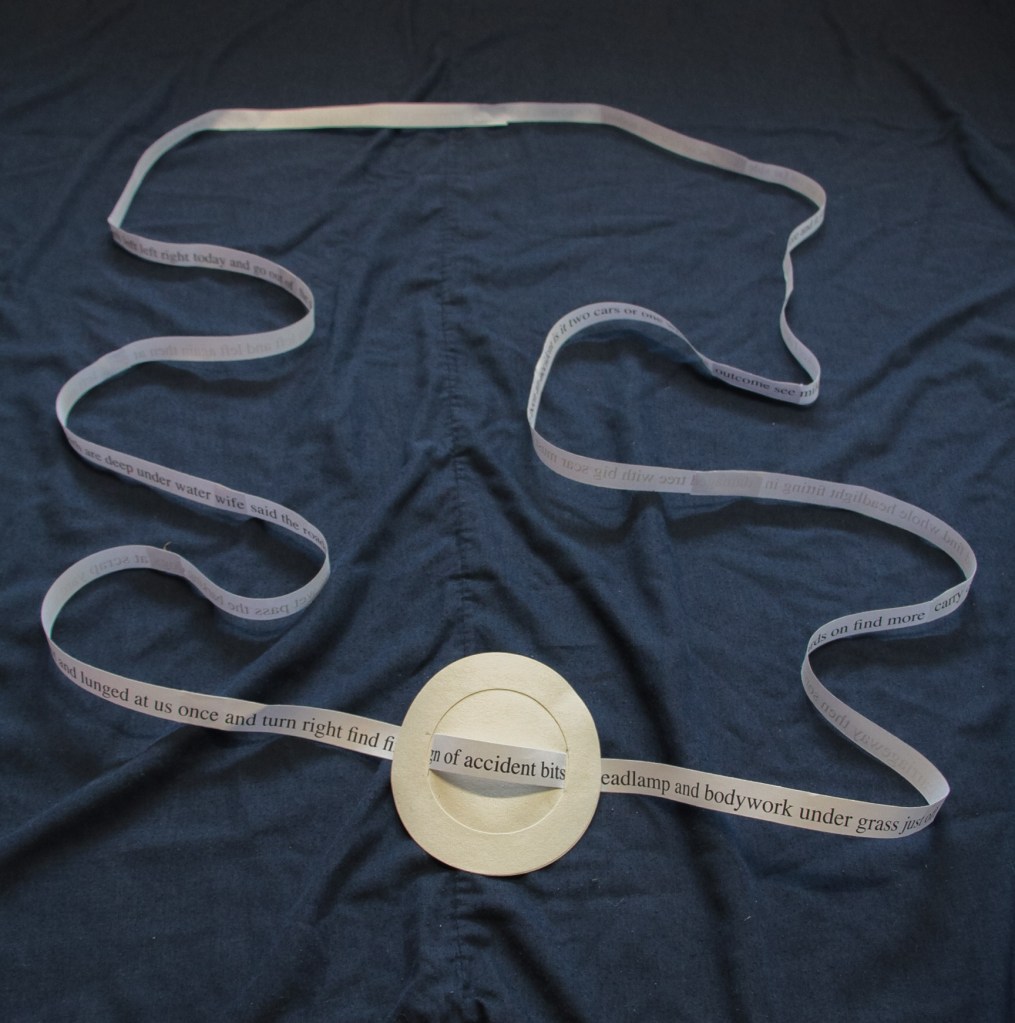
So I started with a stream of consciousness on the walk, I turned it into a string of unpunctuated lowercase words, I wrote them down on a page and the string became a block, I took them to a ribbon to recreate the linear experience of the walk, then I looped them to make them fit in the object. But the object I made remained physically consistent. On reflection the making of the object both explored and expressed the experience, not only of the walk, but the experience of making the object as well. I still find finding the words to describe this lived experience difficult.
In my training as a therapist and later in the reading I did on post-grad arts research the capacity to use research to show efficacy of the art therapies and arts education in a quantitative form through and through the written thesis was questioned. The argument was that the art making was research. Words describing doing were of a second order to the direct first order expression through art making. The words became a discursive adjunct to the non-discursive artform and it’s making. That art can be research is still contested and modes explanation and discourse still abound. But for me the object I made shows a first order expression of the experience. The materiality of it’s construction made it’s own intelligence apparent. It showed me what I could not see. But in part, that it became seen was in part because of the act of performative writing. I saw my confused thoughts on the screen and, in conjuction with the object, worked with them to see some thing hidden from me. Like Boal says of reification of desires above ‘Not only what one wants to reify is reified, but sometimes also things that are there but hidden.’
In the end the elusive experience of the circularity of language in the making of this post was oddly made more fully known through a totally unconnected encounter. I have a newsfeed about art and the outdoors. I found and posted a news item about the intelligence of crows. I adore the whole Corvid family. I have encountered them in the Alps and the Atlas Mountains, in rural Wales and Cumbria, and in the middle of London. Crow is a trickster. Ted Hughes wrote a book of poetry about Crow. Here On the linked site Paul Radin says of the Trickster, ‘s/he became and remained everything to every wo/man—god, animal, human being, hero, buffoon, he who was before good and evil, denier, affirmer, destroyer and creator.’ The trickster is a god and an idiot. The news item is about the intelligence of crows.
In reading the article here I was taken with the central finding of research which showed crows can engage in recursive reasoning, a form of intelligence assumed to be singularly human, and a product of language. It derives from Latin recurs-, stem of recurrere “run back”. Wiki succinctly describes recursion as ‘the process a procedure goes through when one of the steps of the procedure involves invoking the procedure itself.’ here
Experiential Learning as Recursion
There are many descriptors of experiential learning, but in all there is a big element of recursion. What we do informs what we do next. We have an experience which when attended to, informs our next experience. It is a loop. Our next action is informed by a looping back to previous actions. But sometimes we need to go round the loop many times to be able to see how we can get out of a loop.
Examples of recursion are many. It is well used in language, mathematics and logic, but also occurs in art and biology, so descriptions of recursion will vary. But the act of recursion seemed very apt on reflection of the experience of taking my walk, making my art object and trying to write about the experience. The experience of writing, going round and round in a seemingly endless loop was moved on by changing the way I saw my object to be an endless loop.
So to me recursion would seem to be a way of seeing patterns in patterns. To see patterns in patterns needs you to see a lot of patterns. But once you see the pattern, you cannot unsee it. If recursion is based in language, then how come Crows can do it. Pattern recognition comes from the experience of patterns. Recursive learning can be experiential. It may well occur in the natural world, as well as in the world of mathematics, and some mathematicians say the world is mathematical in essence. It does occur in language. It does occur in art making as the story of Patricia Townsend shows, and my story of making the endless language loop in my art and not seeing it also attests.
The thing within recursion is that it has a naturally closed element whereby you can only say something about a thing by saying something about the thing you are saying something about. But going round that loop allows you to see a pattern and in seeing the pattern you are able to move on, to another loop, but through seeing another pattern. My proposal is that in making art, the experience of making becomes concretised, materialised through materials which have their own intelligence, (their intrinsic form) so it enables you to see the pattern of your experience, and move on to seeing another pattern. You literally have an object that is the experience. It is recursive.
A symbol that was given in my dramatherapy training was Orobouros, and this is a symbol of recursion.

Coming from experiential learning I took this to mean the experiential learning cycle and glibly failed to pay attention to it in detail. But looking again I realise the snake is feeding itself by eating itself. That what I learn by doing informs what I do still stands as a model for experiential learning, irrespective of what a snake eats for dinner. But what I wanted to show here was an example of how one can learn from the experience of making art. And as an example, it shows both the pitfalls and the productive paths. I have learned something through art making, but it’s description in words took longer than I thought.
My plan now is to work with artform to explore the experience of exploring recursion. This will go up in a series of posts rather than one long one.
 Moving Space