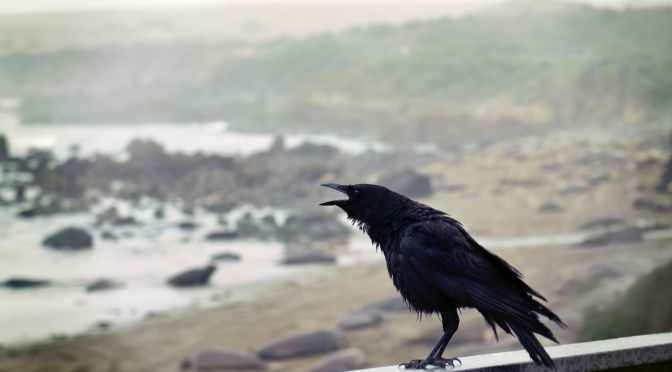
I is Croci
I sing my name
I is not me
I is we
I is all Crow
We all croak I
We rehearse
We curse
We recurse
All thee that are not Crow
You go
We flow
We flew
Liquid as the air
One river
Called Croci
One black Crow
One black flow
We go
We sing
The singular song
Of the flow of us Crow
One in all
Our call
We is Croci
We sing our name
About The Song of the Crow
The name Croci had been in my head for ages. Once, a few years ago it just popped into my head. It seemed the perfect start to a poem about the song of the crow. A crocus is a very colourful little plant which comes up in the spring, The name Croci worked for me, as it appeared to be the singular of a plural that was crocus. I liked that a black bird could have a name of such a colourful flower. That a black bird, a carrion eater, a scavenger, a bird with a croak for a call could identify with a delicate spring jewel seemed to suggest a creature unlike it’s public image, suggesting delicacy and an aesthetic sensibility. That the name of the crow was a declarative pun was also very appealing. Like a punch line to a dirty joke.
Taxonomically the corvids are oscine (singing) passerines (perching birds) and as such have complex voice boxes. The corvids, the crows, include, Ravens, Crows, Rooks, Jackdaws, Magpies, Choughs and Jays, the most colourful of the corvids are residents of the UK but there are over 120 species worldwide. In my writing I will use crow for corvid. Corvid is our linguistic Linnaean parsing of a life form that does not care what we call it. Crow is the vernacular. I can do taxonomy, just not in poetry.
That the calls of the crow, and all corvids generally are not songful and not always of a single bird, like a nightingale, appealed to me. Given what we hear of the corvids, the eponymous singularity of the ‘croak’ heard at a distance, once you spend time close to them together, you will hear the plurality of all sorts of little whiffles, chatterings, bill clappings and sundry noises, unheard at a distance. I believe the quieter calls are meant for other crows in a social setting. They are meant for kin not man. This suggests a private life.
For this poem I wanted to mix the plural and the singular, and I wanted a certain non-binary feel, as the sexes look identical. The individual birds identity would be inexorably linked to the group identity of a flock of birds who to non-corvids look all the same. The sexes are not expressed through different plumage. This, I felt, could reinforce the embodied and lived experience of the crow as bracketed, a thing within a thing, the one in the all. That for the research into crows, brackets were used, added a certain irony to the findings. In linguistics it seems bracketing is an important academic practice. In writing poetry I let the words speak for themselves, and play with each other and talk to each other. The repeated I, I, I, followed by We, We, We, seemed to come from the words being asked to do short repetitive utterances like a crows call. Then the repetition later dissolved into clamour of lines each with a different voice seemed apt.
In writing to a page, making the words seen, I noticed the ‘curse’ in recurse. So the way the corvids are seen as pests and vilified on farmland suggested an antipathy to the vilifiers, and possibly the glamorous, performing songbirds with elaborate and colourful plumage. Croaking as cursing was a great discovery.
The shift from ‘I is…’ and ‘I sing…’ to We is…’ and ‘We sing…’ from beginning to end, again, was suggested by the words themselves, and suggested a loss of the individual into a flock. The song of the crow went from all singing together to collective improvisation. So the words, once freed from my head onto the page, improvised too. The sky is the birds stage. The page is the words stage. The experience of the birds reified and embodied in ink.
This poem emerged like I hear the lyrics and sonics of rap. In rap I love the way in performance the words in one line change the words in preceding and following lines, through meaning and rhythm. When I spoke the song of the crow out loud it sounded like code-switching, so what was given by performance, was a capacity for being multi-lingual when you are taken for being sub-lingual, speaking a restricted code. Thus those willing to attend, hear a secret code, words of hidden experience, hidden in plain sight. So the birds blackness was not lost on me. We see them but don’t see them. Jim Crow, down by law.
I hear my local corvids differently now. Attention is focussed through intention and action to make art. When I go out the door to walk I step into their home. I step out now with more deference. Respect. I attend more. I say hello.
I felt like I had the song of the crow in verse, but I needed narrative, a story, to speak of their cunning. This is my next post – Three Cursing Crows
 Moving Space