In the context of art making as experiential learning, the bit of the article that caught my attention was where in reference to how groups of things, gas particles in cloud or geese flying in a flock, it described how they went from chaos to a kind of self-organisation. In the research, the experimenters found that what brought about this change was not external factors, but intrinsic chaos found within the group of things. It reminded me of experiential learning and art making. The change that occurs, the learning, is internally generated in and through process, what happens, and product, what it happens to, the thing that is made and the material that makes it, the geese and the gas. In the experiment the chaos, the process, is referred to as fluctuations, deviations from a mean, and the product, the things in process, as particles. The article reports “The scientists found fluctuations made the particles more responsive to one another and, in a way more persistent in that response.” This fits with the idea of performance and art, in which the art or performance emerged out of relational interactions of the things as much as the things themselves.
The major limitation is the application is only subjective, but as such, this allows me to apply it universally only to my subjective experience. It leads to a formula which I share in the understanding that regards this phenomenon, fluctuation, this is one of many formulas that can be applied, most of which make my brain hurt.
So maths is applied in the context of art and performance, wherein I work with a mathematical formula ‘as if’ it were art as research and not pure maths. Like I can encounter the Mona Lisa ‘as if’ I was encountering Lisa Gherardini, the original sitter, who was born on June 15, 1479, in Via Maggio. Lisa is not present, but the painting makes it feel as if she is as long as in my subjective, fictive imagination, she is.
So what follows is entirely fictive. It is made up, not proper maths, but mathematical or empirical ideas treated as if they could be related to art, through imagination. A kind of science fiction is explored.
I started with the concept of fluctuations.
Characterisation of Fluctuations
Or the emergence of order in chaotic systems
From 5.1: Characterization of Fluctuations
Fluctuation formula:-
𝑓 ≡𝑓−⟨𝑓⟩
𝑓 is the degree to which an individual variable diverges from the average
≡ means ‘is identical to’
𝑓 is the individual variable & ⟨𝑓⟩ the individual variables averaged
So if 𝑓 is individual behaviour as diversion from the typical ⟨𝑓⟩ and 𝑓 is any behaviour, 𝑓 in any form can have some level of variance – or + . So if 𝑓 is identical ≡ to ⟨𝑓⟩, ⟨𝑓⟩ does not change.
If 𝑓 is greater than ⟨𝑓⟩ ie diverts from the average by a larger integer, say 11, and the average is say 10, 𝑓 becomes a positive integer +1. If 𝑓 is less than ⟨𝑓⟩ ie diverts from the average by a larger integer, say 9, and the average is say 10, 𝑓 becomes a negative integer -1.
The most important property of any fluctuation is that its average (over the same statistical ensemble) equals zero and tends to zero as the system size grows (N→∞)
Could we imagine this in everyday life ?
So for a human system if the average represents a stable system and the diversions as + or – represent variance from average, the system remains stable if + and – as variances occur in equal numbers. An imbalance will move the average. So to move typical normative behaviour of a system variance, behaviour which diverts from what is typical is required. But within the system one can have a high degree of variance as long as there is a balance of + and -. whatever that is. But in this system there may be potentially some level of conflict between whatever is deemed + and -. If we need to change the average, the norm, the typical, the status quo in any direction, one mode of behaviour, + or – needs to dominate.
This could be evolution, fitness to adapt to change in the environment. But the formula, as a proxy for real life and thus not real life could suggest….
- Little variance reduces the scope for change.
- If change occurs it is conflictual.
- We can have behaviour which diverts from what is typical but if some level of balance is in place the system remains stable.
- Sometimes we need to change what is typical.
- More variance in a stable system means change, should it be needed, can occur more rapidly.
- Diversity enhances our capacity to respond to change in the environment and evolve to match the change.
- What constitutes + and – is subjective, situational, emergent and multi-faceted.
- Art making is ideally suited to research phenomena which are subjective, situational, emergent and multi-faceted.
- Art making has an evolutionary benefit.
- Diversity and thus neurodiversity has an evolutionary advantage.
- Suppression of art reduces our scope for evolution and is an act to maintain the status quo. Maintenance of the status quo is always fixed in a retrospective perspective and represents a poor response to a changing environment which will lead to extinction. Maybe the maintenance of the status quo is a death wish disguised and is deadly and evokes death cults, war, repression of diversity, undue or rapacious administration and rule-making, the establishment of binaries fixed on unhealthy attachments to whatever is deemed the + and – things, ideas, actions, political parties etc etc. Or something like that!
The norm is stasis and systems attain more stasis the bigger they get, but change to the system occurs within the system on exposure to changes away from the average. Bigger systems need bigger changes. In art-making I can expose myself to changes away from the average. Art impels me into the exposure to new states and new experiences. Evolution emerges out of new experience.
So when Nietzsche said
“We have art so that we shall not die of reality”
I was reminded of how we can see anything we make intentionally as art. I liked the following quote for Irving Lavin and think of it often, and see it as central to the idea of art as life and life as art.
“Anything we make is a work of art, even the lowliest and most purely functional. We, indeed, might be defined as the art-making animal, and the fact that we choose to regard some human-made things as works of art and others not, is a matter of conditioning. Our conventions in this respect are themselves, in a manner of speaking, works of art.”
Irving Lavin (edited) here
Art, as performance, emerges in the interaction of things. Looking for its emergence in the things is pointless. All art is in process. That process, occurs in the process by which you perceive it, and what happens upon perception. Art is movement, ratio and interaction.
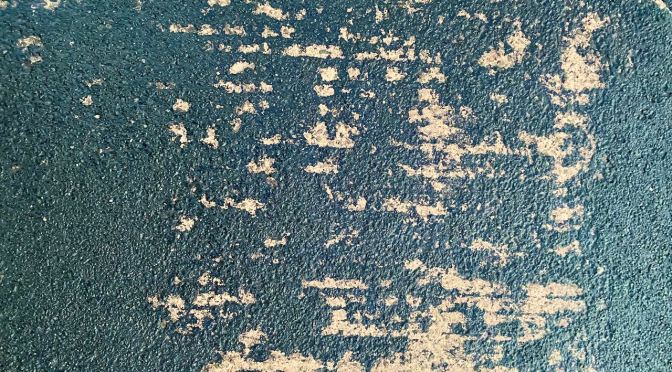
The header image is a bit of road surface I pass on my daily walk worn by tyres to form a pattern. The pattern was neither in the tyres or the surface but in the interaction between them. The image was not even in the place but made by me seeing it and making it into a photograph on a website. On the chip on your device, it is not an image either, it is just code. You reading this and seeing the image makes it a road surface with a pattern, or whatever you make it out to be. Nothing is fixed. It is all in process between things.
 Moving Space