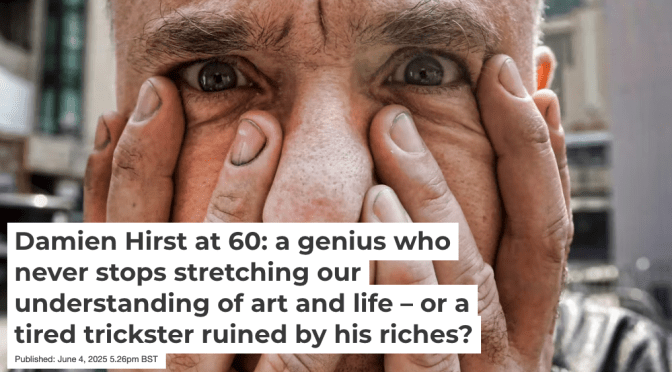
For some reason in 1997 I visited London and went to the now infamous Sensation show at the Royal Academy. My enduring memory is of the work by Hirst called ‘The Physical Impossibility of Death in the Mind of Someone Living’ (1991) © Damien Hirst, below.

This is Hirst’s pickled shark in a tank. When I was there, I saw a father and son enter the show. The boy promptly ran over to the shark in the tank, shouted “SHARK” at the top of his voice and whacked the glass tank so hard it made people jump. The panicked ushers ran over to see what had happened, but the boy had moved on. He now visited every exhibit and shouted the same thing, “SHARK”, “SHARK”, “SHARK”. It literally was sensational. I enjoyed the show itself, but also the bruhaha it caused in more conservative circles. It was called ‘Sensation’. The clue is in the name. I enjoyed following the boy about seeing what people made of the clear, untrammelled joy at what he found in that big room that day. He got a mixed response. The name of the show performed in the show. Very clever.
I bring this article about Hirst and the quote from Picasso together to bring some ideas about art as product and process of art. The thing that is art and what it does, or more specifically, the art object and the process by which it is made and encountered.
In a formal ‘Fine Art’ setting the product is usually some thing made by an artist. What I am proposing with art as research is that when Picasso says “Art is a lie that makes us realize truth, at least the truth that is given us to understand.” he could be saying that the ‘truth’ is some thing we learn through the experience of encountering the art. But Picasso makes the point when he says “..the truth that is given us to understand.” that this truth is subjective.
The linked article talks about truth regards what Hirst and many other artists say about their art. David Hockney caused a sensation by suggesting some the ‘Great Masters’ of art used seeing devices to aid their art making. Hockney questions what is ‘Truth’.
In my training as a dramatherapist we worked with an ‘Arts Therapist’. She worked with image, painting, drawing etc. She taught us a good lesson. She showed us an object, a piece of paper with a greyscale image printed onto it. She asked us what we saw. Prospective therapists all, we said things like “Oh. It is a mother and her child. The child seems distracted, like the mother is not attending to him.”
Then she taught us something vital by saying “There is no mother or child in this room…”. We were genuinely shocked by that. She said “This is a piece of paper with a greyscale image printed onto it. Where did the mother and child come from?” We got the point. This is the point Picasso made. The art object, the product, the objective material thing or sensation of the thing has no truth. If truth is found, it is in the subjective process of encountering the object.
The very wonderful Linda Barry made these images below…
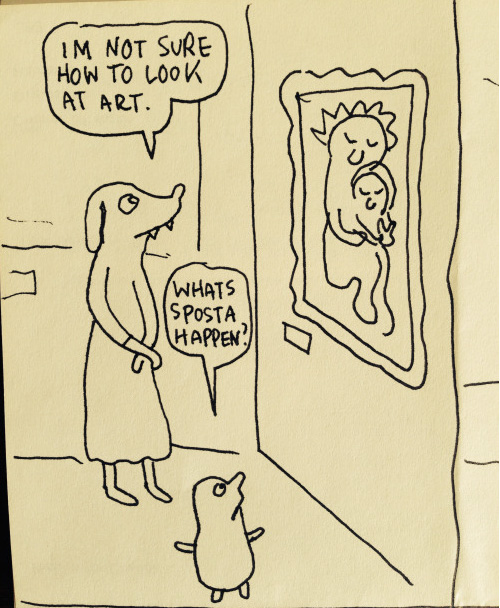
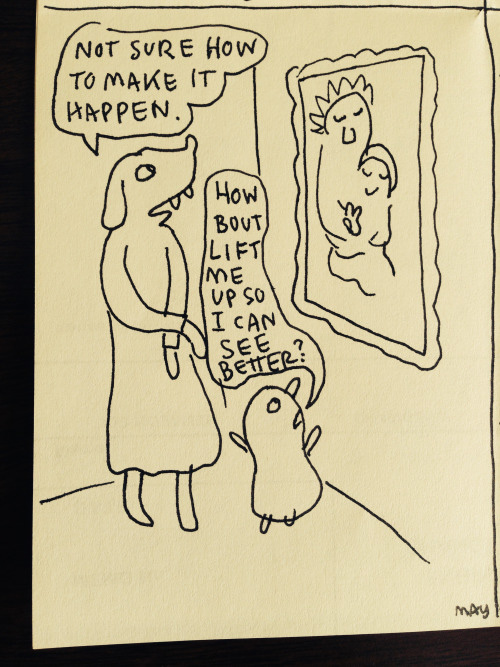
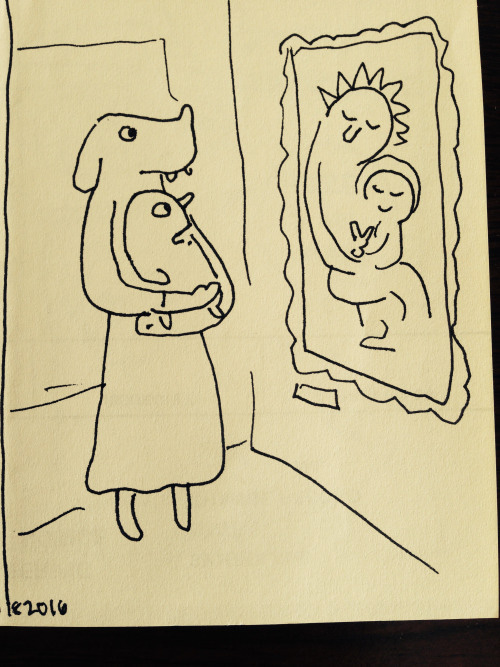
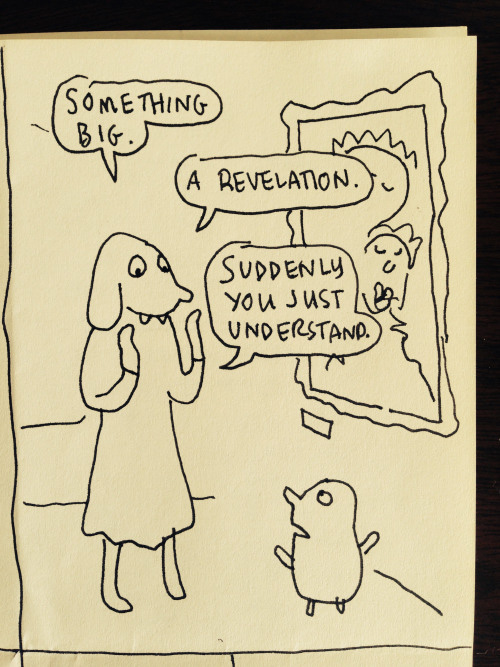
She talks about art as a way of thinking.
More specifically, in her broader work, she talks about art making yourself as a way of thinking about yourself. The art that other people make is useful, but not as useful as the art that you make. Not everyone can be an artist, but we can all make art.
The product, the thing you make, cannot be separated from the process, the means by which you encounter it. But it is the process by which the art makes something known to you. In art making you become process and product if you make art and attend to what you make and what happens when you make it. But you also separate process and product. It is at once very simple and very complicated.
My own art process and product reached a bit of a hiatus recently. I am not sure what this means, but I think it may be useful.
I intend to develop this over the next few weeks, some is already in process. Please feel free to follow and see what happens.
 Moving Space