Moving Space

Making . Things . Happen

Arts . Outdoors . Health

Making art and going outdoors, for people who don’t make art or go outdoors.

Lois Hetland’s Eight Arts Habits of Mind

Lois Hetland and her team caused a bit of a stir by suggesting students of art may learn something about life from the act of working together to make art.

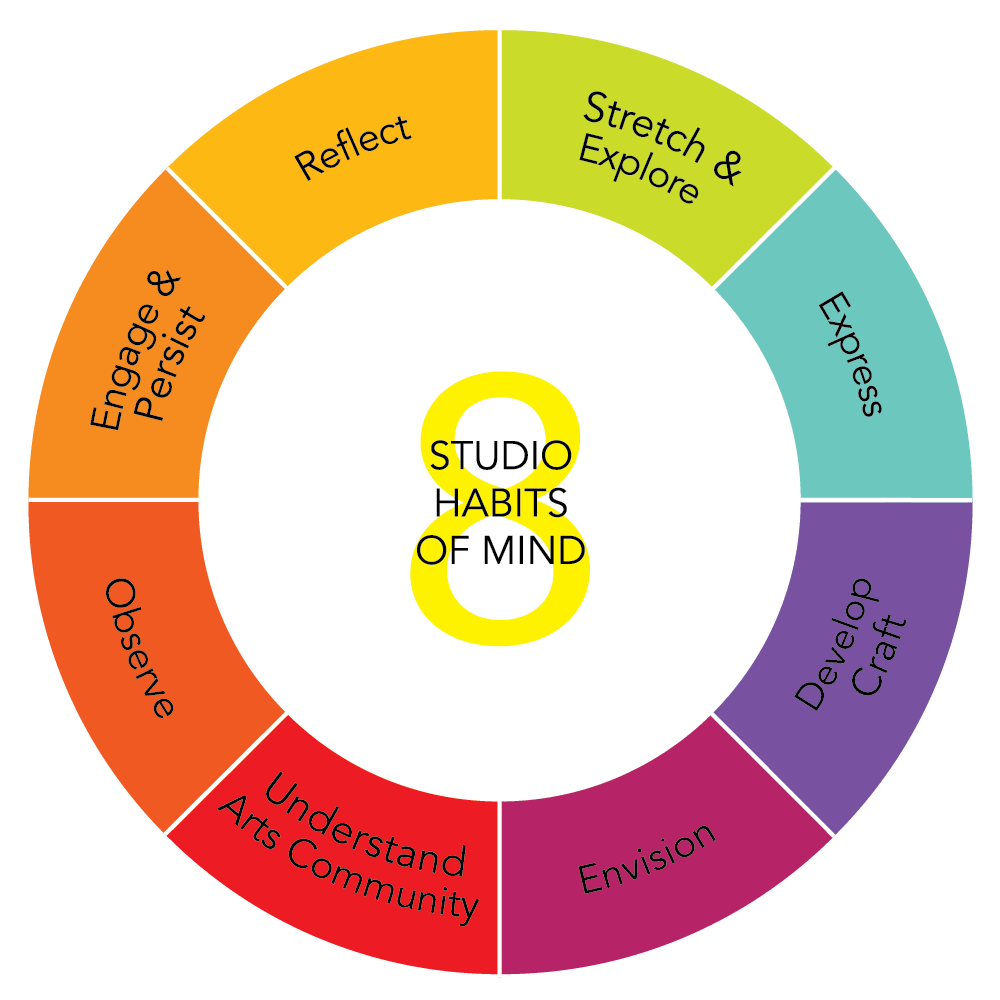
Her book ‘Studio Thinking’ here presents 8 art habits for learning.

Summarised, these are:-

Develop Craft: Learning to use and care for tools, materials, and artistic conventions.
Engage & Persist: Finding problems of personal interest and sticking with them despite frustration or difficulty.
Envision: Imagining and mentally picturing what cannot be directly observed and using this to plan.
Express: Finding meaning, emotion, or a personal vision within a work of art and communicating it.
Observe: Looking closely at the world and paying attention to visual details that are often missed.
Reflect: Questioning, explaining, and evaluating one’s own work and working process (and those of others).
Stretch & Explore: Learning to play, push beyond one’s comfort zone, embrace accidents, and discover new techniques.
Understand Art Worlds: Learning about art history, communities, and the broader creative domain.

These fit well with what I am proposing with Moving Space. It could be suggested that art is the science of the subjective and science is the art of the objective.

Here is an interesting podcast about the intersection between art and science.

Visit the Studio Thinking website here.
One response to “Lois Hetland’s Eight Arts Habits of Mind”

  1. That’s a very interesting podcast and set of thinking/doing habits, shared with my local Art Club. In my own school experience as child/adolescent and subsequently working in schools I have observed/endured both an attitude of discounting of the arts in relation to the sciences and the basic segregation of all areas of knowledge, exploration and activity, especially creative thinking, into “subjects”, taught on the whole by remarkably narrowly-focused teachers. I think this is an important causal factor in the wider social views of Art, Creativity and Sciences as separate camps or tribes. This was epitomised by articles I recall reading in the late 1990s in the Human Resources press (I hate that term) about firms discovering that “creatives” were useful in boosting business.. as if there were creative and non-creative people… though I’ve met too many people who had developed a limiting self-belief that they simply weren’t creative at all… The sun has emerged at last, I’m going outdoors, maybe even make some art, or at least observe, that’s the important thing. Thanks for posting this podcast link.

Leave a Reply

Discover more from Moving Space

Subscribe now to keep reading and get access to the full archive.

Continue reading