Category Archives: Practice Ideas

Ideas from many different settings describing ideas and activities about art as research with a particular focus on arts for health.

Art is Anything You Make as Art

We may ask, “What is art?”

It could be….

Art as a Verb

At the core of ideas about art as a way to explore and express personal experience, this is of central importance. We are talking about working with art as a verb.

A verb is a word used to describe an action, state, or occurrence. We are focusing on art as an active state of being and doing. If you look up the word ‘art’ it is only ever expressed as a noun, the name of a thing. This means we tend to think of art mainly through it being an object, a painting or a sculpture, and not the process or the experience of making the art. For art as a noun, the act of making can get overlooked. The art object has a name, but the act of making art does not.

Could I Ever Be ‘Arting’

A person can describe themself as a ’Traveller’. This could be a description of a discrete cultural group. This could be the name a person calls themself if they practice independent travelling to remote settings. For both, their experience of being a traveller could be ‘travelling’, a description of an experience, a verb. They could say their favourite experience is to ‘travel’. But a person describing themself as an ‘Artist’ would not describe the experience of being an artist as ‘arting’. They could not say their favourite experience is to ‘art’.

Art as Change

But this factor is not lost in the world of fine art. Yoko Ono is a fine artist and was part of an art movement called Fluxus. Yoko was once quoted as saying, “I thought art was a verb, rather than a noun.” Wiki describes Fluxus as ‘…an international, interdisciplinary community of artists, composers, designers and poets during the 1960s and 1970s who engaged in experimental art performances which emphasised the artistic process over the finished product.’ The name derives from flux, a state of continuous change. An object like a painting does not change. But an artform like music or theatre can exist in a state of change. Unsurprisingly, Fluxus had a manifesto here, of which the first line was ’To affect, or bring to a certain state, by subjecting to, or treating with, a flux.’ and equally unsurprisingly included a goal to ‘Purge the world of bourgeois sickness’. Art as revolution….

I thought art was a verb, rather than a noun.

Yoko Ono

Art Making as Performance

So, given what Fluxus extolled, a performance sensibility could be applied to art making. Richard Schechner is a theatre director and Professor of Performance Studies. He asserts we can understand any human action ‘as if’ it were performance. From the point of view of performance studies the performance is the thing that happens between things, with one thing being a view of the spectator, the other being the thing viewed. So a painting can be seen to be performed as much as a play, if the painting or the play is seen by somebody. It becomes art if it is observed in such a way as some thing happens for the person who sees the painting or the play. The object does something. It becomes subjective. It goes beyond being just a passive object.

This suggests that we may make art out of anything we do that we pay attention to if we attend to it in a particular way, with a particular attitude. When we write in a journal about our experience. Or when we draw in a sketchbook some thing we saw. When we make a representation through words or image of some thing we experience, we can see our words or our drawing as art.

A Definition of Art as a Verb

It is tempting at this stage to seek a definition of art. But given a definition of art will necessarily refer to art as a noun, as an object, even if that object is theatre, a performance, I wondered for ages about a definition of art as a verb, a doing thing, an action. In the end, I figured one definition of art as a verb could simply be ‘Art is defined as anything you make as art.’ For me, this works. This renders the definition subjective. This makes the making the definition. It does not need words. What you do is the definition of what you do. This makes art recursive, a theme I will return to.

But. You may well paint a garage door with high-gloss exterior paint and call it art. And you may well be laughed at and be shown the door if you seek to sell it to Sotheby’s. However. If in painting it, you learn how to paint it better next time, if you find a way to make it be flatter and shinier in a way that pleases you aesthetically, then for the purposes of Moving Space, you have made art if you say it is art. You may have to accept that your subjective definition has little or no objective value beyond your subjectivity, hence Sotheby’s declining to put it up for sale alongside the next Banksy or Breugel. Sorry. It’s back to work for you buddy.

Art is defined as anything you make as art.

You the reader…

I think once we see art as process and activity in a state of flux, art as a noun, art as an object becomes less important. The art object as ‘Fine Art’ however, never becomes irrelevant. The fine art object made by a fine artist can become a source of ideas and inspiration for your own art making. And ‘art’ as a subjective definition, art by your definition, as a thing you make as art, may be just a garage door to someone else. Seriously, get over it. But Andy Warhol, an artist equally loved and scorned, once said, “Don’t think about making art, just get it done. Let everyone else decide if it’s good or bad, whether they love it or hate it. While they are deciding, make even more art.” I can tell you I have thought a lot about all this, but art making has tempered the value I place on thinking. Art can help you to avoid thinking too much. This is a health benefit.

Don’t think about making art, just get it done. Let everyone else decide if it’s good or bad, whether they love it or hate it. While they are deciding, make even more art.

Andy Warhol

Top 10 Tips for Arts For Health

  1. The art is the experience. We learn to make art through our experience of art making, so art can be used to learn about our personal experience.
  2. Make art not Art. We cannot all be artists but we can all make art. Make some art to neither sell nor show. Treat art making as research and investigation of yourself.
  3. Intend to attend. Pay attention to what you make and what happens when you make it. This makes making art like meditation. Inhabit and enjoy the process.
  4. Make art as adventure. It is a journey of uncertain outcome. Enjoy the journey. Your destination will make itself known, and it will pass.
  5. Make art as performance. It is what happens between you doing and you seeing what you are doing. Your thoughts and deeds are the material of your own acting.
  6. Just keep going. Do little bits regularly. Take a break. Benefits appear and grow over time. Just keep going.
  7. Attend to other peoples art. Find stuff you like and want to copy. Steal it and make it your own. All art starts with theft. Be a thief.
  8. Try lots of ways of making art. Find stuff you like and explore your way of making it. If you don’t like it, don’t make it. Be ruthless.
  9. Art is anything you make as art. You can paint, sing, dance, walk, sculpt, write, sew, draw and even sail or sleep as art. Seriously it’s all been done. The world is your oyster.
  10. Show and share carefully. If you do show what you made, show it to your people, the ones you trust. It is still art even if it is not in a gallery or for sale. People, including you, don’t need to like it. Your art can speak for itself. This is it’s power. Pay attention.

Art . Outdoors . Health

Introduction

Moving Space draws on ideas and practices from experiential learning, and the arts therapies to use art making as research to explore and express personal experience and promote health and wellbeing.

The website is intended to provide materials to support this and invite conversation and collaboration.

Background

This work has been developed through 40+ years of professional work with experiential and outdoor learning in a variety of education, therapy and care settings in the UK, EU and USA, guided by professional training as a teacher, counsellor and HCPC registered Drama and Movement Therapist, and supported by a decade of personal art practice researching arts for health indoors and out.

Art, the outdoors and health are the three key themes that comprise the content of this website and the work of Moving Space.

What follows is a kind of benchmark for what art, the outdoors and health mean on this site and for Moving Space.


Art

Art as Research

Essentially, I am proposing that art making is the most accessible means by which to research personal experience. It is research you can do with a sketchbook and a pencil. You do not need a research lab and a PhD.

Research as a singular descriptor brings together a lot of the ideas and practices that comprise the content of the site. The content of the site has been

Art making is…

research (v.)

1590s, “to investigate or study (a matter) closely, search or examine with continued care,” from French recercher, from Old French recercher “to seek out, search closely,” from re-, here perhaps an intensive prefix (see re-), + cercher “to seek for,” from Latin circare “to go about, wander, traverse,” in Late Latin “to wander hither and thither,” from circus “circle” (see circus).

From Etymonline

It describes art as a verb, a doing thing. It supports the idea of art making as an intentional and concerted search or investigation. It supports the idea of it being a bit of an adventure, a wandering journey where we don’t know what we are going to find. It supports the idea of having a circular or recursive quality. What we find in our search feeds forward into the next act of searching and finding. It also has, through ‘circus’, connections to performance.

It supports the idea of art making as a way of researching personal experience. This emerges directly out of experiential learning and the arts therapies. It focuses on the process of making art rather than the product made. In this, it can promote wellbeing, make art a form of experiential learning, and when done outdoors, deepen and expand the experience of being outdoors.

Art is Anything You Make as Art as Long as it is Art.

The emphasis is on doing art more than viewing art, on art as a verb rather than a noun, and on art as a process more than a product. You make art, attend to what you make and what happens when you make it. Art is anything you make as long as it is art. You draw on the work of other artists, of art you like, and you make it your own. The art making is seen as a form of research, exploring and expressing personal experience. You may show and share if you wish, but this is not seen as the end point. The point is to make something yourself, for yourself.

Treat Art Making as Experiential Learning

Art making as a way to promote wellbeing is best undertaken as a way of learning from the experience of making art. The art is the experience.

When I worked with climbing or expeditioning participants, the learning to climb or hike was not the point. Sure, people learned new skills, but mostly what they learned from the experience of climbing was to overcome fears, or from expeditioning was to work as a team. When I worked as a Dramatherapist using dance, the non-speaking clients learned new ways to move. Movement and gesture were often their only means of communicating. In the absence of words, they found that their movement vocabulary was extended. They learned new ways to communicate. On the climb, on the expedition, on the dance floor, the experience of the clients was the source of their own learning. So it is with art making. You learn to make art in the experience of making art. What you learn is down to you, your art and your experience making it.

Treat Art Making as a Therapeutic Experience

If you make your own art to make you well, you are not doing therapy, but the experience can be therapeutic. At its most basic level, to make art, attend to what you make and what happens when you make it is a form of mindful meditation. It is intention, attention and attitude, the core of meditative practice. You intend to make art, you attend to what you make and what happens when you make it and you do so with an attitude of openness to what may happen. An absence of skill to knowledge enhances the openness. Tom Waits for example, always seeks to use new instruments he cannot play, or to find ways of making new instruments for his music. He says this helps him find some new thing to do with his music.

Learning that you can learn some new thing is intrinsically therapeutic. It is an act of moving on. That your personal art making facilitates this process through the same principles as mindful meditation supports the principle that the act of making is as important as the thing you make. It is in the process. Whatever ails thee is exposed to your knowledge that, by making some new thing, you can make some new thing happen. There is a movement in your vocabulary. Your art has done some new thing so you can say some new thing. You witness yourself doing some new thing. You know from experience that you can make yourself change.

Also, if you are anxious about art making, the principles of the arts therapies also apply. Arts therapies take place in a closed space. If you make art nobody sees but yourself, whatever you make as art never leaves your sight. It is never open to being called ’not art’, ‘not good’, ‘not skilled enough’. Nor are you. It is still art, because you made it as art. It becomes part of your personal arts practice. You are an art maker.

Steal Art and Make it Your Own

The emphasis is on you making art. For this, you do not need to be an artist or skilled in art making. You may well look to what is called ‘Art’, or ‘Fine Art’, and made by a professional ‘Artist’. All artists start with theft. They use what are called ‘source materials’, images of established artists work, or they learn the chords of their favourite musician, or they read the poems of a favourite poet. Jean-Luc Godard the French New-Wave film-maker said ‘It’s not where you take things from — it’s where you take them to.’ In his book ‘Steal Like as Artist’, Austin Kleon quotes Picasso as saying ‘All art is theft.’, David Bowie is quoted as saying ‘The only art I’ll ever study is stuff I can steal from.’

When you make art you take some thing you like and make some new thing of it. Just look on YouTube about how to use oil paint, or how to make beats for your poem to turn it into a rap, or how to edit your photographs. Just do something. Make something and see what happens. Some thing will happen. Some thing will come into existence that did not previously exist. Inhabit and enjoy the experience of making it.

Outdoors

The outdoors is the place outside your front door

The outdoors is a creative Place. Even in the most urban of settings, if you venture outside, over time some thing will change. One day it is dry, the next it is wet. Last week it was cold, now it is warm. Your indoor space keeps you dry and warm over time. We hope our indoor spaces are safe and consistent. Sadly for some people they are not. For many people I worked with who inhabited unsafe home spaces, the consistency of outdoor spaces was a great boon. They liked that it was consistent in the way it changed. It remained unmoved by whatever ailed them indoors. The outdoors, like art, is paradoxical. Both are intrinsically creative.

An Inclusive Place

Much is made of the health benefits of green spaces, of exposure to nature and natural environments. For example, evidence shows that exposure to Phytoncides, which help plants fight disease, when we breathe forest air, help our bodies make white blood cells, which help us fight disease. But in proposing exposure to nature and natural environments, to forests, to green space, whilst evidentially beneficial, has intrinsic limits for many people. Most people live in cities. Also the identification to ‘nature’ and ‘natural’ has to me always been a bit academic and open to interpretation. It is useful, and easily understood, but in the spirit of creativity, of seeing things with new eyes, I suggest that it has become a bit of a trope.

So my proposal is that to work simply with ‘The Outdoors’ seems much simpler, more concrete. It is that space outside your front door. It is unequivocal. It is a concrete place, not an abstract idea or an evidential phenomenon. I have run several ‘urban outdoor programmes’ in which the outdoors was canoeing on a canal full of traffic cones and discarded tyres. I have been on Alpine mountain tops and seen the same crowds of shouting crows as I see on the tops of city tower blocks. ‘Nature’ is everywhere. Do the bugs eat your beans in your garden in the city? They do, they are part of some bigger ecosytem displaying biodiversity over urban and rural spaces. The bugs don’t care about Phytoncides. They are hungry everywhere. ‘Nature’ is a philosophical construct. The Outdoors is a physical place.

In urban settings, the street is outdoors. The street can be heaving with people of all races and creeds. The street can be a vibrant outdoor setting full of human diversity. Often, rural spaces run on low levels of human diversity. The outdoors can be dangerous and replete with adventure. So can urban spaces. All that is different is the nature of the danger and adventure. The act of going ‘outside’ seems to me to be more inclusive than being exposed to nature.

The Other Place

What makes the outdoors valuable is its ‘otherness’, it’s act of constantly changing whilst being also being consistently unchanging, it’s being just outside your window or your door, yet extending to the ends of the universe. Its otherness invites other ways of experiencing. Art does the same thing. The outdoors and art are both dialectic, thus both are containers for change. Our indoor spaces are human-made spaces, controlled by us. The outdoors is home to the more than human world. To step outdoors makes you a guest in their home. To step outdoors, you become a visitor, a foreigner. This, like art, promotes the scope for reflection on who you are. You become changed by a step change out the door.

Like a health benefit of art making is just making art and attending to what happens when you make it, a health benefit of the outdoors is just being in it and attending to what happens when you are in it. With its weather, its daily darkening, its consistently changing seasons, its capacity to be warm, wet, cold and dry on four different days or even in an hour of a day, provides for consistent exposure to new things and new experiences. It can be a mountain top and a street corner, a flowerbed in a park and a forest far away. Most of my art making outdoors has been either outside my front door, within walking distance, or under a half-hour drive away. Art making, like the outdoor experience, is always accessible.

A Place Just A Step Away

Avoiding the trap of assuming one needs to be an ‘Artist’ to make art mirrors avoiding the trap of assuming one needs to be exposed to ‘Nature’ to be outdoors. It’s all a bit too academic and conditional, a thing defined. It is all a bit prone to gatekeeping and control, a thing permitted. You can experience the health benefits art and the outdoors without an evidentially significant ‘control group’ or some controlling opinions of what is or what is not ‘Art’. Make art! Step outdoors! Anyone can do it. What benefits accrue are due to what you do. You make it and you make it happen. The outdoors is a step away.

Place and Space

Place and Space provide some very useful ideas linking art making and the outdoors. Emerging originally out of my degree in Human Ecology and the humanistic geography ideas of Y-Fu Tuan, the assumption is that our use of space and place is relational, and we start with an empty space which we make into our place.

I suggest that place is followed by polis, the Greek name for a governed city-state. Now in polis, the place we occupy is subject to influence by people other than ourselves. Art making follows a similar sequence. I start with a blank canvas. The canvas becomes my painting. Then my painting may be placed in the public domain. In art making for health and the arts therapies, the sequence ends at place, a safe place over which I/we have control. For fine art, the sequence ends at polis, a place over which I have no control. We may choose to go from place to polis but we do so with intention regarding to our health and wellbeing.

More recently, the idea of the more-than-human world extended this. When we enter or occupy the outdoors, we do so as a place that is already home to the more-than-human world. It is already occupied. This supports a post-humanist perspective. Art making outdoors helps us connect and co-create with the more-than-human world. The closer we are to our own home, the more the place we enter is co-occupied by the more-than-human world. This helps us gauge what art to make outdoors. We may thus seek to conduct our outdoor art making in urban and urban fringe settings if our art making is invasive. As a respectful attitude, we still seek to leave nothing but footprints and take nothing but photographs.

Health

Health is your ability to interact well with your environment.

Health is your ability to interact well with your environment. This description of health comes from ideas of mind from Dr. Dan J Siegal which goes thus “The mind is a self-organizing, emergent, embodied and relational process that arises from and regulates energy and information within the body we live in, between our self & other people, and with the planet.” Siegal’s description is integrative, suggesting the mind, the body, other people and the place we live are inseparable parts of our health and wellbeing. This fits well with using art making and outdoor experience to make you well. They will affect mostly your mind but in an integrative way. They will not treat illness the way medical treatment does and may be best understood as an adjunct or complement to allopathic medicine.

Art is Health

This description of the mind also reflects ideas in art as research by artist and researcher Professor Estelle Barrett describes art-based research as an experiential, self-organising, emergent, embodied and relational process. Art making as a way to research personal experience is thus suggested to be integrative, the way Siegal suggests the mind is integrative. It is a good way to explore and express personal experience to promote wellbeing. Siegal offers simple and powerful dyad for describing unwellness. If the process becomes problematic, he suggests it does so by becoming too rigid or too loose. We cannot self-diagnose, but we can attend to whether our ways of integrating with the world are too loose of too rigid. We may, by choosing how we make art, act to counterbalance what we perceive as a state of being out of balance.

Siegal’s description also sees ourselves in relation to other people and our environment. As such, we may not be in control of other people and our environment. To take some lead out of the idea of the social model of disability, such that a person in a wheelchair in seeking access a building, is only disabled by stairs. A ramp or direct access renders them not-disabled. Our ability to integrate with the world in a healthy way, is situational. A situation of poverty, poor sanitation or building quality, lack of access to services or the presence of threat or trauma may render us unable to be fully healthy. A remedy takes more than art making, but in art making, we make an environment with which we can integrate. In his book ‘Will to Power’ Friedrich Nietzsche says ‘We have art in order not to die of the truth.’ I think this is what he means. Art cannot treat illness or threat, but it may help us process the experience of them.

Practice Making Yourself Well

My experience is that art making and outdoor experiences evoke what is known in meditative practice as an ‘approach mentality’. I am through art making, able to approach things that previously seemed to big, or fearful, or uncontrollable. Explored and expressed through art, the art object made, and the process of making it, makes the source handleable. Augusto Boal, theatre practitioner and social activist says ‘It is not the place of theatre to show the correct path, but only to offer the means by which all possible paths may be examined.’

My proposal is that we may replace Boal’s ‘theatre’ with art making as performance, in which we see ourselves in the process of doing and viewing our own experience. We make it concrete through the materiality of the art medium. This renders experience handleable. Long time collaborator with Estelle Barrett, artist and researcher Barbara Bolt has written about the value of art making’s handleability as a source of praxical knowledge, knowing through doing. She says that researching things that concern us, that we care about through art brings understanding, ‘Understanding is the care that comes from handling, of being thrown into the world and dealing with things.’ And the art making is integrated, in relation with the world such that ‘In this relationship, the work of art is the particular understanding that is realised though our concernful dealings with ideas, tools and materials of production. The work of art is not the artwork.’ The art work is the work we do with art regards the thing that concerns us, our own experience. The art is the experience. The experience of art making is the source of our making ourselves well.

Just Keep Going

My Dad called this ‘Nous’. Knowledge gained by doing. He ran British Railways Craft Apprenticeships. Each apprentices first learning task was to learn to file ‘flat and square’, They got five, 1 inch blocks of aluminium, a 1 inch hand file and a vice. The had to make one block an inch by an inch by 7/8 of an inch. The cutoff had to be ‘flat and square’ as measured by a micrometer to a specific tolerance, a specific degree of error. Few did it first time. All did in the end. What they learned was partly about metal, but mostly about how they filed. Each apprentice learned about themself. It was learned through experience. And it took time.

My experience is that the health benefits of my art work to promote my wellbeing were immediately apparent in my own arts practice. But the benefits, apparently, given 10 years practice, were just the first few simple blocks. The more elaborate and difficult engineering came later, often unbidden, but only by continuing to file flat and square. I have learned a lot of interesting stuff along the way, but most interestingly, every new thing I learn, I learn eventually is just an aspect of filing flat and square. So this seems partly futile, but also partly liberating, given that the first thing I learned was the most useful thing. I realised whatever new thing that I learn to do now, that I could do it all along. It is reassuring. It produces, promotes and proves resilience.

For the Journey

In the health practice of ‘Recovery’, one comes to realise one can become ill but recover ones health. But it is best approached as an ongoing journey. Like an adventure, the power of healing is in the walking, the journey, the filing flat and square, the making and attending to what you make and what happens when you make it, the thing that happens before you arrive. As Barbara Bolt says, the art work is not the artwork.

Art is Healthy Chaos

This post is a link to a very interesting article, describing arts practice as a way to practice finding a healthy balance between chaos and predictability.  Mark Miller, a philosopher of cognition and research fellow at both the University of Toronto and Monash University in Melbourne talks about the human brain as a prediction machine. The source, VOX, has as its strapline ‘Your mind needs chaos – The human mind is designed to predict, but uncertainty helps us thrive.’ In the article Miller proposes that mental health needs some chaos, and art making can healthily provide that chaos.

The article summarised

Being able to predict what happens in the world is useful. We have a system in our head that seeks to predict what happens in the chaos of the world which upon experiencing this chaos feeds back to modify the model so that it can then feed forward to guide our behaviour. This is the recursive act of learning from experience, or not. If we don’t learn from experience we can become overly fixed or overly chaotic in this process and thus become unwell. The proposal is that viewing and doing art both provide an experiential arena where we can practice the skills of managing our encounters with chaos.

Arts materials like words, paint, musical notes, wood, stone and movement are in an unstructured or chaotic form when we encounter them. In creating form as art makers we learn to make form out of what starts as unformed, but in doing so some new or unexpected or chaotic element makes itself known. We take things we think we know and see them in a new way. Form and chaos coalesce.

Me summarised

The header image shows grass responding to its environment. I worked for an events organiser and mats put down for a wedding overlapped and removed the light so the grass stopped photosynthesising. One layer of matting let enough light through for the grass to photosynthesise. In my art making I end up with an embodied account of my experience. This image immediately struck me as an embodiment of the experience of the grass.

I found this very exciting like the grass had become an artist. It filled me with wonder and awe in a way that kind of freaked other people out. I do genuinely believe my awe at seeing the experience of grass was a result of my persistent and consistent exposure to art making.

In viewing and doing art I am consistently in awe at seeing some new thing I have never seen before. It might even be a thing I made. Yet the awe emerges out of the most mundane things, paint, pencil marks, and poetry as just organised words we speak every day. It is like through art the intentional exposure to uncertainty and unpredictability teaches me to be able to see new possibilities. And not only that, but to know that I know from my experience of art making, that I will see new possibilities in both chaos and mundanity. This is I think, the wellbeing the author and article refer to enacted and rehearsed through the act of making art.

The link below will lead to the original article on VOX, which in turn leads to the original podcast.

Poetry & Health

10 Poetry Books About Mental Health

A great article from the wonderfully named book website Book Riot here. On the site the author Chris M. Arnone says of their choice. ‘The final result is a list of great poetry books, all focusing on different aspects of mental health, and most are from poets who are relatively unknown to readers.’ To visit click button below.

4 Tips for writing poetry to promote wellbeing.

Write so only you see your poetry.

Step out of the idea that poetry is written to be read by other people. Write so only you see it. The benefits start with you thinking about some thing you want to write about. You commit an intentional act. All art is intentional and you can write with the intetion to to keep your art making private. The next benefit is you see your words, your ideas, your thoughts as if on the stage of the empty page. You become the audience to your own drama. You have permission to be a queen.

This will not open a can of worms.

The act of writing will not cure your ails, nor will it unlease a hidden demon. Shaun McNiff, Arts Therapist, says the benefits of art making emerge out of many small acts of witnessing. In writing and seeing your words you witness yourself. They say mad people talk to themselves. This is not true. Sane people talk to themselves because they realise it is the world that is mad. In talking to yourself you get a sensible converation. Try and remember to write when you feel like it or need it. Don’t sweat if you don’t write for a week. Get a book or an app to write in and use it at will.

Treat your art based outing as if a journey.

On the journey you will spend time on a well trodden path or go cross-country, you may bushwhack. The good days are the trodden path. The anxious days are when it your life goes off-track and into the wilderness. When you are in the wilderness, leave trail markers. For a trail marker you clip a tree with an axe to show where you have been, to better find your way back should you get lost. These markers will be your private writings. They are little clips of words that mark your trail. This is what you put in your book or app.

Read back what you wrote in privacy.

Your word clips, your poems, show you where you have been. You witness yourself. This may help you descide where next to go. Commit to privacy by buying a notebook with a closure, or close it with a hair band or elastic band. Use this act to reinforce your intention. This is intended for your eyes only. When you read the content of your book, just observe what you see. Make, where possible, no judgement. If you do. Write it down and witness your judgement. This is like meditation. It is Intention, attention, attitude. The intention is to write, the attention is your witnessing, the attitude is one of witnessing yourself not beating yourself up.

If you are in the Carlisle area of Cumbria please feel free to share your poetry, music or any other form of expression not concidered unlawful, at The Source Collective ‘Speakeazy Night’, last Wednesday of the month. It would be great to see you or hear you. I will be there. Chris Reed. Click below for more details of The Source. Some great gigs comin’ up….

Art as Adventure

At some level there is a connection between art making and adventure. The place this can happen is in the making of art. Arts practice. Arts practice could be seen as a journey of uncertain outcome. A big part of the adventure journey is the travelling rather than the destination. The journey is made in the walking of it. So it is with art making. I will give you two ways.

Art as Adventure – No 1

The Journey of Uncertain Outcome

I had an art adventure this weekend (Oct 21–22 2023) on Adobe FireFly here. Adobe is doing a big sell on their new service, FireFly. This is an AI image maker. Kinda controversial in some quarters. Some AI image programs scrape art off the interweb and quite rightly some object when art is scraped but not attributed to the maker. Everybody wants the artist to do some art for them for nothing. Hey it’s good publicity right!

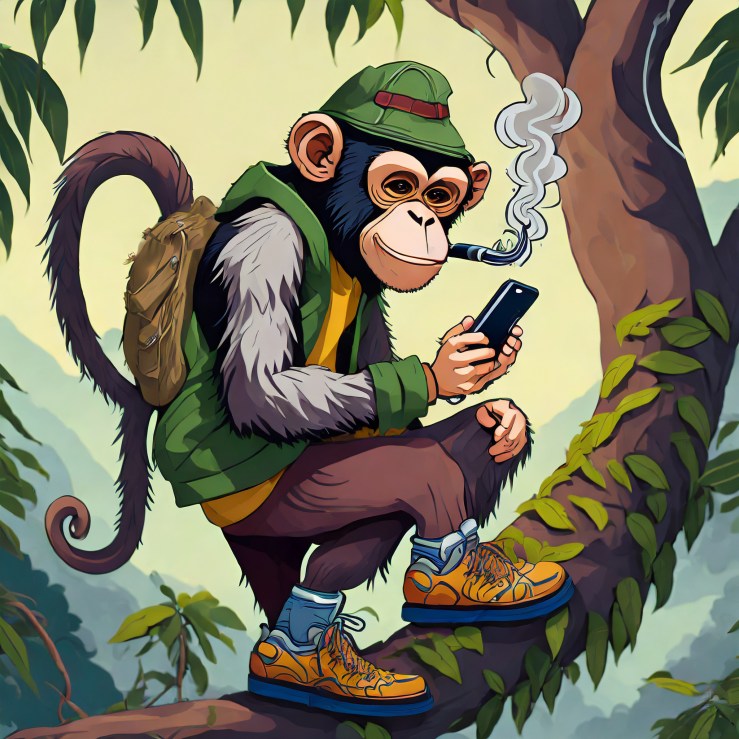
But Adobe base FireFly on their product Adobe Stock of 2 million or somethingorother images here and here. For this you sell them a photo or artwork and they then own it, then designers and advertiser and artists can buy other people images for their art/product/service etc. So Adobe scrape their stock of bought art and images, where the artists are paid. Fair enuf. But this is then used to drive their AI image making machine. They then sell on this service to subscribers. But this all goes (or went) live November the 1st , the paid bit that is. But ’til then it is (or was) up for grabs for payed up subscribers for nowt. I have the ‘Photography Plan’ so I experimented with it. This was my adventure. I put in ‘a monkey in a tree wearing trainers and smoking a pipe, looking at her mobile phone,’ and this is what I got…

‘a monkey in a tree wearing trainers and smoking a pipe, looking at her mobile phone,’

This begs the question ‘Did the monkey agree to this and did she get payed and is she in Equity?’. Art can be so difficult.

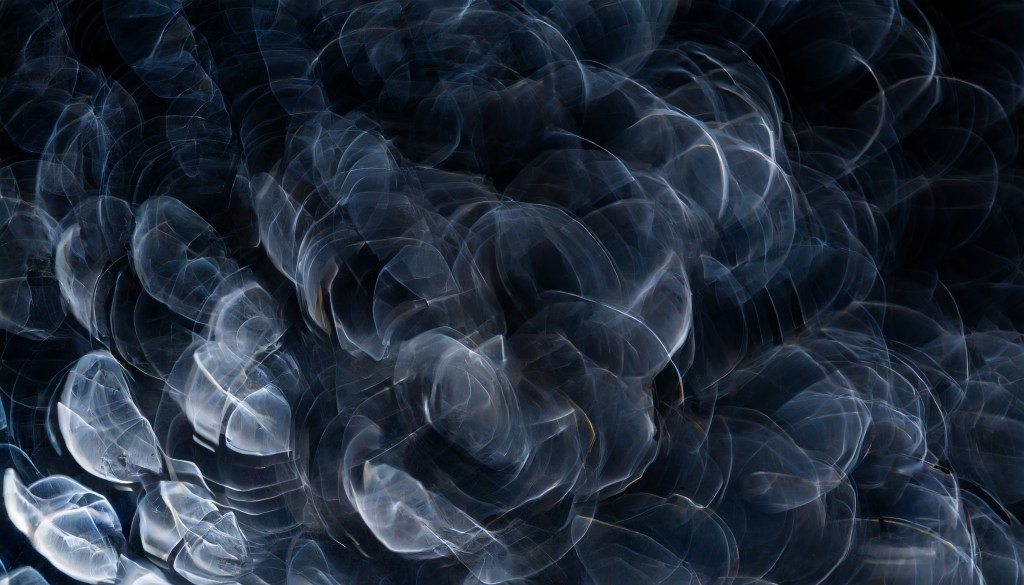
My interest (beyond smoking monkeys) really was not in such concrete manifestations but in more abstract ones. Below are some images and the text prompts I gave for more abstract ideas. I wanted to see what I would get.

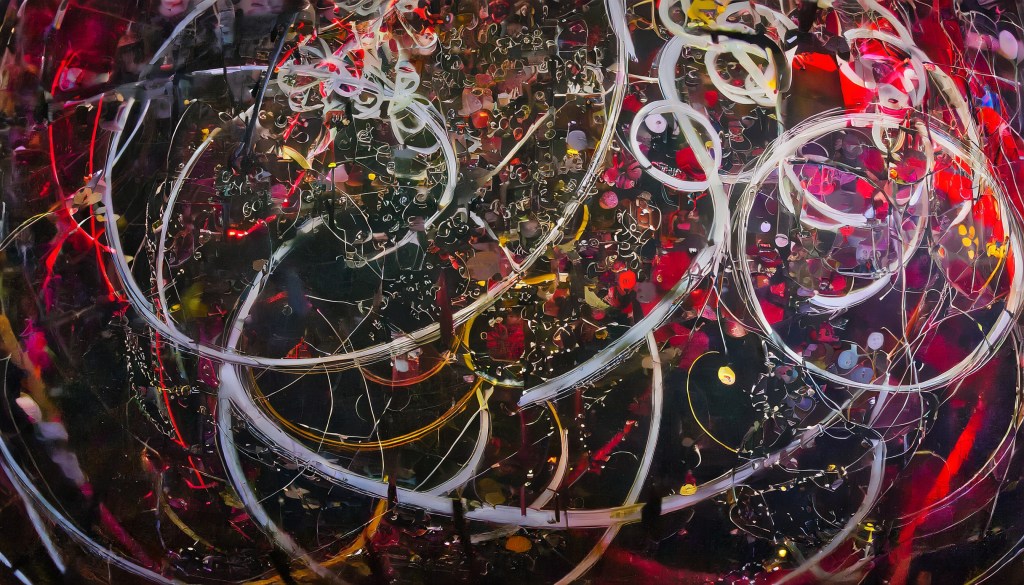
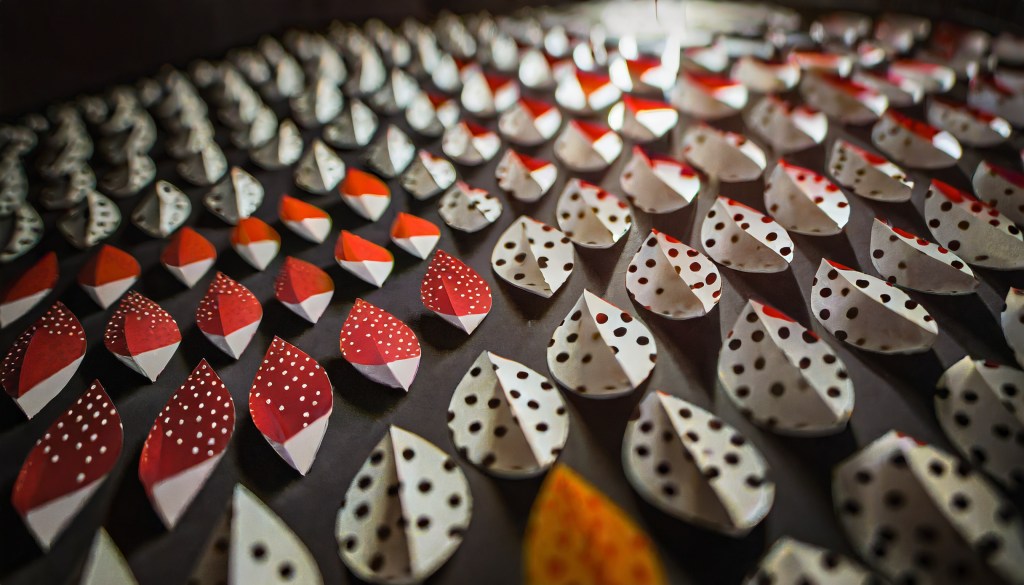
I prompted with ‘cycles and cycles and cycles of dark foreboding substrate’. I got this…

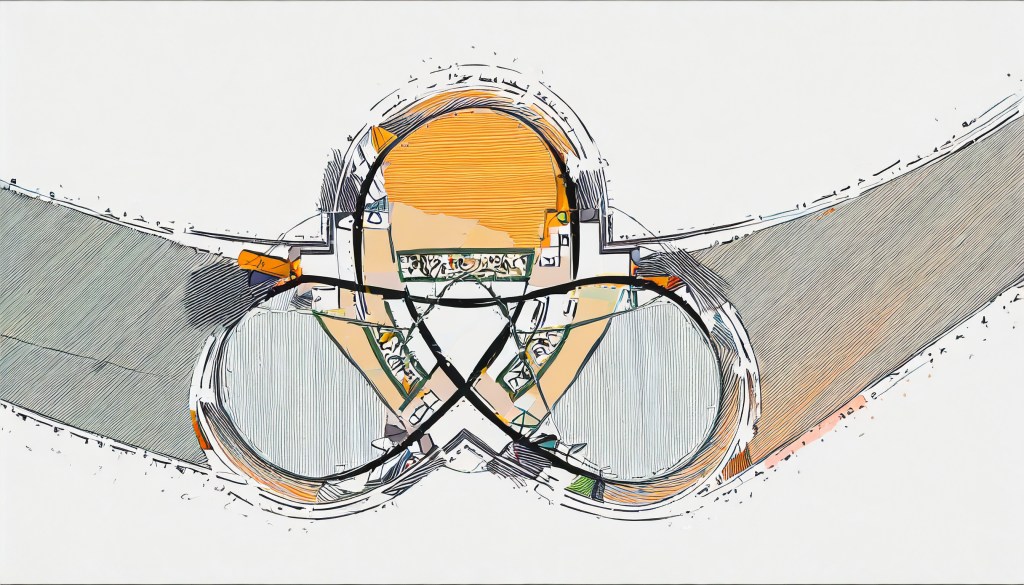
Then I changed parameters, making the image ‘oil painting’, or ‘archtectiral drawing’ or ‘bright colours’ or included say, ‘three cycles’ and got these.

It was impressive. I suspect this will make millions for Adobe. Designers no longer need to trawl through image libraries, if they want a ‘a monkey in a tree wearing trainers and smoking a pipe, looking at her mobile phone,’ for say, a New Scientist article on hominid evolution in the age of the interweb. They subscribe to FireFly on their device, type in the aforementioned prompt, and then there she is, on their PC in about 5 seconds if you have the latest Intel chip. So as mentioned, from Nov 1st on you will be charged for this as part of your plan.

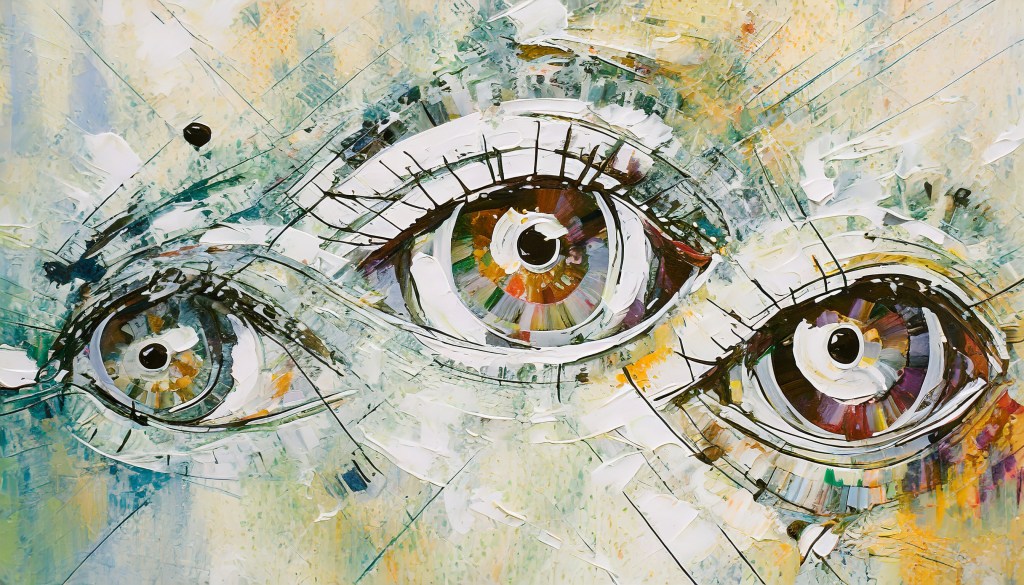
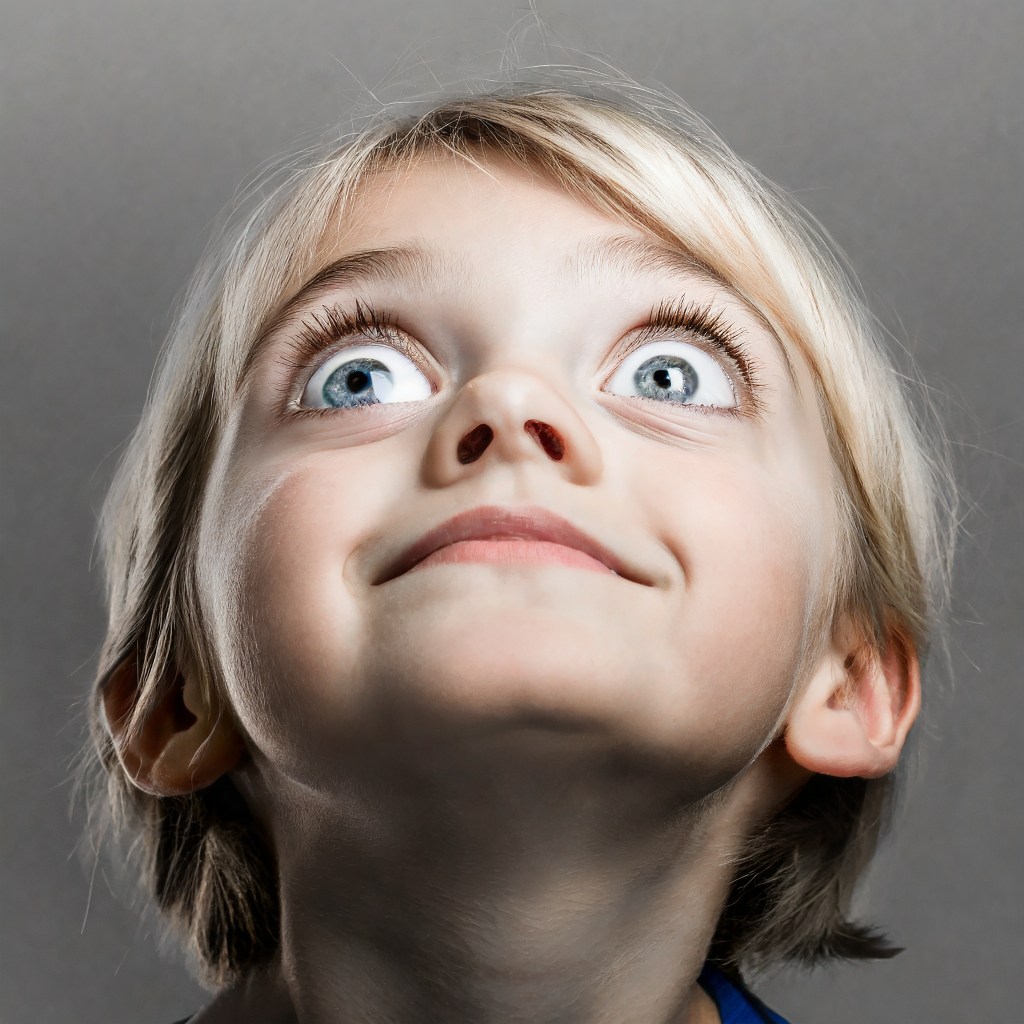
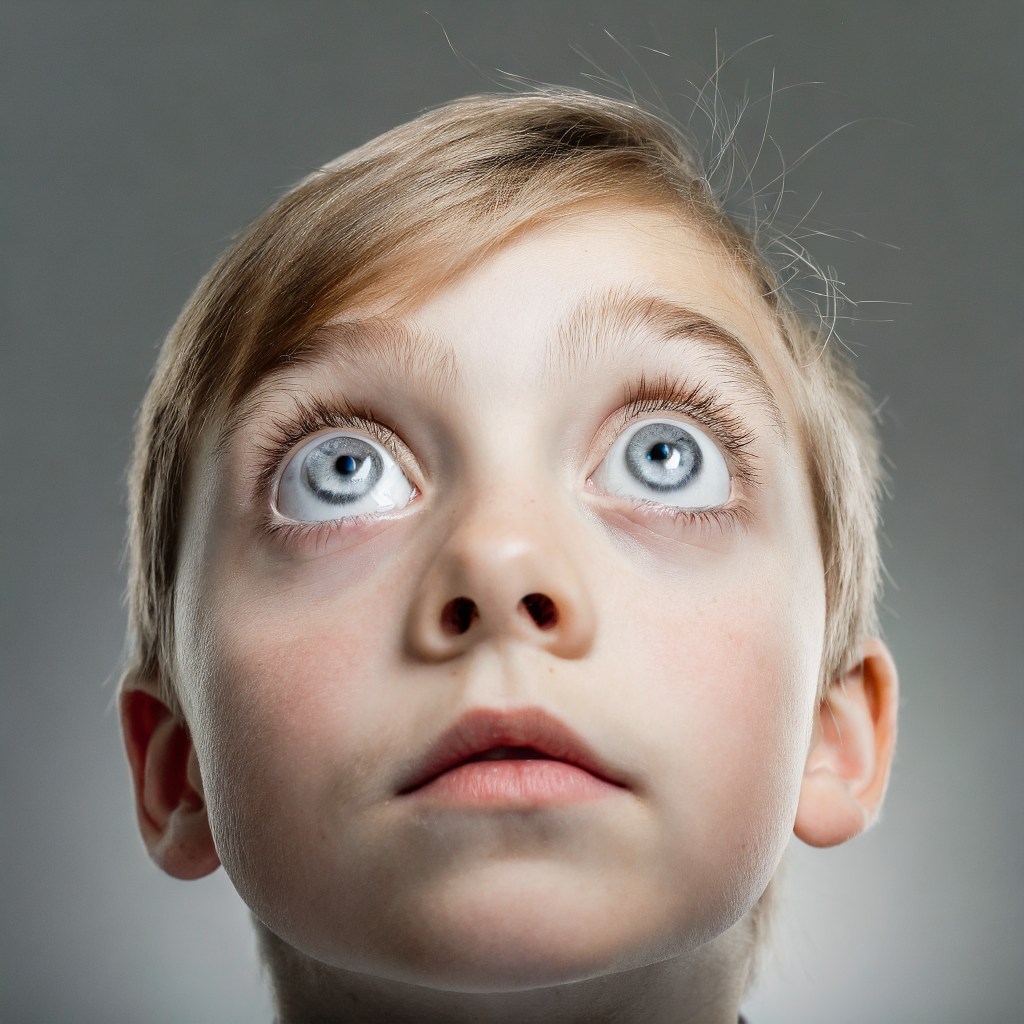
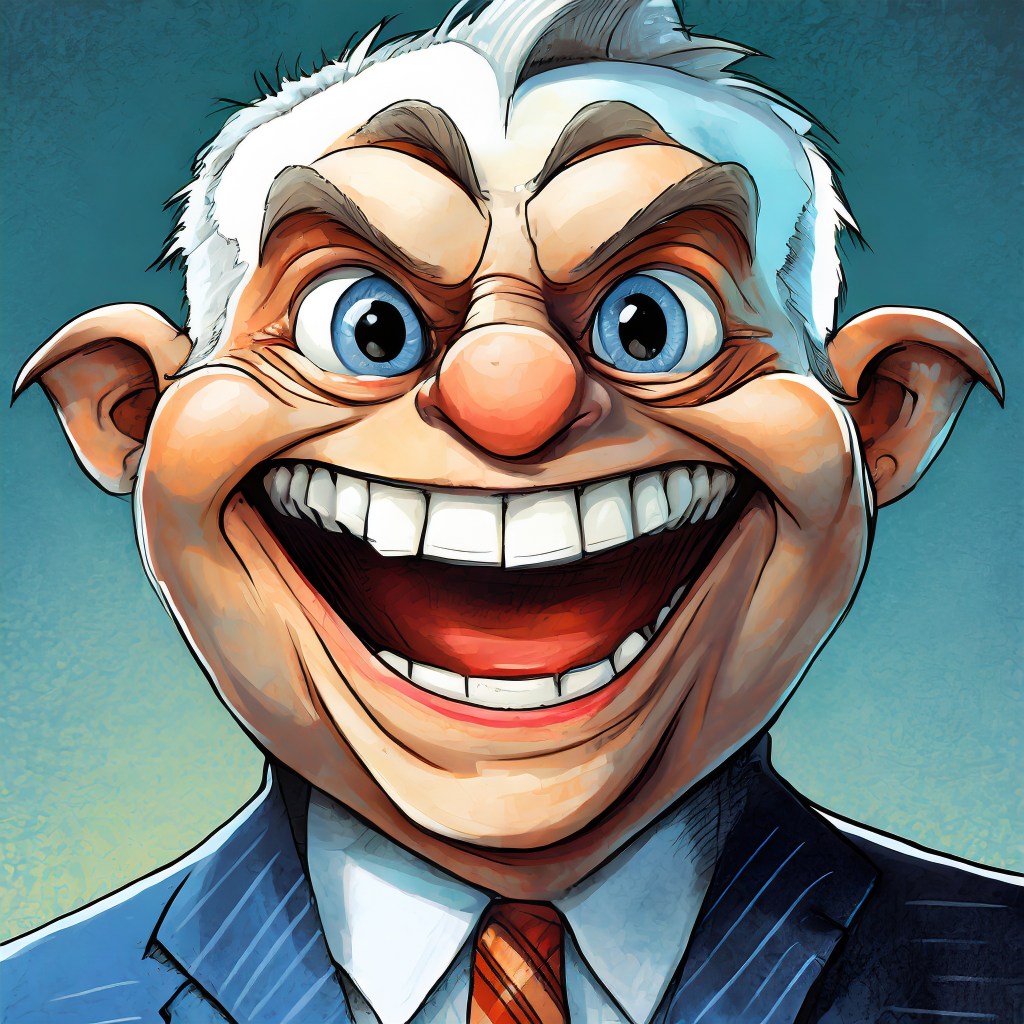
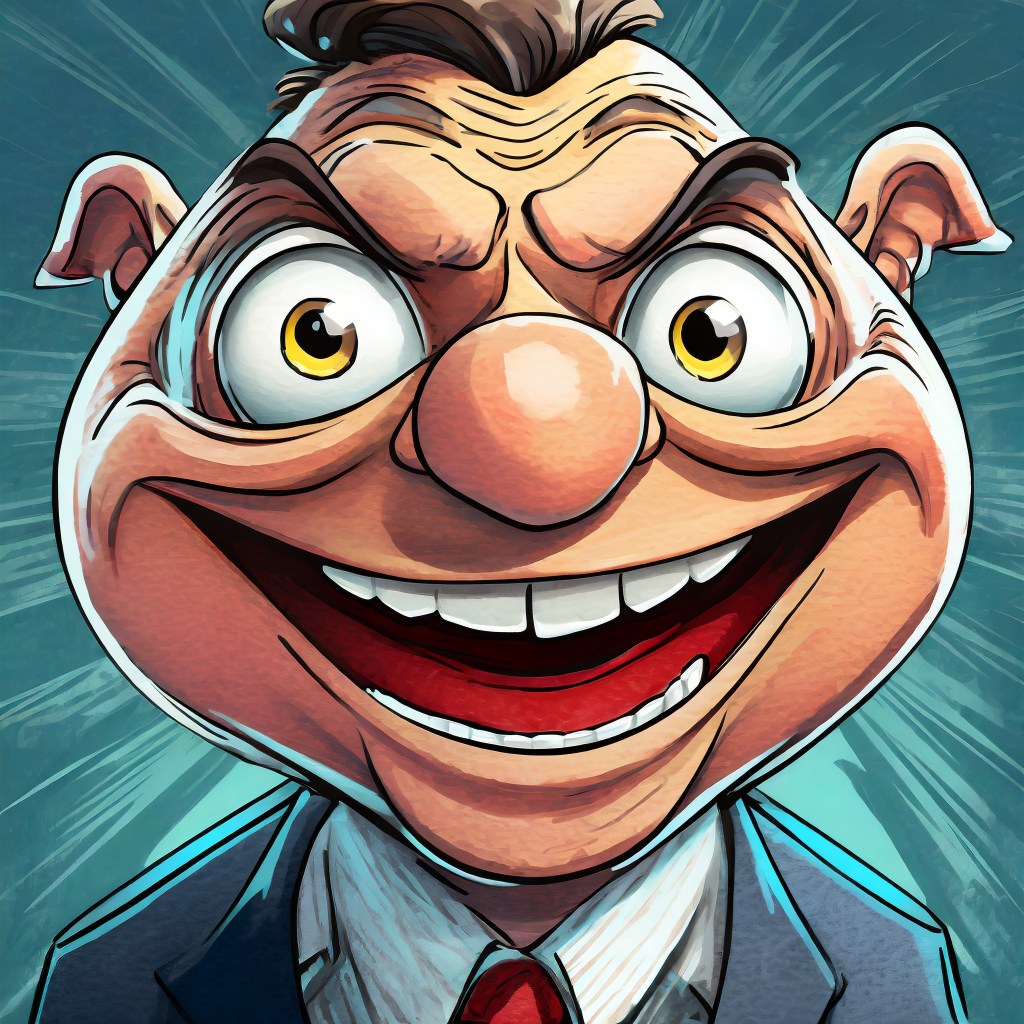
So my counter cultural alter ego kicked in and I decided to make a little artwork from the initial text prompt ‘huge face with big white blank eyes with no pupils looking up’ and got these.

Part of what I was after with my little artwork was some critique of the Attention Economy (see here), about how young people particularly are being trained by social media and their device centric social life to make money for the shareholders of multinationals see here. Adobe apparently read my mind. Uncanny. Scary. My Lu’d I rest my case. Adobe initially gave me children with big trustful eyes.

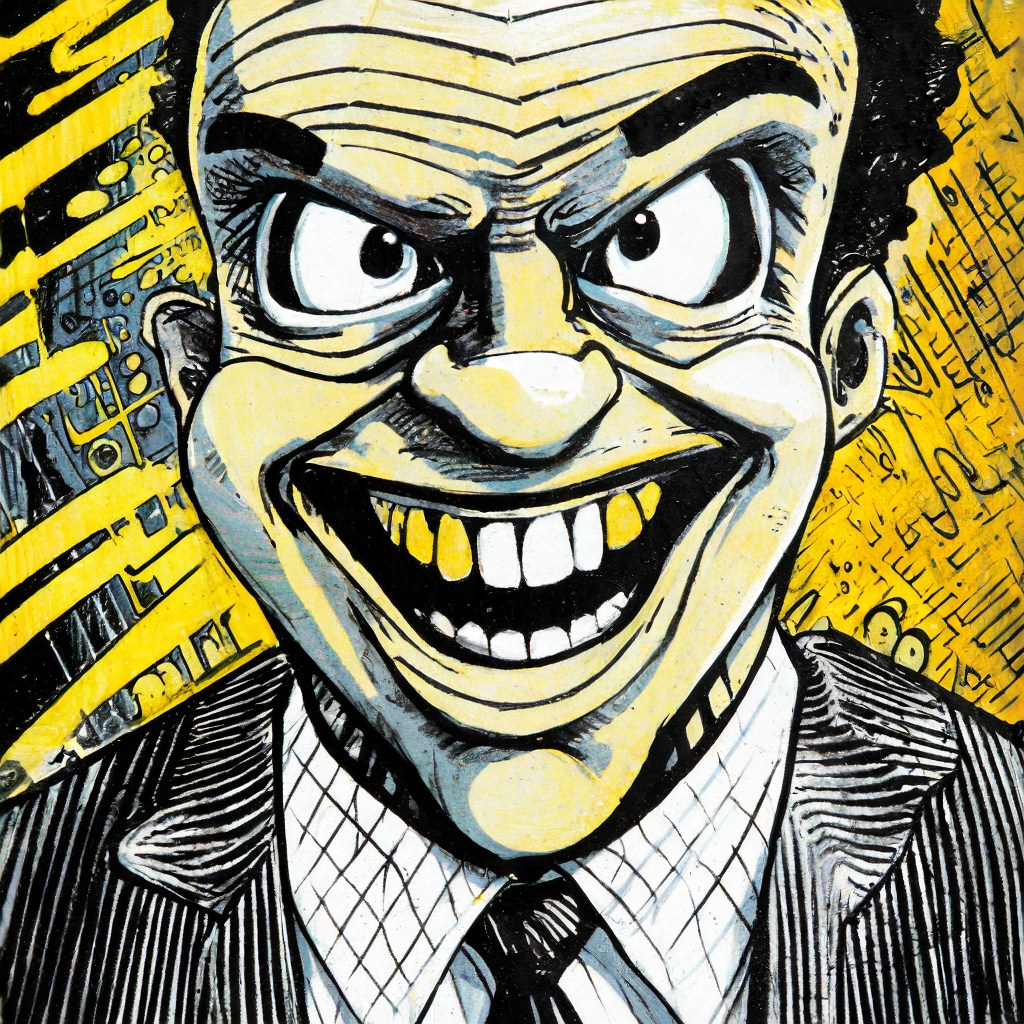
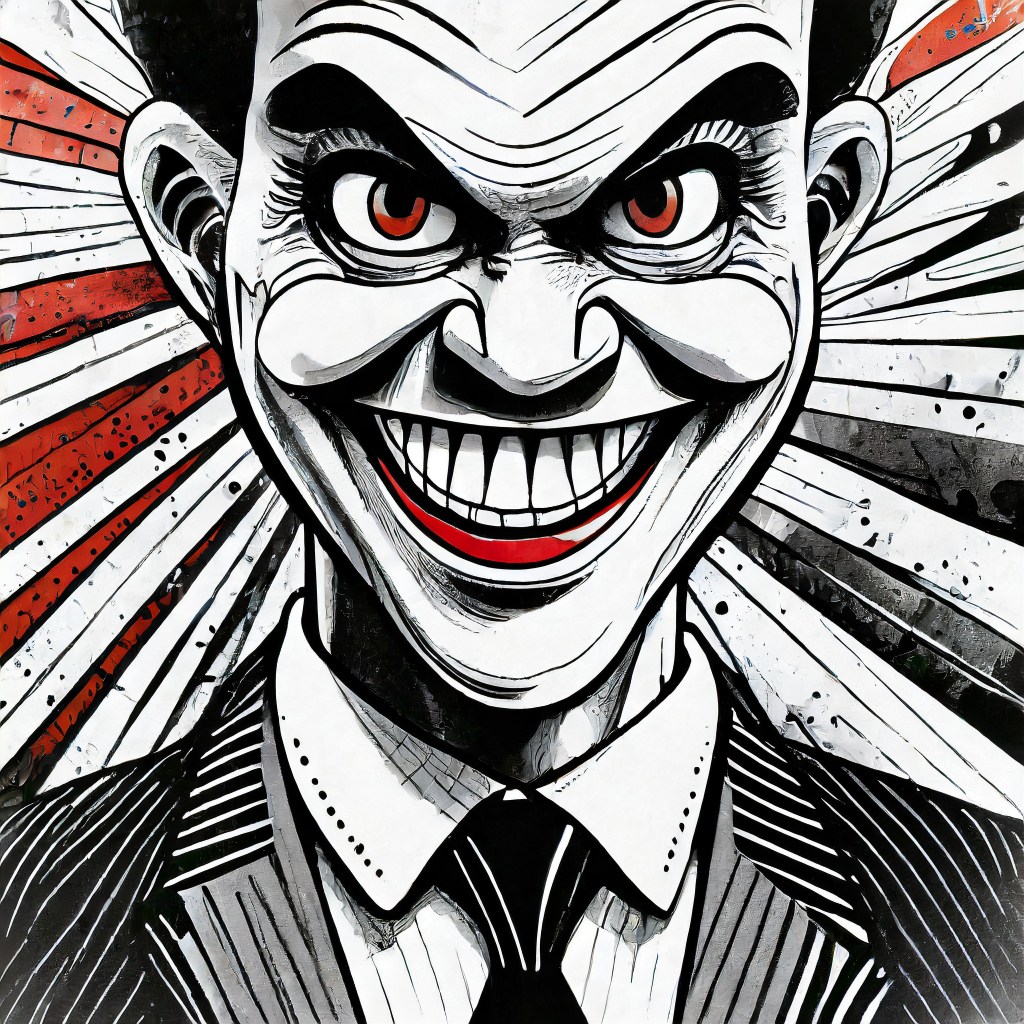
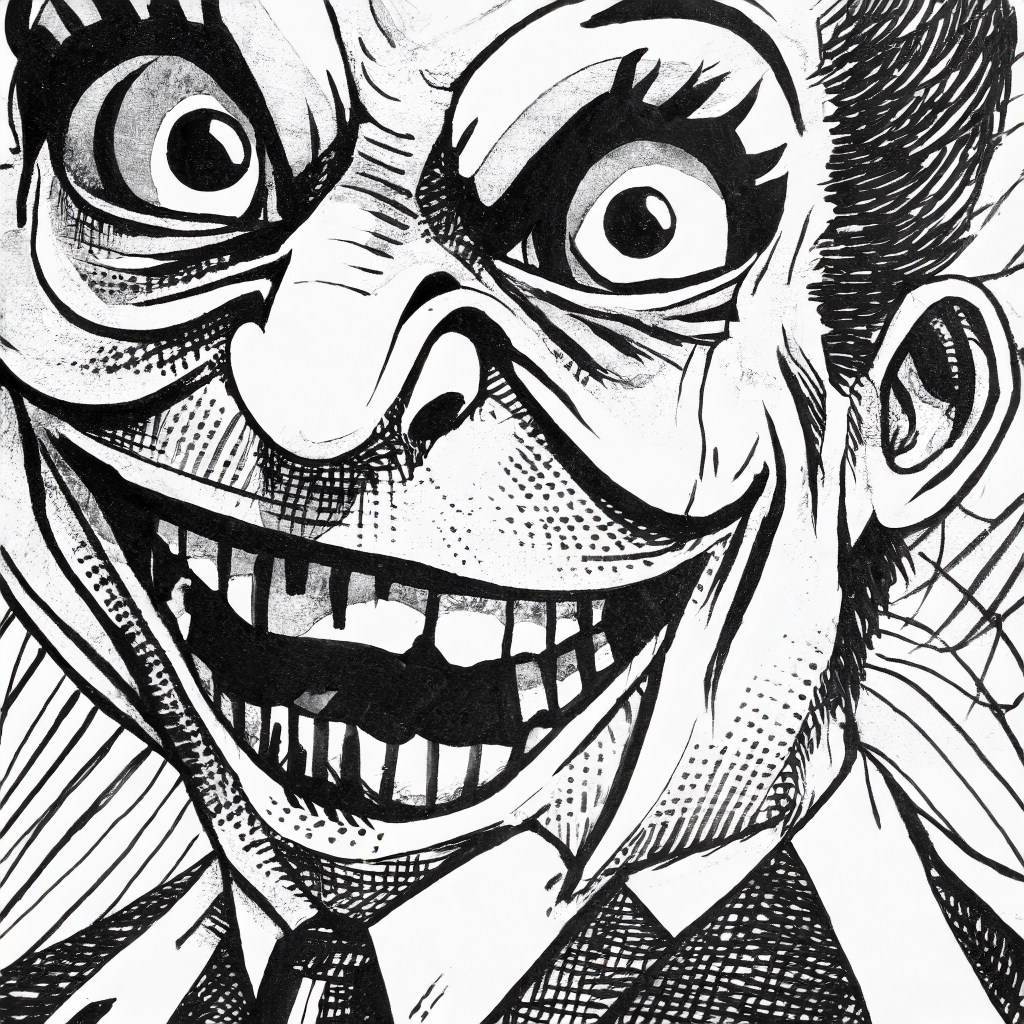
But to be truthful in this case I was after a more specific image so I typed in ‘huge grinning smiling business man face with huge big oversized white blank eyes’, then ‘huge ugly grinning smiling business man face with huge big oversized eyes looking at viewer’ and got these (amongst many more, unlike a real human artist, AI never gets tired or wants to eat or go to the toilet).

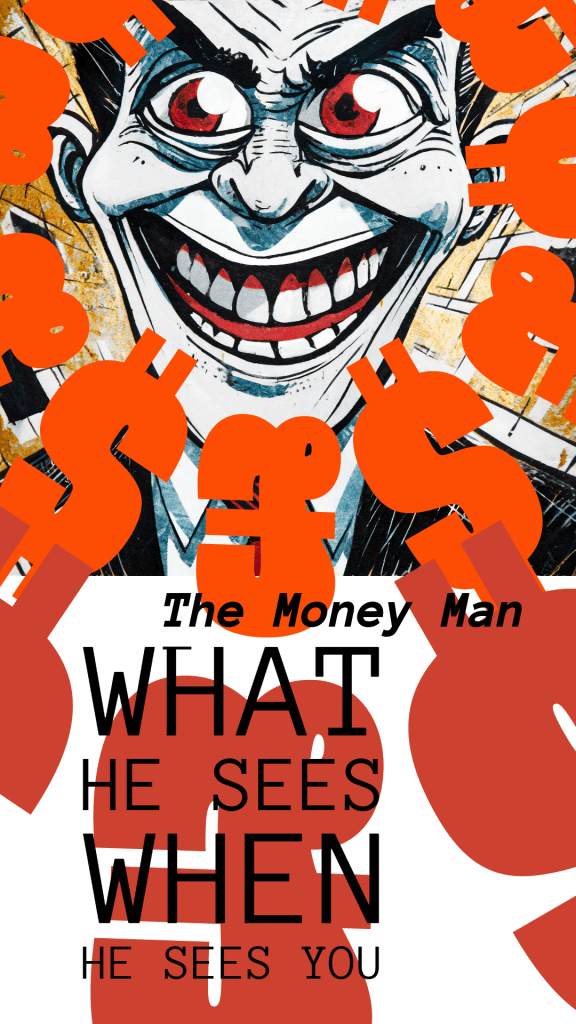
Now FireFly is connected to Adobe Express, a thing to make graphics and images for social media. Express is a quick and easy way to make graphic design. So I made this…

It kinda worked but was not quite what I was after. I moved on and planned to come back to this ismege agian later. But this moving on made me think.

Art as Adventure – No 2

Artworks as way-markers (and as cheating).

This act of art making lead me on to my No 2, Art as Adventure idea, the art object as way-marker or ‘flash’.

On an adventure the ‘flash’ was a thing you left on a tree with your hand-axe. In the wilderness an axe mark can only be the work of a human hand. A bit like a work of art. It was a way to mark your trail, so you can find your way back to whence to came, or have someone else find your remains if you were eaten by a bear say.

People are afraid of bears as people are afraid of art. Like avoiding hungry bears, people avoid making art for fear their art be seen and critiqued. Publicly. In my school if you had your art put up on the wall it was sign of a being a sellout, see here and you were shunned in the dinner queue. Harsh, but just. I got CSE grade 1 in Art and Physics. Social pressure has a lot to answer for. I did a BSc.

So to overcome this fear a suggestion is to see each little artwork you make as a way marker, a flash, a flash in the pan, a thing to be discarded and left behind, a thing to show where you have been not where you are. A thing only you see. A small sign of moving on.

A bigger art work, a project, a show, an article on your local radio station, then a national, then Breakfast TV, Sky Arts, the Venice Biennale here the Turner Prize here, can be seen as an encampment. You set up camp and make a lot more mess. A midden, a dunny, a campfire circle and some discarded lager cans. You know…. ‘Culture’. An encampment will make you officially a ‘Real Artist’. Is it an old tent or Tracy Emin’s artwork? See here. I have seen her tent and I loved it, don’t get me wrong.

So I made the image above and moved on. The lettering did not work. The £ and $ signs ended up upside down so it kinda missed point. The face was great, but I did not make it, AI did.

So what? Well some principles from the arts therapies and experiential learning apply. Whatever thought or idea you had becomes concretised, reified, made a subjective object see here. You make it as art and this experience becomes concretised, reified, made a subjective object. You get to view and re-view yourself, your inner world. You go beyond being a consumer of images and become a producer. That nobody sees your way-marker but you removes you from the echo chamber of on-line life. Like a sketchbook or journal, you see your journey unfold and know where you have been that you better see where you could go. I believe this can make health. It can aid recovery of whatever need to be recovered. It is recovering your own ground. It is in the process in which states become traits to quote Dan Siegel see here. It is art in process. It is art making with intention, attention attitude. I intend to make art, I attend to what I make and what happens when I make it within an attitude of openness and the capacity to non-attachment. This is a just way-marker and I let it pass. Nobody sees it but me. It shows where my adventure took me. This is art not ‘Art’. I do not have to account for it. I am a safe in the dinner queue.

So check out Adobe FireFly. Or ignore it out of principle. But remember David Hockney said ‘The moment you cheat for the sake of beauty, you know you’re an artist.’ See here and here. My business man was not a beauty, nor was my art, but I was a bit of a cheat so maybe I was being an artist. If you cheat, you too can be an artist. Just avoid the dinner queue.