Posts linking to realted, useful and informative source material including work of practicing artists, theorists and commentators, research of anecdotal evidence, magazine or news items.
I have been covering shifts at work and have missed posting, but I have been reading.
Jeremy Deller is a fave artist. See here, here, and here.
He did a performance piece with Brass Bands doing rave hits here and made great video about Rave Culture here.
This article about Deller working in prison with art making caught my interest.
Two quotes in it said a lot about how the arts can be beneficial simply through engagement, making art with other people. Simple engagement is all it needs.
The art room in prisons [..] is the only space you go into where things seem a little bit calmer and people are getting on with something.
Jeremy Deller
We’re looking at it for what it is – not who’s made it or what they’ve done.
This little rambling expedition was prompted by my reading this article below (click it to see it or here)
It is an article about a scientifically measurable phenomenon that occurs in both physical living and non-living systems and gives evidence that all order emerges out of disorder. It struck me that this could be seen to have some relevance to making art.
This is a thing that interests me because I believe art-making does this in the interaction between the physical living art-maker and the non-living materiality of the art object, as painting or piano. I am interested in this, like I am interested in the phenomena of ‘recursion’. Recursion as an idea can be found in art, science, maths, coding, ecology, language and experiential learning and I am interested in things that crop up in diverse settings. That this can describe a gas as well as a goose is what interests me. I like the idea that this may describe some underlying (or overbearing) principle that can be, with limitations, be applied universally.
A link to a BBC Radio programme, The Verb, which is described as ‘Radio 3’s cabaret of the word, featuring the best poetry, new writing and performance.’ This week it featured Margaret Atwood and Alice Oswald talking about how we write poetry, and their own process, the natural world, time, and the possibilities of myth.
At around 35 minutes there is an interesting account of how writing poetry changes the poet. This reinforces the idea that it is an act of experiential learning, and it is recursive, the poet makes the poem which makes itself and also makes the maker. The header image reflects this as a self-making pattern of continuity and discontinuity.
This post is a link to a very interesting article, describing arts practice as a way to practice finding a healthy balance between chaos and predictability. Mark Miller, a philosopher of cognition and research fellow at both the University of Toronto and Monash University in Melbourne talks about the human brain as a prediction machine. The source, VOX, has as its strapline ‘Your mind needs chaos – The human mind is designed to predict, but uncertainty helps us thrive.’ In the article Miller proposes that mental health needs some chaos, and art making can healthily provide that chaos.
The article summarised
Being able to predict what happens in the world is useful. We have a system in our head that seeks to predict what happens in the chaos of the world which upon experiencing this chaos feeds back to modify the model so that it can then feed forward to guide our behaviour. This is the recursive act of learning from experience, or not. If we don’t learn from experience we can become overly fixed or overly chaotic in this process and thus become unwell. The proposal is that viewing and doing art both provide an experiential arena where we can practice the skills of managing our encounters with chaos.
Arts materials like words, paint, musical notes, wood, stone and movement are in an unstructured or chaotic form when we encounter them. In creating form as art makers we learn to make form out of what starts as unformed, but in doing so some new or unexpected or chaotic element makes itself known. We take things we think we know and see them in a new way. Form and chaos coalesce.
Me summarised
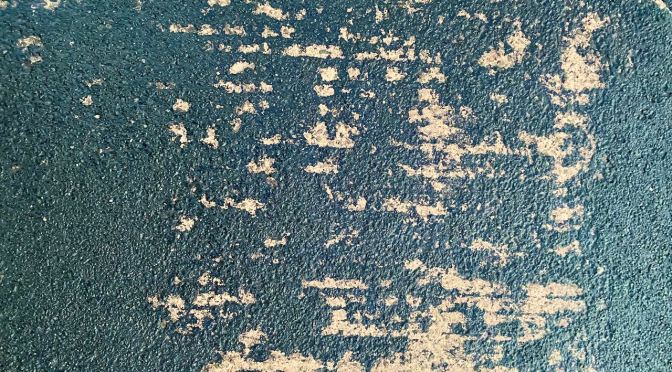
The header image shows grass responding to its environment. I worked for an events organiser and mats put down for a wedding overlapped and removed the light so the grass stopped photosynthesising. One layer of matting let enough light through for the grass to photosynthesise. In my art making I end up with an embodied account of my experience. This image immediately struck me as an embodiment of the experience of the grass.
I found this very exciting like the grass had become an artist. It filled me with wonder and awe in a way that kind of freaked other people out. I do genuinely believe my awe at seeing the experience of grass was a result of my persistent and consistent exposure to art making.
In viewing and doing art I am consistently in awe at seeing some new thing I have never seen before. It might even be a thing I made. Yet the awe emerges out of the most mundane things, paint, pencil marks, and poetry as just organised words we speak every day. It is like through art the intentional exposure to uncertainty and unpredictability teaches me to be able to see new possibilities. And not only that, but to know that I know from my experience of art making, that I will see new possibilities in both chaos and mundanity. This is I think, the wellbeing the author and article refer to enacted and rehearsed through the act of making art.
The link below will lead to the original article on VOX, which in turn leads to the original podcast.



 Moving Space