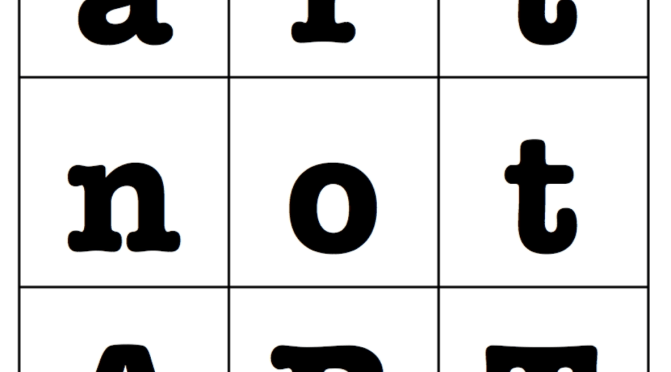
The header image expresses a key idea.
My proposal is that we make art not ART.
We make a space that is about the active experience doing art rather than the more passive experience of viewing ART.
We make art as experiential learning.
Viewing ART
ART is useful and important but ART with all capitals in this context refers more to ‘Fine Art’, a thing made by somebody else and experienced more as viewing rather than doing. Generally it is a thing sold for capital. Fine Art is great. It can be inspirational, expressive, socially and culturally active, rebellious, revolutionary, but it can become propaganda, misinformation, the source of vast wealth and money laundering here and here. All things are good and bad.
The journey from art to ART
Arts education generally starts at secondary level in school. The work of established artists and the modes of art making that comprise Fine Art are explored and experienced. The setting in secondary and tertiary education is aimed at academic qualification, movement onto the next level of learning and generally on to being a professional artist. This is one path art making can take. It is a good path.
Primary and early years tend not to do ‘Art’ per se, except later on. In primary and the early years, in the UK, the young ones do more by way of mark making, free play, and exploration here and here. This is much more rooted in playfulness, experience and child centredness. This is much closer to the idea of art not Art. It is art more as experiential learning.
For young people at secondary art tends to be viewed within a curricular lens. It becomes a subject. A great subject, but art becomes Fine Art. It becomes, design studies, music, drama, dance, cinematics and photography, crafts, creative/imaginative writing. There are arguments that art in an after-school setting, with the academic pressure removed, presents much more scope for the broader benefits of art making see here and here. I think art making is potentially problematic for young people and adults emerging out of school but not seeking to be ‘Artists’. Doing art tends to revolve around being, or not being, an artist. They may tend to see themselves as a non-artist, because they don’t study art as an option. They may tend to see art as a thing they see, hear, read, experience only as audience or customer. It can tend to passify art. Art is a thing they consume, not produce.
The EYFS is different. It is underpinned by themes around ‘The Unique Child’, ‘Positive Relationships’, ‘Enabling Environments’ and ‘Learning and Development’. Mark making, free play and exploration in EYFS and primary contain experiences that later will become art, performance and personal arts practice in secondary, tertiary and work based environments. The roots of Fine Art are active, they are play, exploration and the experiential approaches of early years. It is odd that once one becomes an artist it is precisely these skills which contribute to original work. I have heard arts educators talk about ‘the dip’. Art is fun in primary and in adulthood, but not in between, not for everyone anyway. Interest in art dips in secondary school.
Doing art
So I suggest that ART, Fine Art, is useful and important. But art, all lowercase, is the thing that happens before it becomes Fine Art. Capital ART. Lowercase art is art anyone can make themselves. This is art made by somebody who is not an artist. We cannot all be artists but we can all make art.
My proposal is that there should be a way of working with experiential approaches to learning with non-artists, adults and young people, in which they experience art as mark making, free play and exploration without it being seen as infantile. Or they experience it as something they can do as non-artists to find themselves as unique individuals, together with other people in an enabling environment where they learn and develop in a way they find for themselves and do for themselves. Maybe rather than EYFS, Early Years Foundational Stage we could have an OYDS, an Older Years Developmental Stage of Learning. Experiential learning.
To me this could happen indoors or outdoors. The indoor setting may be to some extend already understood as a space to make art, the artists studio, the workshop, the gallery, the concert hall.
But there is a long tradition of the arts and the outdoors, in landscape painting, literature, music (I was raised listening to Vaughan Williams, The Lark Ascending here from Meredith’s poem here and spent every summer weekend listening to Larks ascending as ‘crew’ at Drum Hill scout camp site here.) There is a strong modern art tradition of the arts outdoors, going back to the romantics the impressionists and performance art here.
Work in an indoor setting must already exist, but would, I assume, be more focussed on Art not art. Night classes, museum arts programmes, gallery education programmes. Or it may be health and wellbeing focussed, art therapy or social prescribing, arts for health, or community arts.
Experiential Arts Indoors and Out
My interest in this goes back years. I pursued this as an outdoor and educator and developmental group-worker. I got involved in various innovative outdoor and arts programmes at Brathay and Prism Arts in Cumbria. But I think my ND neurodiverse brain does not play well with the corporate setting or being an employee. I never really managed to get it going. The clanking of the machinery that manufacture these settings deafens me. The noise has made me ill. I made art outdoors and an antidote.
Art making and the outdoors attenuate the noise. They make it go quieter. I kind of assume that this may go for other people too and not just the ND ones. Shops offering quiet sessions for people on the spectrum here found footfall increased all round once word got round. I think there is scope for quiet playful work with art that does not train ‘artists’, that is not delivered as part of some treatment plan, but uses experietial approaches to empower people to make art for themselves and find benefits for themself. The arts and the outdoors can do this. They have some things in common.
At Outward Bound we had three expeditions, training, main and final. The first was for learning skills, the latter an independent journey, but the main expedition in the middle was transitional or liminal. Arts education is, I assume, similar. You start with source material from fine artists as a kind of training, then you develop your own arts practice, then you have a show, to the public, then you become an independent artist. Expeditioning and arts education are like a three stage initiation ritual. Each has it’s training main and final. Each is like a liminal three stage right of passage.
This could be seen through an arts lens, as performance. Professor Richard Schechner is University Professor Emeritus at the Tisch School of the Arts, New York University, and editor of TDR: The Drama Review. and of the liminal three stage right of passage he says…
I think we could work with the arts and the outdoors to help people learn to make art, find their own arts practice then show and share what they made and what happened when they made it. This is the three stage process in expeditioning and the arts. Having undergone some level of transition, their emergent arts practice could then be pursued independently to promote health and wellbeing. Also, participants in said journey, could loop back and bring other people along on their own journey. Art making, the physical form of art, and having people to support the journey remain safe and contained, but art like expeditioning is an adventure. It has an inner and an outer eadventure, the inner adventure is the art making, the outer one is the outdoor experience.
So they experience this as something they can do as non-artists to find themselves as unique individuals, together with other people in an enabling environment where they learn and develop so learn from experience that health and wellbeing is something they can do for themselves. An OYDS, an older years developmental stage based on an early years foundational stage, the EYFS, art as an adventure a journey, intitiating transition, inviting change.
I am putting this out into the world to see if anybody is already doing this or may want to talk about making it happen. Call me if you are interested in talking about this or doing this.
 Moving Space