Working on an upcoming post I am writing about the difficulty of describing making art. The words get in the way. But it made me think of this track by King Crimson, called Indiscipline. This track transcends words.
It was written by their guitarist and singer Adrian Belew. He is an art maker and this song is about his experience of making art. It perfectly describes my experience of art making. Art makers and artists may be able to relate to this, or not. Who knows? Non-artists, or those interested in making art, or those struck with terror at the very idea of making art could find inspiration, or not. Who knows? I like that it is very serious, but it is also a bit tongue in cheek as well.
Who knows?
And without going too Prog Rock, for those who remember it and those who do not here is Prog Rock and it’s best, or worst, depending on your position. The same with three drummers. Seriously!
In developing Moving Space and my own arts practice I was greatly influenced by work by the arts therapies and arts education doing art as research. It was a revelation. Driven by a need to provide quantitative evidence to demonstrate efficacy of the arts therapies was vital to their being licenced and peascribed. They are still unable to provide the gold standard double blind quantitative evidence. This can be seen as evidence of inefficacy, or that absence of evidence is not the same as evidence of absence, or that art making is a creative act so you cannot intrisically say what an outcome is and test it. One suggestion is that art as research is performative research, and an adjuct to quantitative and qualitative research. Indeed, Brad Haseman an artist resercher wrote ‘A Manifesto for Performative Research’ in 2007 avaialable for download here.
When I trained at Central School a therapist called Shaun McNiff had published his first book ‘Art as Research’. It was a lone voice. Now it is one of many. The idea of art making as research, to me in practice, seemed obvious. Making art facillitates finding stuff out about my experience of the world. But ideas about research, beyond personal practice, make the idea less obvious, particularly when judged alongside the hard evidence needed for quantitative research. The practice is also confusingly know by many differesnt epithets, practice based research, studio research, performative research, practice led research, art as research, art based research etc etc. One book that influenced me greatly was ‘Practice as Research: Approaches to Creative Arts Enquiry’ by Estelle Barrett and Barbara Bolt, two Australian artist researchers, here on Amazon.
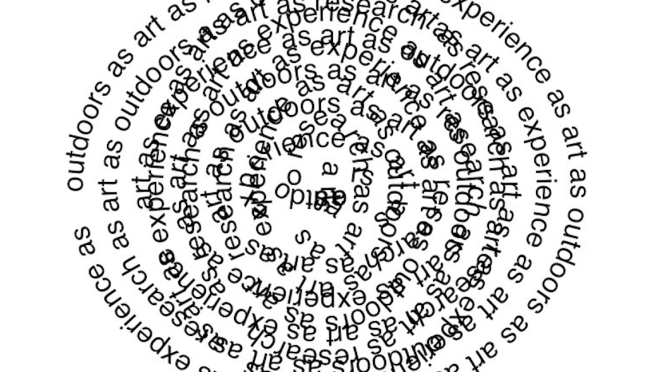
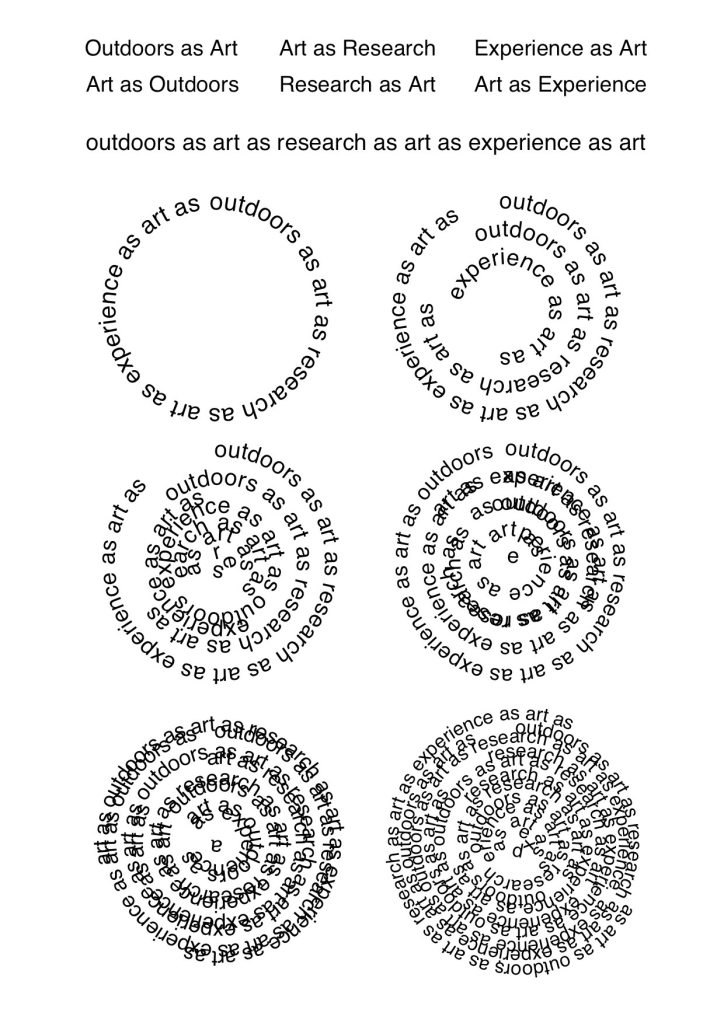
For a lot of this site I have refered to art as research, it was part of the ‘site identity’ on WordPress, the strapline inder the site name. On reflection however I think art as experience is more accessible than art as research. I think they are interchangeable. Art making can be experienced as personal research. But explaining ‘art as experience’ in which one learns something through experience…’, whilst to my mind is intercahangeable with ‘art as research in which one learns something…’, the latter takes more explaining. Indeed in 2007 Estelle Barrett wrote the article ‘Experiential learning in practice as research: Context, method, knowledge’ available for free download here.
So… on reflection I have made all my ‘art as research’ references into ‘art as experience’ for ease of explanation and accesibility. In my heart of hearts this sound like a slight sellout. I liked the kind of punk feel to the idea of art as research in the kind of DIY way that punk extolled. We only need three chords and some attitude to shake the world up.
But the work done by arts based researcers, in the arts therapies and fine art is now very serious stuff, and changing the arts. So I believe art making as personal research, ‘art as research’ is the same as art making as learning through personal experience ‘art as experience’. But for ease of accessibility of explanation, to themes, and practice, I have changed ‘art as research’ to ‘art as experience’ throughout the site. If I have missed any, let me know. I will also continue to tag posts with experiential learning and/or art as research depending on content and context.
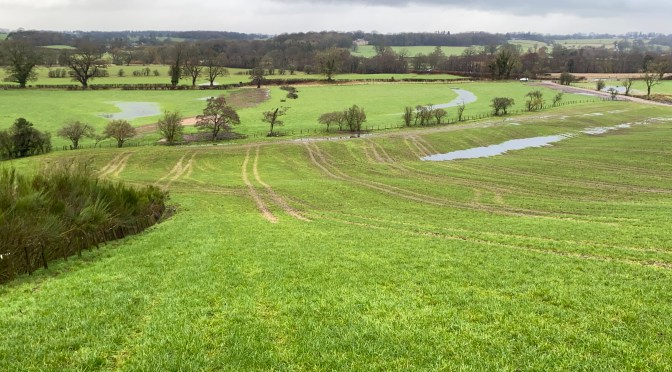
Decide on left left left right today and go out of the drive turn left and left again then at next left road and path are deep under water wife said the roads were wet pass the barking dogs at scrap yard that got out and lunged at us once and turn right find first sign of accident bits of headlamp and bodywork under grass just off the carriageway then some yards on find more carry on and find whole headlight fitting in damaged tree with big scar must have been an accident is it two cars or one what was outcome see mile marker I never really examined before and it just has ten on far side and one on near side nothing else so must be a mile to brampton and ten to longtown shortly after see the grisly remains of some roadkill which I guess is what is left of a young badger just the skin then become aware of a flowing stream down side of the road that is usually dry and accompany it downhill a ways to find a broken pipe by a gate in the field suggesting more deliberate engineering but it just dumps into field which is now flooded with runoff gurgling down to the irthing further on road narrows and I loose the grass curb for my walking and get onto the tarmac but see big tractor tyre marks cutting into verge on longtown bound side and see wet field has open gate with big tractor tyre tracks so guess marks made by autumn muck spreader swinging out left to make right turn into field now close to river and do next left to find road flooded again with water both side in hollows in field and a slow clear curve of old river course on downstream side filled up with overtopping groundwater left again into field and more signs of old river route including what seem to be grassed up riverbank sandbank beside the old river flow up hill now and find a single red sand stone pebble in field on top of grass like it was just dropped there today why where did it come from who dropped it maybe it came off a tractor and see several tracks of small animals come under fence and over field then cross same fence by old style and on to the hilltop badger sett which is clear red soil and earth and not overgrown like the beasts are about at night and see little one plank bench above it like people set it up to look at the view or wait for the badgers in the dusk and see big bank with lots of clear paths most likely not from farmers stock but maybe badger roads squeeze through lined up old gates and see very new dead sheep wool pulled of her hind quarters just eyes and tongue gone into crows belly see no other sheep and farm buildings nearby then follow fence and find rest of sheep flock at field corner by style either getting out of wind or as far as possible from dead sister and they all do that shudder thing like dogs to shake off rain as bits of blue sky appear then on to road with good flow down it into gurgling drain as it is right over the partly fossilised watercourse in the lazy bottom of the shallow valley and links the brampton glacial till ridge with the irthing which only appears after rain then in other places flows overground or through broken culverts and along field boundaries see curious gouges and marks in tarmac of road which must have taken something big to do it that deep and clean then find I can do my second right and then three lefts to find myself back on road of my first right but further up near brampton by the schools so would then do next three lefts like before and be stuck in a perpetual loop like a figure of eight so decide to end it and drop the algorithm then feel a bit weird thinking what would it be like to just keep walking and not ever go home but turn right past sprappies and back to my house by same route I took to start with and get back to dry out and drink tea and recollect the walk and the glory of it’s mundanity
Reflection
The intention for this walk was to start a new year by reconnecting with my local space after a bit of a hiatus. I wanted to concentrate on the act of walking more than the act of going to some destination.
One way of doing that is to use a simple algorithm to decide the path taken. I chose to take a path based on turns left and right. I decided on going LLLR, three left turns and a right turn, for two or three iterations, and see where it took me. This idea still gives some control over outcomes. It was very wet so a wanted to stick to roads and footpaths. It is an idea used in psychogeography for urban walking, as a way to move around a city in a way that brings the walker to places they don’t choose and don’t expect. The idea is to stop attending to the navigation and attend to the senses as you walk. You find all sorts of paths you never would normally notice, and in sticking to your chosen algorithm, feel compelled to take them. In my locale I found all sorts of little unmarked paths, in Cumbria called ‘Lonnings’, using this way of walking.
The day was wet and I timed my walk to miss the showers. I took my phone to photograph anything that took my fancy. I have walked all my local paths and could work out where I would go in my head. I wanted to see what had changed since my last walk this way. There is a saying, I think from the german, that says “If you want to find something new, take a familiar path.” It was in this spirit that I set out to walk.
“If you want to find something new, take a familiar path.”
I walked and photographed whatever took my fancy. On the way I thought about how I could represent the walk when I got back. In my head I had images from old scientific expeditions. My Father in Law got the new Taschen ‘Science Illustration’ for Christmas and some of the images were a great combination of the objective and the aesthetic. See the content of this book here.
Out of my front gate I went left, then two more lefts and then a right. Then I repeated it. After two iterations I worked out that if I did another iteration I would end up in an endless loop. I set off on my third ‘right’ down the same road as my second ‘right’, then broke the pattern and turned home. The intentional act of granting yourself responsibility to relinquish responsibility for navigation is quite strange. It behoves attention. It invokes an oddly relaxing attitude. It lets you be more in the here and now. This way of walking allows you to be present where you are, rather than where you want to be. It is intrinsically meditative.
“This way of walking allows you to be present where you are, rather than where you want to be. It is intrinsically meditative.”
My phone has an app that can use GPS to map my track. On return I wanted to use this as a kind of objective account of the walk, but do some ‘arty’ thing as well. I was not sure what it would be. Maybe some kind of faux expedition illustration like in the Taschen book! I also had in my head a separate idea about a construction of card exploring the relationship between the experience and the words used to describe the experience. I will work on this and show you in another post, but with this in my head, the prosepoemwalk idea with a slide show kind of formed as I woke a day later. This is at the top of this post. It seemed to capture the dyadic experience of the being present, attending on the spot as a singular phenomenon, and the walking as an extended, linear flowing phenomenon. I liked the idea of the words and the images mirroring and complementing each other. I liked the idea of the thing I made being self contained. It shows you what happened without explanation. The LLLR ending up as an iteration was pleasing too, like it revealed a natural mathematical formula, a universal platonic pattern, in my local landscape. Very cool!
On this walk I wanted to simply pass through a space and observe it, and express my experience through some artform. Here I chose words expressed with an aesthetic which I feel reflected the experience. This action will go on to be developed in other artforms posted up here later. I am working on a kind of construction made of card and paper to develop this experience further. Exploring the same experience through different forms is part of the art as research process. Each form reveals a different thing. But I see a generalised sequence which goes we observe, we reflect, we interact and we modify, make and share. In the Taschen Science Illustration book mentioned earlier are the products of observation, the reflection is embodied through image, but the image is used to guide interaction, then modify, make and share ideas, products, processes. This walk was done in this context, to simply observe and record and reflect on the experience of the space I walked through. As 2023 pans out I want to use art making to explore my relationship with my local spaces through observation, then interaction to modification. I want to use this to develop ideas about the outdoors as art and art as research.

 Moving Space