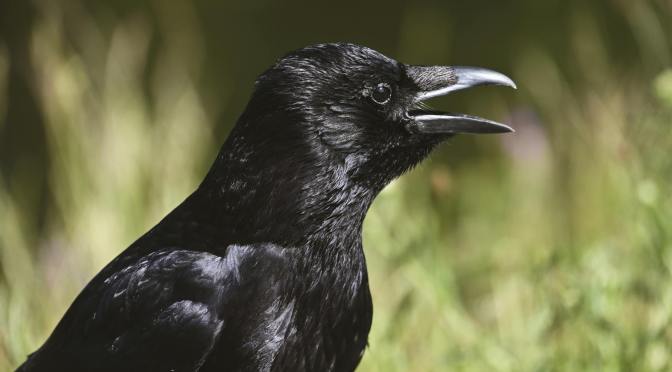
Croci the Crow cronked a cronk. A cronk is a crow call that says ‘There is that man from the car there, with a clipboard, a pencil, three cages and his bag of carrion’. The man just heard a croak and a collective set of caws returning the call around him in the woods. ‘Well,’ the man said, ‘the crows are definitely here.’ and put down his bag of carrion. The caronia carcass. The dead body. The prize. Croci had smelled it before the man entered the woods. Before he got out of his car. Croci had called the crow call ‘cawcsss’ (with a silent sss, at least to men), and as one, the crows converged, convened and conspired to steal his food.
One crow is all crows. They live en masse. No crow ever leaves the side of another crow. See one crow and you know some other crow is nearby. Each crow lives bracketed, like a word in a sentence, speaking about crows and what they intend to do. Crows calling to themselves be outspoken and literate in the wild non-human world, in the city, in the sky, on the rubbish dump, over the mountain top. Everywhere. Crows calling together to echolocate their fellow crows and hear their own call answering back, in the throat of another crow. And these crows spoke of theft and trickery, because tricksters are they all. The thing with the crow is they go with the flow, because adventurers are they all, always here but always going there. When they were away, they alway return to their nest, avoid the trap, trick away and escape and curse and re-curse the fools who tried to trick them one and all.
Croci set off the moment the bag of sweet-smelling rotten flesh hit the floor. All the crows so, set off too. All crows so landed too, in a circle around the man and his soon-to-be stolen bag of booty. Croci hopped right up to the man and his bag. Two fellow crows followed and triangulated and quartered him, hopped forth, took their third of the prize, and slipped into the cages to eat alone together in peace. They even closed the cage door, with a click and a clack and a corvidian caw. The caw is the call that says, ‘We have him. He is ours’. It is said of men, which is why man only hears this call. It’s subtext is ‘Sucker! and if crows could grin it would be said with a grin.
The man was pleased. He had to get three crows for an experiment and had planned for it to take a month or more, to train the crows with food, to trick them into the cages and carry them off to put them in his lab and test them. But the trap closed on the man the moment they put themselves in his cages, and he put them in his car.
The car was warm, and with their bellies full, the crows slept. They woke at the lab as the cold air tickled their nostrils and were put in a cage indoors on one perch, together as a three. The man went home, pleased with himself for gaining a month, for the ease with which his plan unfolded, for tricking the birds into taking his test. But all, with their far eye open so the man would see only three sleeping birds, the crows conspired and conversed. With little whiffles and shuffles of breath, imperceptible whispers and ruffles of jet black feathers, and almost silent clickings of bills, they had it all worked out. The way in was the way out. They knew…. How the cage was built. How the lock was clicked. Where the sun came from, so where the windows were. In the darkness, Croci conferred with his confederation of three. They reviewed and renewed their hasty plan made in the woods. If it was food the man thought had trapped them, it was food they would take from the man to undo his trap. They would refuse his tricks until they were fed, up to the gullet line under their bills, until he was fed up of their silence and their turned backs of sleek black feathers. For four weeks, they got fatter every day until they feared their weight would slow their escape, so then they turned and looked at him, and complied, complicitous and contrite. He suddenly found them friendly, almost apologetic, ready to do as he asked.
So off they went. Each was put in a separate cage. Each given treats for pecking at some marks on a piece of paper. Each chatting to the next. Each knowing where the other ones were. Each saying to all, what each was doing. Cribbing. cheating. conferring and sharing notes in the exam room with the answers given to the one by the one that went before. They saw and pecked some shapes like bones. Curved bones. Square bones. Cursive bones. Bones alone and in pairs, nested and bracketed in repeating patterns of self-similarity. It was easy. Funny little bones on white shiny sheets. They were the connoisseurs of bones. They were carrion crows.
They came into this world nested in a nest of other crows. Each knew their place. A pecking order from birth. Their family group bracketed together. Each a word in a crow call sentence. They partnered for life. Their partner and them bracketed for life. First single then double quotation marks quoting “I do” forever together. All chatter and clatter and calling names. All finishing each others croak called sentences. Each knowing what the other was thinking. Embedded, a single bird, in a family, in a pair, in a roost, in a rookery, in a flock, murmerating en-masse. One crow is all crows. Each lives in and through the other. Their life and living is made through self similarity. We is I is we, palindrome and palimpsest, each word uttered by the one, is covered by the rest. A three line, tree line poem.
So Croci and the crew were happy with their work. Or should I say holiday. A warm bed. Unlimited food. No predators. No men with guns. Simple tricks. Simple solutions. They made the law they lived by. Free. Rebels all. A parliament of crows. All for one and one for all. Croci and the crew knew the time and place to go. After the moon had rolled over her milky form three times, they would go at night. This was their plan. The man disappeared for two nights, three times every moon-turn. He had a shiny little bone he kept on a hook on the wall by the window. This clicked in the cage and made it open, but did not click to make it close. It remained by the window on their entering their cage. One night, after the games with the little bones on the paper, Croci landed on the man’s head and made him shout. An accomplice stole the shiny little bone when the man was not looking and put it under their wing. He went away blustering and huffing for his two days off.
On return, he found them gone. The window open and the cage lay bare. They left, cursing and re-cursing man, the fool, the sucker, the feeder, the tester, the test they passed with ease. Way too easy for minds en masse. Each bird a word in the collective prose poem that is crow life. The singular song. Of the flow of us Crow. One in all. Our call. We is Croci. We sing our name.
Begone wicked.
We is gone.
Chris Reed





 Moving Space