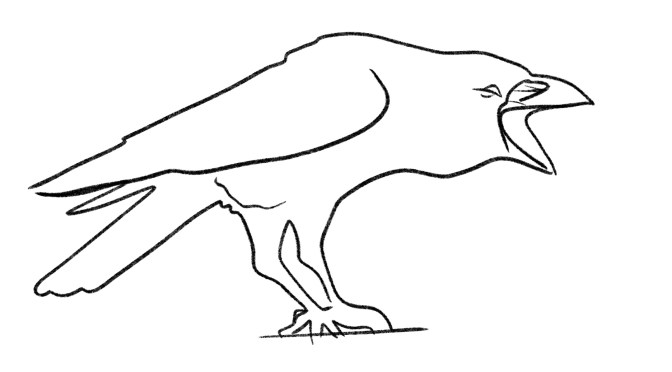
This project came out of me reading a couple of articles about crow intelligence, here and here. Articles like this abound, but this one was about the capacity for recursive reasoning, assumed to be uniquely human.
Recursivity allows us to take a string of words and understand them in a circular, reflexive way such that they make sense not just as a sequence but in relation to each other. Crows, or Corvids, the research shows, exhibit the ability to think recursively, yet they cannot read.
The words sequence sat, mat, the, the, on, cat, only makes sense recursively as ‘the cat sat on the mat’. The recursive relationship between the words is what makes them make a sentence. Crows have the ability, in experiments with sequences of little symbols, to do the same and think recursively. Crows obviously cannot read. So how can they think recursively? How can they do clever things like humans? Poor humans they hate it when that happens.
So I researched this through art, through prose and poetry.
We have a lot of corvids locally, crows, rooks and jackdaws. The word ‘crow’ was used as a catch-all for all the corvids, but I am particularly fond of Rooks and ideas about recursive thinking were explored with those in mind.
I watch Rooks avidly, and from a distance and when young, Rooks and Crows appear the same. But there is a saying to distinguish them that hints at why Rooks, particularly, may think recursively. It goes ‘If tha sees a rook, tha’s a crow. If tha sees crows’s, tha’s rooks’. Rooks, like all corvids are never alone. Corvids live their lives in a recursive relationship with other birds. My belief was that they experience the world as a collective, as individual words in a sentence. They speak together all the time.
At some point I had a word idea about the ‘croak’ of the crow. About how this is what they speak to each other. The idea of the crow declaming ‘Croak I’ led to the idea of a character called ‘Croci’. That a croci is also a beautiful little brightly coloured flower was very appealing for an all black bird.
So my intention was to see if I could, through fiction, research the fact of the empirical data of the research. Could I more broadly explore Croci’s experience through imagination and writing? I was also a bit defensive of the Corvids, the way humans think they are so clever, in their comfy houses, warm and safe. These birds live by their wits, outdoors all year round, everywhere in the world. They are highly successful. We should give them their due.
-
The Song of the Crow
Introducing Croci, the one crow that is all crows
-
Three Cursing Crows
A story of how Croci the Trickster, outwitted a clever man
-
All Crows Look the Same
How Croci sees us but we don’t see Croci
-
Croci Dug Down
Croci does the dirt work
-
Croci Liked Crow
Croci reads Ted Hughes and tells us how to live life as art
Ted Hughes reads Crow.
Exposition
This set of 5 pieces of writing seemed to run its course.
My intention was fulfilled. The research article and responding to the idea of recursive thinking led me to believe that it was utterly obvious why crows could think recursively.
The whole thing got me thinking about how what we as humans think of as very clever, because it is clever, to use language, had a material and relational substrate to it. I went to read more about recursion and found it, like crows, everywhere, suggesting it is a function that underpins a lot of other processes and experiences. It is, like art making, a thing that makes itself, defines itself, learns from itself and as such it has become a significant influence on my ideas about creativity, art, consciousness and life. Life makes itself. That is a definition of ‘life’. It is self-sustaining auto-poiesis.
Reading Ted Hughes ‘Crow‘ was very interesting. I read it in the dead of winter. Our local rookery were unable to feed on the local frozen ground. So I witnessed them meet en masse and convene and be led by the elders to the Solway, 25 miles west, to find unfrozen fields. I drove past the whole rookery in flight, following the road I took to work. I found them in hundreds later in the day on a drive with a client. This, to me, was culture. Some birds had the memory and led the other to feed.
My mind went to a Chuck Palahniuk quote…
“There are only patterns, patterns on top of patterns, patterns that affect other patterns. Patterns hidden by patterns. Patterns within patterns.
If you watch close, history does nothing but repeat itself.
What we call chaos is just patterns we haven’t recognized. What we call random is just patterns we can’t decipher. What we can’t understand we call nonsense. What we can’t read we call gibberish.
There is no free will.
There are no variables.”
― Chuck Palahniuk, Survivor
I think in making patterns, making art makes us able to see the patterns and makes us able to see some patterns we cannot make, so we follow. We make patterns that make some sense to us. We follow others that need not make sense. Recursion then seems to be a pattern that we share with crows. We call it art, they have no names that we know as art but life artfully.
 Moving Space