A great series of 6 videos about the life and writing of Ursula le Guin.
A number of things interested me with this video series. The description of the journey being the thing that matters reinforces the idea of art as adventure. The path is made in the walking of it to quote Zhuang Zhi. The act of making your art is inseparable from the act of making yourself.
The path is made in the walking of it
Zuang Zhi
So whilst the author published goes on to be read by others the first reader is the author herself. She sees herself on the page, her own words as subjective objects. Her life reified.
The product is important but the process of making the product, the journey, is what matters.
This is the story of a journey and arrival at the making of a logo, a small and simple graphic representation of a much bigger and more complex thing. I can see the value in a logo to represent Moving Space. I use one already. WordPress lets you put up a small site icon to help give your site an identity. It appear where the url movingspace.art is displayed at the header of your browser. I use the Copyleft symbol. C Gnu.org, the home of free open source software says..
Copyrights exist in order to protect authors of documentation or software from unauthorised copying or selling of their work. A Copyleft, on the other hand, provides a method for software or documentation to be modified, and distributed back to the community, provided it remains Libre.
I like the idea that I put stuff up on my website, some my own and some other peoples, and you are free to use it but don’t claim it as your own. Credit the author, me or a. n. other. But more importantly make it part of a dialogue or joint venture. The image of an inverted copyright symbol expresses this better than a thousand words, but the words make it more explicit.
Part by design and part by chance I found a simple form which could become a logo without copyright infringements, which could function as textual and imaginal representation and connect art and science, mythos and logos, experiential learning and the arts therapies, and capture in essence what I am trying to do with Moving Space. I see what I do as a thing in process, an adventure, a thing in a state of constant self making, ouroborus, the snake eating its own tail. Recent research on the idea of recursion seemed to capture this and led to me seeing an idea I had already explored in a new light. To me this is the point of the exercise.
The image that emerged is this… i/i and represents the idea of the image of the image. I want to go on to more detail about the ideas that i/i connects together in another post but first I want to talk about the journey.
Long ago I read an article about an article about people and television. It stuck with me. The original article was from the 1990’s and in Christian Science Monitor and called ‘Behind the Glass’. It suggested that people were increasingly seeing a world behind the glass of their TV that some TV viewers judged to be better than life in front of the glass, in the living room, in their life. Thus they sought to emulate life ‘behind the glass’ so as to make their real life on their side of the glass more like the pretend life they saw behind the glass of the TV. The original article suggested this was problematic on the basis that much of the stuff they saw behind the glass was not real, it was manufactured in a TV studio or movie lot. The article about this article, that I read in the 2000’s suggested it had all got worse since the arrival of the internet on our computers. We could have seen this coming it said. Today the influence of life behind the glass of the mobile phone or tablet is similarly critiqued. Some say it is a grave problem, some that it is not a problem at all. I figure it is both. Images, like the imagination, can become a source of good and bad.
Imagination comes from the verb imaginari ‘picture to oneself’, from imago, imagin- ‘image’. This is central to what I am trying to do. To make art as a form of personal research. To make art and pay attention to what you make and what happens what you make it. This connects the arts therapies with experiential learning. In this an image, as a concrete object, a word, a poem, a painting, a dance move, your own or someone else’s can be used to make another image and thus act as a form of re-viewing or reflection or development of the preceding image. This is recursive or iterative. In this is also the idea of a mental image, in one’s imagination. This is the source of the thing you make as art, and the making, the embodiment, has a hand in this as well, literally.
I like working with projects and will usually have several overlapping projects on the go at any one time. I started work on a project I called ‘The Image of the Image’, connected to the idea started above, but ending with a person preferring their online image to their offline image. What struck me was the idea that the image people make of themselves online can, in some cases, become more attractive to them than the image they have offline. The politician sees the TV soundbite as more important than the thing the soundbite was meant to be about. But it became too generalised and unfocused.
It struck me that this idea, the image of the image of the self, was a problematic thing. For example it could be seen in an identification with the subjective projected image of self as opposed to identification with the body, the inhabited lived object that is the self. I became aware of concerns that there is a rising level of body dysmorphia in adolescents. Here and here. It seemed it could at some level to be connected to a relationship between the life lived in the embodied world of the here and now and the disembodied world of the internet going on forever. The suggestion was that it was a new thing.
It got me thinking about the myth of Narcissus. In one of a number of versions Ovid tells of a boy seeing his image in a pool, and fell in love with the boy he saw there but on this love being unreciprocated, turned into a gold and white flower, remaining rooted to the spot. In an earlier version, Narcissus spurns a boy, who curses him to fall in love with his self image in a pool and, because the image is unobtainable, Narcissus kills himself. This story is old, suggesting that it is nothing new. The Narcissus myth is a story of youth.
This appeared to me to be the story of the dangers of the image of the image, the disembodied image on the digital world being preferred over the embodied image in the analogue world. But in art making one is always working with an image of an image. The photographer Garry Winogrand, here said ‘I photograph to see what the world looks like in photographs.’ He sees an image on the street and photographs it. He is interested more in the image of the image than the image. Galleries are full of paintings, images of an image the painter had of the real world or in their mind’s eye. All images of images. I read a lot and the thing that is written is an idea about an idea the writer had. Be it an idea in a book about an idea about how a future world, set in 1984, could display the qualities of totalitarianism. Then I read Haruki Murakami’s 1Q84, in which ideas were developed based on the ideas in Orwell’s book, the aforementioned 1984. Hockney painted ‘A Bigger Splash’ here expressing his delight at living in the California sun after living in Bradford. It is an exuberant image of the image of exuberant poolside life.
But is not just art. For a performance piece I did here I developed this Faux Maths formula to describe the algorithm for a walk.
Where P is the path of the walk, as an iteration or repeat of p, which is each leg as a straight line a-b until this is changed by meeting a person (the m is an aboriginal sign for a person, basically, the bottom mark left in the sand where a person was sitting) in which case the path p changes (the triangle) by n degrees. Although entirely fake as maths, I wanted this to be a symbolic representation of a walk. In my walk on January the 1st I also used a very simple version of this, an algorithm sending me LLLR and ultimately into a closed loop. Maths contains symbolic forms called numbers and formulae. Maths, language, art, all are symbolic. All contain elements of repetition, images of images, ideas about ideas, things referring to other things or nesting within things.
At the end of the last post I encountered contact with the capacity for crows to engage in recursive reasoning. This piqued my interest and I wrote about recursivity in experiential learning and commented on it’s occurrence in a wide variety of settings. In maths recursion featured in a maths controversy. A book was written called Principia Mathematica attempted to prove all arithmetic from basic principles. But a mathematician called Goedel proved using maths that there are mathematical statements that are incomplete ‘that are true but unprovable, and perhaps even more surprising, that said the system of axioms will lead to a proof of its own consistency (lack of contradictions) if and only if it is itself inconsistent.’ Here. So a form of recursion was used by Godel in his ‘Incompleteness Theorum’ which could prove itself true by proving itself false through an act of recursion by referring to itself, a thing considered heretical to maths. And you thought modern art was weird.
The research on recursion proved very fruitful. Some of it was quite demanding intellectually. I reconnected with maths and came to see it as a language I could understand. I started to see recursion everywhere. In accounts of consciousness. In accounts of creativity and imagination. In accounts of human and animal evolution. In the simplest and most grand acts of art making, in the works of great literature and music and Fine Art, in performance and theatre. It was intrinsic to experiential learning. It was central to infant development and attachment. I came to believe it was central to human evolution through attachment and teaching and toolmaking as an inseparable trinity of familiality, sociability and teamwork. It is a way of seeing things as being simultaneously both single entities and things in process, naturally developing hierarchies of complexity providing simultaneously a global and a granular perspective. I think it can spin tales of fascination, creation myths and literature, create mathematic formulas that allow us mastery over the material world, enable music that will make you weep, it can move matter.
But it was also to be seen in ideas about echo-chambers on the internet and in conspiracy theories and in accounts of totalitarian systems. It could be seen to feed into the inter-generationality of abuse. The easiest way to become an abuser is to have been abused. But it can spin tales of deceit, make men and women dance on tables in the Capitol on January the 6th, and send people to the gas chambers. Recursivity can produce infinite loops from which there appears to be no escape. Cancer could be seen as a form of recursive growth. Unending. Extinguished by death of the organism. The climate emergency a form of cultural cancer. The myth of unlimited economic growth. Extinguished by the extinction of the human line.
I saw this on YouTube. By William Burroughs…
And that line ‘…evolution did not come to a reverent halt with the arrival of homo sapiens…’ stopped me in my tracks. So very funny. So very true. I became interested how this idea might work through a serialised story at a poetry night I attend and started writing and through developing the story I came to see this fictional scenario was actually worryingly realistic and that this may be the inevitable outcome. The story remains unfinished. It frightened me. Maybe the Earth wants rid of us. The Goddess in the story is driving global warming to rid the world of man. There are some interesting ideas about that suggest fiction is a way of working through ideas about the big issues that facts and figure fail to achieve. Wagner is good for gender issues, Orwell for the politics of totalitarianism, Marquez for the crossover between magic and realism.
In the story I worked with the goddess as the one facilitating the end. The Goddess says to Eva the human protagonist…
“I am not who you think I am. I am not lightness and sunshine. I was once but I am no longer. I am Eumenides, I am Athena, I am Banshee, I am the Furies. I am the Maniae, I am black Kali the destroyer. I am Ran the Giantess of the ocean. I am Hel the Queen of Death.
I am the perpetrator and purveyor of global warming. It is my act of homeostasis. I bring global genocide, infanticide, regicide, patricide, sapiocide. I want the end of man. I want man cooled and comatose. I want man unevolved and extinct. I want man dead.”
And creativity and imagination is, I think, behind it all. It is our curse and our blessing. We can imagine unlimited growth but not how to prevent it becoming cancerous. Recursivity is many things, but I have come to believe it is central to our imagination. Our imagination is limitless, unbounded by the material objective world. This makes it at once liberating and dangerous. I came to see i/i as a symbol of imagination. The ability to make an image of an image, make an idea from an idea. But unbounded imagination is problematic. We can get lost in such a vast world, believe the world is flat, or that Trump won the election or that we can ‘Take back control’ or that nobody will notice if people put vast numbers of people into camps to be ‘re-educated’ again. I can get lost in thinking about thinking, writing endless blog posts that nobody reads.
Through my discursion around recursion, prompted by an article about how crows are a clever as people, I have found a way that makes all my wanderings make sense. But that sensibility is subjective. It works for me. Recursion is a form that cannot be expressed as one word. At heart I am a nominalist. I have come to realise that all we experience are symbols of some deeper reality. Words point the way but are never the destination. The path is made in the walking of it. The map is not the territory.
A favourite quote of mine is from Orson Welles who said “The absence of limitations is the enemy of art.” My hiatus filled with reading and art making related to recursion has acted to put some brackets around the overly open and discursive path of the last few years. Like my self-imposed and entirely amateur and anti-academic PhD has ended. Oddly on my 65th birthday. My plan, stated at the end of my last post, to work with artform to explore the experience of exploring recursion has taken longer, and generated more words than I expected, but has been fascinating. All I have to show is a new logo of bracketed imagination, but getting there has been fruitful, and instructive. The symbol, the image, the imagination, is everything. One picture is worth a thousand words, but without the words there would be no symbol. The symbol emerged from a long journey. So it could also be a symbol for adventure, the thing that happens before you arrive. Art is a journey, a thing in process, made material momentarily by the flash of an image, a painting or a poem left on the trail to show the traveller where they have been. So i/i may change but for now it works. I will ramble on.
Not all those who wander are lost…
Tolkien
Header image courtesy of thisisnthappiness.com – ‘art. photography, design, dissapointment’
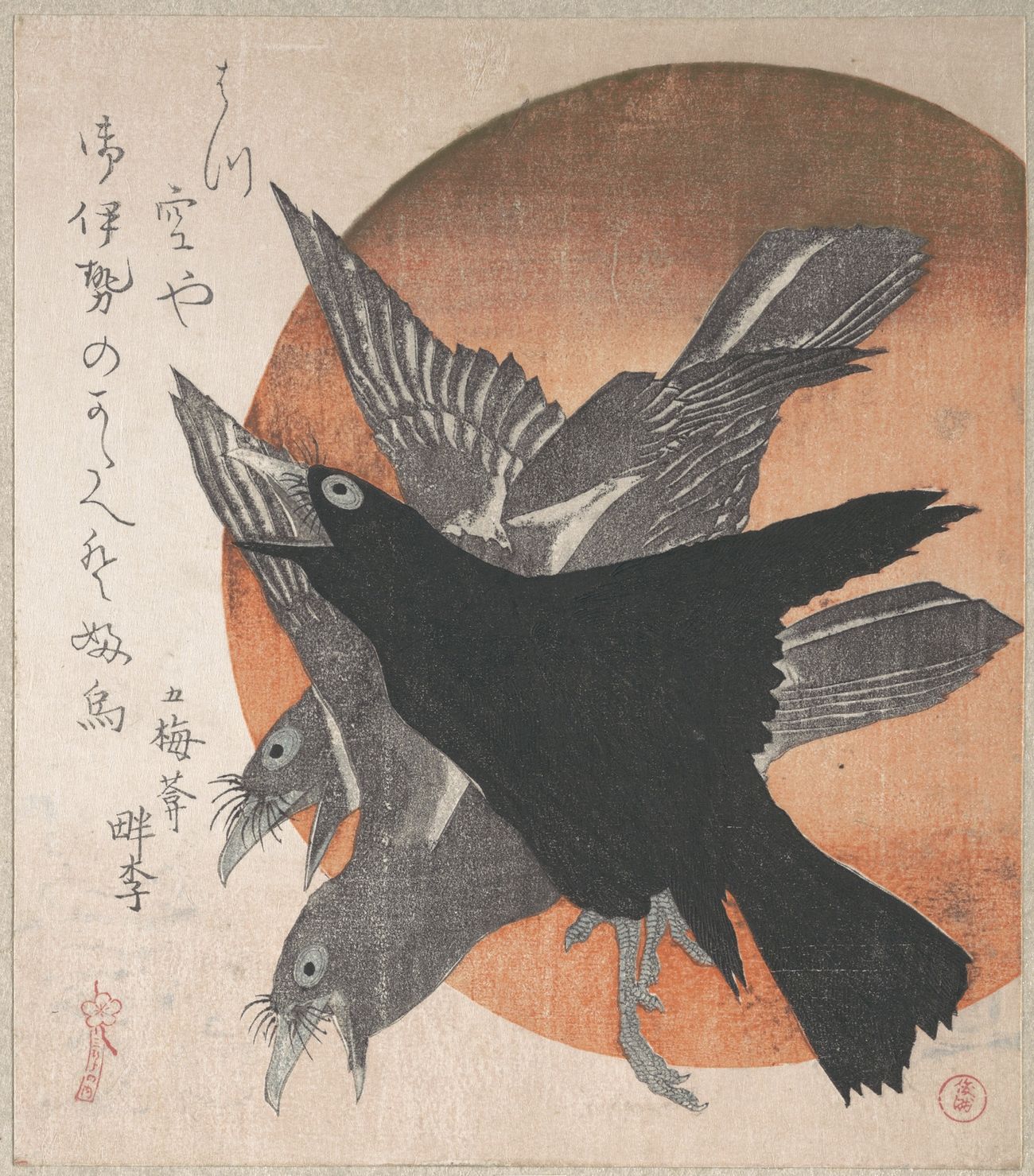
At the end of my last post I wrote about how I saw an article here crows titled ‘Recursive sequence generation in crows’, what it stated next piqued my interest ‘Recursion, the process of embedding structures within similar structures, is often considered a foundation of symbolic competence and a uniquely human capability.’ Other articles had more clickbait in their headlines, one stating ‘Crows Perform Yet Another Skill Once Thought Distinctively Human’, here and whilst this claim is not fully endorsed by all scientists I got to thinking about what I know of the Corvids and how this recursivity might be linked to their capacity for learning from experience. I wondered, given the frustration expressed in my last post about the difficulty in describing doing, and the proposal that experiential learning could be recursive, and the proposal that recursive thinking is based on language, and the observation that crows don’t talk, I wondered what it was in the experience of the crow that could produce recursive thinking.
So this post and some following posts will explore this through applied research and art as research with a view to applying ideas of recursivity to art making and experiential learning. The intention is to engage in subjective research, to use my own and other people’s observations along with art making to help me develop ideas through the action of making stuff and attending to what I make and what happens when I make it. This does not render an objective outcome in a scientific or empirical sense but it does render objects which provide opportunities for reflection and thus render personal insight and subjective knowledge. Outcomes are subjective, situational, experiential, embodied, emergent and multi-modal. As research, this will be generative and performative1. I hope it will make something happen.
Observing Doing
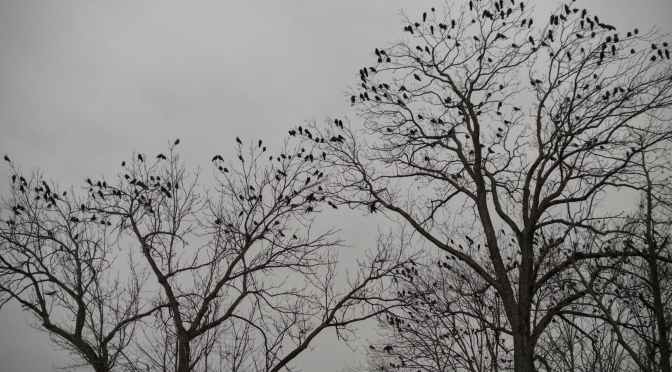
As part of my current outdoor as art practice, I walk a lot locally, I like the outdoors outside my front door and enjoy making art there. In my walking and my art making I have become quite attached to a local rookery. Through observation and reading, I came to realise the local rooks had culture. They had a form of collective knowledge learned from experience and shared. For example, in the winter I observed that they all left at dawn to feed remotely. They settled in a tree then set off en-masse to some remote destination. Normally they fed locally. I suspect they left for the Solway when the fields nearby were frozen solid. As a maritime environment, the ground freezes by the sea last. On my travels, driving as part of my day job, on frozen days I saw rooks feeding by the Solway in large numbers, but they were not there on warmer, unfrozen days. My hypothesis was that the local flock probably had birds with memories of feeding remotely on frozen days and these birds led the whole flock to feed. Memories of past events are seen as an aspect of recursive thinking enabling planning for future events or enacting plans for alternative actions in the present.
Describing Doing
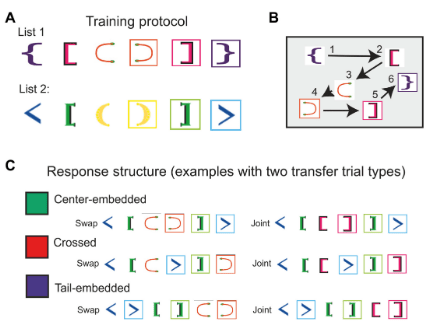
In the aforementioned research, crows are shown to possess the power of recursive thinking. This is proposed to be a skill previously only seen in humans by virtue of being expressed through language. The implication being that crows don’t talk so how can they possess recursion as a skill. Central to the research was the act of bracketing, of seeing one pattern within another pattern. Crows were shown to be able to see the pattern within the pattern below with brackets within brackets.
This is said to relate to recursion emerging through our capacity to use language to embed one idea within or express one idea as another. Much of this relates to the work of Noam Chomsky. Chomsky explains linguistic recursion as something that occurs when a grammatical sentence, which includes a noun or noun phrase and a verb, might or might not contain another sentence. Again at its core recursion is the idea of perceiving one thing within or through another thing. Extended, this leads to ideas of language, empathy, imagination, planning, art, memory, culture, science and maths. The idea of symbolic thought, thinking beyond the here and now of animals. So crows thinking recursively intrigued me and delighted me.
I got to thinking about how my observation of my local rooks and crows suggests they are very familiar with one thing within another thing. I believed they could have a form of embodied recursivity. As a dramatherapist and experiential educator this interests me.
Crow Talk
When I walk locally I often see a crow and when she calls I hear other crows nearby which I cannot see. My supposition is that individual birds use calls to locate where other crows are. Thus they are aware of themselves as a thing within another thing, the bigger thing being them as a group or flock. They are social birds, specially the rooks, and their experience of their vocalisations will almost always be of themselves vocalising in relation to other birds’ vocalisations. One could imagine the call of one crow as a word within a bigger sentence uttered by the flock, but this is spatial and embodied not sequential and spoken like we speak.
In my initial research relating to me checking if I was understanding recursion correctly, I found that the idea of recursion cropped up in a broad range of settings. It recurred within maths, logic, biology, ecology, linguistics, philosophy, media studies, code and programming, art, literacy and creative writing, psychology and neuroscience including studies of consciousness, evolution and ontogeny, aesthetics, fractals and chaos theory, and that was in just one google search.
My interest is in experiential learning and art making as a form of experiential learning. So whilst in all this I could find no direct references to experiential learning and recursion, there was enough to provide material to connect recursion to experiential learning and art making. The range of references suggested a phenomenon that could connect many different things, which interests me as this suggests a phenomenon which could be at the root of many other phenomena. A key to art as research to explore and express personal experience is its multimodal use, exploring one thing through many artforms to see patterns, connections and exclusions. Art making is seeing one thing through another thing which suggests a core recursive function.
A Plan For a Direction of Travel
So my plan is to use basic research approaches, document searches and reading alongside art making as personal subjective research to explore and develop my understanding of recursion. This will be posted on my blog, but because a blog has the most recent post first, and this journey may be useful to be seen as going from it’s departure to it’s destination and not the reverse, I will put up pages showing the journey in it natural order. Because it is my belief that art making and/as experiential learning is intrinsically adventure, there will be no fixed destination. From the little I had read, I could immediately see that recursive processes are the same. A mathematical sequence has a fixed formula, often with an end point. But the recursivity exists as a process, moreover, it exists ‘in process.’ The formula makes some thing change. The recursive formula in maths could seem to be as far as you can get from art making and experiential learning, but each iteration of the formula derives its outcome from the previous iteration. It is cyclic like it learns from experience. Like art making it is a difficult thing to describe in words.
One definition of recursion (of many) is that recursion is a thing that defines itself by it’s own definition. here It is described as exhibiting self-similarity. In programming languages, if a program allows you to call a function inside the same function, then it is called a recursive call of the function. One example of recursivity brought together the aesthetics of art and geometry and a philosophical ideal for ancient Greece, the golden mean. In my training as a dramatherapist we put great emphasis on the archetype and the symbol in myth and storytelling. But with a background in science, I could see that the emergence of Euclid and Pythagoras also relied on the archetype and the symbol but through maths and geometry. Euclid worked out basic geometry and expressed it through his book Elements which was used as a core text until the 19th C. It is plausible that the work was done with nothing more than a compass and line in the sand on the floor, like at a campsite or like on a blank canvas. It was plain that the golden mean made itself from scratch. You start with a straight line, divide it into three, use a compass to make a right angle and define the section so AB/AS = AS/SB = 1.618… Yet the golden mean is found in nature, art, science, music theory, architecture, on and on. It is deeply self-similar and seems to recur in many diverse settings.
Doing Doing
What struck me was that recursion is a thing made in the making, it is a doing thing that remains elusive for words, it is as the saying goes, a path made in the walking of it, the principle of Dao as stated by Zhuangzi. So for my starting point I embarked on a path of making some thing, or numbers of things and work multi-modally. I want to also use poetry and story as if crow could inhabit recursivity, to show how crows subjective experience may include recursivity. I want to see if I could make the golden mean with a compass and a ruler, or more specifically, have the golden mean make itself facilitated by me. I want to do this through art making but also dig through more formal research descriptors. I want to see where this intended path will take me. I start with direction not destination.
Given that my initial interest was captured by the nature of crows I decided to work with language, but through poetry and imaginative writing to better express my ideas about recursion and how crows could experience and embody recursion without using words. This would be an experiment to see if a creative process could be used to explore and express the embodied experience of crows as recursion. This would, like I said, not be an alternative to scientific research, but an adjunct, an act of performative research to describe in a creative form what the science expressed in quantitative form. A subjective re-viewing of the thing the science showed us. The subjective object.
Barrett and Bolt; Practice as Research – Approaches to Creative Arts Enquiry – Introduction. ↩


 Moving Space