In developing Moving Space and my own arts practice I was greatly influenced by work by the arts therapies and arts education doing art as research. It was a revelation. Driven by a need to provide quantitative evidence to demonstrate efficacy of the arts therapies was vital to their being licenced and peascribed. They are still unable to provide the gold standard double blind quantitative evidence. This can be seen as evidence of inefficacy, or that absence of evidence is not the same as evidence of absence, or that art making is a creative act so you cannot intrisically say what an outcome is and test it. One suggestion is that art as research is performative research, and an adjuct to quantitative and qualitative research. Indeed, Brad Haseman an artist resercher wrote ‘A Manifesto for Performative Research’ in 2007 avaialable for download here.
When I trained at Central School a therapist called Shaun McNiff had published his first book ‘Art as Research’. It was a lone voice. Now it is one of many. The idea of art making as research, to me in practice, seemed obvious. Making art facillitates finding stuff out about my experience of the world. But ideas about research, beyond personal practice, make the idea less obvious, particularly when judged alongside the hard evidence needed for quantitative research. The practice is also confusingly know by many differesnt epithets, practice based research, studio research, performative research, practice led research, art as research, art based research etc etc. One book that influenced me greatly was ‘Practice as Research: Approaches to Creative Arts Enquiry’ by Estelle Barrett and Barbara Bolt, two Australian artist researchers, here on Amazon.
For a lot of this site I have refered to art as research, it was part of the ‘site identity’ on WordPress, the strapline inder the site name. On reflection however I think art as experience is more accessible than art as research. I think they are interchangeable. Art making can be experienced as personal research. But explaining ‘art as experience’ in which one learns something through experience…’, whilst to my mind is intercahangeable with ‘art as research in which one learns something…’, the latter takes more explaining. Indeed in 2007 Estelle Barrett wrote the article ‘Experiential learning in practice as research: Context, method, knowledge’ available for free download here.
So… on reflection I have made all my ‘art as research’ references into ‘art as experience’ for ease of explanation and accesibility. In my heart of hearts this sound like a slight sellout. I liked the kind of punk feel to the idea of art as research in the kind of DIY way that punk extolled. We only need three chords and some attitude to shake the world up.
But the work done by arts based researcers, in the arts therapies and fine art is now very serious stuff, and changing the arts. So I believe art making as personal research, ‘art as research’ is the same as art making as learning through personal experience ‘art as experience’. But for ease of accessibility of explanation, to themes, and practice, I have changed ‘art as research’ to ‘art as experience’ throughout the site. If I have missed any, let me know. I will also continue to tag posts with experiential learning and/or art as research depending on content and context.
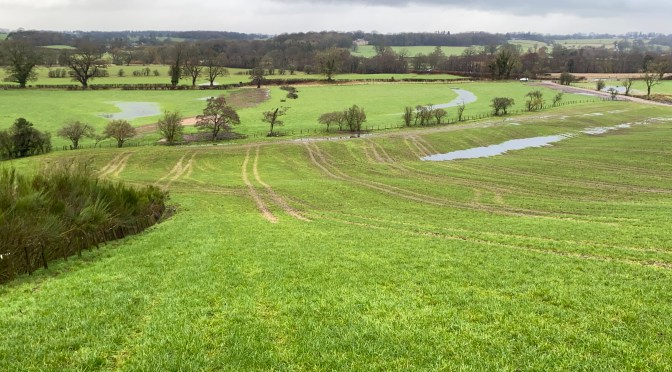
Decide on left left left right today and go out of the drive turn left and left again then at next left road and path are deep under water wife said the roads were wet pass the barking dogs at scrap yard that got out and lunged at us once and turn right find first sign of accident bits of headlamp and bodywork under grass just off the carriageway then some yards on find more carry on and find whole headlight fitting in damaged tree with big scar must have been an accident is it two cars or one what was outcome see mile marker I never really examined before and it just has ten on far side and one on near side nothing else so must be a mile to brampton and ten to longtown shortly after see the grisly remains of some roadkill which I guess is what is left of a young badger just the skin then become aware of a flowing stream down side of the road that is usually dry and accompany it downhill a ways to find a broken pipe by a gate in the field suggesting more deliberate engineering but it just dumps into field which is now flooded with runoff gurgling down to the irthing further on road narrows and I loose the grass curb for my walking and get onto the tarmac but see big tractor tyre marks cutting into verge on longtown bound side and see wet field has open gate with big tractor tyre tracks so guess marks made by autumn muck spreader swinging out left to make right turn into field now close to river and do next left to find road flooded again with water both side in hollows in field and a slow clear curve of old river course on downstream side filled up with overtopping groundwater left again into field and more signs of old river route including what seem to be grassed up riverbank sandbank beside the old river flow up hill now and find a single red sand stone pebble in field on top of grass like it was just dropped there today why where did it come from who dropped it maybe it came off a tractor and see several tracks of small animals come under fence and over field then cross same fence by old style and on to the hilltop badger sett which is clear red soil and earth and not overgrown like the beasts are about at night and see little one plank bench above it like people set it up to look at the view or wait for the badgers in the dusk and see big bank with lots of clear paths most likely not from farmers stock but maybe badger roads squeeze through lined up old gates and see very new dead sheep wool pulled of her hind quarters just eyes and tongue gone into crows belly see no other sheep and farm buildings nearby then follow fence and find rest of sheep flock at field corner by style either getting out of wind or as far as possible from dead sister and they all do that shudder thing like dogs to shake off rain as bits of blue sky appear then on to road with good flow down it into gurgling drain as it is right over the partly fossilised watercourse in the lazy bottom of the shallow valley and links the brampton glacial till ridge with the irthing which only appears after rain then in other places flows overground or through broken culverts and along field boundaries see curious gouges and marks in tarmac of road which must have taken something big to do it that deep and clean then find I can do my second right and then three lefts to find myself back on road of my first right but further up near brampton by the schools so would then do next three lefts like before and be stuck in a perpetual loop like a figure of eight so decide to end it and drop the algorithm then feel a bit weird thinking what would it be like to just keep walking and not ever go home but turn right past sprappies and back to my house by same route I took to start with and get back to dry out and drink tea and recollect the walk and the glory of it’s mundanity
Reflection
The intention for this walk was to start a new year by reconnecting with my local space after a bit of a hiatus. I wanted to concentrate on the act of walking more than the act of going to some destination.
One way of doing that is to use a simple algorithm to decide the path taken. I chose to take a path based on turns left and right. I decided on going LLLR, three left turns and a right turn, for two or three iterations, and see where it took me. This idea still gives some control over outcomes. It was very wet so a wanted to stick to roads and footpaths. It is an idea used in psychogeography for urban walking, as a way to move around a city in a way that brings the walker to places they don’t choose and don’t expect. The idea is to stop attending to the navigation and attend to the senses as you walk. You find all sorts of paths you never would normally notice, and in sticking to your chosen algorithm, feel compelled to take them. In my locale I found all sorts of little unmarked paths, in Cumbria called ‘Lonnings’, using this way of walking.
The day was wet and I timed my walk to miss the showers. I took my phone to photograph anything that took my fancy. I have walked all my local paths and could work out where I would go in my head. I wanted to see what had changed since my last walk this way. There is a saying, I think from the german, that says “If you want to find something new, take a familiar path.” It was in this spirit that I set out to walk.
“If you want to find something new, take a familiar path.”
I walked and photographed whatever took my fancy. On the way I thought about how I could represent the walk when I got back. In my head I had images from old scientific expeditions. My Father in Law got the new Taschen ‘Science Illustration’ for Christmas and some of the images were a great combination of the objective and the aesthetic. See the content of this book here.
Out of my front gate I went left, then two more lefts and then a right. Then I repeated it. After two iterations I worked out that if I did another iteration I would end up in an endless loop. I set off on my third ‘right’ down the same road as my second ‘right’, then broke the pattern and turned home. The intentional act of granting yourself responsibility to relinquish responsibility for navigation is quite strange. It behoves attention. It invokes an oddly relaxing attitude. It lets you be more in the here and now. This way of walking allows you to be present where you are, rather than where you want to be. It is intrinsically meditative.
“This way of walking allows you to be present where you are, rather than where you want to be. It is intrinsically meditative.”
My phone has an app that can use GPS to map my track. On return I wanted to use this as a kind of objective account of the walk, but do some ‘arty’ thing as well. I was not sure what it would be. Maybe some kind of faux expedition illustration like in the Taschen book! I also had in my head a separate idea about a construction of card exploring the relationship between the experience and the words used to describe the experience. I will work on this and show you in another post, but with this in my head, the prosepoemwalk idea with a slide show kind of formed as I woke a day later. This is at the top of this post. It seemed to capture the dyadic experience of the being present, attending on the spot as a singular phenomenon, and the walking as an extended, linear flowing phenomenon. I liked the idea of the words and the images mirroring and complementing each other. I liked the idea of the thing I made being self contained. It shows you what happened without explanation. The LLLR ending up as an iteration was pleasing too, like it revealed a natural mathematical formula, a universal platonic pattern, in my local landscape. Very cool!
On this walk I wanted to simply pass through a space and observe it, and express my experience through some artform. Here I chose words expressed with an aesthetic which I feel reflected the experience. This action will go on to be developed in other artforms posted up here later. I am working on a kind of construction made of card and paper to develop this experience further. Exploring the same experience through different forms is part of the art as research process. Each form reveals a different thing. But I see a generalised sequence which goes we observe, we reflect, we interact and we modify, make and share. In the Taschen Science Illustration book mentioned earlier are the products of observation, the reflection is embodied through image, but the image is used to guide interaction, then modify, make and share ideas, products, processes. This walk was done in this context, to simply observe and record and reflect on the experience of the space I walked through. As 2023 pans out I want to use art making to explore my relationship with my local spaces through observation, then interaction to modification. I want to use this to develop ideas about the outdoors as art and art as research.
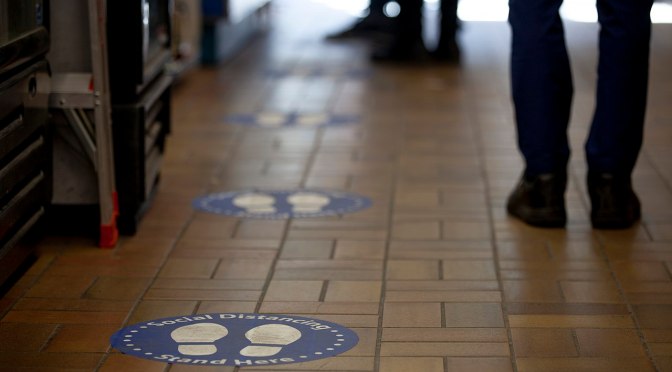
Social distancing was introduced to the UK around March 17, 2020
On March 18, 2020 I did a walking art performance to explore the then new idea and practice of ‘social distancing’.
On reflection, a year on, it is interesting that this simple act gave me insight that evening into the way that ‘social distancing’ would very quickly become normalised in society, as did the sensation of coming to avoid or mistrust the proximity of other people.
It just reinforces for me how performance and art as research may be able pre-empt experience and give insight into experiences to come, but do so through feelings, not through empirical data.
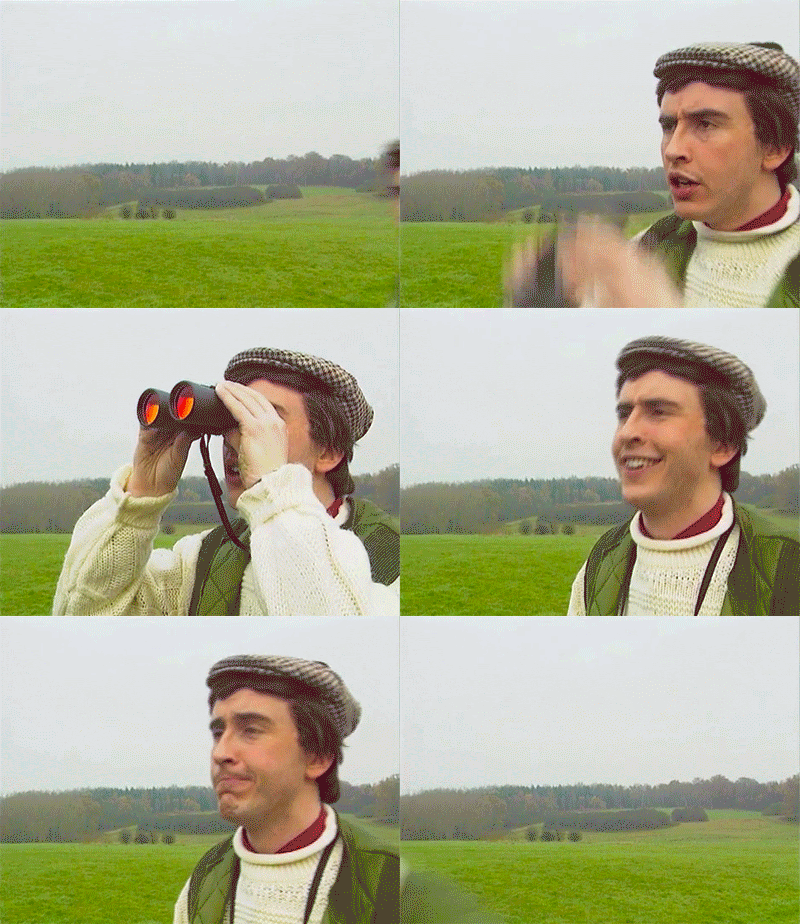
Be careful what you think you see.
This reminds me of Cassandra, who was able to see the future, but was cursed by nobody believing what she said. She was cursed by Apollo for lying when she said she would get jiggy with him. She was cursed for lying, so the curse made her words became an untruth.
Maybe the moral is then is to not lie to yourself about what you may see, but beware that to say what you see may help nobody. And if you do speak, maybe only speak to people who see the world the way you do. Therein is the dilemma of holding your own counsel or speaking only to become stuck in a bubble. Trump and Brexit and QAnon all rolled into one.
Or maybe the moral is simply that words are not accurate representations of feelings, and interpreting feelings is an art not a science.
Below is my account of that performance written somewhere around the end of March 2020.
Performing Distancing March 18, 2020
(Written end of March 2020.)
On the basis that art and performance can be used as research, to explore and express personal experience, I wondered what would happen if I walked through Carlisle town centre maintaining 2m social distancing, but do it as performance, choreographed like a dance or with applied dramaturgical principles, and record it with GPS.
A simple algorithm was devised to work like choreographic directions.
Walk in a straight line until I was within 2m of another person, then turn away until the distance exceeded 2m, then resume the straight line.
Where I met an obstacle turn through 90+ degrees and continue in a straight line.
Limit the walk to the central shopping area.
Walk for 1 hour.
I imagined this visualised as a faux maths formula, because moving an idea between forms, like turning word into image, can sometimes reveal a new aspect to the idea.
Faux math formula
Where P is the path of the walk, as an iteration or repeat of p, which is each leg as a straight line a-b until this is changed by meeting a person (the m is an aboriginal sign for a person, basically, the bottom mark left in the sand where a person was sitting) in which case the path p changes (the triangle) by n degrees.
The basic principle of art as research is to make art, in this case performance, and pay attention to what happens when you do.
On the 18th March I did a social distancing walk for an hour in Carlisle city centre, and payed attention to my thoughts and feelings and other peoples response. I tracked it with GPS tracker.
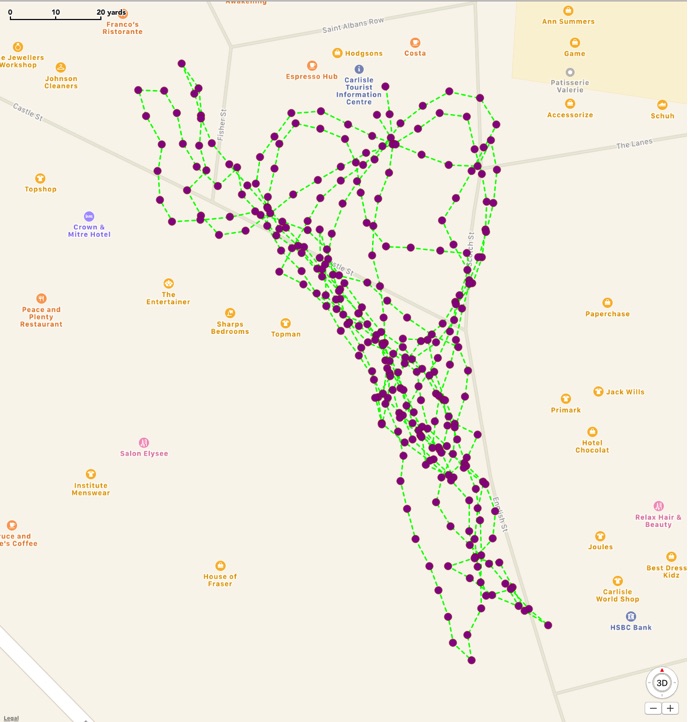
This is the raw GPS visualisation of that walk.
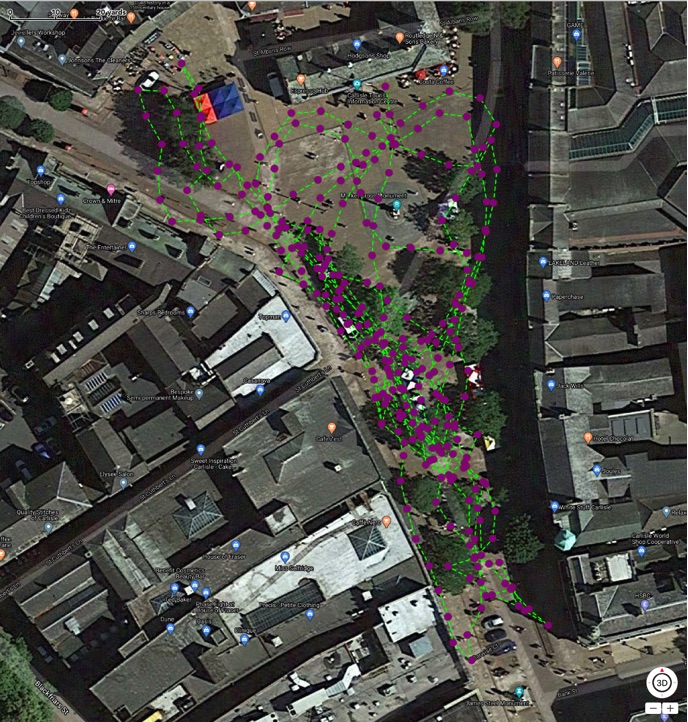
This shows the path I followed as the green line. The dots are simply GPS way points.
This is a satellite view. The image is old and some things were absent in March.
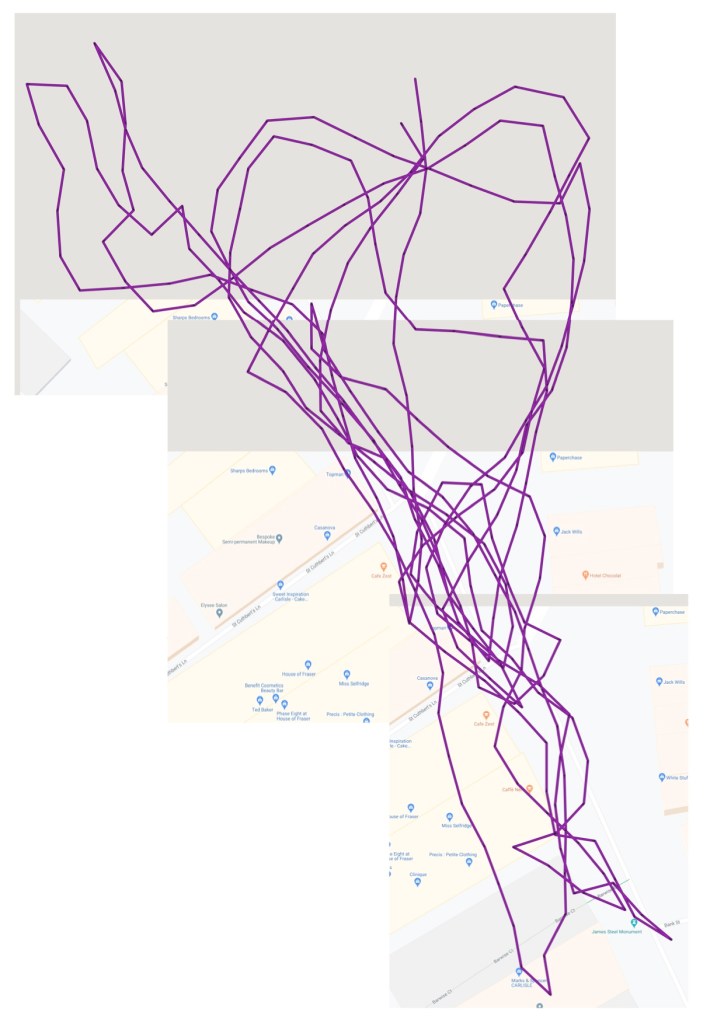
I worked with a GPS track editor and removed as many intermediary waypoints as possible to leave only turns in response to social distancing or turns in response to an obstacle, like a shop front.
I got this, edited down as three images joined together.
Simplified social distancing walk.
What the walk/performance did as research, was give me insight into social distancing, then a very new phenomenon.
Over the hours walk, I started to become anxious when I got close to people. As a person approached me and I anticipated the need to distance, I felt a rise in my level of anxiety. I felt isolated and distanced. I felt sad.
I was also nervous about wandering around in circles for an hour on CCTV. In the end nobody even batted an eyelid. I was utterly uninterrupted and fully ignored.T his added to a sense of aloneness.
Part of the creative process is the period of incubation, in which the creator moves away from the art making and does some other thing. On returning to the theme or the artform, after incubation, new insights emerge. The form created is seen in a new light. I noted this sadness and anxiety at the time, but on writing this, months later, another aspect of my experience of performance/art as research came into play.
I reflect now that this experience gave me insight into how social distancing would feel. Now, months later people are not rushing back to contact, many people appear reluctant to go back to the shops and the pubs and the office. This week, mid-June, the MP is now imploring people to go back to the office and the shops and the pubs. The anxiety prevails.
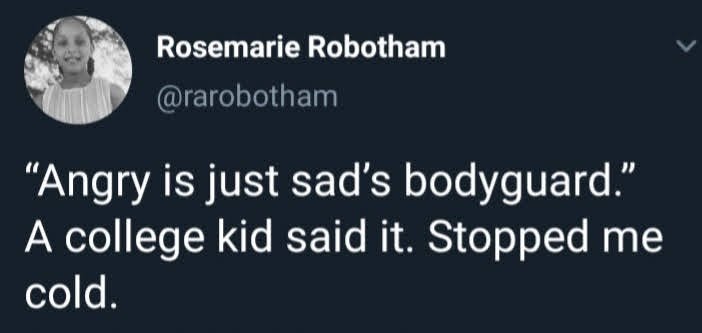
Also there is growing anger in the UK and clear riotous anger in the USA in some quarters of society. Today I found the following meme.
My experience of children in care is that many are angry and this is just a product of sadness and anxiety. Whilst different, both are connected to loss. Anxiety may be an anticipation of discomfort and danger, but also the anticipation of the loss of safety, the familiar, and the predictable. Our stress response is fight, flight or freeze. We have been unable to flee in lockdown, which leaves fight and freeze, anger and sadness.
On March 18, the day of my social distancing walk, the experience of social distancing was new. This art based research could not be seen as producing a clear empirical evidence based outcome, but I did experience feelings in myself which could have anticipated feelings shared by other people once the lockdown deepened in its impact. I anticipated sadness and could, in retrospect, have anticipated anger.
This work is highly influenced by the arts therapies and dramatherapy and by experiential learning. In the arts therapies, whilst art is made, the role of the artform as an end product, for sale, or for viewing by an audience, is not significant. What is significant is the experience of art making on the part of the art maker. As such it is a form of experiential learning in which direct experience of art forms the basis of learning or research in which the art making is both the mode of research and the outcome of the research. It is part research, part performance, part personal therapy, part play, part experiential learning but is never fully any of these things.
Undertaken with the intention to make this as art, invites the creative process, and as such it is unique, not in any grand way, but in a way that invokes creativity as a simple and easily available act accessible to anybody. The act that makes it art in intentionality and this intentionality can be learned.
My hope is to use this website and my own art making to show ways to learn this. We cannot all be artists but we can all make art. What this experiment revealed was simple and oddly mundane, but also complex and profound. I want to show how art making can help you explore and express your experience of the world.
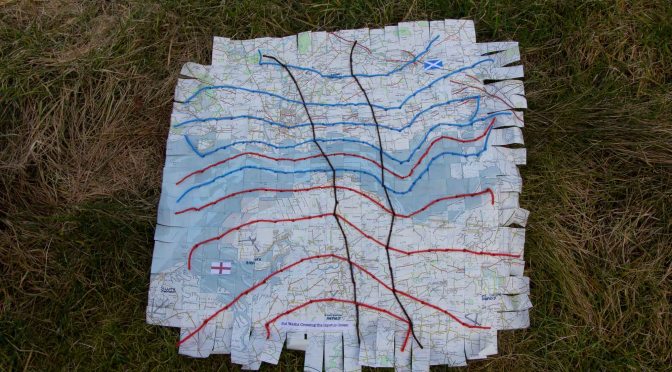
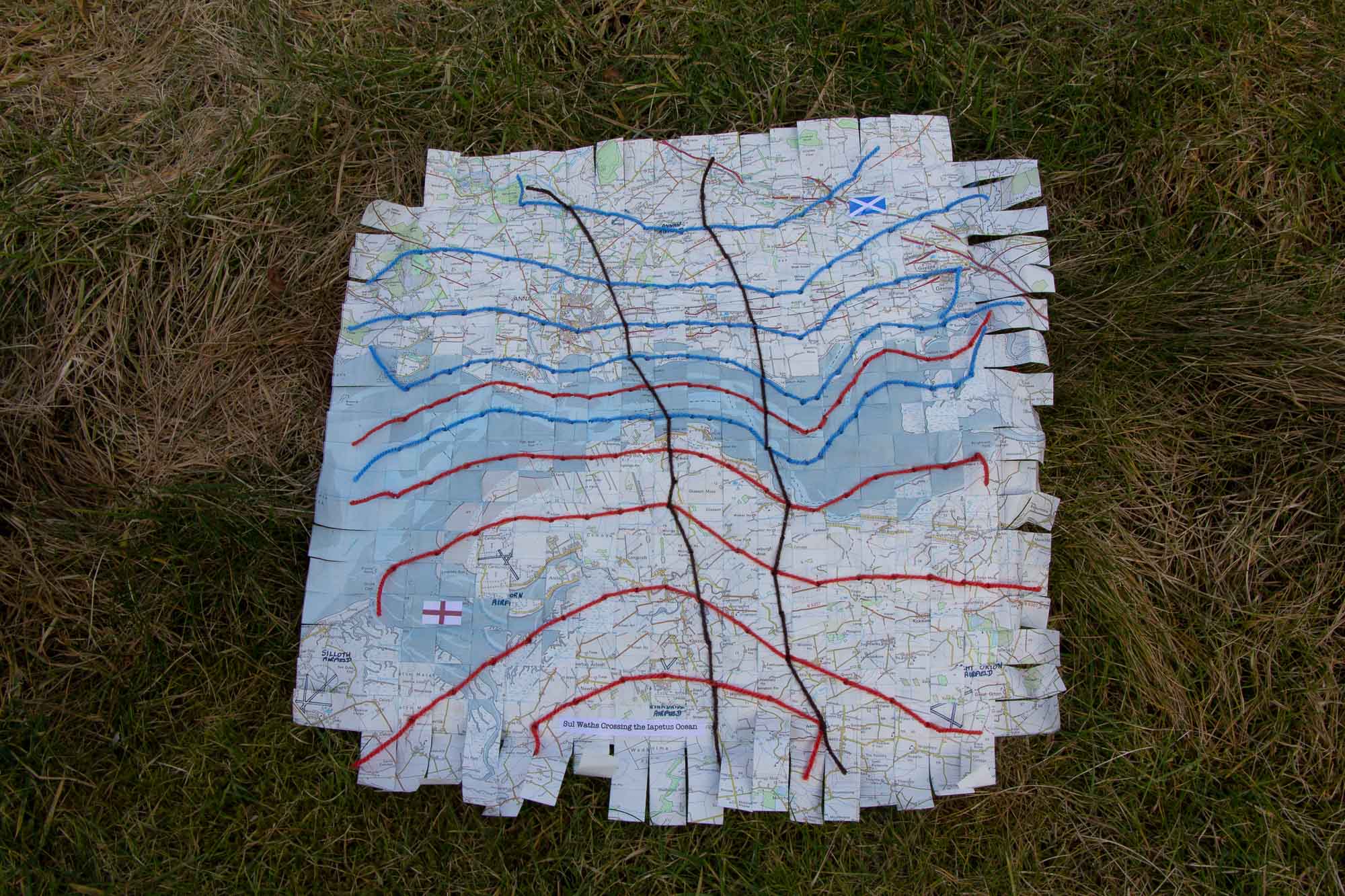
Following on from my exploration of the Solway I wondered if I could make an object that captured the way it was a real objective place, but was open to a number of subjective impressions.
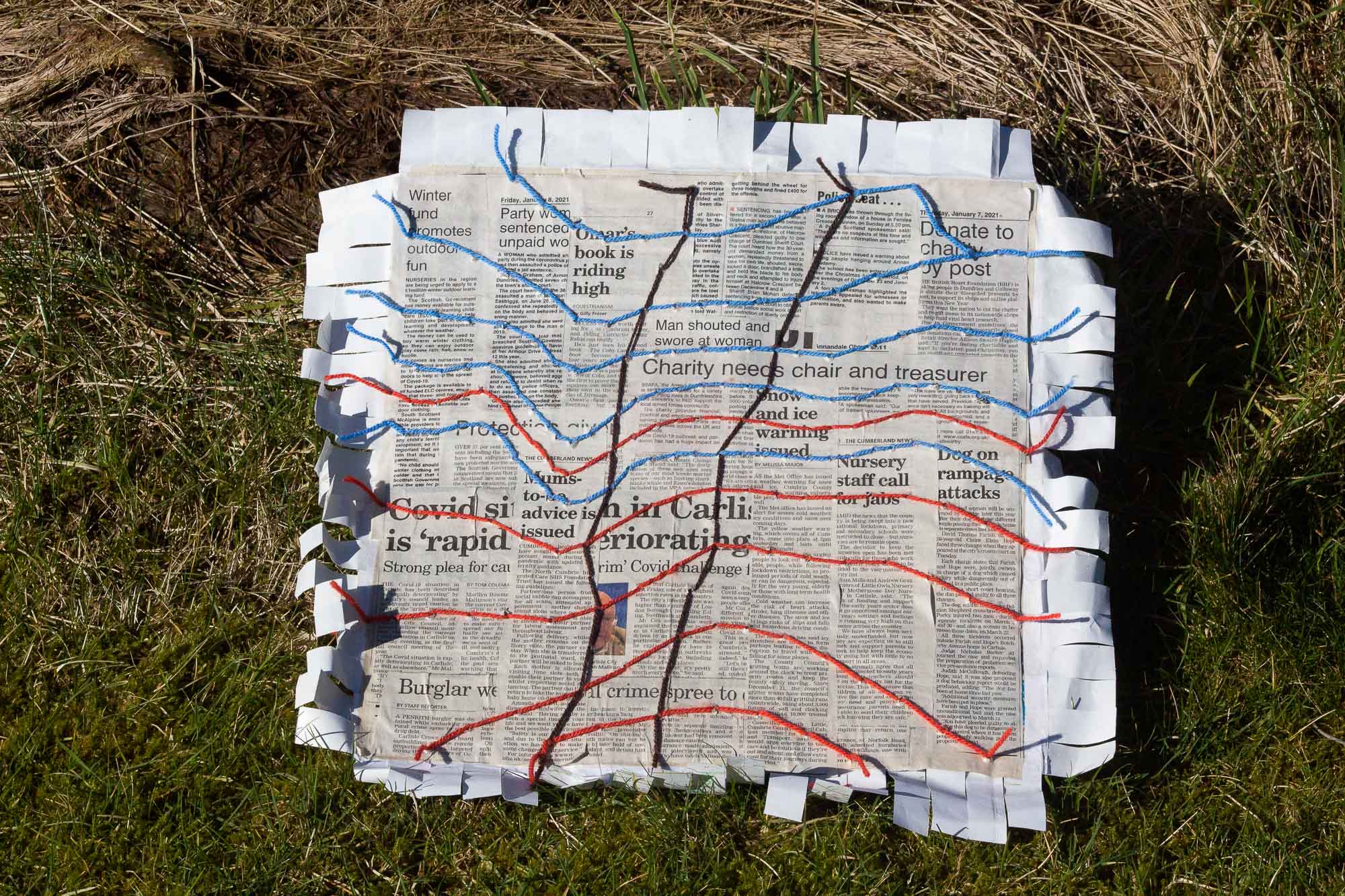
For a while I have experimented with weaving Ordnance Survey maps, with the grid squares becoming the warp and the weft of the created object. In the past it has been two different maps, but for this I wanted to experiment with two maps of the same place, but shift them so the Solway became kind of extended and ambiguous. Like it is. So I made the object above.
It will never win a Turner Prize but my interest is not in creating ‘Fine Art’, but in using art-making to explore ideas and express experience. What I wanted to express was…
Blurring the boundary between England and Scotland.
Showing how the Waths crossed this boundary.
Make something that looked recognisable from a distance but changed before your eyes as you approached it.
Make you kind of wonder what it was, a picture, a map, some weaving or needlepoint.
Shifting your sense of time. The Iapetus Ocean was the water between the two tectonic plates that mashed together to make the Borders. The Solway is all that is left. I liked it as an archaeological object.
To also have bits of it that were from the time it was made. I liked it as a contemporaneous object as well.
To work with text and image and object and colour as things to stand in for something else.
Sometime I would like to return to making this as a more aesthetically sophisticated object. But as a starting point, it is a good place to start.
Two circular walks around a newly erected fence and the old line between cut and uncut grass.
Enclosurenoun
Old French - enclos - closed in
Similar - Paddock, fold, pen, compound, stockade, ring, yard, pound.
An area surrounded by a barrier.
A section of a racecourse for a specified activity or group of people.
The state of being enclosed, especially in a religious community.
The process or policy of fencing in wasteland or common land so as to make it private property, as pursued in much of Britain in the 18th and early 19th centuries.
A document or object placed in an envelope together with a letter.
Boundarynoun
Old French - bonde - a visible mark indicating a dividing line.
Similar - Border, frontier, borderline, partition, dividing line.
A limit of something abstract, especially a subject or sphere of activity.
In Cricket, a hit crossing the limits of the field, scoring four or six runs.
An entity demarcated from its surroundings.
Guidelines or rules or limits that a person creates to identify safe ways for other people to behave towards them.
Circumnavigateverb
Latin - circumnavigare - to sail around
Similar - Bypass, skirt, compass, circumvent, move around.
To sail or travel all the way around (something, especially the world).
Go around or avoid (an obstacle).
Avoid dealing with (something difficult or unpleasant).
The complete navigation around an entire island, continent, or astronomical body (eg. a planet or moon).
My visit to the Solway was prompted by a need for a large space without physical barriers to explore what would happen if I walked a drawing of an model of experiential learning through the arts. In doing so my idea about my model changed.
The original model
Models are slippery things. Their appeal is that they appear to give a fixed image of a thing, but in practice whilst they serve as a very useful signpost about which way to go when you set off, the thing you find when you get there is never fixed. So the walk was undertaken as an experiment ‘to explore what would happen…’
What the model predicted was that a number of factors would contribute to the art making. In this case my thoughts were that source material would be Richard Long and the walking and land artists. My personal arts practice or art made included using a GPS and walking to make a mark on the landscape and experience of film making as a means of exploration, reflection and expression of experience. I drew on ongoing research and theory about the outdoors as a liminal space and art making as adventure, as a journey of uncertain outcome, and Shaun McNiff’s ideas about witnessing in the arts therapies1.
The model was correct in that my path would lead in to and out of the art making on the day and on to more art making, research, source materials and theory, and that the generic coloured blobs would be specific to the art making experience. My initial thinking after the event went to ideas about performance and the epistemic object and further trips to photograph and film, reporting this through blog posts.
At the centre of this, an act of art making and poiesis occurs. Something comes into existence that did not exist before and it is called art. It is art by convention, because all this could describe the making of a cup of tea. To this conundrum ’Why is this art?’ one asks the question asked by artist John Baldessari, “Why is this not art.” It is art because it was my intention to make art and my act was guided by research, reference to existent artform and artists, theories of art and my experience of art I made before.
But there was something incomplete about the central concentric circle structure. I was interested in the model showing how each experience of art making occured within a loop of experience, like in Kolb’s learning cycle.
But like the Kolb model is an ideal form which would be expressed differently depending on the setting, the strict concentric form may vary depending on the setting. My experience of art-making was, however, that in making art I stepped away from the day to day life experience and went to a different place. This could state is sometimes known as a ‘Flow’ state from work by Mihály Csíkszentmihályi. You get in the zone of concentration and attention, of doing and the senses. But for art-making as experiential learning or personal research or art therapy, you enter a state that is similar to a meditative state, like flow with awareness. You are focussed on making art but also on what it is that you have made and what happens when you make it.
So in the model, as well as cycling through an iterative learning process, there was a linear path away from the world, into a creative state where something happens in partnership with your artform, then back to the world.
Reflecting on how the model changed
On return home from the Solway and recollecting the emergence of performance I went back to my Dramatherapy training. In a dramatherapy session you work with a basic three part structure. ‘It begins with a physical warm-up leading to the Main Event, the place where the real action is. It concludes with the ‘grounding’, returning people from the ‘Land of Imagination’ to their own everyday selves.2’
During the walk recreating the drawing, the shift from walking to dancing, from recreating the drawing to improvising and performance emerged unbidden. One could say this idea came out of my imagination or my unconscious, or it was the product of a state of flow, or having danced in the past, I simply remembered something from my past related to what I was doing in the present.
So there are two things here. One is a linear journey into a place with some degree of separation from the everyday world, into ‘flow’ or ‘Land of Imagination’, followed by a return. This is a linear journey in an iterative looping cycle of learning. The other is the experience of being in ‘flow’ or the ‘Land of Imagination’. This is an experience of art making as somewhat separated from ones day to day life.
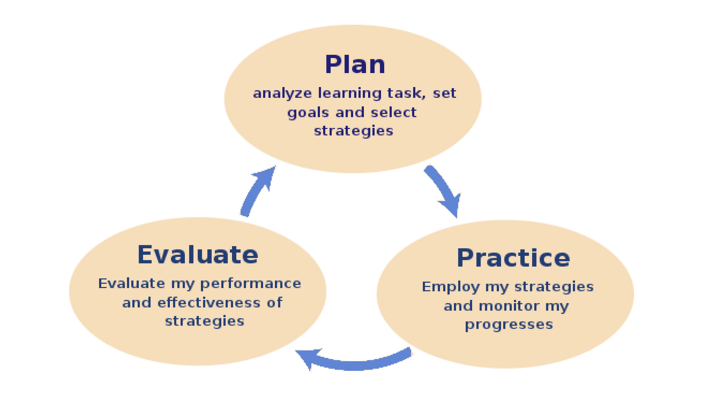
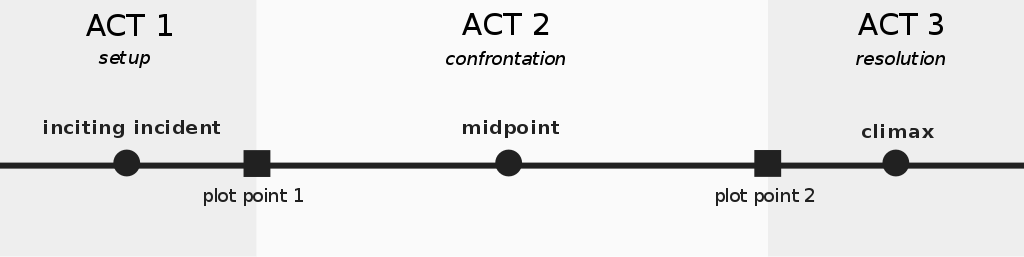
Something like this three-stage process occurs in many settings. In story and in film and theatre there is a thing called the ‘Three Act Structure.’ On one hand, this is as simple as a beginning a middle and an end or it is sometimes understood as set-up, confrontation and resolution. Many interpretations exist and there are examples to be found of its use in say cinema, but it is not without some contention. Like one article says ‘The true three-act structure isn’t a formula, it keeps your beginning separate from your middle and your middle separate from your end. That’s it.’
But the ‘beginning, middle and end’ could be seen as a universal or archetypal structure. For example at Outward Bound, in experiential learning, you worked with a ‘training, main and final expedition’. Your training expedition was where you taught skills, the main expedition was where you had the conflict as you got the people to move from being a group to being a team. Final was the unaccompanied independent journey.
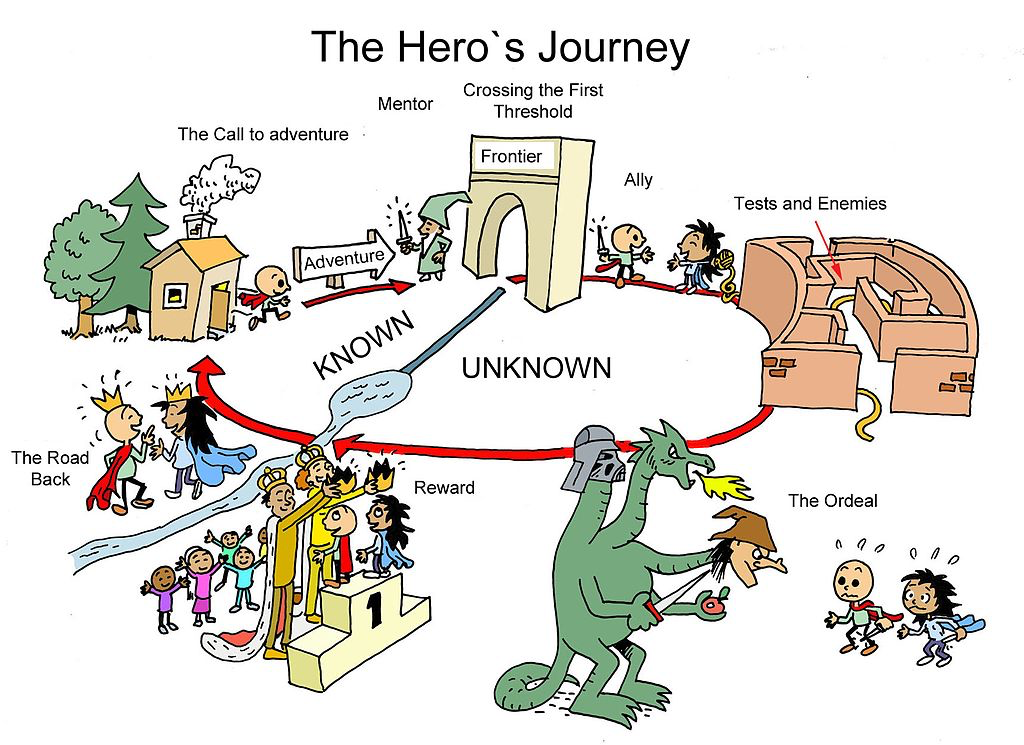
In care, we worked with a conflict model and resolution tool called ‘ABC Charts’ meaning A – antecedent, B – behaviour, and C – consequences. Joseph Campbell’s Hero’s Journey has a specific expression and detail but is also a three-stage form, the call to adventure, the test and the return.
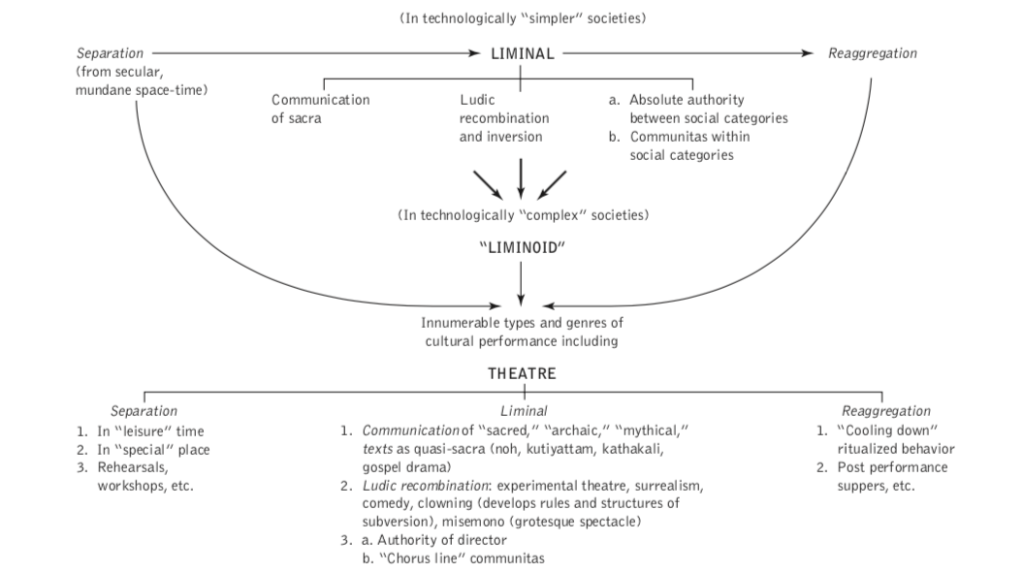
But the simple, warm up, main event and grounding of dramatherapy mentioned above can be also seen in a form described by Victor Turner and Arnold van Gennep as Rites of Passage.
The above diagram is from Victor Turner a British anthropologist who theorised the above from studies of non-western settings at the top, and western settings at the bottom. This is a three stage journey of return that is linear and cyclical and has a central liminal or liminoid space somewhat separated from everyday life called The Land of Imagination in the dramatherapy model.
Art as liminal space
My proposal is that art making and experiential learning could be understood as having some some elements of the above structure in their practice. I don’t think it is coincidental that after a while on the Solway Walk, I spontaneously rediscovered that I could do the walk as performance. This could be seen as me, albeit briefly, entering a mild ludic state.
There is a lot to this seemingly simple experience of walking in circles on a beach like an idiot. Not least the idiocy. I was being playful throughout. I was in the land of the Trickster or the Court Jester, at once playful and challenging, the one who can perform recombination and inversion.
This is also adventure. The journey between departure and arrival. The journey of uncertain outcome with misadventure available. The three part expedition cycle of Outward Bound. On a slave ship, the middle passage. The refugee in the hands of the trafficker. It is not a thing of the past.
To me there is also something in this of being in the Solway, a liminal space if ever I saw one, between two countries, high and low water, land and sea. To me this is also a state of walking. In walking you are between places, outdoors, in a state of flow, and returned to a mode of existence that predates all of the modern world.
So after a few weeks of reflection my research led me a realisation. The experience was ‘like’ a lot of things, from experiential learning, theatre, anthropology, adventure sports, performance art, and conflict resolution, to Outward Bound and Joseph Campbell’s Hero’s Journey.
This could also be applied to many arts based contexts and the model has ART FORM as a liminal or liminoid experience at it’s heart, the same as dramatherapy. But the artform that fits this experience best if what is known as Walking Art.
My exploration of my Solway walk has reached a convenient place to move on and in my next set of posts I want to look at Walking Art with a particular focus on it’s scope for promoting health and wellbeing.
Mindfulness and the Arts Therapies – Theory and Practice – Laury Rappaport ed. ↩︎
Discovering the Self through Drama and Movement – The Sesame Approach. Jenny Pearson ed. ↩︎
Performance Studies – An Introduction. By Richard Schechner. Routledge. ↩︎
After doing my Solway Walk I went back to some academic and practice material, reconnecting with Augusto Boal on performance as a dichotomous, and thus creative, process. This connected with my experience of art making as performance as a journey of uncertain outcome. But some of my art making ended up with art objects. However the Boal stuff reminded me of other materials I had read.
In a book called ‘Using Art as Research in Learning an Teaching; Multidisciplinary Approaches Across the Arts’ by Ross W. Prior, there is a chapter that reiterated some of what Boal had to say about the ambiguity of the art making process. In Chapter 8 ‘The ‘Epistemic Object’ in the Creative Process of Doctoral Inquiry’, Carole Gray, Julian Malins and Maxine Bristow the authors, develop ideas about the art object which reinforces Boal’s ideas about aesthetic space but in relation to visual art and the arts object as part of an experiential process. It also talk about ways of viewing art that moves us away from the fine art exhibition, and towards ways of showing art product and process much more conducive to experiential learning. It is about art as research at postgrad level but we can think of art as experiential learning as a form of research or as a source of knowledge at many levels.
The Epistemic Object
Whilst Augusto Boal’s idea of performance containing the aesthetic space as a dichotomous space in which a person acts, witnesses and learns through their own actions, thoughts and feelings, the act of performance is highly experiential and produces no object in the way visual art does.
In the article, the epistemic object is understood as an object which, through engagement and experience, acts as a source of knowledge. In this sense, the object could be a painting or an architectural model or the Large Hadron Collider or a diagram of a particle accelerator or the Sistine Chapel. The epistemic object or epistemic art contains ambiguity or uncertainty and thus can be a vehicle for inquiry and thus learning. So whilst ideas about what we can learn from art is not without contention, as a perspective on art as experiential learning the idea may be useful.
It struck me that when I worked at Outward Bound two classic experiential learning, or ‘problem-solving’ activities that could be understood as epistemic objects were ‘The Wall’ and ‘Barrels and Planks’. Both used creative experiential activities as a source of knowledge. Both could also be understood as performance in the way Boal suggested.
Aberdovey Outward Bound, my old stomping ground.
Viewing and more importantly doing art, making art objects could, I suggest, be understood as epistemic objects. What interests me is the way this idea, adopted and hybridised by art-based researchers could bring together ways of thinking about and engaging in experiential learning that could encompass science, the arts, outdoor adventure and the arts therapies.
In the article, a number of ideas are presented about the epistemic object being ambiguous or dichotomous and open to interpretation and as such, through interaction, open to creative development or re-viewing. With the article, the devil is in the detail. To paraphrase or quote parts of the article would lose a lot of the explanation. So a copy of the article is available for download on my blog under this post or can be downloaded here.
Hans-Jörg Rheinberger’s term ‘epistemic things’ is used as a starting point. Rheinberger is quoted thus. ‘An experiment […] is an exploratory movement, a game in which one plays with possible positions, an open arrangement’. The article continues ‘For an epistemic object to have the potential to develop scientific research, it must embody a degree of uncertainty to be useful’. He asserts that epistemic things ‘are by nature made to be surpassed’’
In the article, the things that pass as epistemic objects include Crick and Watson’s model of DNA, made with lab equipment. Things used by architects to design buildings including sketches, drawings, plans, charts; photographs; project management tools – timelines, schedules, tables; virtual prototypes, scale models, and even machines and parts are epistemic objects. A design consultancy process in cited, where individual employees select ‘core value’ cards – a given set of random images – to visually express particular values that they each associate with their company.
Finally there is a wonderful description of how Antonio Gaudi designed the Crypt of the Church of Colonia Güell. ‘Gaudi’s stereostatic model.. brought together a set of inquiring materials – a wooden board, cords, cloth, pellets, photographs. From each catenaric arch (formed by hanging the cords from the board) small sacks of pellets were suspended. The structure was photographed. The final shape of the church’s future architecture was revealed by turning one of the photographs upside-down– indeed a productive thing.’ Read about it here.
To me, an ‘experiment’ as described above by Rheinberger, could be an expedition, a painting, or canoe trip, a walk on a beach, a drawing of an idea of experiential learning, or making a movie about a walk on a beach, or a map. All, like a petri dish or a painting, can be an epistemic object.
These are all things that could be understood as ‘thinking by doing’, ‘embodied cognition’ or ‘material thinking’. These could be things used by artists, physicists, architects, musicians, geologists, and sports coaches. The ‘epistemological object’ differs from the ‘model’ in how it is used and by virtue of it being incomplete, ambiguous, dichotomous, open or emergent. The interaction of the maker of the object with the object is what makes it a source of knowledge or creativity. The model tells us what we already know.
The article describes the role of epistemic objects ‘..is not to represent what is already known, but on the contrary, to come to terms with what is not yet known. The epistemic object is defined by what it is not (or not yet) as much by what it is’, and says artworks are ‘‘generators of that which we do not yet know’ inviting us to think and thereby are epistemic agents’.
My proposal throughout is that if we understand art making as experiential learning then the outcomes of learning are determined by the interaction of a person doing something in which, as Rheinberger notes above, they think ‘a degree of uncertainty to be useful’. This is endemic to art making, to the art object, to the epistemic object. So as a source of knowledge, a mode of discourse and exploration of experience, art making, in all it’s myriad and contested forms treats, like with like. It’s uncertainty matches the uncertainty of experience.
Exposition
But in making art, how do we show what we have learned, in and of experience, if it is uncertain. The article goes on to link the epistemic object to the act of exposition. Exposition can be understood as being characterised by exposure, a showing of all and an explanation.
The word exposition is now a noun, the name of a thing. Etymologically it is from exponere which is a verb, a describer of a doing. In the context of art as experiential learning, as part of a research discourse, the writers of the article think of exposition as more of an exposure of doing, thinking, of materials and processes.
The article goes further and suggests it is ‘…the sharing of thinking processes and the revealing of methodology; and perhaps most importantly it invites participation in order to enrich and expand understandings from the inquiry,’ and ‘There is a didactic element to the notion of exposition, as far as it teaches how, and as what something may be seen without determining outcomes.’
Visual examples can be found in the article of recent PhD art as research doctoral expositions. Here.
In showing art in the fine art context, the exhibition could have the quality of a museum, with lots of explanations, or it could seek to rely on the capacity of the artworks to speak for themselves. The explanatory method can tend to give a fixed account of the art made. The art speaks for itself is fine, if you speak art in the same way as the artist. Grayson Perry suggested in the BBC Reith lectures that all galleries should have a big sign at the entrance that says ‘YOU DON’T HAVE TO LIKE IT ALL’. He did and exhibition of work by renowned artists and rank amateurs. He said he liked the idea that when people first walked in nobody knew who made what. They just found stuff they liked.
A big part of what I want to get as is art not ART. The making art rather than the viewing of ‘Fine Art’. Art as doing not viewing. We cannot all be artists but we can all make art. We can make art as a way to learn something about your experience, of art making, of what your art is about.
When I was at school I got a grade ‘A’ in Art and Physics. It took me 50 years to get back to the art thing. But the thought of me showing my art in an exhibition is horrific. At school you had to be wary of being good at art ‘cos if your art was good it got put on the wall. In my school that meant you had sold out. ‘Teachers Pet!’.
But my exposition is here, in my showing and sharing. I want to show you what I made and my thinking about my making. The trick that I am working on is to find a balance between being too rigidly didactic and teacherish and too vaguely arty and obscure. My goal is to show so that you may find some thing you like that resonates for yourself. But like Grayson Perry says, you don’t have to like it all. In this sharing, I am sharing my finding my own way.
With a bit of time we can work out for ourselves what is going on.
In the article there is a quote from an arts researcher, Schwab who says ‘One may even say that there is something inherently gentle to exposition considered as introduction, a relief, perhaps, from the obligation of being a ‘work of art’, in the serious sense of the word.’
Art as experiential learning begs you to take notice of the art you make and what happens when you make it. Exposition could be seen as an antidote to feeling compelled to make a ‘work of art’, and show it like a sellout, and instead make some art and tell us what you did and what it was like, what you learned and then share with us what you made. We can work out what it means for ourselves.





 Moving Space