Anyone around Carlisle and the borders UK want to meet and drum…
Drop me a line, I have drums for group drumming…
Let’s alter states…
“If something is boring after two minutes, try it for four. If still boring, then eight. Then sixteen. Then thirty-two. Eventually one discovers that it is not boring at all.”
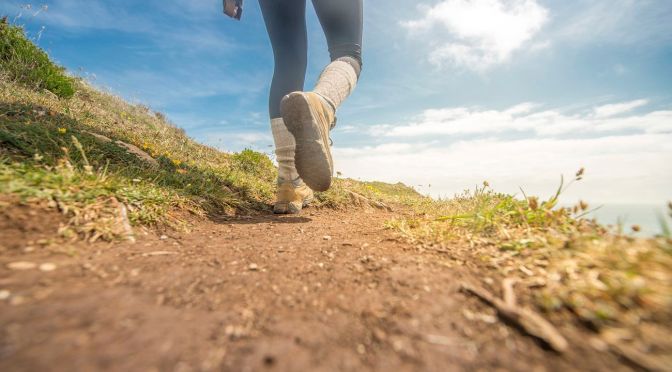
This post comes three weeks after a walk on New Year’s Day 2023. On the walk, I wanted to use a walking algorithm of turning LLLR at path intersections to reconnect with my local walking range after a hiatus. The walking algorithm helps me attend to the experience rather than concentrating on navigation. After the walk, I wanted to make some thing that said something about the experience. I made a string of words describing the experience of the walk along with a slideshow of images and put up a post.
I wanted to use the words in a way that showed the experience of the walk, the form showing just one thing after another to indicate the experience of walking a linear path, and the content indicating what I saw and thought. A long string of unpunctuated lowercase words describing the thinking and sensing seemed to do this. It was not prose nor was it a poem, it was an impression of the walk in words. I called it LLLR prosepoemwalk. here
On the page, the string of words became a word block, a physical form, something I have worked with before. The words represented a series of encounters with the place I walked through. Each one occurred as the here-and-now experience, but which added up to a sense of time passing as I physically passed through the outdoor space.
One of the things that interests me is the way showing or describing doing, the words and pictures of the experience, never fully express the fullness or completeness or singularity of the experience. This is specially the case if you are intentionally attending in a state of flow.
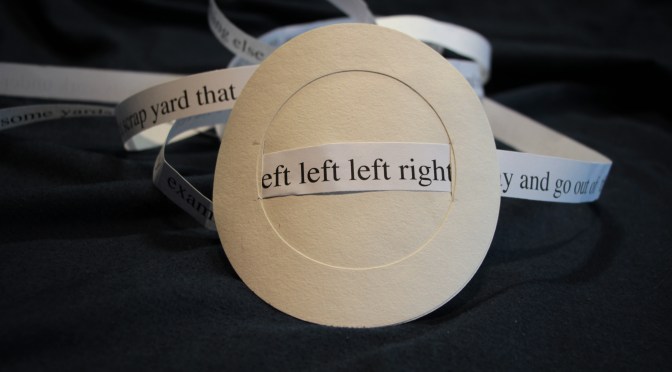
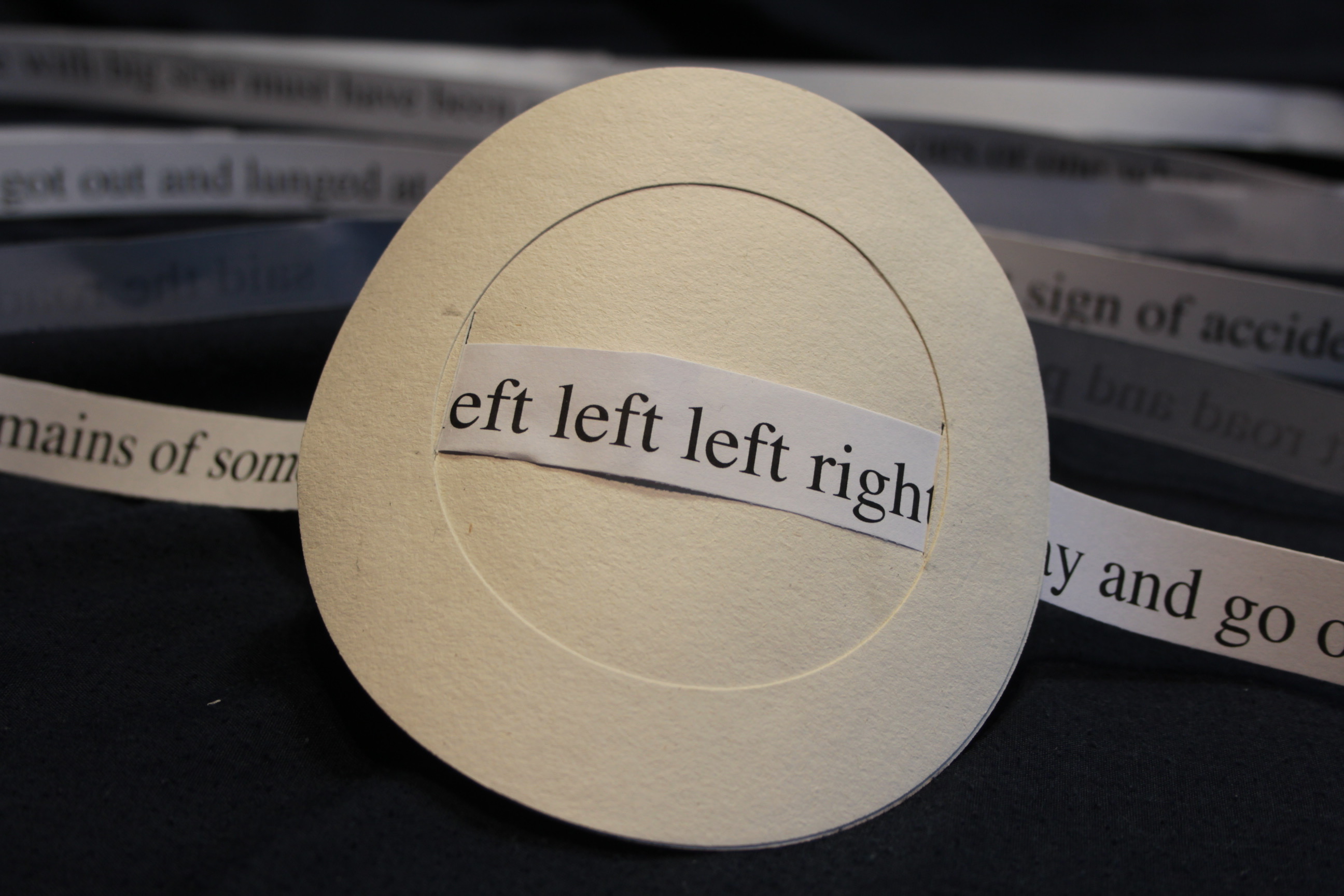
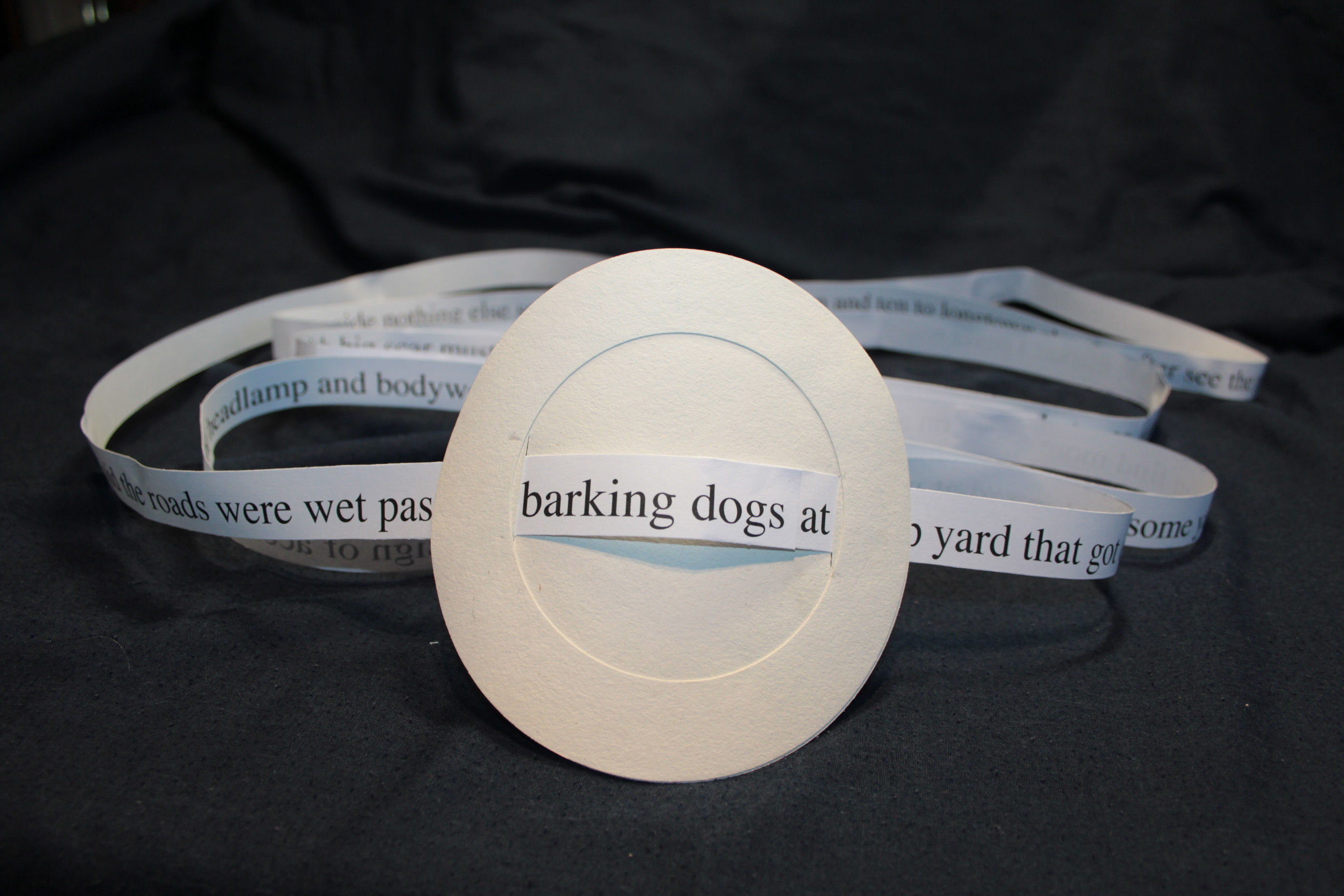
This post has been worked on for three weeks. I made the object shown above and below to try and express the experience frustration of describing doing, and translating experience into words. What writing the post revealed surprised me. I want to bring what it revealed into the post, but first I want to describe the wandering path I took to get to what it showed me.
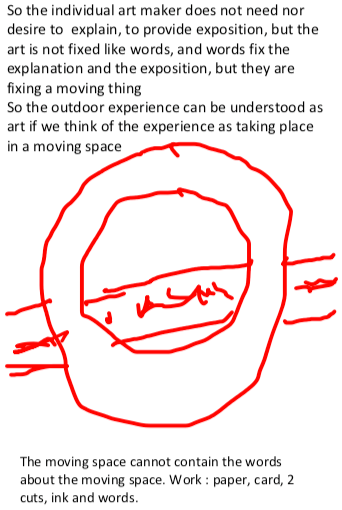
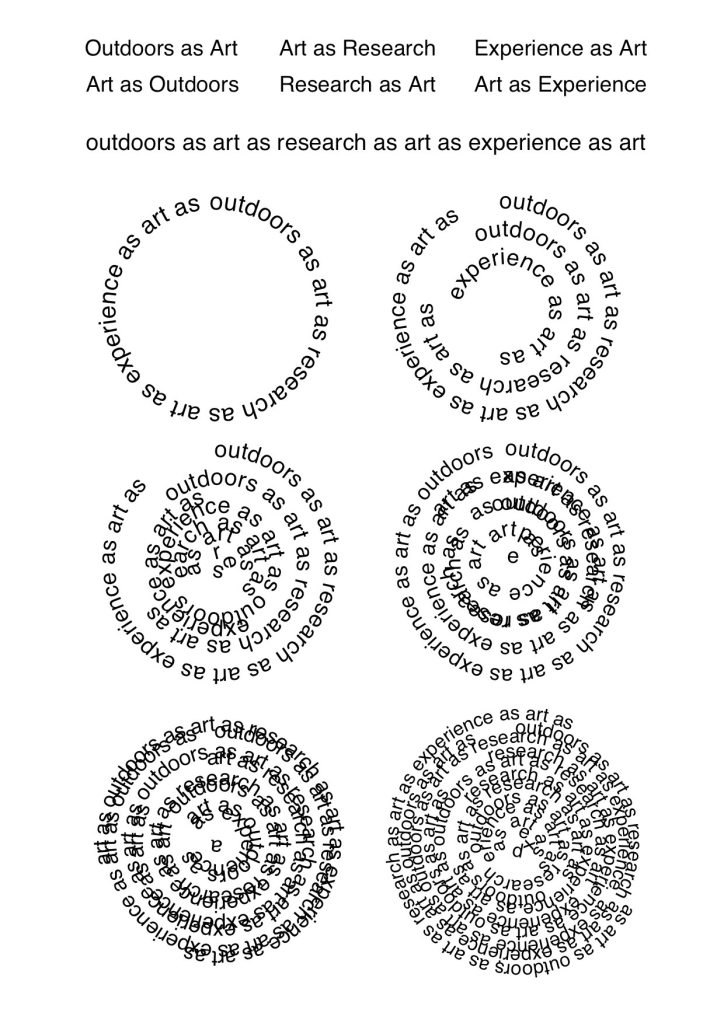
Looking at the words, in unpunctuated lowercase text as a block, I was interested in what would happen if I made the words take on a linear form, rather than the block imposed by the page. A memory of ticker tape experiments in physics came to mind. Then I saw a big string of words describing doing extending way beyond a tight space of a small circle, showing only 2–3 words. I wanted to make this image or idea as a material object, to express the difficulties in using words for describing doing. This was my original sketch, in MS OneNote. I saw the inner circle as my experience within the bigger circle, the space I was walking in. I saw the words as just a little bit of the experience, not really fully describing my experience. They went on and on at length about some shorter succinct experiences. The experience, like the artform, could speak for itself simply without verbosity and verbiage.
In my dramatherapy training and practice and my reading about art as research, the idea of art as a form of material thinking was developed and was very compelling. Can we think, through the experience of making material objects? Can the materiality of art making be research without needing words? I work on this a lot. Some arts practitioners have explored ideas and experiences of material thinking.
Some Ideas about Material Thinking
Two interesting arts practitioners who have worked with theories and practices about material thinking, the capacity for arts materials and practices to act as a way of thinking through doing are Barbara Bolt and Augusto Boal. Each uses different words to describe the experience, but the core phenomena is similar.
In a great piece of writing by Bolt here she says ‘Theorising out of practice, I would argue, involves a very different way of thinking than applying theory to practice. It offers a very specific way of understanding the world, one that is grounded in (to borrow Paul Carter’s term) “material thinking” rather than merely conceptual thinking. Material thinking offers us a way of considering the relations that take place within the very process or tissue of making. In this conception the materials are not just passive objects to be used instrumentally by the artist, but rather the materials and processes of production have their own intelligence that come into play in interaction with the artist’s creative intelligence.’
In ‘Rainbow of Desires’ Boal writes in a different way about ‘Concretisation’ in the experience of artistic or therapeutic performance. He says ‘Concretisation is the putting of ideas or thoughts into concrete form, concretisation being the act of materialisation of these desires’. He uses the word desire as an amalgam of idea and intention. He goes on to say ‘The desire becomes a thing. The verb becomes a palpable noun.’ Then of the artist/performer through the experience of doing, of acting, of action he goes on to say ‘In living the scene, she is trying to concretise a desire, in reliving it, she is reifying it. Her desire… transforms itself into an object which is observable, by herself and others. The desire, having become a thing, can be better be studied, analysed, and (who knows) transformed… Not only what one wants to reify is reified, but sometimes also things that are there but hidden.’ (pg 24 Rainbow of Desires).
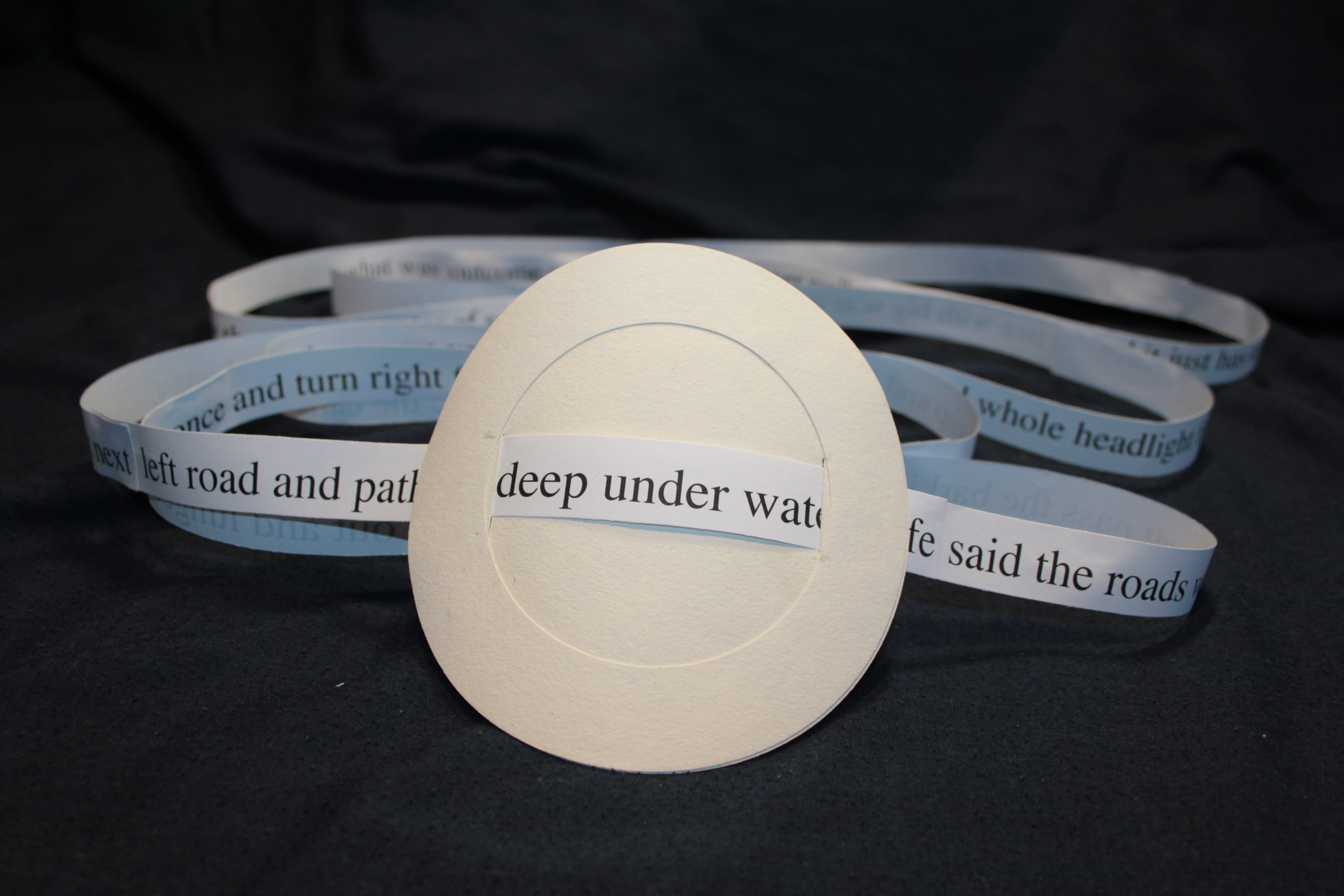
Both Bolt and Boal advocate for material thinking. The materiality can be through a physical object, or through performance, an engagement with space. In both cases we make some thing come into existence that previously did not exist. This was called poiesis by the greeks and included art objects and theatre. My proposal is that this is experiential at it’s core and making art as an object or as a performance is a form of experiential learning. We make art and attend to what we make and what happens when we make it. So I did this and am telling you about what happened now. This is what I made as an act of material thinking. The inner circle is the experience. The words, taken from my writing about the experience, take up much more space than the experience.
So what does this object have to say?
The Object – A Subjective Reflection
I could find no name for it at the time and still cannot. That it has no name interests me seeing as it is mostly words. The original image I had in my head was of a circular object made of stiff paper with cuts to allow a tape with words on it to pass through it, like a line of text. This was my idea. My intention was to make it and see what it had to say. My preparation was to fiddle about making prototypes and find a form that worked for me. Then I made it.
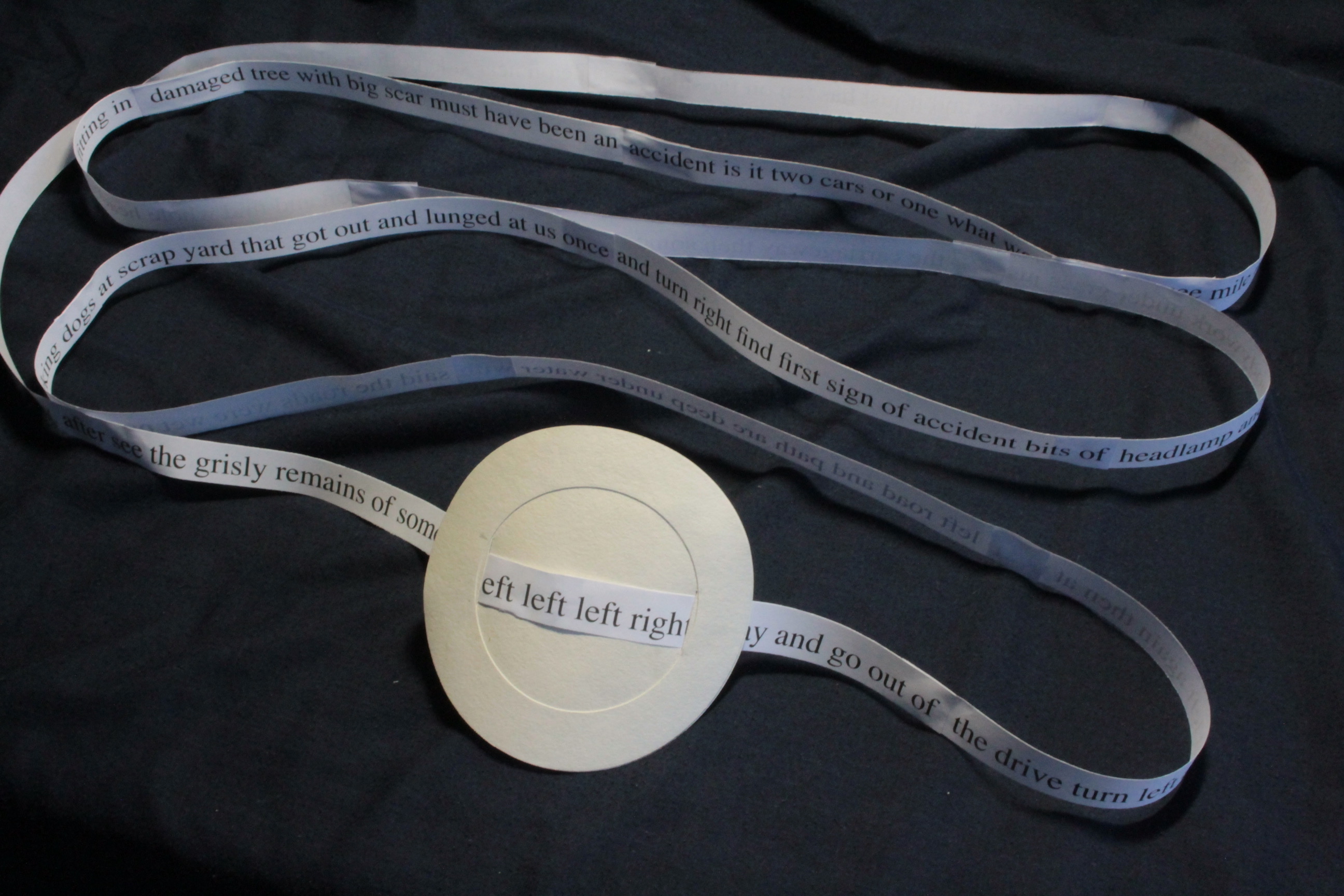
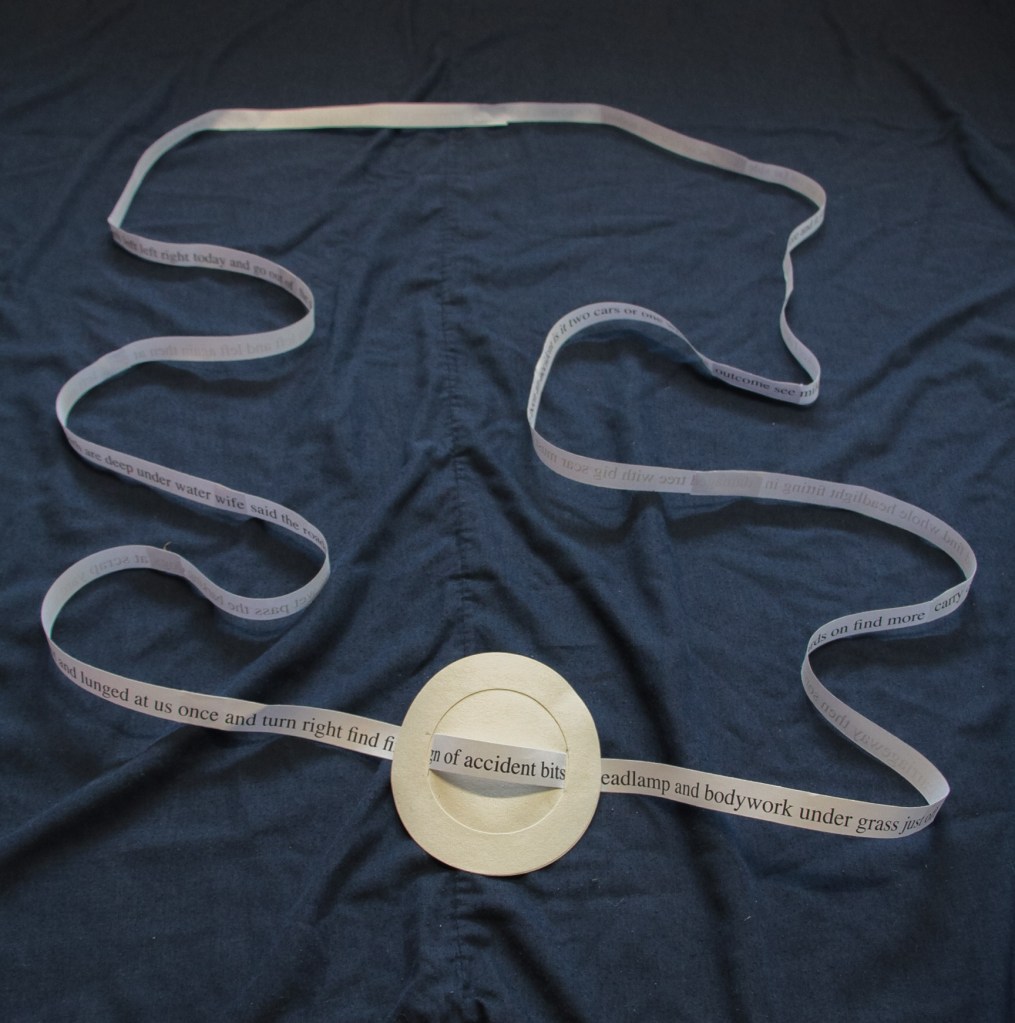
In my mind was a way that the circular bit would be the singularity of the experience, present in the landscape, and the words would be utterly unable to fit into this. The words in the prosepoem were also made the way they were to represent the line made by walking. So I printed out the whole thing as large text as vertical lines going top to bottom of an A4 sheet. My intention was to do the whole prosepoem and cut it into strips and stick them end to end but it would have been 36m long which would have taken too long to make. I have to go to work some time. This only served to reinforce the idea of the difficulty of describing doing.
In my prototypes I experimented with circles of card with smaller circles drawn inside them but it did not work for me. So I used some cutting dies used in crafting to make the form which worked nicely for me. The words were constructed as a loop, so I got circles within circles within circles which was pleasing. I played with it, moving the strip back and forth and found the way that it only showed a few words at a time was also pleasing.
An important part of art making is the act of reflection. This is a core element of experiential learning. But the great thing about an object, a material manifestation of your subjective experience is that it persists after the experience. It is like you hold the the experience in your hand to aid reflection. In the action phase of art making there are three elements. Action, the doing, Reflection, the thinking and Incubation, the not doing or thinking. The object helps with this. You can forget it completely, let it sit and come back to it. Some thing happens at an unconscious level. Like when you cannot remember the name of something and then 10 minutes later it pops into your head. Some thing incubates like an egg or a seed, then pops open or sprouts little leaves. The Celts start their day at sunset and their year at the end of autumn on what we call Halloween or All Saints Day. Growth starts in darkness.
In my previous post, King Crimson sings a song about his experience of art making here. The writer Adrian Belew talks about the art object he made.
‘I do remember one thing
It took hours and hours but
By the time I was done with it
I was so involved, I didn’t know what to think
I carried it around with me for days and days
Playing little games
Like not looking at it for a whole day
And then, looking at it to see if I still liked it
I did!
The more I look at it, the more I like it
I do think it’s good
The fact is…
No matter how closely I study it
No matter how I take it apart
No matter how I break it down
It remains consistent
I wish you were here to see it!
I like it!
This is what my unnamed object did. It remained consistent. In contemplating it it became a material objective form expressing my experience, my ideas and words could roll around. The object and the experience of making it became a form of material thinking. And as Barbara Bolt says ‘Material thinking offers us a way of considering the relations that take place within the very process or tissue of making.’ I made the thing out of a desire to better understand describing doing. Of this Boal says ‘The desire, having become a thing, can be better be studied, analysed, and (who knows) transformed… Not only what one wants to reify is reified, but sometimes also things that are there but hidden.’ The last bit is important and links to the image on my home page. Here Art lets you see things from another point of view.
Part of my research surrounding the making of the object was writing. I have a journal and used this and wrote various forms of this blog post. John Baldesarri, here one of the elders of modern art talks about writing thus, ‘Writing helped me understand what I was thinking about.’
I suggest we see writing as performance or a form of material thinking. You have an idea or a desire and in writing it down you see it as words on a page or screen. Your thoughts are materialised. You see them dance onto the screen and deliver the content of your own script. You see your ideas perform like actors on the silver screen like a movie, but on the screen of your PC or Mac.
Rachel Lois Clapham says ‘To call something a performance is to separate it from the world and then present it back to the world as something distinct. This double movement of separation and re-presentation is the writing of the performance, and it is in this writing that performing exceeds doing. Being written gives the performed thing the simultaneous immediacy and distance of language, by which its separation from the world permits the fullness of its expression.’ here.
That ‘..double movement of separation and representation..’ she talks about, is the cyclic form of experiential learning. It is what Performance Studies progenitor Michael Schechner calls ‘Restored Behaviour’. here Viewed through the lens of performance, writing can be seen as experiential learning. In writing I can experience my thoughts as material(ised) thinking about experience. This is writing as doing, a verb, as performance, as well as a noun, the thing I have written, my writing, the thing you read.
In writing this post I cycled through different titles, but like the object I made, I could never settle on a title as a fixed thing. I could not name it. The noun, the linguistic act of fixing a thing with a name eluded me. The act of the noun to name a thing, as opposed to the act of a verb, to denote an action seemed to me to be in opposition. The words on a page describing doing seemed to take the action of the noun and thus seemed to fix the verb, the action of doing the thing, thus rendering it inaccessible to the reader. ‘You had to be there’ you might say when a description of an experience falls short of the experience. One title I tried was ‘The Subjective Object’. On reflection, this seemed to work very well. It has an intrinsically oxymoronic nature, which seemed to express the intrinsically oxymoronic quest to describe doing. An objective description is intrinsically incapable of being congruous with the subjective experience of doing.
My proposal is that we can make art as experiential learning to conduct subjective research to explore and express personal experience, including outdoor experiences. I see this as an adventure, which taken from the Latin adventurus ‘about to happen’, which also makes this an oxymoron. The thing about to happen does not currently exist, and when it comes into existence it is no longer about to happen, so it cannot be what it’s name claims it is. It feels like trying to explain things by giving an explanation of the thing.
I lived with my object for three weeks. I had made it in the form I imagined which fixed it. But I wanted it to move me on. I wanted it to propose a new form and meaning for itself. So I ignored it. I let it incubate. I tried writing about it but the words would not organise themselves, they just circled back round and returned to themselves. I put up this post to express this experience. here
My experience is that all made things will change form and meaning over time. I had to bide my time. I once went to a lecture by an artist and psychotherapist, called Patricia Townsend who wrote ‘Creative States of Mind’ here in part because there were lots of books about the skills needed to make art and about the psychology of named artists and named artworks, but few about the experience or psychology of making art. Lots about art as a noun, but little about art as a verb. Where art as doing was described it was presented as the skills of the oil painter or the jazz pianist or the method actor. Patricia talked about her journey to becoming a skilled artist, exhibiting and selling work and working as an arts therapist. She talked about how she had found her unique way of working after a long journey. She talked with pride about eventually finding her unique artistic vision. But in writing the book she had looked back at her undergraduate work, having ignored it for years. She described her shock at seeing her unique artistic vision in her earliest work, in plain sight. What had changed was not her work, but her capacity to see how she saw. My experience is similar. I look back at my early work and see things there that in my mind are new exciting and current developments in my work. Not looking at things can help you see better the things you are looking at.
Like the man in the King Crimson track, I played games with my subjective object, ‘Not looking at it then looking at it to see if I still liked it…’ and the way I saw it changed. In the original image I only saw the circle with words going through it. In making it, I cut it joined the ends together. The making of it made me make the prosepoem into a shortened edited loop. But the loop moved through the opening. This offered new ways of understanding the object. I played with the materiality of the object and new ways of thinking about the describing the doing became apparent. The material thinking capacity of the object offered new ideas that were there all along, like Patricia’s undergraduate work and my earlier work. What the period of not looking had changed was not the object, but my capacity to see how I saw it.
I photographed the object just after I made it but missed the way the words formed and endless loop. Later I could see that. So I photographed it again to show the word loop.
So I started with a stream of consciousness on the walk, I turned it into a string of unpunctuated lowercase words, I wrote them down on a page and the string became a block, I took them to a ribbon to recreate the linear experience of the walk, then I looped them to make them fit in the object. But the object I made remained physically consistent. On reflection the making of the object both explored and expressed the experience, not only of the walk, but the experience of making the object as well. I still find finding the words to describe this lived experience difficult.
In my training as a therapist and later in the reading I did on post-grad arts research the capacity to use research to show efficacy of the art therapies and arts education in a quantitative form through and through the written thesis was questioned. The argument was that the art making was research. Words describing doing were of a second order to the direct first order expression through art making. The words became a discursive adjunct to the non-discursive artform and it’s making. That art can be research is still contested and modes explanation and discourse still abound. But for me the object I made shows a first order expression of the experience. The materiality of it’s construction made it’s own intelligence apparent. It showed me what I could not see. But in part, that it became seen was in part because of the act of performative writing. I saw my confused thoughts on the screen and, in conjuction with the object, worked with them to see some thing hidden from me. Like Boal says of reification of desires above ‘Not only what one wants to reify is reified, but sometimes also things that are there but hidden.’
In the end the elusive experience of the circularity of language in the making of this post was oddly made more fully known through a totally unconnected encounter. I have a newsfeed about art and the outdoors. I found and posted a news item about the intelligence of crows. I adore the whole Corvid family. I have encountered them in the Alps and the Atlas Mountains, in rural Wales and Cumbria, and in the middle of London. Crow is a trickster. Ted Hughes wrote a book of poetry about Crow. Here On the linked site Paul Radin says of the Trickster, ‘s/he became and remained everything to every wo/man—god, animal, human being, hero, buffoon, he who was before good and evil, denier, affirmer, destroyer and creator.’ The trickster is a god and an idiot. The news item is about the intelligence of crows.
In reading the article here I was taken with the central finding of research which showed crows can engage in recursive reasoning, a form of intelligence assumed to be singularly human, and a product of language. It derives from Latin recurs-, stem of recurrere “run back”. Wiki succinctly describes recursion as ‘the process a procedure goes through when one of the steps of the procedure involves invoking the procedure itself.’ here
Experiential Learning as Recursion
There are many descriptors of experiential learning, but in all there is a big element of recursion. What we do informs what we do next. We have an experience which when attended to, informs our next experience. It is a loop. Our next action is informed by a looping back to previous actions. But sometimes we need to go round the loop many times to be able to see how we can get out of a loop.
Examples of recursion are many. It is well used in language, mathematics and logic, but also occurs in art and biology, so descriptions of recursion will vary. But the act of recursion seemed very apt on reflection of the experience of taking my walk, making my art object and trying to write about the experience. The experience of writing, going round and round in a seemingly endless loop was moved on by changing the way I saw my object to be an endless loop.
So to me recursion would seem to be a way of seeing patterns in patterns. To see patterns in patterns needs you to see a lot of patterns. But once you see the pattern, you cannot unsee it. If recursion is based in language, then how come Crows can do it. Pattern recognition comes from the experience of patterns. Recursive learning can be experiential. It may well occur in the natural world, as well as in the world of mathematics, and some mathematicians say the world is mathematical in essence. It does occur in language. It does occur in art making as the story of Patricia Townsend shows, and my story of making the endless language loop in my art and not seeing it also attests.
The thing within recursion is that it has a naturally closed element whereby you can only say something about a thing by saying something about the thing you are saying something about. But going round that loop allows you to see a pattern and in seeing the pattern you are able to move on, to another loop, but through seeing another pattern. My proposal is that in making art, the experience of making becomes concretised, materialised through materials which have their own intelligence, (their intrinsic form) so it enables you to see the pattern of your experience, and move on to seeing another pattern. You literally have an object that is the experience. It is recursive.
A symbol that was given in my dramatherapy training was Orobouros, and this is a symbol of recursion.
Coming from experiential learning I took this to mean the experiential learning cycle and glibly failed to pay attention to it in detail. But looking again I realise the snake is feeding itself by eating itself. That what I learn by doing informs what I do still stands as a model for experiential learning, irrespective of what a snake eats for dinner. But what I wanted to show here was an example of how one can learn from the experience of making art. And as an example, it shows both the pitfalls and the productive paths. I have learned something through art making, but it’s description in words took longer than I thought.
My plan now is to work with artform to explore the experience of exploring recursion. This will go up in a series of posts rather than one long one.
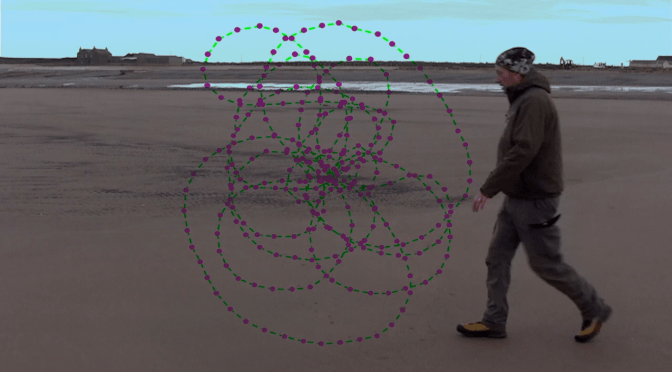
My visit to the Solway was prompted by a need for a large space without physical barriers to explore what would happen if I walked a drawing of an model of experiential learning through the arts. In doing so my idea about my model changed.
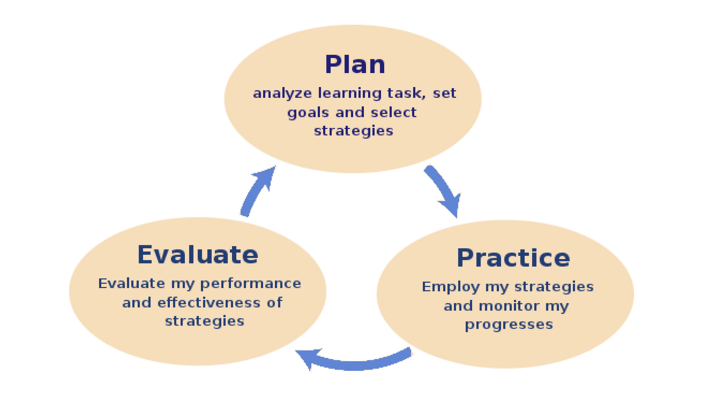
The original model
Models are slippery things. Their appeal is that they appear to give a fixed image of a thing, but in practice whilst they serve as a very useful signpost about which way to go when you set off, the thing you find when you get there is never fixed. So the walk was undertaken as an experiment ‘to explore what would happen…’
What the model predicted was that a number of factors would contribute to the art making. In this case my thoughts were that source material would be Richard Long and the walking and land artists. My personal arts practice or art made included using a GPS and walking to make a mark on the landscape and experience of film making as a means of exploration, reflection and expression of experience. I drew on ongoing research and theory about the outdoors as a liminal space and art making as adventure, as a journey of uncertain outcome, and Shaun McNiff’s ideas about witnessing in the arts therapies1.
The model was correct in that my path would lead in to and out of the art making on the day and on to more art making, research, source materials and theory, and that the generic coloured blobs would be specific to the art making experience. My initial thinking after the event went to ideas about performance and the epistemic object and further trips to photograph and film, reporting this through blog posts.
At the centre of this, an act of art making and poiesis occurs. Something comes into existence that did not exist before and it is called art. It is art by convention, because all this could describe the making of a cup of tea. To this conundrum ’Why is this art?’ one asks the question asked by artist John Baldessari, “Why is this not art.” It is art because it was my intention to make art and my act was guided by research, reference to existent artform and artists, theories of art and my experience of art I made before.
But there was something incomplete about the central concentric circle structure. I was interested in the model showing how each experience of art making occured within a loop of experience, like in Kolb’s learning cycle.
But like the Kolb model is an ideal form which would be expressed differently depending on the setting, the strict concentric form may vary depending on the setting. My experience of art-making was, however, that in making art I stepped away from the day to day life experience and went to a different place. This could state is sometimes known as a ‘Flow’ state from work by Mihály Csíkszentmihályi. You get in the zone of concentration and attention, of doing and the senses. But for art-making as experiential learning or personal research or art therapy, you enter a state that is similar to a meditative state, like flow with awareness. You are focussed on making art but also on what it is that you have made and what happens when you make it.
So in the model, as well as cycling through an iterative learning process, there was a linear path away from the world, into a creative state where something happens in partnership with your artform, then back to the world.
Reflecting on how the model changed
On return home from the Solway and recollecting the emergence of performance I went back to my Dramatherapy training. In a dramatherapy session you work with a basic three part structure. ‘It begins with a physical warm-up leading to the Main Event, the place where the real action is. It concludes with the ‘grounding’, returning people from the ‘Land of Imagination’ to their own everyday selves.2’
During the walk recreating the drawing, the shift from walking to dancing, from recreating the drawing to improvising and performance emerged unbidden. One could say this idea came out of my imagination or my unconscious, or it was the product of a state of flow, or having danced in the past, I simply remembered something from my past related to what I was doing in the present.
So there are two things here. One is a linear journey into a place with some degree of separation from the everyday world, into ‘flow’ or ‘Land of Imagination’, followed by a return. This is a linear journey in an iterative looping cycle of learning. The other is the experience of being in ‘flow’ or the ‘Land of Imagination’. This is an experience of art making as somewhat separated from ones day to day life.
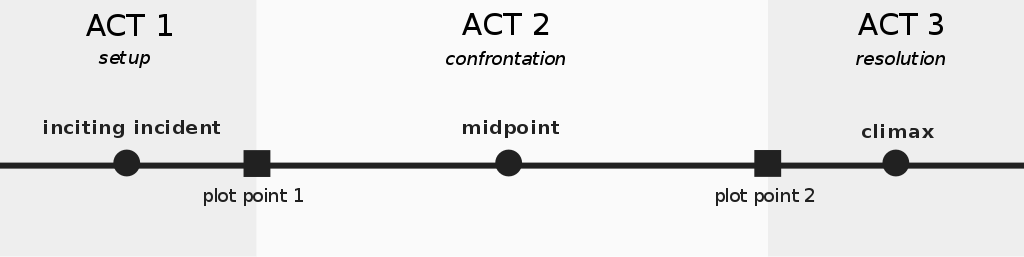
Something like this three-stage process occurs in many settings. In story and in film and theatre there is a thing called the ‘Three Act Structure.’ On one hand, this is as simple as a beginning a middle and an end or it is sometimes understood as set-up, confrontation and resolution. Many interpretations exist and there are examples to be found of its use in say cinema, but it is not without some contention. Like one article says ‘The true three-act structure isn’t a formula, it keeps your beginning separate from your middle and your middle separate from your end. That’s it.’
But the ‘beginning, middle and end’ could be seen as a universal or archetypal structure. For example at Outward Bound, in experiential learning, you worked with a ‘training, main and final expedition’. Your training expedition was where you taught skills, the main expedition was where you had the conflict as you got the people to move from being a group to being a team. Final was the unaccompanied independent journey.
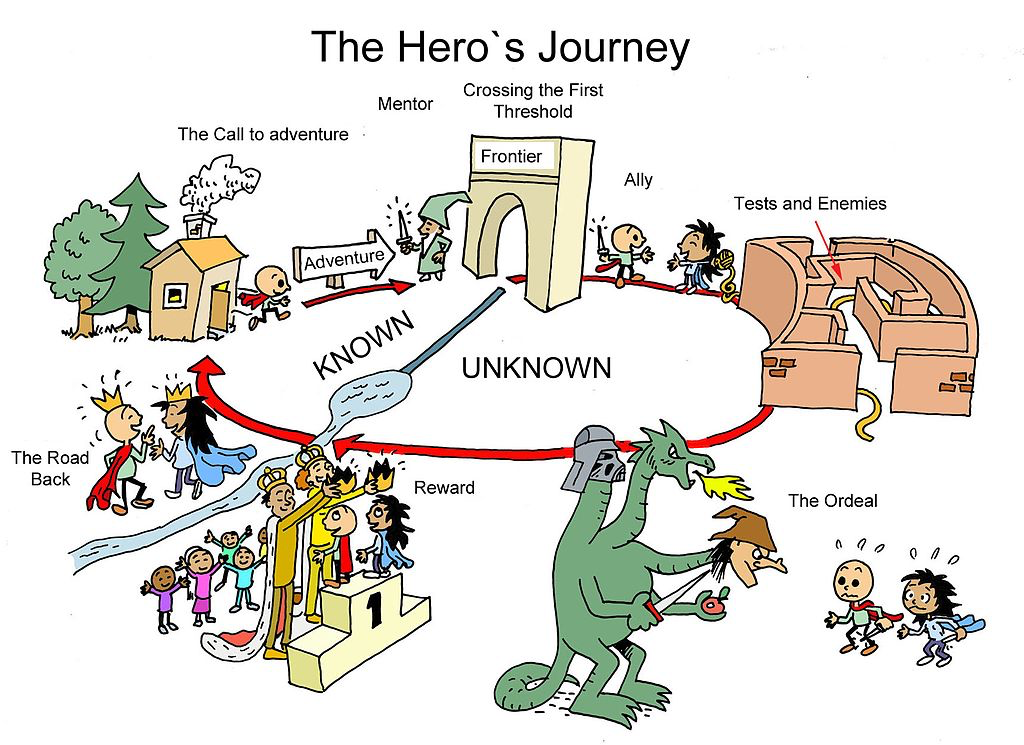
In care, we worked with a conflict model and resolution tool called ‘ABC Charts’ meaning A – antecedent, B – behaviour, and C – consequences. Joseph Campbell’s Hero’s Journey has a specific expression and detail but is also a three-stage form, the call to adventure, the test and the return.
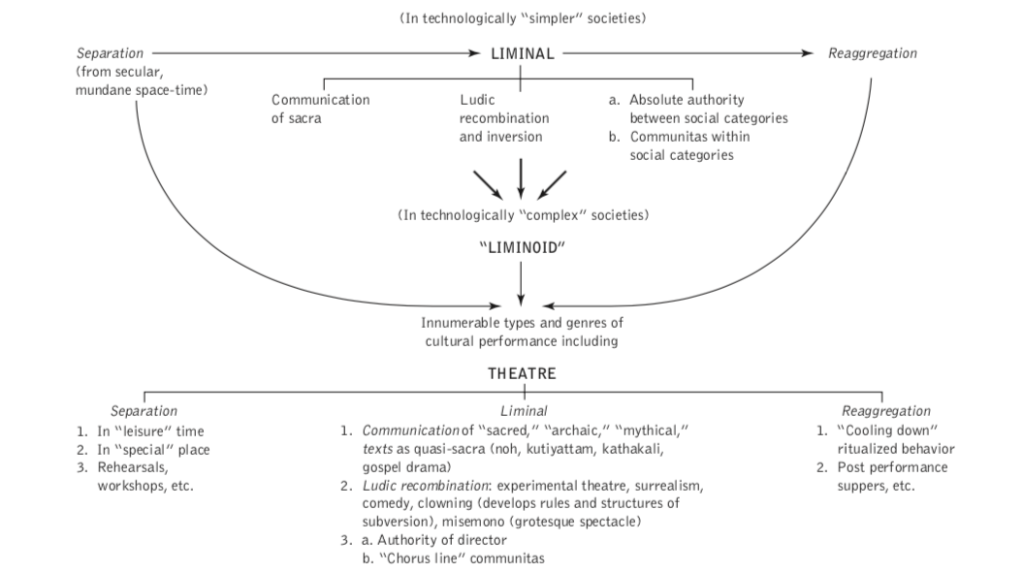
But the simple, warm up, main event and grounding of dramatherapy mentioned above can be also seen in a form described by Victor Turner and Arnold van Gennep as Rites of Passage.
The above diagram is from Victor Turner a British anthropologist who theorised the above from studies of non-western settings at the top, and western settings at the bottom. This is a three stage journey of return that is linear and cyclical and has a central liminal or liminoid space somewhat separated from everyday life called The Land of Imagination in the dramatherapy model.
Art as liminal space
My proposal is that art making and experiential learning could be understood as having some some elements of the above structure in their practice. I don’t think it is coincidental that after a while on the Solway Walk, I spontaneously rediscovered that I could do the walk as performance. This could be seen as me, albeit briefly, entering a mild ludic state.
There is a lot to this seemingly simple experience of walking in circles on a beach like an idiot. Not least the idiocy. I was being playful throughout. I was in the land of the Trickster or the Court Jester, at once playful and challenging, the one who can perform recombination and inversion.
This is also adventure. The journey between departure and arrival. The journey of uncertain outcome with misadventure available. The three part expedition cycle of Outward Bound. On a slave ship, the middle passage. The refugee in the hands of the trafficker. It is not a thing of the past.
To me there is also something in this of being in the Solway, a liminal space if ever I saw one, between two countries, high and low water, land and sea. To me this is also a state of walking. In walking you are between places, outdoors, in a state of flow, and returned to a mode of existence that predates all of the modern world.
So after a few weeks of reflection my research led me a realisation. The experience was ‘like’ a lot of things, from experiential learning, theatre, anthropology, adventure sports, performance art, and conflict resolution, to Outward Bound and Joseph Campbell’s Hero’s Journey.
This could also be applied to many arts based contexts and the model has ART FORM as a liminal or liminoid experience at it’s heart, the same as dramatherapy. But the artform that fits this experience best if what is known as Walking Art.
My exploration of my Solway walk has reached a convenient place to move on and in my next set of posts I want to look at Walking Art with a particular focus on it’s scope for promoting health and wellbeing.
Mindfulness and the Arts Therapies – Theory and Practice – Laury Rappaport ed. ↩︎
Discovering the Self through Drama and Movement – The Sesame Approach. Jenny Pearson ed. ↩︎
Performance Studies – An Introduction. By Richard Schechner. Routledge. ↩︎
After doing my Solway Walk I went back to some academic and practice material, reconnecting with Augusto Boal on performance as a dichotomous, and thus creative, process. This connected with my experience of art making as performance as a journey of uncertain outcome. But some of my art making ended up with art objects. However the Boal stuff reminded me of other materials I had read.
In a book called ‘Using Art as Research in Learning an Teaching; Multidisciplinary Approaches Across the Arts’ by Ross W. Prior, there is a chapter that reiterated some of what Boal had to say about the ambiguity of the art making process. In Chapter 8 ‘The ‘Epistemic Object’ in the Creative Process of Doctoral Inquiry’, Carole Gray, Julian Malins and Maxine Bristow the authors, develop ideas about the art object which reinforces Boal’s ideas about aesthetic space but in relation to visual art and the arts object as part of an experiential process. It also talk about ways of viewing art that moves us away from the fine art exhibition, and towards ways of showing art product and process much more conducive to experiential learning. It is about art as research at postgrad level but we can think of art as experiential learning as a form of research or as a source of knowledge at many levels.
The Epistemic Object
Whilst Augusto Boal’s idea of performance containing the aesthetic space as a dichotomous space in which a person acts, witnesses and learns through their own actions, thoughts and feelings, the act of performance is highly experiential and produces no object in the way visual art does.
In the article, the epistemic object is understood as an object which, through engagement and experience, acts as a source of knowledge. In this sense, the object could be a painting or an architectural model or the Large Hadron Collider or a diagram of a particle accelerator or the Sistine Chapel. The epistemic object or epistemic art contains ambiguity or uncertainty and thus can be a vehicle for inquiry and thus learning. So whilst ideas about what we can learn from art is not without contention, as a perspective on art as experiential learning the idea may be useful.
It struck me that when I worked at Outward Bound two classic experiential learning, or ‘problem-solving’ activities that could be understood as epistemic objects were ‘The Wall’ and ‘Barrels and Planks’. Both used creative experiential activities as a source of knowledge. Both could also be understood as performance in the way Boal suggested.
Aberdovey Outward Bound, my old stomping ground.
Viewing and more importantly doing art, making art objects could, I suggest, be understood as epistemic objects. What interests me is the way this idea, adopted and hybridised by art-based researchers could bring together ways of thinking about and engaging in experiential learning that could encompass science, the arts, outdoor adventure and the arts therapies.
In the article, a number of ideas are presented about the epistemic object being ambiguous or dichotomous and open to interpretation and as such, through interaction, open to creative development or re-viewing. With the article, the devil is in the detail. To paraphrase or quote parts of the article would lose a lot of the explanation. So a copy of the article is available for download on my blog under this post or can be downloaded here.
Hans-Jörg Rheinberger’s term ‘epistemic things’ is used as a starting point. Rheinberger is quoted thus. ‘An experiment […] is an exploratory movement, a game in which one plays with possible positions, an open arrangement’. The article continues ‘For an epistemic object to have the potential to develop scientific research, it must embody a degree of uncertainty to be useful’. He asserts that epistemic things ‘are by nature made to be surpassed’’
In the article, the things that pass as epistemic objects include Crick and Watson’s model of DNA, made with lab equipment. Things used by architects to design buildings including sketches, drawings, plans, charts; photographs; project management tools – timelines, schedules, tables; virtual prototypes, scale models, and even machines and parts are epistemic objects. A design consultancy process in cited, where individual employees select ‘core value’ cards – a given set of random images – to visually express particular values that they each associate with their company.
Finally there is a wonderful description of how Antonio Gaudi designed the Crypt of the Church of Colonia Güell. ‘Gaudi’s stereostatic model.. brought together a set of inquiring materials – a wooden board, cords, cloth, pellets, photographs. From each catenaric arch (formed by hanging the cords from the board) small sacks of pellets were suspended. The structure was photographed. The final shape of the church’s future architecture was revealed by turning one of the photographs upside-down– indeed a productive thing.’ Read about it here.
To me, an ‘experiment’ as described above by Rheinberger, could be an expedition, a painting, or canoe trip, a walk on a beach, a drawing of an idea of experiential learning, or making a movie about a walk on a beach, or a map. All, like a petri dish or a painting, can be an epistemic object.
These are all things that could be understood as ‘thinking by doing’, ‘embodied cognition’ or ‘material thinking’. These could be things used by artists, physicists, architects, musicians, geologists, and sports coaches. The ‘epistemological object’ differs from the ‘model’ in how it is used and by virtue of it being incomplete, ambiguous, dichotomous, open or emergent. The interaction of the maker of the object with the object is what makes it a source of knowledge or creativity. The model tells us what we already know.
The article describes the role of epistemic objects ‘..is not to represent what is already known, but on the contrary, to come to terms with what is not yet known. The epistemic object is defined by what it is not (or not yet) as much by what it is’, and says artworks are ‘‘generators of that which we do not yet know’ inviting us to think and thereby are epistemic agents’.
My proposal throughout is that if we understand art making as experiential learning then the outcomes of learning are determined by the interaction of a person doing something in which, as Rheinberger notes above, they think ‘a degree of uncertainty to be useful’. This is endemic to art making, to the art object, to the epistemic object. So as a source of knowledge, a mode of discourse and exploration of experience, art making, in all it’s myriad and contested forms treats, like with like. It’s uncertainty matches the uncertainty of experience.
Exposition
But in making art, how do we show what we have learned, in and of experience, if it is uncertain. The article goes on to link the epistemic object to the act of exposition. Exposition can be understood as being characterised by exposure, a showing of all and an explanation.
The word exposition is now a noun, the name of a thing. Etymologically it is from exponere which is a verb, a describer of a doing. In the context of art as experiential learning, as part of a research discourse, the writers of the article think of exposition as more of an exposure of doing, thinking, of materials and processes.
The article goes further and suggests it is ‘…the sharing of thinking processes and the revealing of methodology; and perhaps most importantly it invites participation in order to enrich and expand understandings from the inquiry,’ and ‘There is a didactic element to the notion of exposition, as far as it teaches how, and as what something may be seen without determining outcomes.’
Visual examples can be found in the article of recent PhD art as research doctoral expositions. Here.
In showing art in the fine art context, the exhibition could have the quality of a museum, with lots of explanations, or it could seek to rely on the capacity of the artworks to speak for themselves. The explanatory method can tend to give a fixed account of the art made. The art speaks for itself is fine, if you speak art in the same way as the artist. Grayson Perry suggested in the BBC Reith lectures that all galleries should have a big sign at the entrance that says ‘YOU DON’T HAVE TO LIKE IT ALL’. He did and exhibition of work by renowned artists and rank amateurs. He said he liked the idea that when people first walked in nobody knew who made what. They just found stuff they liked.
A big part of what I want to get as is art not ART. The making art rather than the viewing of ‘Fine Art’. Art as doing not viewing. We cannot all be artists but we can all make art. We can make art as a way to learn something about your experience, of art making, of what your art is about.
When I was at school I got a grade ‘A’ in Art and Physics. It took me 50 years to get back to the art thing. But the thought of me showing my art in an exhibition is horrific. At school you had to be wary of being good at art ‘cos if your art was good it got put on the wall. In my school that meant you had sold out. ‘Teachers Pet!’.
But my exposition is here, in my showing and sharing. I want to show you what I made and my thinking about my making. The trick that I am working on is to find a balance between being too rigidly didactic and teacherish and too vaguely arty and obscure. My goal is to show so that you may find some thing you like that resonates for yourself. But like Grayson Perry says, you don’t have to like it all. In this sharing, I am sharing my finding my own way.
With a bit of time we can work out for ourselves what is going on.
In the article there is a quote from an arts researcher, Schwab who says ‘One may even say that there is something inherently gentle to exposition considered as introduction, a relief, perhaps, from the obligation of being a ‘work of art’, in the serious sense of the word.’
Art as experiential learning begs you to take notice of the art you make and what happens when you make it. Exposition could be seen as an antidote to feeling compelled to make a ‘work of art’, and show it like a sellout, and instead make some art and tell us what you did and what it was like, what you learned and then share with us what you made. We can work out what it means for ourselves.
Introducing Augusto Boal’s ideas about performance as a creative space for experiential learning
The act of reflection on my Solway Walk led me back to performance. Performance, like art, is a variable and often contested phenomenon. It can include theatre, dance, music, sports, business, ritual, play, performance arts and general social functioning. It can be a source of entertainment as actor or audience, but here it would be useful to connect with performance as a form of experiential learning. All art making could be understood as experiential learning as a source of knowledge, but performance has a particularly strong affinity with experiential learning as an active embodied process. My take on performance has to be influenced by my Dramatherapy training, in which a group or and individual can engage directly with performance to learn from experience.
One practitioner who works directly with performance as learning is dramatherapist and Social Activist Augusto Boal. He starts with theatre but develops it with the idea of the spect/actor, simultaneously spectator and actor. The spect/actor is performer and audience in one.
In Rainbow of Desire Boal describes theatre by quoting 16th century Spanish playwright Lope de Vega as ’two human beings, a passion and a platform’. This confirms the theatrical mode of performance as being a collective experience. In this case the ‘company’ is two, (and possibly more) persons interacting with one another. The passion is a reference to strong feelings and often suffering. Passion implies experiences beyond the mundane. Finally there is reference to the platform. In theatre this is usually the stage, as separated form the audience. Boal however moves beyond the actors and spectators as physically separated on auditorium and stage.
What is important to Boal is the act of separation rather than the form of two physically separate spaces. He says ‘The separation of spaces can occur without the ‘platform’ existing as as an actual object. All that is required is that, within the bounds of a certain space, spectators and actors designate a more restricted space as a ‘stage’,: an aesthetic space’.1 By this he says ‘In its greek root ‘aesthetic’ means ‘of or pertaining to things perceptible by the senses’’. Boal goes on ’So theatre does not exist in the objectivity of bricks and mortar, sets and costumes, but in the subjectivity of those who practice it’. He establishes theatre can take place anywhere you want it too. I chose a beach.
Boal continues ‘The ‘theatre (or ‘platform’, at it’s simplest, or ‘aesthetic’ space’, at it’s purest) serves as a means of separating actor from spectator; the one who acts from the one who observes. Actor and spectator can be two different people; they can also coincide in the same person.’ (Boal’s italicisation). The individual performer is witness to their own performance in real time and retrospectively.
Boal says ‘The aesthetic space possesses gnoseological properties, that is, properties which stimulate knowledge and discovery, cognition and recognition; properties which stimulate the process of learning by experience. Theatre is a form of knowledge.’ Here he describes theatre and performance as experiential learning. But away from the confines of theatre as a building with a stage, as a state of entering aesthetic space as a form ‘in the subjectivity of those who practice it.’ then theatre and performance as separation between actor and spectator, could be seen as having occured when I made the beach a stage, an aesthetic space, in which I was both spectator and actor. This is reflective practice.
My reflection, or my ‘review’ was live in the doing and the senses, direct in my direct recollection of the experience, reviewed by the witnessing of the camera and my seeing and editing the footage, in the production of the gps track, as a direct reflection of how I recreated an image of an idea, and how I deviated and moved form representation to improvisation. I witnessed myself in performance. Now you witness what came form my performance.
Boal offers one perspective, and there are other perspectives from other arts and performance theorists and practitioners, but in my reflection, reconnecting with Boal’s idea of aesthetic space resonated with my experience of going from walking an image of an idea to making the beach a place to improvise or perform a new image of an idea. He goes on to further develop the idea of the aesthetic space which offers some interesting insights.
He talks about how aesthetic space has a property of plasticity. It can can be anything we want it to be. ‘A battered old chair will be the kings thrown, the branch of a tree a forest…’ The Solway beach became a canvas to draw an image of an idea, then it became a stage on which to choreograph a dance with a piece of seaweed. Boal says ‘The aesthetic space liberates memory and imagination’.
He also says it offers an affective and oneiric dimension which ‘exist only in the mind of the subject… The affective dimension fills the aesthetic space with new significations and awakens in each observer, in divers forms and intensities, emotions, sensations and thoughts’. In the affective dimension the performer is in the moment and observing them self in the moment, they become spectator and actor. The affective dimension is ambiguous and dichotomatic. I think this is the bit that makes reflection on experience in situ available.
Boal goes on to say ‘Oneiric space is not dichotomous because in dreaming, we loose our consciousness of the physical space in which we the dreamers, are dreaming, here she penetrates into her own projections, she passes through the looking glass; everything merges and mixes together, anything is possible’. Which is why at the end of the walk/dance/performance I knew something had happened, but only on reflection at home did this thing that happened decompress. The act of making images of the experience helped with this. I think this aspect is the bit that makes, in the words of Monet and Rothko, the art the experience. The art form becomes a form of knowledge. The art making is research with the art made is the process and product of research.
The dichotomy of the experience is a key element. Of dichotomy Boal says ‘ This property is born out of the fact that we are dealing within a space within a space; two spaces occupy the same space at the same time.. And all those who penetrate it become dichotomous there.’ As a member of the audience watching Macbeth, I am in the auditorium and also on a heath, there to meet Macbeth. As a walker on the beach, I was on the beach but also on a canvas to paint a picture, then on a stage to do a dance. On a ropes course I am safely moving over a step across, but I am also a person who fears that may fall to their death. I want to return to dichotomy in my next posting, but from the point of view of the art object in fine art.
As a therapist Boal also talks about the effect of the dichotomy on the protagonist actor in the aesthetic space. In theatrical mode, he says, ‘..the protagonist-actor produces thoughts and releases emotions and sentiments which.. Belong to the character, that is to say, someone else.’ In therapeutic mode ‘..the protagonist-patient (the patient-actor) reproduces her own thoughts and releases anew her own emotions and sentiments.’ In the case of my Solway walk, the beach was the aesthetic space and the work done was partly about my material I brought, ie the image of an idea, but also my experience of the place as an active participant as art form and process. In all of my work and ideas about art as a form of experiential leaning, the approach is much closer to the therapeutic mode. From experience I have found this sets the whole mode of working with art appart from ideas and practices found in ‘The Arts’ or ‘Fine Art’.
Finally Boal talks about the aesthetic space as being telemicroscopic. ‘In creating the stage-auditorium division, we transform the stage into a place where everything acquires new dimensions, becomes magnified, as under a powerful microscope, thus brought closer and made larger, human actions can be better observed.’
Boal as a therapist and social activist has a good deal to say about how theatre and performance can enable spect/actors to reflect on their own experience and ‘..help the spect/actor transform himself into a protagonist of the dramatic action and rehearse alternatives for his situation so that he may then be able to extrapolate into his real life the actions he has rehearsed in the practice of theatre’.
In moving from representation of an image of an idea to improvisation of a new image and thus a new idea I believe the Solway walk did this for me. The dichotomy or ambiguity in the experience invited me to ‘rehearse alternatives for the situation’. This is a creative act, it is experiential learning, it is adventure. Creativity is a state of uncertain outcome. The journey of uncertain outcome is built on ambiguity. Art is adventure, and whilst misadventure was absent here, it is present in some arts practices and, if I got my tide times wrong, the Solway is a dangerous place. My suggestion is that art making can be an inner adventure or an outer adventure. This is a thing I will discuss elsewhere.
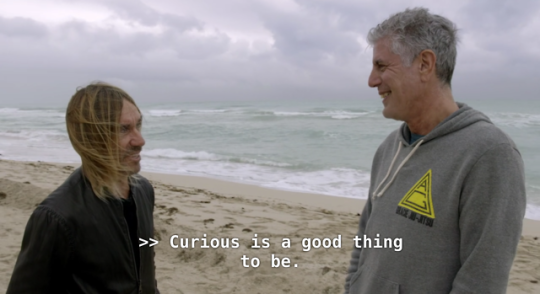
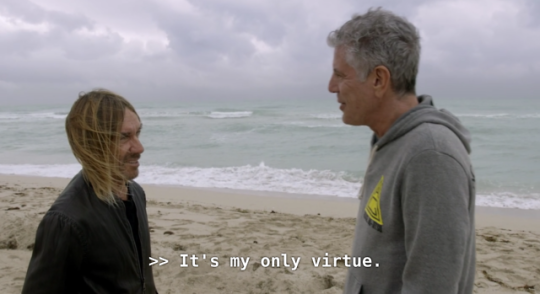
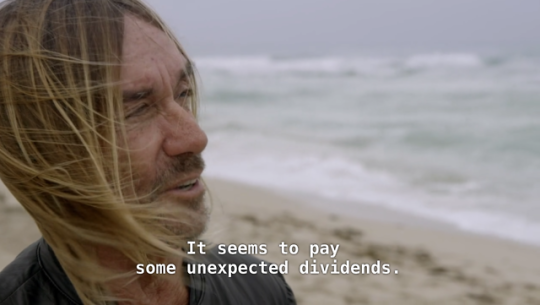
The key themes in this are 1) that performance is an invention of experience not place 2) and as such, by being dichotomous and ambiguous, offers scope for new experiences, and 3) the performance or art made is not just a representation or symbol of experience, it is the experience, and 4) the performance or art made can be understood as research and knowledge of personal experience. This, alongside other modes of understanding experience, offers some unexpected dividends.
Performer, Iggy Pop on a beach talking to someone about curiosity.
In further posts the ideas of performance and art making as a transformational experiential process will be further developed. But a key theme is that this experiential process is dichotomous, subjective, situational, emergent and multi-dimensional, and no single account can describe it in complete and concrete terms and working through direct expression of my own and other peoples working practice is the best way to do this. What I present is art making as adventure, the journey and not the destination.
Back in the world reflecting on the experience of art making.
On return home, my reflections on the Solway walk had a number of sources. I had my direct recollection of the place and the experience of walking around in circles, my gps tracks and my movie footage.
What was most immediate was direct recollection of the move from representation to improvisation of the image of an idea of experiential learning through art. What was interesting was that the return to the camera where I reflected that ‘I learned something about my model’ was partly an image in my head but mostly a feeling. The feeling was that the move from representation to improvisation was a feeling of change. It was not a rational thing.
I saw the footage and recalled that the pause in my speaking was me trying to connect with the learning. I had a vague ghost of an image and I was trying to visualise it. One source of inspiration about art as enquiry in post grad research came from the work of artist and academic, Dr Estelle Barrett1. She describes art as research as being a thing of ‘doing and the senses’. It is subjective, situational, emergent, multi-disciplinary and often non-verbal. I knew some change had taken place. By changing my experience of embodying my drawing of my idea, my idea had changed.
In my head what floated around was an image of a map of different experiences and interests with my walking path moving between them. On my return home I used a drawing app and made an image of I thought the map might look like. This is what I drew.
The drawing showed three elements. The looping line I had walked. This was my experience over time moving from one thing to another. Then the things I moved through over time, the art I made, other artists work as source material, art and learning theory, more structured research and reading and revisiting various ‘projects’ with a coherent theme. Then there was a n idea of my connection with the art making. I thought about it on the way in and out and reported on it. I have a journal and use sketchbooks for ideas and images. I became a witness to my own art making, and through reportage her, other people also witnessed what I made. The art making was characterised by mostly doing and the senses. I moved out of fully thinking mode.
Central to it was working with artform, which had a bit of all of the above, but had its own things to show and share. I felt a need to return to the central bit. What it contained I realised was always specific to the actual experience of artform at the time. I intend to try and map what happened in here on the day. On another day this would contain something different and something the same.
What emerged form this drawing, this thinking through doing and the senses, was not so much the act of art making I had put at the centre, but a realisation that the experience of art-making was inseparable from all the stuff going on in my life. The intention to make something as art at the centre still stood and like the walk on the beach, this making as enquiry makes itself. The art making has a mind of it’s own, the intelligence of material. And intention made the intelligence of many materials available. In this case the material was walking.
The experience of walking, and then dancing or performing the image was close to what I felt was my actual experience. But I had lots of stuff going on. I usually have a couple of art projects on the go, I have in mind the work of other artists and off other art works I had made, many of which involve walking. In many cases I did more formal reading and research or related ideas or phenomena, including academic research and writing. I experiment with different arts practices, with varying degrees of success. I reflect on art I wanted to make and my ability to do so. I make judgement on myself and my art making ability, and what I felt I ‘should’ be making and what I actually did make. Lots of stuff going on at a personal, intellectual, embodied and artistic level. Nothing is ever static, hence ideas in the original drawing of rhizomatic or adimensional knowledge.
My simple map image above came closer but it was a static image and the experience of the land depicted by the map was dynamic. A couple of things emerged.
1 – If a map were to be made to accurately represent the experience it would have to be local. It would have to show the things that were present in my immediate experience specific to the artform I was working on. The point of a map of a place is that it is specifically local. I was struck that the walk was specific to an actual place, but I was using it to make a map of a generalised idea about art making. This connected to a recurring theme.
Can you generalise about the experience of art making, create an image of that is replicable like I wanted to walk a replica of the image of an idea. Or does art making as a creative act and thus inherently improvised, mean that all art making is specifically local to the experience at the time? If we consider visual art, the art of image, the image has to be fixed. An image can only show a snapshot of an experience, but is can show insight into the personal processing going on with me in the experience. This has strengths and weaknesses.
2 – The move from a fixed image, from representation, to improvisation, to performance, opened the possibility of performance as a useful artform in which the artform was the experience. The film I captured of experience would show the walk as it happened. This would not be a snapshot of an experience. But this has limits. The point at which I moved to performance and I changed my ideas about my model and my art making would be present in the form, unless I added a commentary. But a picture is worth a thousand words. A image is a snapshot of an experience but it can show insight into my response to my experience.
Going from static to moving image.
From a static image I went to the movie footage with the intention of seeing if it could help me process my experience. I went to my movie footage and what struck me was the sound of the place I did the walk. I explored making a movie and to just show we wandering around in circles, but this did not appeal to me. A 20 minute movie of a beach with a man wandering about would not appeal to people viewing the footage either.
The duration was important and some artists have used the durational quality of movies to explore ideas. Andy Warhol famously made ‘Empire’, an 8 hour film of the Empire state building. It is boring but raises issues about how we experience and represent time.
But 20 minutes of me walking about was not what I wanted. I worked at speeding it up but lost the sound of the place. The movie below is my attempt at showing what the walk felt like out on the Solway, between high and low water, in feral space between human and wild spaces. To get the sounds of the experience listen with headphones. The soundtrack is from ‘Tu Non Mi Perderai Mai’ (You Will Never Lose Me) by Johann Johannsson and captured the feel of the walk.
As I write this it is now 2021. On viewing the footage what strikes me now is that I was totally mistaken over the date. I was a week out. The walk was the 18th of November. The desire to change the duration and speed up the footage also reflected a sense in which the walking a mile seemed to take no time. It was not boring and passed quickly. I also noticed that the movement of myself was reflected by a dog walker and the vehicles on the road. Over a month after the experience, this account or reflection of the experience shows me new things.
My belief is that the making of an art object that is between being both the experience and an account of the experience offers interesting opportunities to explore experience directly through art making. My research after my walk led on to two ideas from performance and post grad art as research which explore this idea of liminality and ambiguity between art as the experience and the account of the experience which I will cover in subsequent posts.
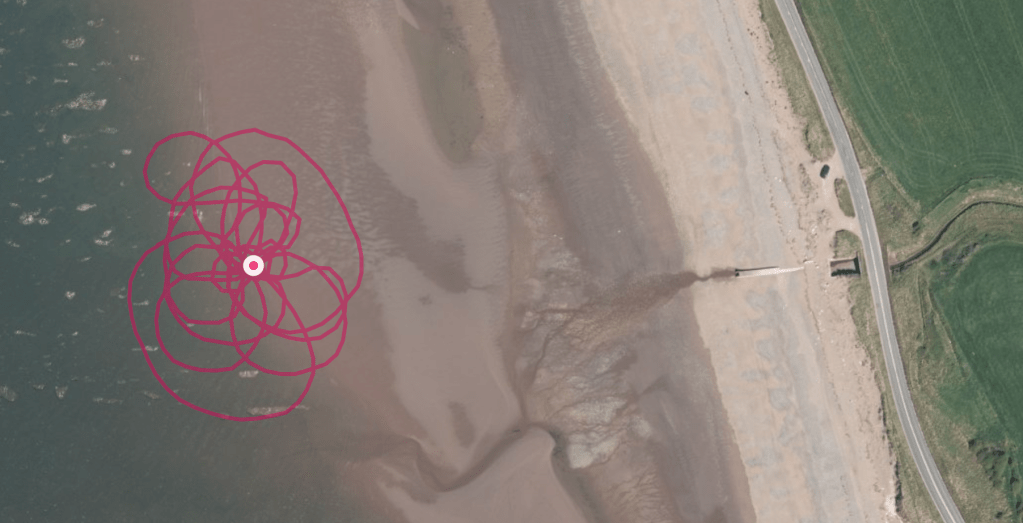
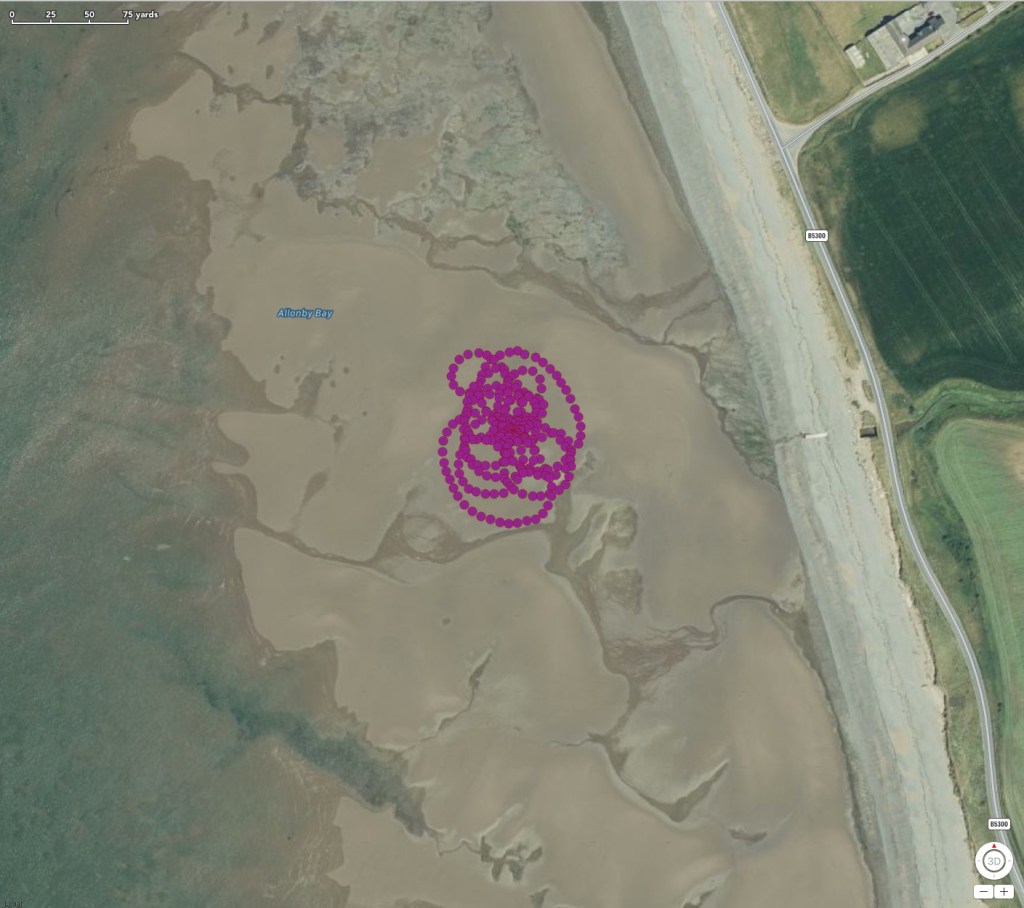
As a souse of reflection I also had my GPS tracks. I downloaded them and plotted them on various maps. I put the raw .gpx files into various apps or online mapping sites. One of the things I am drawn to is the way different maps tell you differne things about place you see on the map. I like Korzibski’s idea that ‘The map is not the territory’, both in terms of our experience of place, but in broader terms of consciousness. This is something I want to cover in posts about humanistic geography and the idea that we perform the outdoors as a place and an idea.
The mapping of .gpx tracks did not disappoint.
The idea that the image is a snapshot of moving experience was evident above.
Different mapping conventions show different things. I am fascinated with how using a map of a place before you visit colours your expectations and information about the place before you arrive and experience it directly. Also, if you go somewhere and look at the map on return, your direct experience dominates but you see new things.
it made me laugh to think that 6 hours later and my walking site would be underwater. Obvious retrospectively but it reminded again me that the Solway is never still and yet it is constant. Tides can be predicted with great accuracy, but never occur at the predicted time. A westerly wind will advance an incoming tide and hasten the time of a high tide. The spring tides always follow the full and new moon, two peaks a month. Neaps follow the moon as she moves from full to new moon. But the range of the springs, the height from top to bottom, vary over the year in a similar way to the month. We have two big springs a year. We have two big springs a month.
Working with the outdoors as art to explore and express personal experience can tell us about art, experience and the outdoors. I think offers interesting opportunities. But the outcome is never fixed in the way the tides are never fixed. We can say what we expect to happen, that at Silloth on the south Solway a spring tide of 9.24m will occur at 1306 on January 14th 2021, but in detail, what actually happens is always local. It is subjective, situational, emergent, an outcome of many factors. Subject to the weather and the sand, the lay of the land. My proposal is that the creative act, art making, is likewise. We start with a clear intention to paint a landscape that could be regognised as a representation of a real place, but the details of what we make is not fixed. It is a known journey of uncertain outcome, it is adventure.
The next two posts are about ideas form the arts about performance and the art object which may provide some academic and practice connections between art making and outdoor experiences.
Practice as Research – Approaches to Creative Arts Enquiry. Edited by Estelle Barrett and Barbara Bolt. I.B.Taurus Press ↩︎





 Moving Space