Tag Archives: Outdoors as Art

Ideas about how we can experience or work with the outdoors as art.

Solway Walk – Thinking and Reporting

Back in the world reflecting on the experience of art making.

On return home, my reflections on the Solway walk had a number of sources. I had my direct recollection of the place and the experience of walking around in circles, my gps tracks and my movie footage.

What was most immediate was direct recollection of the move from representation to improvisation of the image of an idea of experiential learning through art. What was interesting was that the return to the camera where I reflected that ‘I learned something about my model’ was partly an image in my head but mostly a feeling. The feeling was that the move from representation to improvisation was a feeling of change. It was not a rational thing.

I saw the footage and recalled that the pause in my speaking was me trying to connect with the learning. I had a vague ghost of an image and I was trying to visualise it. One source of inspiration about art as enquiry in post grad research came from the work of artist and academic, Dr Estelle Barrett1. She describes art as research as being a thing of ‘doing and the senses’. It is subjective, situational, emergent, multi-disciplinary and often non-verbal. I knew some change had taken place. By changing my experience of embodying my drawing of my idea, my idea had changed.

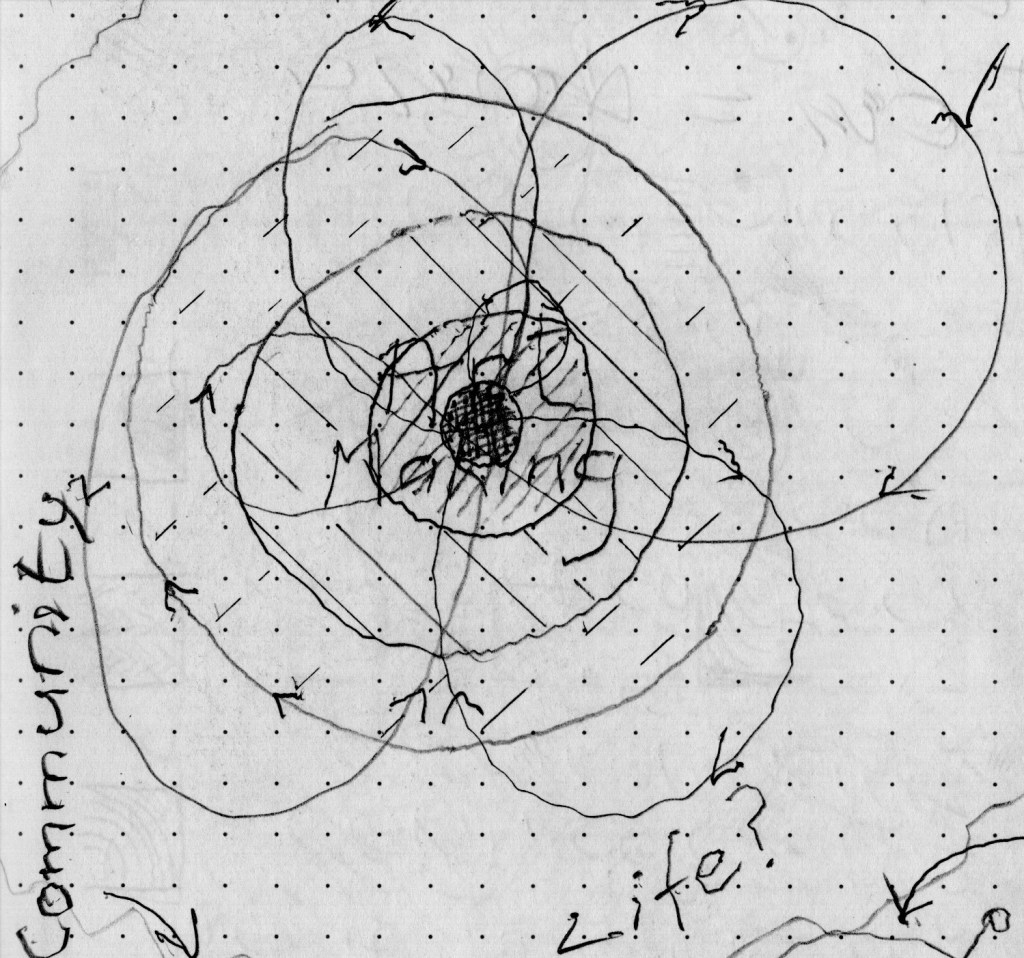
In my head what floated around was an image of a map of different experiences and interests with my walking path moving between them. On my return home I used a drawing app and made an image of I thought the map might look like. This is what I drew.

The drawing showed three elements. The looping line I had walked. This was my experience over time moving from one thing to another. Then the things I moved through over time, the art I made, other artists work as source material, art and learning theory, more structured research and reading and revisiting various ‘projects’ with a coherent theme. Then there was a n idea of my connection with the art making. I thought about it on the way in and out and reported on it. I have a journal and use sketchbooks for ideas and images. I became a witness to my own art making, and through reportage her, other people also witnessed what I made. The art making was characterised by mostly doing and the senses. I moved out of fully thinking mode.

Central to it was working with artform, which had a bit of all of the above, but had its own things to show and share. I felt a need to return to the central bit. What it contained I realised was always specific to the actual experience of artform at the time. I intend to try and map what happened in here on the day. On another day this would contain something different and something the same.

What emerged form this drawing, this thinking through doing and the senses, was not so much the act of art making I had put at the centre, but a realisation that the experience of art-making was inseparable from all the stuff going on in my life. The intention to make something as art at the centre still stood and like the walk on the beach, this making as enquiry makes itself. The art making has a mind of it’s own, the intelligence of material. And intention made the intelligence of many materials available. In this case the material was walking.

The experience of walking, and then dancing or performing the image was close to what I felt was my actual experience. But I had lots of stuff going on. I usually have a couple of art projects on the go, I have in mind the work of other artists and off other art works I had made, many of which involve walking. In many cases I did more formal reading and research or related ideas or phenomena, including academic research and writing. I experiment with different arts practices, with varying degrees of success. I reflect on art I wanted to make and my ability to do so. I make judgement on myself and my art making ability, and what I felt I ‘should’ be making and what I actually did make. Lots of stuff going on at a personal, intellectual, embodied and artistic level. Nothing is ever static, hence ideas in the original drawing of rhizomatic or adimensional knowledge.

My simple map image above came closer but it was a static image and the experience of the land depicted by the map was dynamic. A couple of things emerged.

1 – If a map were to be made to accurately represent the experience it would have to be local. It would have to show the things that were present in my immediate experience specific to the artform I was working on. The point of a map of a place is that it is specifically local. I was struck that the walk was specific to an actual place, but I was using it to make a map of a generalised idea about art making. This connected to a recurring theme.

Can you generalise about the experience of art making, create an image of that is replicable like I wanted to walk a replica of the image of an idea. Or does art making as a creative act and thus inherently improvised, mean that all art making is specifically local to the experience at the time? If we consider visual art, the art of image, the image has to be fixed. An image can only show a snapshot of an experience, but is can show insight into the personal processing going on with me in the experience. This has strengths and weaknesses.

2 – The move from a fixed image, from representation, to improvisation, to performance, opened the possibility of performance as a useful artform in which the artform was the experience. The film I captured of experience would show the walk as it happened. This would not be a snapshot of an experience. But this has limits. The point at which I moved to performance and I changed my ideas about my model and my art making would be present in the form, unless I added a commentary. But a picture is worth a thousand words. A image is a snapshot of an experience but it can show insight into my response to my experience.

Going from static to moving image.

From a static image I went to the movie footage with the intention of seeing if it could help me process my experience. I went to my movie footage and what struck me was the sound of the place I did the walk. I explored making a movie and to just show we wandering around in circles, but this did not appeal to me. A 20 minute movie of a beach with a man wandering about would not appeal to people viewing the footage either.

The duration was important and some artists have used the durational quality of movies to explore ideas. Andy Warhol famously made ‘Empire’, an 8 hour film of the Empire state building. It is boring but raises issues about how we experience and represent time.

But 20 minutes of me walking about was not what I wanted. I worked at speeding it up but lost the sound of the place. The movie below is my attempt at showing what the walk felt like out on the Solway, between high and low water, in feral space between human and wild spaces. To get the sounds of the experience listen with headphones. The soundtrack is from ‘Tu Non Mi Perderai Mai’ (You Will Never Lose Me) by Johann Johannsson and captured the feel of the walk.

As I write this it is now 2021. On viewing the footage what strikes me now is that I was totally mistaken over the date. I was a week out. The walk was the 18th of November. The desire to change the duration and speed up the footage also reflected a sense in which the walking a mile seemed to take no time. It was not boring and passed quickly. I also noticed that the movement of myself was reflected by a dog walker and the vehicles on the road. Over a month after the experience, this account or reflection of the experience shows me new things.

My belief is that the making of an art object that is between being both the experience and an account of the experience offers interesting opportunities to explore experience directly through art making. My research after my walk led on to two ideas from performance and post grad art as research which explore this idea of liminality and ambiguity between art as the experience and the account of the experience which I will cover in subsequent posts.

As a souse of reflection I also had my GPS tracks. I downloaded them and plotted them on various maps. I put the raw .gpx files into various apps or online mapping sites. One of the things I am drawn to is the way different maps tell you differne things about place you see on the map. I like Korzibski’s idea that ‘The map is not the territory’, both in terms of our experience of place, but in broader terms of consciousness. This is something I want to cover in posts about humanistic geography and the idea that we perform the outdoors as a place and an idea.

The mapping of .gpx tracks did not disappoint.
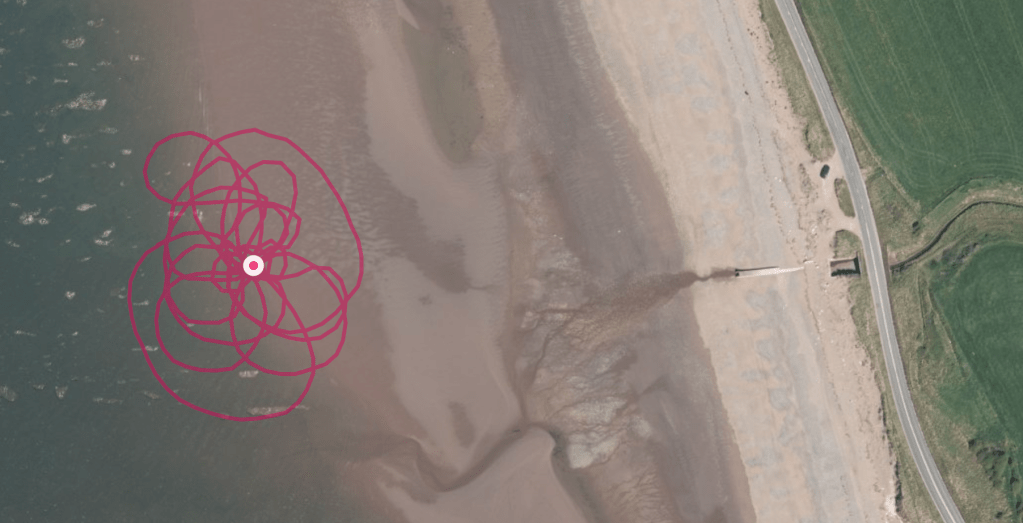
The idea that the image is a snapshot of moving experience was evident above.

Different mapping conventions show different things. I am fascinated with how using a map of a place before you visit colours your expectations and information about the place before you arrive and experience it directly. Also, if you go somewhere and look at the map on return, your direct experience dominates but you see new things.

it made me laugh to think that 6 hours later and my walking site would be underwater. Obvious retrospectively but it reminded again me that the Solway is never still and yet it is constant. Tides can be predicted with great accuracy, but never occur at the predicted time. A westerly wind will advance an incoming tide and hasten the time of a high tide. The spring tides always follow the full and new moon, two peaks a month. Neaps follow the moon as she moves from full to new moon. But the range of the springs, the height from top to bottom, vary over the year in a similar way to the month. We have two big springs a year. We have two big springs a month.

Working with the outdoors as art to explore and express personal experience can tell us about art, experience and the outdoors. I think offers interesting opportunities. But the outcome is never fixed in the way the tides are never fixed. We can say what we expect to happen, that at Silloth on the south Solway a spring tide of 9.24m will occur at 1306 on January 14th 2021, but in detail, what actually happens is always local. It is subjective, situational, emergent, an outcome of many factors. Subject to the weather and the sand, the lay of the land. My proposal is that the creative act, art making, is likewise. We start with a clear intention to paint a landscape that could be regognised as a representation of a real place, but the details of what we make is not fixed. It is a known journey of uncertain outcome, it is adventure.

The next two posts are about ideas form the arts about performance and the art object which may provide some academic and practice connections between art making and outdoor experiences.


  1. Practice as Research – Approaches to Creative Arts Enquiry. Edited by Estelle Barrett and Barbara Bolt. I.B.Taurus Press  ↩︎
Solway Walk – The Experience

The Experience of Walking an Image of an Idea about Art as Experiential Learning

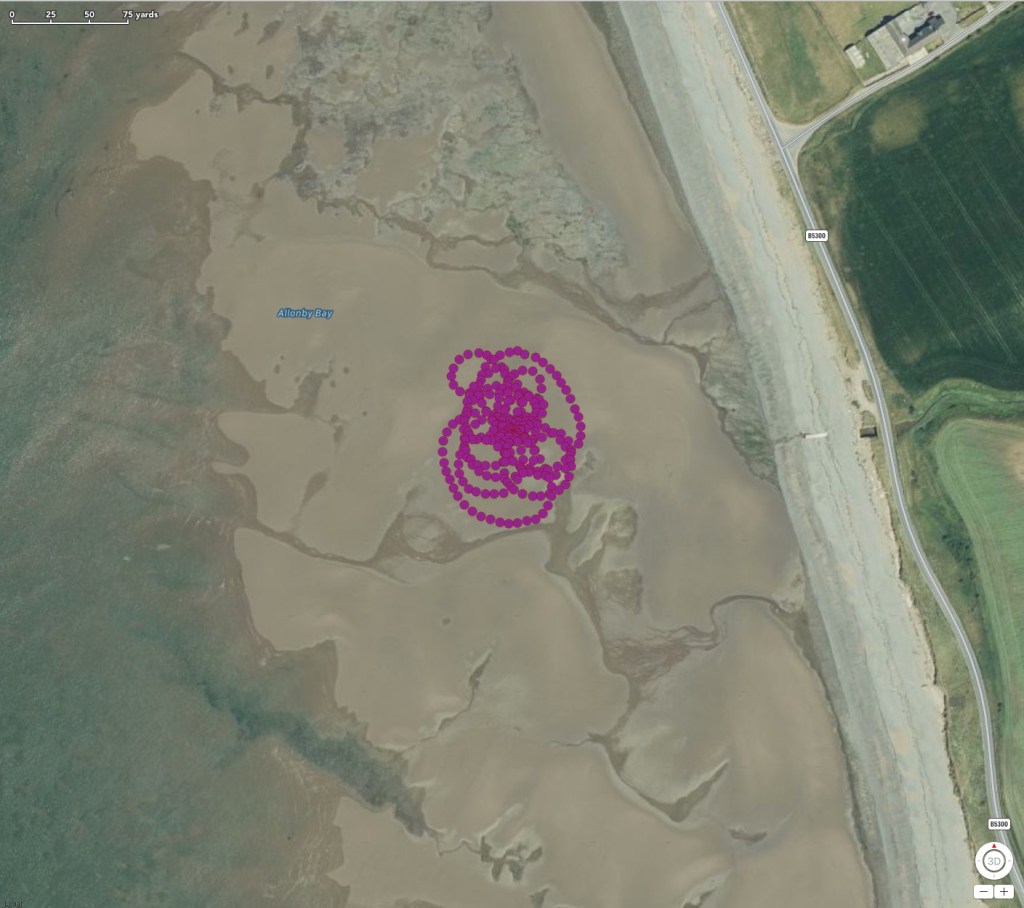
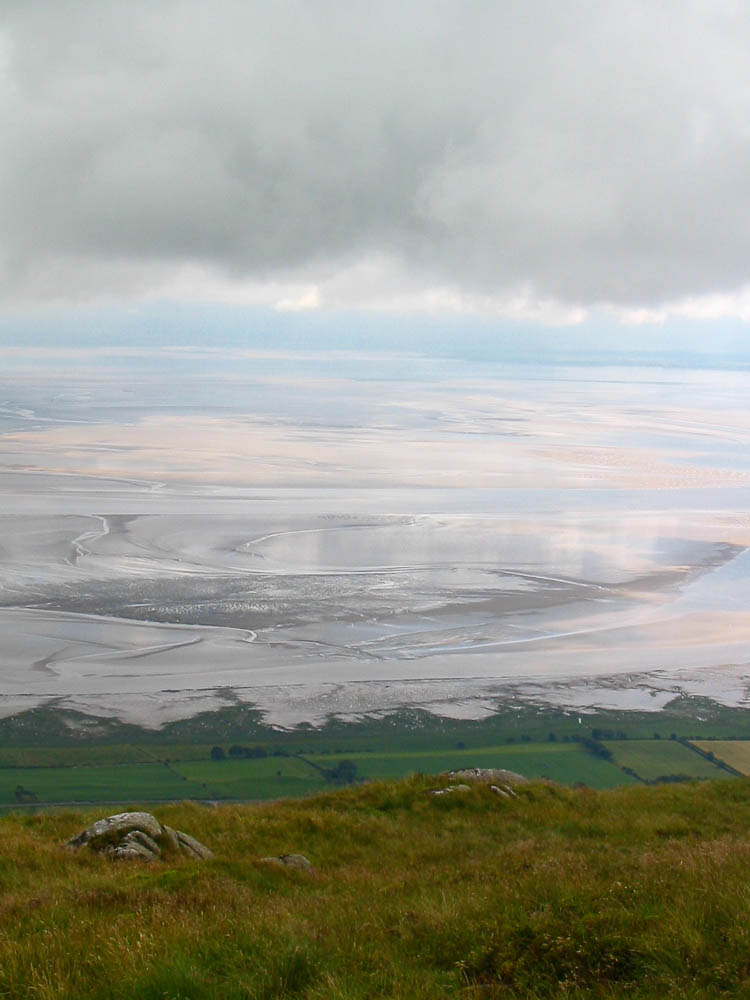
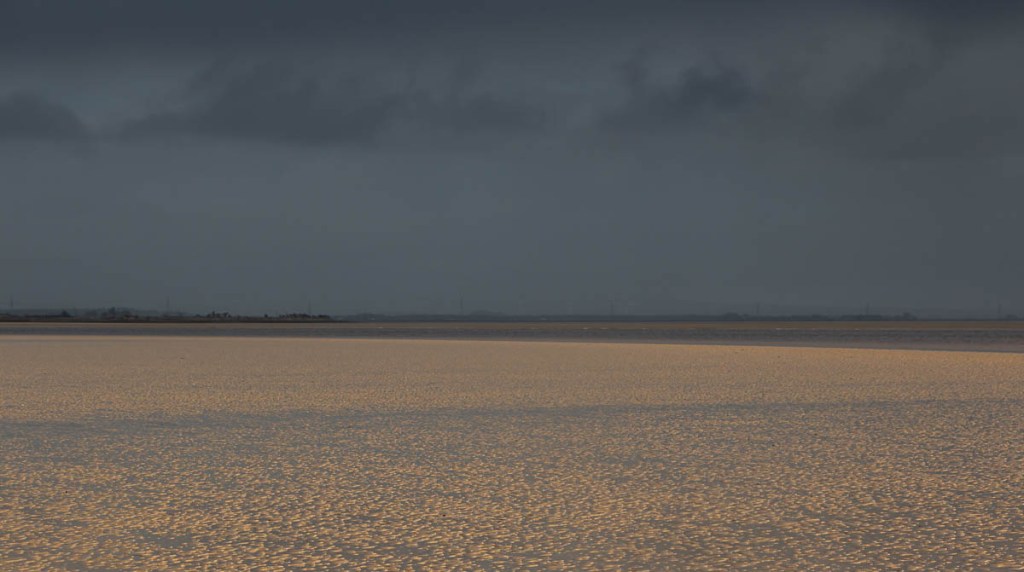
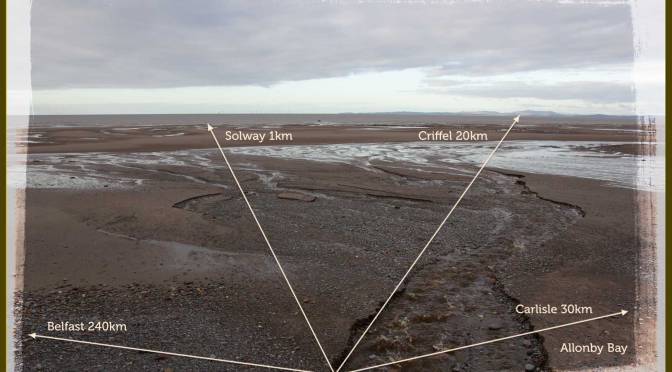
Dubmill Point in Allonby Bay was empty and big. From the road to the low water line was about a kilometre. I chose a spot to walk in the centre of the image above, a low bank of hard sand.

Dubmill Point on the South Solway

My intention was to walk the image below; my sketch of an idea about art making as experiential learning. I wanted to recreate this as a walk on the beach. I would use gps to track the shape I made, and record the walk on camera, and see what happened when I moved an idea from one artform to another, from an image to embodiment. I would walk with intention, attention and attitude. I would then write about my experience, reflect on theories and practices from the arts and learning, and see where this took me next. In my model below I would follow up this experience of art making into reflection, inquiry, reportage and further art making. I would not only walk my talk I would walk my thoughts.

art as experiential learning model

I set up my camera so as to get as much of the walk as possible without me becoming a dot in the distance. I set up my GPS and found my central point, meant to be the ‘Art Making’ part of the image of an idea. I set off walking in big loops.

Music : overdub1 by Chris Reed

As I walked it I kept seeking to return to the centre point. At first I found I lost sight of the central point. This would mean my GPS track would not reflect my drawing, so I put a marker there, a bit of seaweed and started again. I treated this as a rehearsal, an initial loop round my experiential learning model.

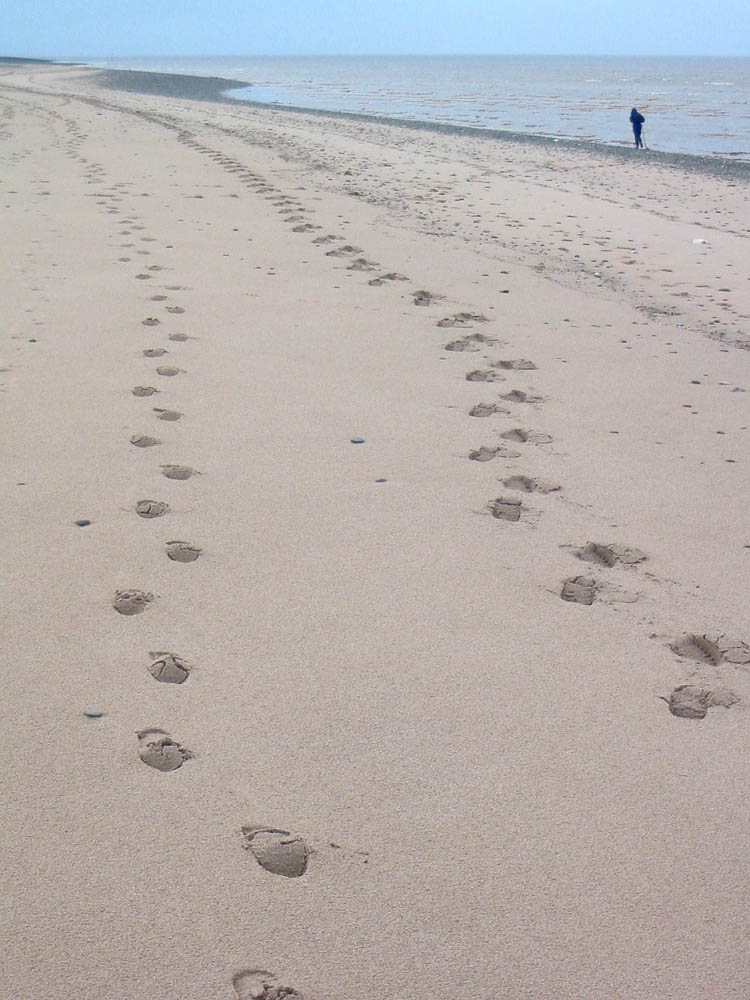
I set off again to recreate my drawing. I walked a line, one foot in front of the other, but by passing through the central point, I also walked in wonky looping circles. I got into a rhythm, I started to pay attention to how this might reflect art making as experiential learning. The central point became the place I returned to, but the loops took me to different places on the beach.

After a while I started to develop a kind of relationship with the central point. It occurred to me that instead of just walking the shape of the image of the idea, I could do a big slow looping dance with the centre as my static partner. I trained as a dancer and wondered why I had not thought of this before.

In the moment of being in moving as an artform, in the intelligence of that material, in witnessing my doing and the senses, it felt like this had significantly changed the experience. I found a freedom from mere representation, from figurative form, and improvised a new form. It became performance. Through this experience I learned a new thing about my art making practice.

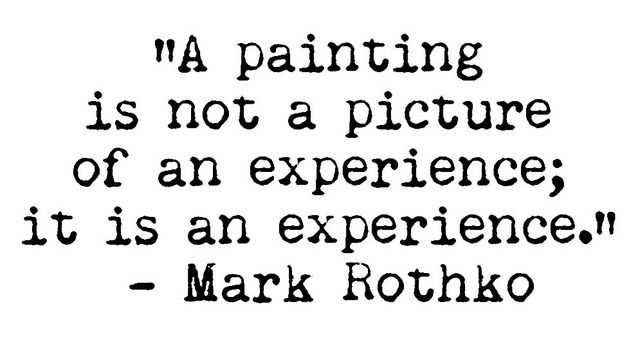
All in all it was a quick and easy thing. It took me about 20 minutes to walk a mile. There is quite a strong tradition of walking as art and performance art in outdoor settings. These forms are interesting in that they are durational, the art making only happens when the person is walking or performing. The experience may well be documented through film, photography or other forms, but it is unlike a painting in which the artform exists after the making it. The artform is the experience. Performance based arts are very experiential and offer interesting opportunities for experiential outdoor learning. But Mark Rothko stated that the art, even a painting, is the experience.

This is something I want to explore further. If the art is the experience, and we work with the outdoors as art, the art we make outdoors can tell us not only tell us something about outdoor experience, it can be the outdoor experience. We make something that is outdoor experience. This interests me a great deal.

Doing strange things in the name of art, like walking around in circles on beach may seem meaningless, but often I find that the most important learning comes out of what seems to be the simplest most meaningless experiences, or experiences that seem to have many different meanings. Ambiguity is important.

Walter de Maria, made action-art and land-art, only available when experienced directly in the outdoors. He said…

“Meaningless work is potentially the most important art-action experience one can undertake today”

…but also

Any good work of art should have at least ten meanings.

Walter de Maria 1968

See video here

Read article here

But my intention was to use this to explore my model of art as experiential learning, and at the time what struck me was that by changing from walking the shape of an image of an idea, to performance, dancing, improvising the idea directly in the space, my model changed, and so did my idea about art as experiential learning.

The image that immediately came to mind was my life as a map with different experiences and interests, different places, other artforms made, with the artform I am currently working on as the one with the closest proximity to where I was at the time. In my next post I want to reflect and report on this aspect.

The Solway – Betwixt and Between

A Visual Introduction to The Solway

The Solway Firth exists in a permanent state of being betwixt and between.

Between England and Scotland, between sea and sky, between high and low tide, between being land and water. It belongs to nobody. It is one of the least industrialised and most unspoilt large estuaries in Europe. It is as magical as it is dangerous. To visit on foot you need your wits about you as it can change from sandbank to fast flowing seawater in minutes.

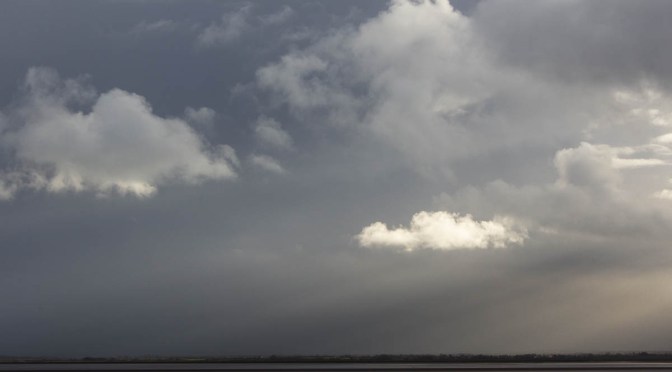
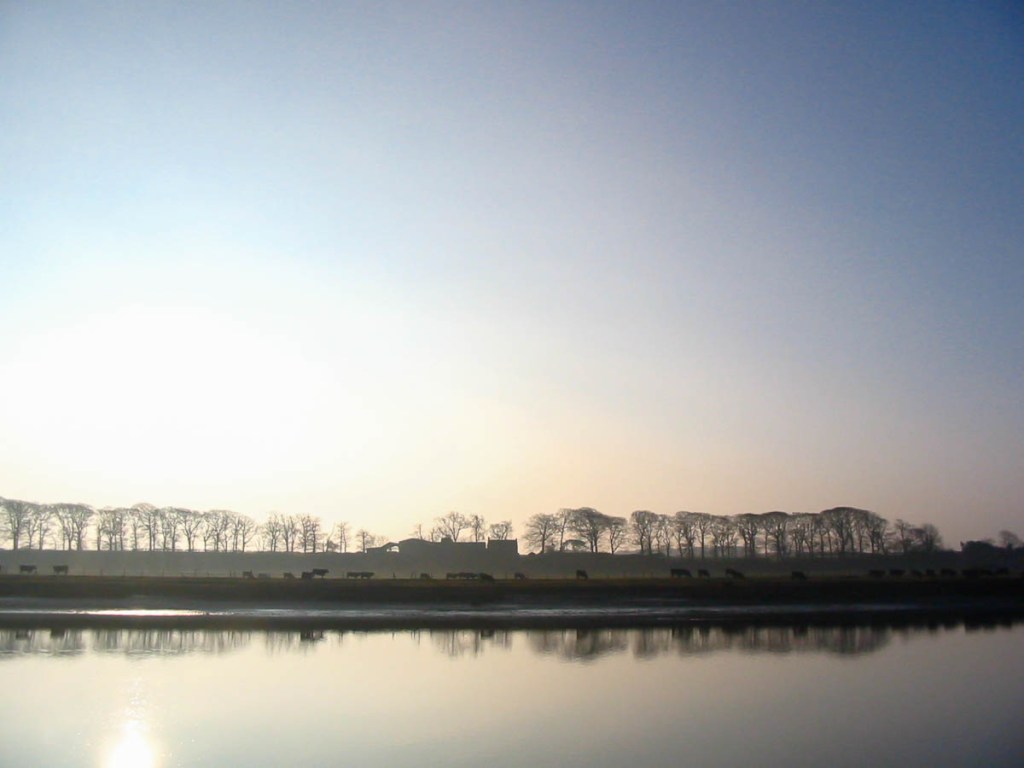
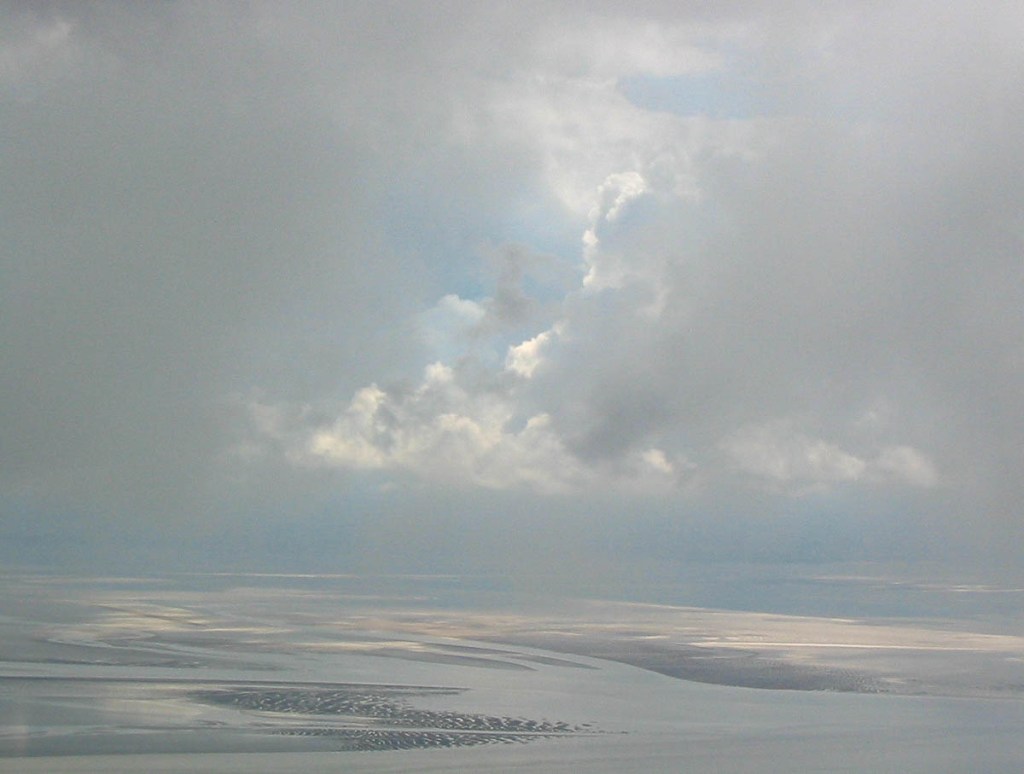
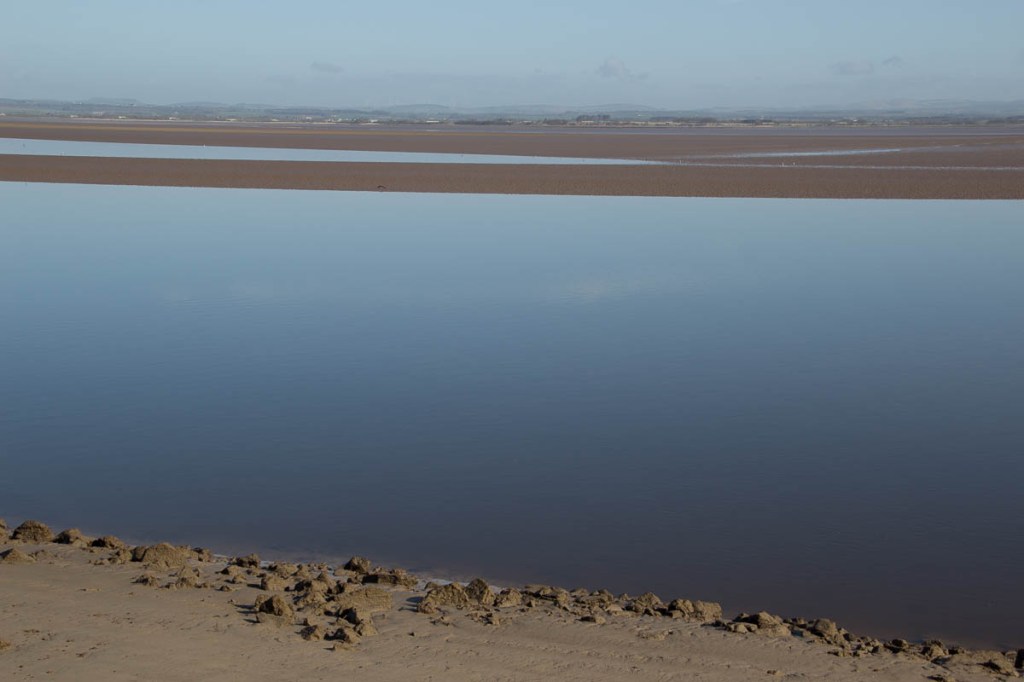
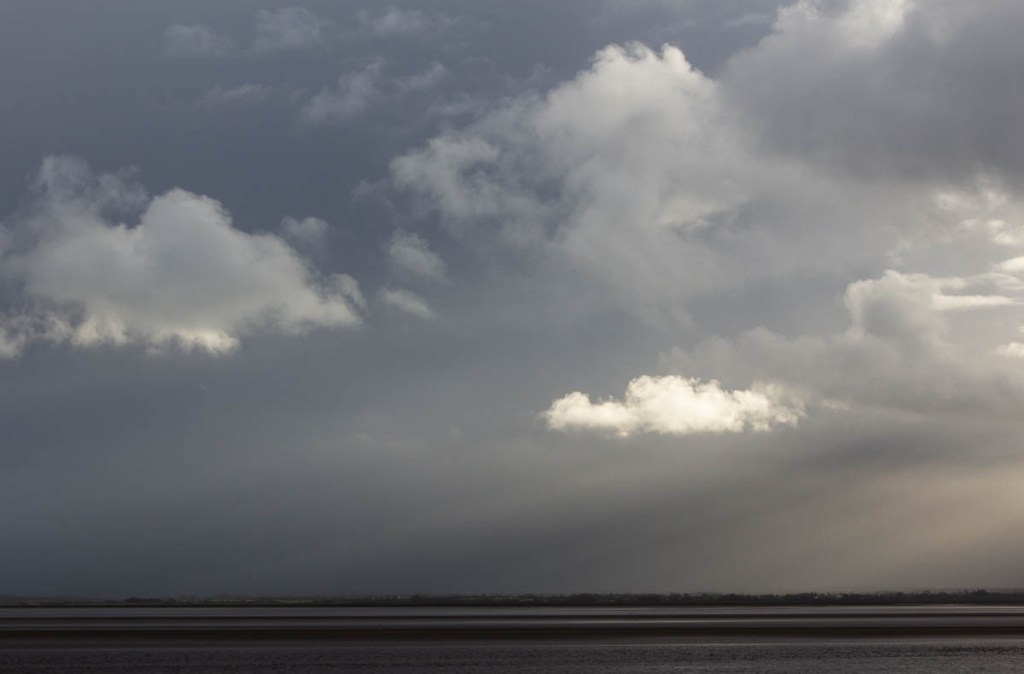
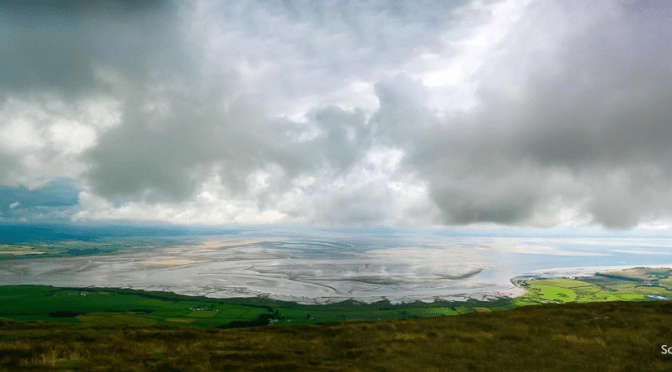
Below are some moving and still images of the Solway. More material will follow of other peoples experiences of the Solway.

  • sky over the solway

Solway Walk – Introduction

Towards a Model of Art as Experiential Learning

On November 18, 2020, I went to Dubmill Scar in Allonby Bay, the English side of the Solway Firth, to walk. I went to walk as art. Guided by the art therapies and experiential learning, I make art outdoors to explore and express personal experience. I work with the outdoors as art.

Most of my art making revolves around a series of place based projects. For this project on the Solway, I started with walking, but walking as a creative act. Walking in the space, I try to pay attention to what is happening with an attitude of openness to experience. I seek to be in the space as an experiment to see what happens rather than be in the space as a venue for activity. The art is the experience, and the experience is the activity.

This walk needed a large space with open access and no boundary fences, and at the bottom of the tide, briefly, the Solway has a lot of walking space. The Solway does this by being eternally transitory. It is always in a state between high and low tide. The border between Scotland and England, it belongs to nobody but the sea, the sand and the things that live there. These things need no fences or footpaths. I have been visiting the Solway for years. It is never the same twice. It is a space open to possibilities, and as such, a place of creativity.

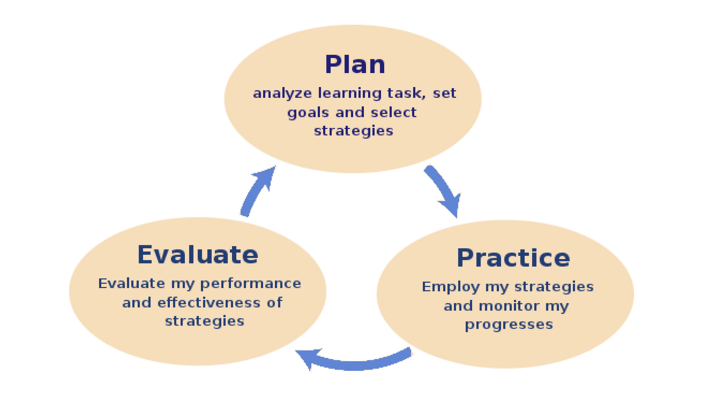
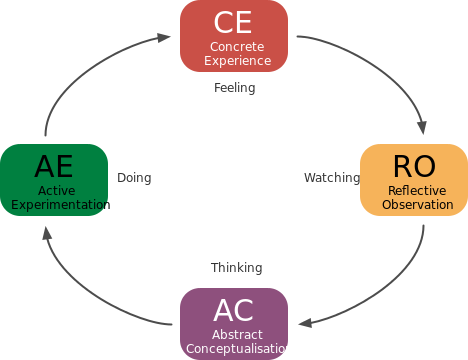
For this walk, the space was needed to recreate an image of an idea I worked on previously on about making art as experiential learning. My background in experiential learning has introduced me to a number of models of how we learn from experience. In all of them, there is an image of simultaneous movement, around a circle and along a line.

Plan Do Review Cycle

Kolb’s Learning Cycle

Using this idea and image of learning from experience as a starting point I reflected on my own art making and drew a sketch of experiential learning with art making at it’s centre to see how it might look. I wanted to move this idea between artforms. Each artform has it’s own intelligence, and shows things from another point of view. It is used in the arts therapies and is called multimodal working. It is an interesting technique. To aid with this I decided to film the walk.

things from a different perspective

As a starting point for how a model of experiential learning from art may look, I drew this.

art as experiential learning

First draft of a model of art as experiential learning.

In this model the looping line is my passage through time, through my life. The central bit is my encounter with art making. When I make art I learn something and this loops out back into my life and informs my next round of art making.

There a sort of sequence to this. I think about making art, then witness and pay attention to what I am doing and my senses when I make the art. The art form, the material of the art making has an intelligence of it’s own which can tell me something. This is an idea from artist and research Paul Carter called the Intelligence of Material (IOM). As part of this I also engage in reportage of my experience, which is what I am trying to do here. Writing and reporting helps me understand what I am thinking. In formal art based research, this is called exegesis, meaning interpreting arcane texts.

At the time I was also thinking about Rhizomatic Knowledge from Deleuze and Guattari and Bubble Charts as I felt that my experience of art making had an adimensional or three dimensional quality, hence the images at the bottom

But the bit I wanted to work with were the big recursive loops through art-making and back into life, where I did more formal research of artform, ideas, the work of other artists, theories of learning or art-making. So off I went to the Solway, with it’s big unimpeded wide open spaces, always in movement between states, and thus ripe for creativity to walk this image of an idea about experiential learning.

It is difficult to create and analyse at the same time, so my intention was to be in the space and the moment, witness what happened when I was walking as art, then reflect and report later on moving an idea from an image to an act of walking.

Generally what happens is that what I learn through the experience of art making acts like a cascade of dominoes, expanding out into inspiration to new art making, connections to theories and practices of art making and learning and insight into place and personal experience.

Over a series of posts to my blog I want to follow the cascade of ideas and art-making that will come out of the walk, then curate the posts into a themed collection of ideas, practices, artworks, a bit like a magazine. Over time I want to do a series of magazines covering different topics relating to art, experience and the outdoors.

In the next post I want to describe what happened when I did the walk of an image of an idea about art as experiential learning.

Mapping Sensation

Livingmaps Network ran an online event yesterday.

DRAWING MAPS, IMAGINED LANDSCAPES AND PANDEMIC STORYTELLING

A LIVINGMAPS WEBINAR

It looked at the impact of Covid on our lives and ways that mapping as an artistic practice could help. Quote…

‘Drawing, or perhaps more broadly speaking – mark making, is a deeply subjective tool that we can use to enter into other spaces beyond the here and now, perhaps into memories or imaginations of a possible future or as a form of visually representing emotional states.’

Lots of really good arts projects about mapping and imagination, of better futures and utopias, great and small. The idea of using mapping to express feeling and the imagination was very interesting and changed my way of thinking about mapping.

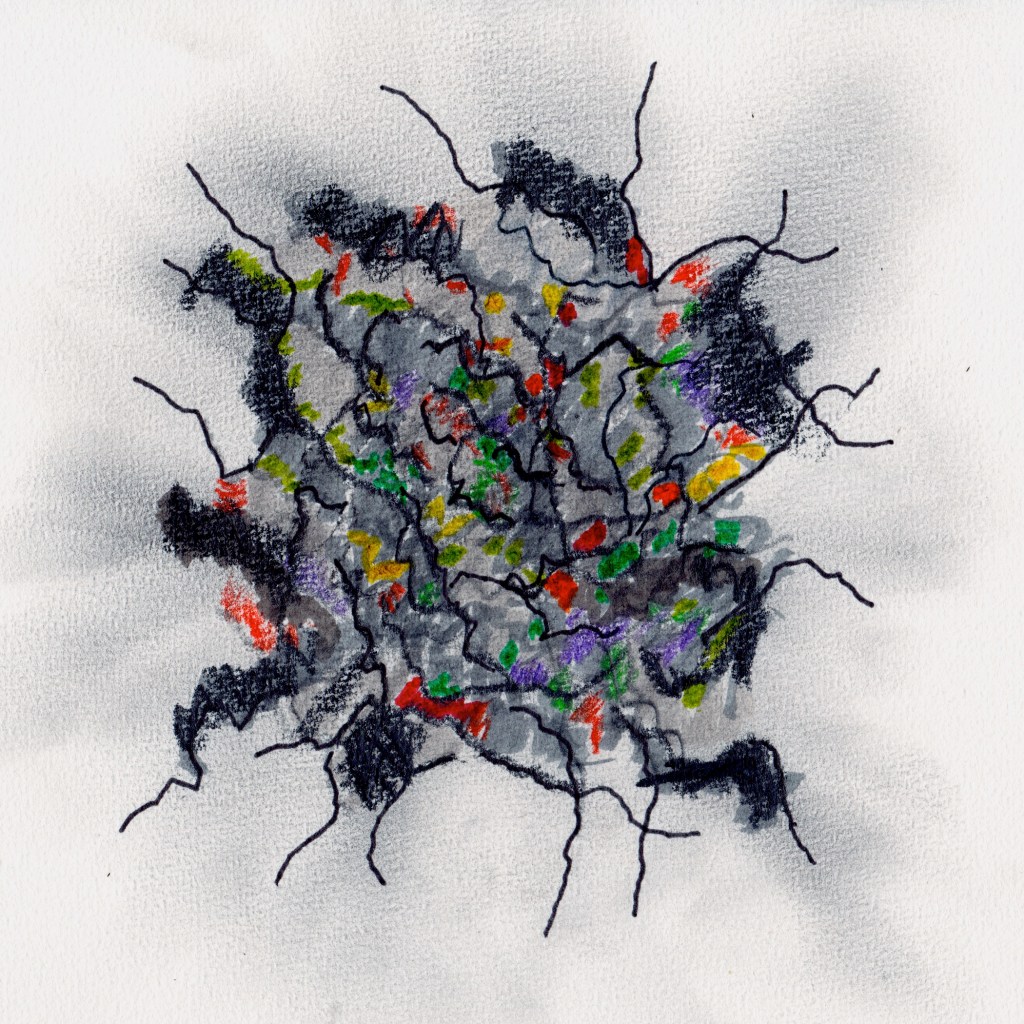
A place I visit called Walton Moss, and seek to make a subject of my art has evaded my skills for a long time. It is too big to photograph, or paint, and capture it’s magnitude. It is not particularly scenic in a classical landscape way, but is very impactful to visit. It seems to exist at two scales of sensation, the very big and the very small.

Walton Moss Sensation Map

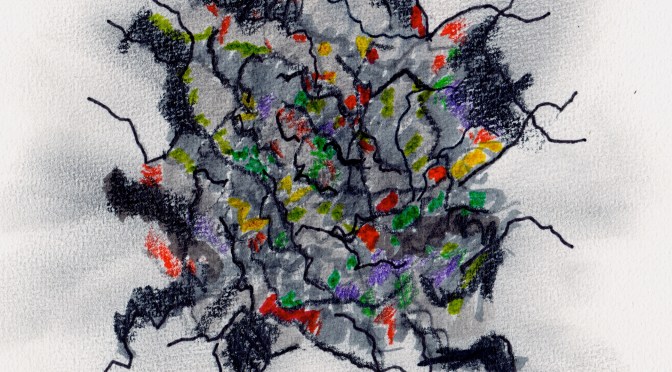
So I did the header image as map of the sensations it evokes, show above. What was useful was the way the map, as a form that expresses a large scale object through a smaller scale object worked really well. The idea of mapping feeling freed me from being trapped with figurative depictions of a magical but enigmatic place, difficult to express figuratively.

I used charcoal crayons, felt tip pens and watercolour pencils, then scanned it.