Tag Archives: Painting

Modern Art is Rubbish

This is an old TV series about Modern Art for those interested in art history.

Ironic eh?

This is Modern Art is from Channel 4 in the UK from 1999. It is a sardonic but serious series of six 1-hour shows, and covers ‘Art’ from Picasso to the Sensation show at the RA end of the 20th Century.

If you can accept the common misconception that ‘Art’ is famous white male painters, then you will be OK. The writer and presenter is artist and critic Matthew Collings. He is very tongue-in-cheek and disrespectful about what many may call ‘Great Art’ and many more may just dismiss as rubbish. He is informative and offers a useful commentary, but is suitably ironic. It also has a good late ’90s soundtrack.

It should appeal to people who know nothing about modern art and people who know a bit more than nothing, and its content is likely to have some people frothing at the mouth with outrage.

I went to Sensations and witnessed a great bit of theatre. The Damien Hirst pickled shark The Physical Impossibility of Death in the Mind of Someone Living was the centrepiece. A father and child came in, and the boy saw the shark and ran over, shouting “SHARK SHARK SHARK” then ducked under the little rope barrier around the tank full of thousands of gallons of preservative and whacked both hands, very loudly, on the tank and triumphantly screamed “SHAAAARK!’.

Everyone jumped, especially the ushers who all charged over in horror, not least ‘cos the boy could have broken the glass and flooded the gallery, thus wrecking the whole show. The boy then, under father’s tutelage, went around pointing to every piece he liked and described them all, now quietly, as ‘A shark!’ It was at least as good as the show. It was so funny. This post is dedicated to that boy.

Collings explores modern art through six themes.

Episode 1 – I am a Genius

Focuses on the current state of modern art, and looks back at Picasso, Jackson Pollock and Andy Warhol to see how they changed the definition of art.

Episode 2 – Shock! Horror!

Revealing the ways modern art attempts to shock the audience.

Episode 3 – Lovely Lovely!

Investigates whether the once accepted view of art as merely a thing of beauty prevails today, examining the works of various artists.

Episode 4 – Nothing Matters

Focuses on minimalist art.

Episode 5 – Hollow Laughter

Examination of the jokes used in modern art.

Episode 6 – The Shock of the Now

An exploration of the authenticity of modern art and the media hype that often surrounds it, asking if it can be accused of repeating the art of the past.


At the end of episode 6, Collings talks about the state of modern art at the turn of the millennium and contemplates the future. He describes what he sees in art then as ‘Big corporate global display.’

So in this old TV series about Modern Art, ironically, we see art as a means by which to contemporaneously see what is coming down the line. We are now, 25 years later, subsumed in the world of the big corporate global display. In retrospect, we may now see that the art was telling us what was going to happen. Just don’t tell our current philosophers and politicians and academics and influencers. They will be so pissed off art beat them to it.

All art asks is that you pay attention, intentionally, with an open mind, and be objective about your subjective response to what is made as art, especially art you make yourself.
Art Can Speak for Itself

Personal Practice : Being told to move on and out into the world.

Autumn on the border between England and Scotland is approaching. Students and teachers are returning to school. It is for many families a time of change.

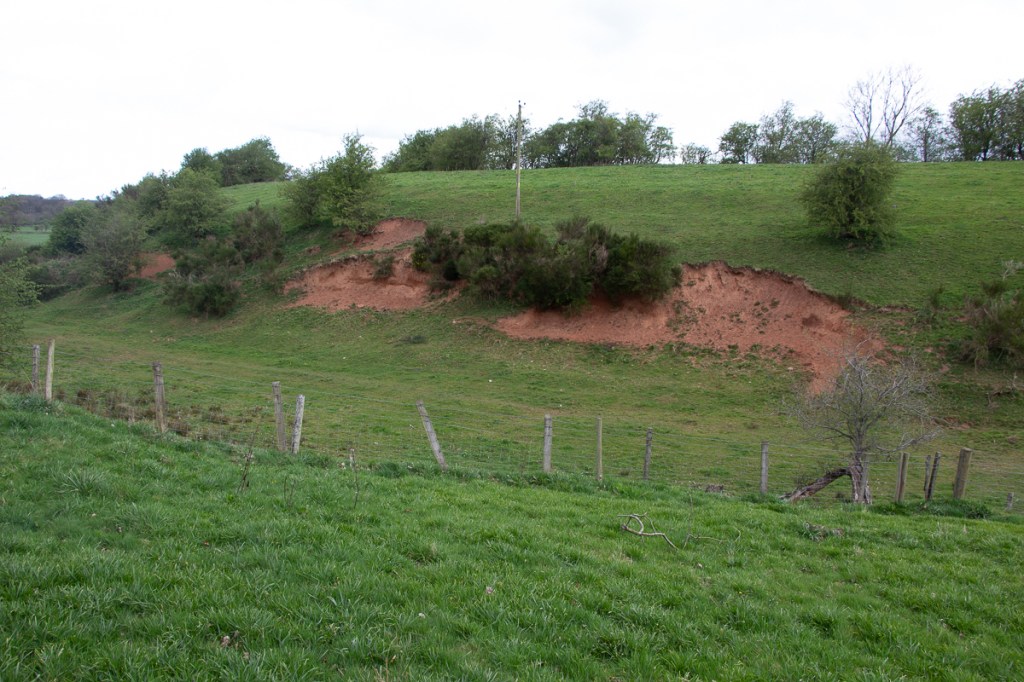
Over the summer, I worked on a large painting. This was in response to arts and research I had been doing locally. Our house sits at the northern limit of Brampton Kame Belt, a vast area of sediment dropped by the melting of glaciers thousands of years ago. This is featured materially and thematically in the painting. This painting was the endpoint of a long chain of outdoor experience and art making. This included imaginal walking artwork, just researching and exploring my local environs and more empirical work with conventional data, some of which is shared through links above and below.

The combination of the empirical and imaginal is very interesting. We can only know so much about things in empirical terms, and in knowing thus, we inevitably do so through entirely objective sources. Myself and the living environment have a subjective way of knowing and doing. To me, this is where art as research is useful. Artist and therapist Pat Allen suggests, ‘Art is a way of finding out what you believe’, and belief is subjective. Art connects me personally to place and process.

‘Art is a way of finding out what you believe’,

Pat B Allen – Artist and Art Therapist

The painting was an object, which was a product and record of my subjective experience of making it and an objective and subjective account of the place it was attached to. And the painting grew out of a mystery.

Background

On our arrival at our house decades ago, we had been told by a neighbour about a flood that came down the ridge above our estate and into her house as a child. There is no water course anywhere nearby, so we put it down to a confused childhood memory. Then, through my walking and art making, I found a culverted stream and confirmation of the story.

The stream was culverted in 1972, after a flood, so it was a real event, hence the culverting. Another older man on the estate saw we doing some research and told me about the flood, and dated it, and when the groundwater rises, the ghost of the stream emerges in the playing field that is now there, as unusually wet ground, and the sound of rushing water under a usually silent concrete block.

Much of my art making involves walking and creating art objects in response. It is never meant for display, just my way of exploring a place and my experience of it. I became interested in the idea of the land as the substrate of experience, the unconscious if you will, with water as a symbol of emotion or affect.

Looking on the Britice Glacial Map, I found that just north of our house was a glacial lake, and on my walks, a site where clay was abundant.

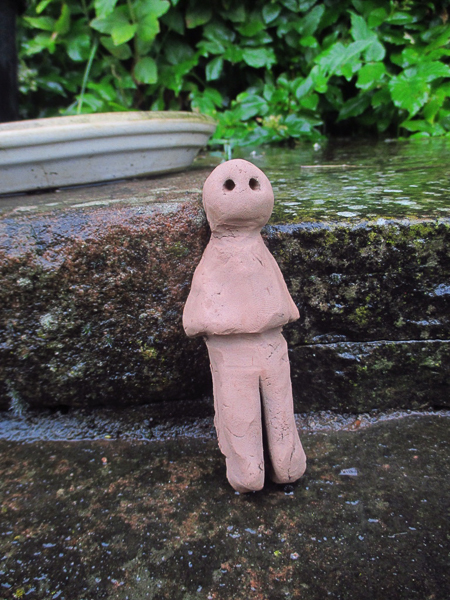
This was, I believe, the head of the lake. I took clay and made clay figures, and used the clay in paintings.

Making the Art

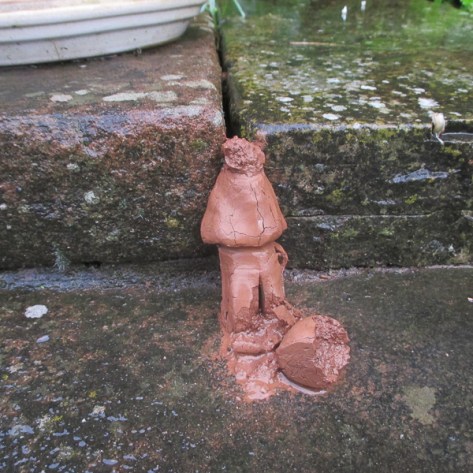
I baked the clay in a domestic oven and explored putting the figures outside to dissolve over time and return to the substrate from whence they came. Click the slideshow below to see the change.

  • clay figure
  • dissolving clay figure
  • dissolved clay figure

I found this very satisfying. I have an image of them as a kind of worry doll, being put out by a worried person as a way of animating the worry going back into the earth.

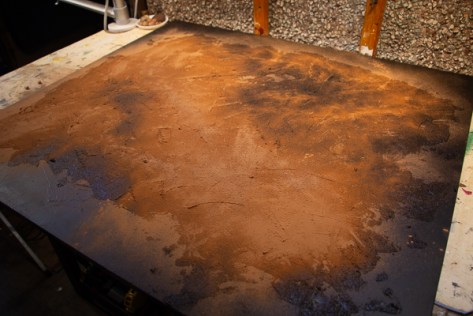
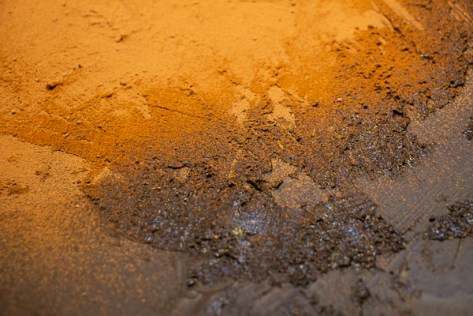
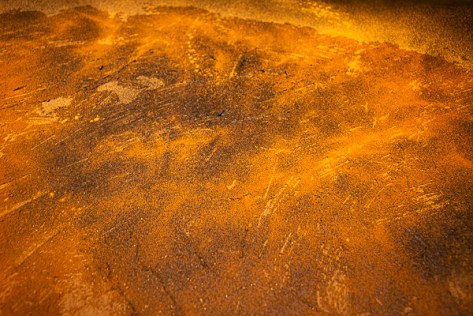
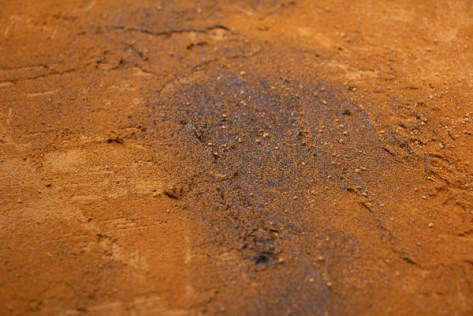
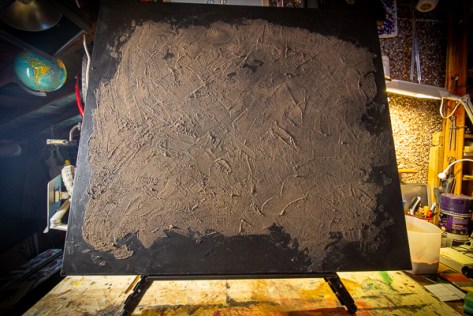
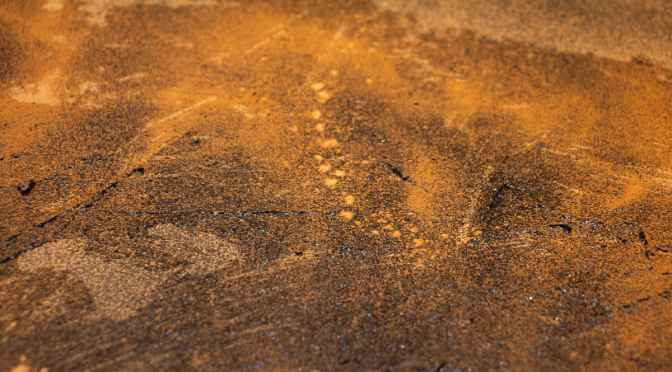
Then I worked with the clay in painting, mixing it with acrylic medium or just domestic epoxy to make a medium. I also put it onto a base of black acrylic paint, let it dry and then removed it with a hair dryer to see what happened. In the end, the object before the removal was much nicer, in fact, curiously beautiful. The slideshow below shows the painting before the removal of the clay, some close-ups, and the painting afterwards.

The final piece was not as I hoped. But the thing before the clay was removed was very interesting. I liked that it made itself, it made itself beautiful, and was entirely temporary. The only permanent thing was the picture of the process of it being made. It struck me as a kind of performance, and it seemed to tell me something. I see this all as work in progress. But the beauty of the moment, captured as a picture, as potentially a work of art in itself, talked to me of a way to make the process of making, the art form itself. I felt a need to show this in public as ‘Art’ or as performance.

What I took this to mean was that it was time to take my art making out of the very fruitful and rewarding realm of purely personal arts research practice and out into the world of public exposure. None of this was verbal or rational or even cognitive. I had the image in my head of the delicate and beautiful patterns made by the clay and a photograph as an objective account of this point in the process of making, now lost. It was the photograph, the image of the image of the painting now gone, and like the Pat Allen quote above, a belief that I needed to make this public emerged, that the photograph was as much art as the object itself and more than just a record of experience, it could be an experience in its own right.

With my background in groupwork outdoors and with art, it told me seek to make this experience available to other people, and that this could also be art in its own right. It could be performance.

So I found the Ramblers Association was looking for Wellness Walk Leaders, and I did the training and am doing three Mindful Art Perambulations.

Moving On

I have three walks in September, October and November. These are targeted at anyone wanting a short, easily accessible walk, including people in wheelchairs and seniors.

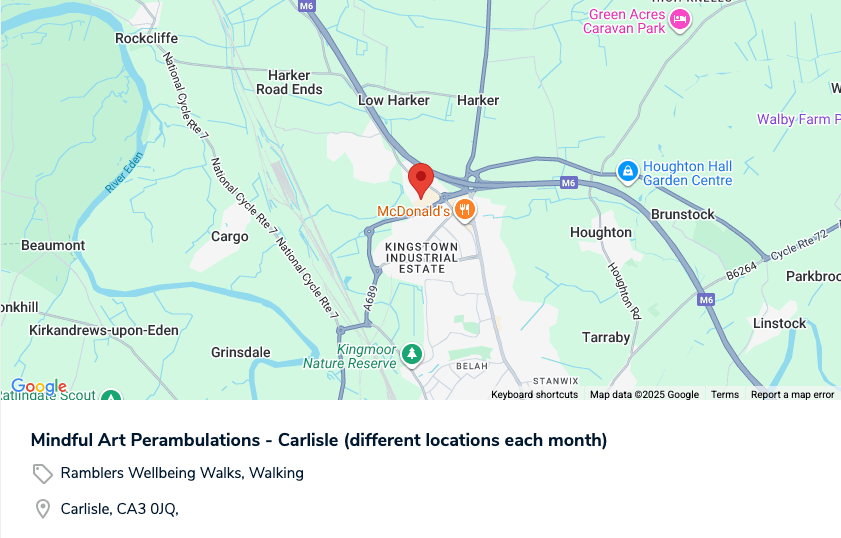
The link to the first can be followed by clicking the picture or the link below.

Map of the start of the first wellness walk in Carlisle.

I will post more later about the walks and what happened.

A Working Model for Art as Research

Introduction

This article introduces a number of ideas I have explored as an attempt to develop a basic experiential learning model to become a model for art making as research of personal experience.

This is the model I developed to describe my own working practice. It draws on all sorts of sources that are generally not referenced in writing I have seen about experiential learning, but through my own practice research, I think are relevant to art making as experiential learning. Experiential learning is assumed to be a form of personal research, and references are made to work from post-graduate arts-based research in Fine Art and the Arts Therapies.

It has seven elements, which are presented as parts of a circular sequence that returns to itself. In practice, these elements often occur simultaneously.

It is a long read of about 7k words, taking about 25–30 minutes.

I present it as a long blog post, click page 2 below.

Art as shitting & dancing & cooking – John Baldesarri

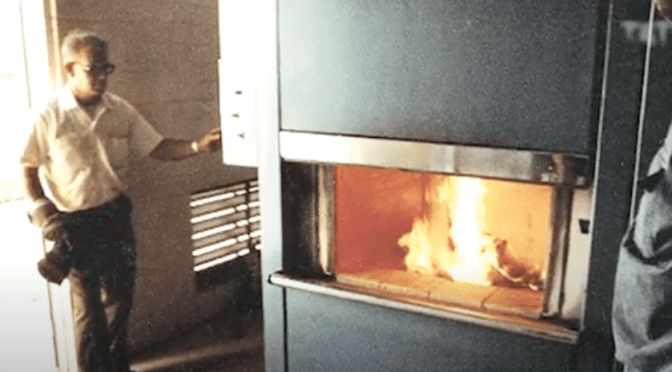
Artist John Baldessari is notorious for, at some point, burning all his paintings. This act enabled him to become a major figure in the development of conceptual art, an art form equally derided and applauded, but close to the idea of art as research of personal experience.

This is what he had to say about it.

“Doing art is the only thing I’ve come across that’s gives me any idea that I’m anywhere close to understanding what the universe is about. It all sounds very mystical I know, but I think that’s what drives me.

The real truth in the universe is there’s movement and change and art reflects that, and dance, you know, any anything with movement or music or whatever. But, you know, in painting or sculpture it’s just all static. I guess around certain objects or certain situations there are certain conventional parameters, and we can begin to use those meanings like a writer you know, like a musician, or like a cook, whatever and create some sort of composition or dish.

I think was around ‘68 thereabouts, close enough, I was getting doubtful that painting equals art and art equals painting. I began to suspect that art might be more than that. I was literally thinking of my work as a surrogate for me, and me talk about a body of work, and so I took it very, very literally and thought of it, you know, this body had to be cremated. The ashes I still have, they were given to me in these sort of like shoe box’s, but not quite as big, and that would be the size for the ashes of an adult.

So I got nine boxes of those and then one smaller box which was used for babies and amputated limbs. They asked me if I wanted an urn for the ashes, and I hadn’t thought about it prior, and I said well let me see what you got. The one I chose was in the shape of a book. I like that you know, that I could have it on my shelf. And I did actually make some cookies out of them at one point.

Only one person and I knew ever ate one and the idea there was that there be some sort of eternal return you know, that pigment comes out of the earth and it comes back you know, and is made in the paintings and the painting is burned and goes back into the Earth again by shitting it out and, and so painting is just one point on the circle. I was truly sick. It was just like a whole new world opening up. I didn’t know what it was but it wasn’t going to be painting….”

Watch the video below.

The transcript ends at about 3:30

Why Art as Research?

This post is a brief discussion about the descriptor ‘Art as Research.’

Like ‘Art’, ‘Research’ has many notions attached to it. The most well known one would be the notion of research as a scientific activity to seek an objective truth or empirical data. This is useful to ‘Art as Research’ but as a supportive or adjunctive activity.

‘Art as Research’ here means using art making to research your personal experience. It is understood as the intentional act of an individual to attend to something or to seek some unknown thing. You make art and attend to what you make and what happens when you make it. Whatever you find in your research, what comes to your attention, will be entirely subjective.

This approach to research as a subjective phenomenon reflects its older pre-modern form. Etymology Online best sums it up thus…

research (v.) – 1590s, “to investigate or study (a matter) closely, search or examine with continued care,” from French recercher, from Old French recercher “to seek out, search closely,” from re-, here perhaps an intensive prefix (see re-), + cercher “to seek for,” from Latin circare “to go about, wander, traverse,” in Late Latin “to wander hither and thither,” from circus “circle” (see circus).

From Etymonline

Research in the sense described above is accessible by anyone with a pencil and a sketchbook. One does not need to be an ‘Artist’, or have a PhD, or access to the Large Hadron Collider. You just need to be curious, and willing to make art, and to attend to yourself making art.

It describes art as a verb, a doing thing. It supports the idea of art making as an intentional and concerted search or investigation. It supports the idea of it being a bit of an adventure, a wandering journey where we don’t know what we are going to find. It also supports the idea of it having a circular or recursive quality. What we find in our search feeds forward into the next act of searching and finding. It also has, through ‘circus’, connections to performance.

It supports the idea of art making as a way of researching personal experience. This emerges directly out of experiential learning and the arts therapies. It focuses on the process of making art rather than the product made. With art making as an activity learned through experience, you learn to make art by making art, so too you learn to find the outcomes of your art as research by making art as research.

Given that what you find will be subjective, I cannot tell you what you will find. But most importantly, No1 in my Top Ten, you learn to make art through your experience of art making, so your art making can be used to learn about your personal experience. You learn about yourself through yourself making art. This is where the benefits lie.

Art is Anything You Make as Art

We may ask, “What is art?”

It could be….

Art as a Verb

At the core of ideas about art as a way to explore and express personal experience, this is of central importance. We are talking about working with art as a verb.

A verb is a word used to describe an action, state, or occurrence. We are focusing on art as an active state of being and doing. If you look up the word ‘art’ it is only ever expressed as a noun, the name of a thing. This means we tend to think of art mainly through it being an object, a painting or a sculpture, and not the process or the experience of making the art. For art as a noun, the act of making can get overlooked. The art object has a name, but the act of making art does not.

Could I Ever Be ‘Arting’

A person can describe themself as a ’Traveller’. This could be a description of a discrete cultural group. This could be the name a person calls themself if they practice independent travelling to remote settings. For both, their experience of being a traveller could be ‘travelling’, a description of an experience, a verb. They could say their favourite experience is to ‘travel’. But a person describing themself as an ‘Artist’ would not describe the experience of being an artist as ‘arting’. They could not say their favourite experience is to ‘art’.

Art as Change

But this factor is not lost in the world of fine art. Yoko Ono is a fine artist and was part of an art movement called Fluxus. Yoko was once quoted as saying, “I thought art was a verb, rather than a noun.” Wiki describes Fluxus as ‘…an international, interdisciplinary community of artists, composers, designers and poets during the 1960s and 1970s who engaged in experimental art performances which emphasised the artistic process over the finished product.’ The name derives from flux, a state of continuous change. An object like a painting does not change. But an artform like music or theatre can exist in a state of change. Unsurprisingly, Fluxus had a manifesto here, of which the first line was ’To affect, or bring to a certain state, by subjecting to, or treating with, a flux.’ and equally unsurprisingly included a goal to ‘Purge the world of bourgeois sickness’. Art as revolution….

I thought art was a verb, rather than a noun.

Yoko Ono

Art Making as Performance

So, given what Fluxus extolled, a performance sensibility could be applied to art making. Richard Schechner is a theatre director and Professor of Performance Studies. He asserts we can understand any human action ‘as if’ it were performance. From the point of view of performance studies the performance is the thing that happens between things, with one thing being a view of the spectator, the other being the thing viewed. So a painting can be seen to be performed as much as a play, if the painting or the play is seen by somebody. It becomes art if it is observed in such a way as some thing happens for the person who sees the painting or the play. The object does something. It becomes subjective. It goes beyond being just a passive object.

This suggests that we may make art out of anything we do that we pay attention to if we attend to it in a particular way, with a particular attitude. When we write in a journal about our experience. Or when we draw in a sketchbook some thing we saw. When we make a representation through words or image of some thing we experience, we can see our words or our drawing as art.

A Definition of Art as a Verb

It is tempting at this stage to seek a definition of art. But given a definition of art will necessarily refer to art as a noun, as an object, even if that object is theatre, a performance, I wondered for ages about a definition of art as a verb, a doing thing, an action. In the end, I figured one definition of art as a verb could simply be ‘Art is defined as anything you make as art.’ For me, this works. This renders the definition subjective. This makes the making the definition. It does not need words. What you do is the definition of what you do. This makes art recursive, a theme I will return to.

But. You may well paint a garage door with high-gloss exterior paint and call it art. And you may well be laughed at and be shown the door if you seek to sell it to Sotheby’s. However. If in painting it, you learn how to paint it better next time, if you find a way to make it be flatter and shinier in a way that pleases you aesthetically, then for the purposes of Moving Space, you have made art if you say it is art. You may have to accept that your subjective definition has little or no objective value beyond your subjectivity, hence Sotheby’s declining to put it up for sale alongside the next Banksy or Breugel. Sorry. It’s back to work for you buddy.

Art is defined as anything you make as art.

You the reader…

I think once we see art as process and activity in a state of flux, art as a noun, art as an object becomes less important. The art object as ‘Fine Art’ however, never becomes irrelevant. The fine art object made by a fine artist can become a source of ideas and inspiration for your own art making. And ‘art’ as a subjective definition, art by your definition, as a thing you make as art, may be just a garage door to someone else. Seriously, get over it. But Andy Warhol, an artist equally loved and scorned, once said, “Don’t think about making art, just get it done. Let everyone else decide if it’s good or bad, whether they love it or hate it. While they are deciding, make even more art.” I can tell you I have thought a lot about all this, but art making has tempered the value I place on thinking. Art can help you to avoid thinking too much. This is a health benefit.

Don’t think about making art, just get it done. Let everyone else decide if it’s good or bad, whether they love it or hate it. While they are deciding, make even more art.

Andy Warhol

Top 10 Tips for Arts For Health

  1. The art is the experience. We learn to make art through our experience of art making, so art can be used to learn about our personal experience.
  2. Make art not Art. We cannot all be artists but we can all make art. Make some art to neither sell nor show. Treat art making as research and investigation of yourself.
  3. Intend to attend. Pay attention to what you make and what happens when you make it. This makes making art like meditation. Inhabit and enjoy the process.
  4. Make art as adventure. It is a journey of uncertain outcome. Enjoy the journey. Your destination will make itself known, and it will pass.
  5. Make art as performance. It is what happens between you doing and you seeing what you are doing. Your thoughts and deeds are the material of your own acting.
  6. Just keep going. Do little bits regularly. Take a break. Benefits appear and grow over time. Just keep going.
  7. Attend to other peoples art. Find stuff you like and want to copy. Steal it and make it your own. All art starts with theft. Be a thief.
  8. Try lots of ways of making art. Find stuff you like and explore your way of making it. If you don’t like it, don’t make it. Be ruthless.
  9. Art is anything you make as art. You can paint, sing, dance, walk, sculpt, write, sew, draw and even sail or sleep as art. Seriously it’s all been done. The world is your oyster.
  10. Show and share carefully. If you do show what you made, show it to your people, the ones you trust. It is still art even if it is not in a gallery or for sale. People, including you, don’t need to like it. Your art can speak for itself. This is it’s power. Pay attention.