The fourth leg of the grid square walk.
Heading east.
Click the link below to read the page.
Items about place and how we understand it
The fourth leg of the grid square walk.
Heading east.
Click the link below to read the page.
A link to a BBC Radio programme, The Verb, which is described as ‘Radio 3’s cabaret of the word, featuring the best poetry, new writing and performance.’ This week it featured Margaret Atwood and Alice Oswald talking about how we write poetry, and their own process, the natural world, time, and the possibilities of myth.
At around 35 minutes there is an interesting account of how writing poetry changes the poet. This reinforces the idea that it is an act of experiential learning, and it is recursive, the poet makes the poem which makes itself and also makes the maker. The header image reflects this as a self-making pattern of continuity and discontinuity.
This post is a link to a very interesting article, describing arts practice as a way to practice finding a healthy balance between chaos and predictability. Mark Miller, a philosopher of cognition and research fellow at both the University of Toronto and Monash University in Melbourne talks about the human brain as a prediction machine. The source, VOX, has as its strapline ‘Your mind needs chaos – The human mind is designed to predict, but uncertainty helps us thrive.’ In the article Miller proposes that mental health needs some chaos, and art making can healthily provide that chaos.
The article summarised
Being able to predict what happens in the world is useful. We have a system in our head that seeks to predict what happens in the chaos of the world which upon experiencing this chaos feeds back to modify the model so that it can then feed forward to guide our behaviour. This is the recursive act of learning from experience, or not. If we don’t learn from experience we can become overly fixed or overly chaotic in this process and thus become unwell. The proposal is that viewing and doing art both provide an experiential arena where we can practice the skills of managing our encounters with chaos.
Arts materials like words, paint, musical notes, wood, stone and movement are in an unstructured or chaotic form when we encounter them. In creating form as art makers we learn to make form out of what starts as unformed, but in doing so some new or unexpected or chaotic element makes itself known. We take things we think we know and see them in a new way. Form and chaos coalesce.
Me summarised
The header image shows grass responding to its environment. I worked for an events organiser and mats put down for a wedding overlapped and removed the light so the grass stopped photosynthesising. One layer of matting let enough light through for the grass to photosynthesise. In my art making I end up with an embodied account of my experience. This image immediately struck me as an embodiment of the experience of the grass.
I found this very exciting like the grass had become an artist. It filled me with wonder and awe in a way that kind of freaked other people out. I do genuinely believe my awe at seeing the experience of grass was a result of my persistent and consistent exposure to art making.
In viewing and doing art I am consistently in awe at seeing some new thing I have never seen before. It might even be a thing I made. Yet the awe emerges out of the most mundane things, paint, pencil marks, and poetry as just organised words we speak every day. It is like through art the intentional exposure to uncertainty and unpredictability teaches me to be able to see new possibilities. And not only that, but to know that I know from my experience of art making, that I will see new possibilities in both chaos and mundanity. This is I think, the wellbeing the author and article refer to enacted and rehearsed through the act of making art.
The link below will lead to the original article on VOX, which in turn leads to the original podcast.
The third leg of the grid square walk.
Heading south.
Click the link below to read the article.
The second leg of the walking as art.
Things get serious.
Click the link below to read the article.
The Devils Hill.
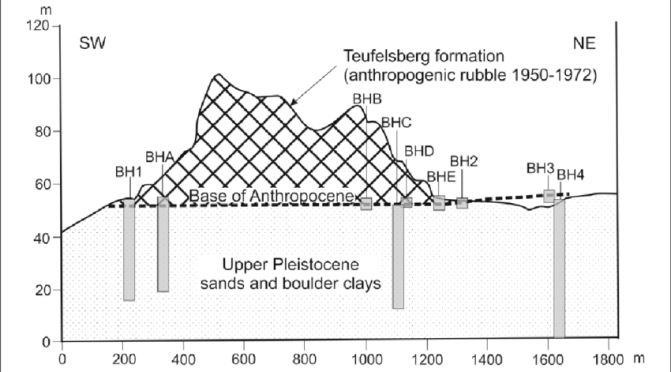
The caption says…’The Teufelsberg Formation was built of war rubble including concrete, brick, clinker, rock, fly ash, slag and solid chemical waste, deposited between 1950 and 1972, forming the highest elevation of Berlin. Thin Holocene deposits may locally separate the Pleistocene and Anthropocene units.’
https://en.wikipedia.org/wiki/Teufelsberg
The allies raised Berlin in 1945. I watched a PBS thing which showcases how the cities of Le Havre, London, Berlin and Warsaw were destroyed during World War II and then rebuilt, using archival footage, visual effects and first-hand witnesses who contributed to the cities’ rebirths.
I did a search and came across the header image of the substrate of the Holocene, overburdened with a man-made hill 80m high of the detritus of war, put there to make space to rebuild Berlin, and if moved industrially, replete with the dead, humans, children, men and women, and it was quite shocking.
At the moment I am trying to write an academic thing about art as research, and the theme is the ideas of the New Materialists, Donna Haraway, Karen Bard, Rosi Braidotti and my favourite Jane Bennett, you know, Gordons sister.
There is a lot to it but the hu-man centred world, The Anthropocene, features highly. Like, the idea that, by being just centred about ourselves as hu-men in a world made of inert matter and dumb animals and even more dumb plants, protista and protazoans, all there for our taking, might be a bit of problem. Humanism, us at the centre of the cosmos, might be best left behind through an idea of post-humanism, where we share the world with the more than human world and vibrant matter, makes sense.
But that line in Hi Ren… “You got to kill you if you wanna kill me…” rang a bell. If bad Ren is the one making us make war, and making a wasteland of the world, then bad Ren is right, you got to kill you if you wanna kill me… we will kill ourselves short term to live with ourselves long term. I s’pose that is evolution, seeing as 99.9% of all living species are now dead. If we go post-human will we, by will of our newly shared more than human world nature, just become a man-made hill 800m high of the detritus of war and call it evolution. Like Woody Allen said, “I’m not afraid of dying. I just don’t want to be around when it happens.”
A theme developed in post-humanism, is that we have to find a way of ‘Staying with the Trouble’ ie the trouble we have made for ourselves. We need, like Ren shows us, to have a word with ourselves.
And on hearing Ren I remembered a thing I did as a performance that showed the act of co-evolution, two species evolving independently to arrive at the same place. I wrote this
Two Figures:
At 64 and over time
Grit in wind and water
Erosion and corrosion
Remove matter
To show what matters
Two figures emerge
In black and gold
Millstone grit
Unsure what they are at first
Until a diptych
Two parts
Connected
Remain
The First Part
As the end of life
shines brighter than birth
A hard core
Of misanthropy
Takes hold
And says
‘I am
Looking forward
To leaving this all behind
All that we have done to this world
It’s your’s
You can keep it
Too many kinds of phones
Too many kinds of coffees
Too many kinds of milk
Too many choices
Enough
We are consumed
Evolution did not halt
With the arrival
Of Homo Sapiens
Finish me before the extinction event
It is unfair I know
But children,
It is your’s
You can have it.
I don’t care any more
The Second Part
But
Sensation
I will miss
The sound
Of children coming out of school
Or walking
At the end of summer
And hearing
Joni Mitchell singing..
Blue
Drifting out a car stereo
In a jam
Blue
The colour of the sky
My daughters hand
My wife arms
Wind at my back on the Pennines
Waking up outdoors
Sleeping under canvas
The smell of coffee
The scent of cut flowers
I will miss my body
I will miss you
I will miss the world
I will miss this
Sunday afternoon beckons. Saturday was interesting. The usual suspects played up.
If you have work to do and need some chilled and slightly warmed sounds to keep you focussed and alert, try Tru Thought’s latest chilled 2 hour slot of modern British and Global tunes. I am proud to be part of this that follows…
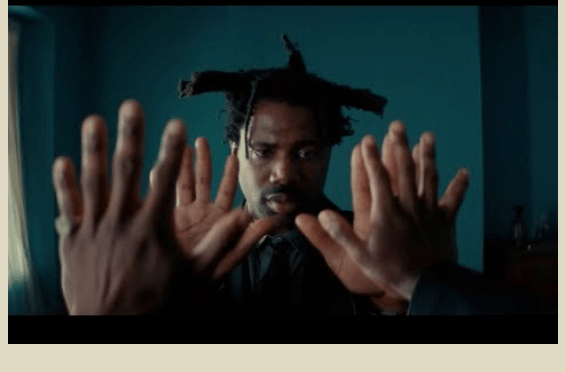
The mix above features Sampha, a great upcoming artist using music to explore and express experience. He sings at one point about ‘la la la la fingers in my ears…’ like lately we all maybe hear too much stuff we don’t need to hear. Like Sappho said “What cannot be spoken will be wept.”
Visit him here.
Or see the warmed up single video version…


 Moving Space