Tag Archives: Poetry

Posts about or presenting poetry

The Teufelsberg Formation

The Devils Hill.

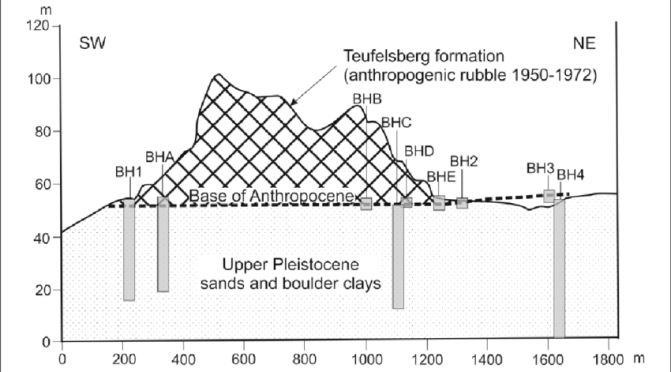
The caption says…’The Teufelsberg Formation was built of war rubble including concrete, brick, clinker, rock, fly ash, slag and solid chemical waste, deposited between 1950 and 1972, forming the highest elevation of Berlin. Thin Holocene deposits may locally separate the Pleistocene and Anthropocene units.’

https://en.wikipedia.org/wiki/Teufelsberg

The allies raised Berlin in 1945. I watched a PBS thing which showcases how the cities of Le Havre, London, Berlin and Warsaw were destroyed during World War II and then rebuilt, using archival footage, visual effects and first-hand witnesses who contributed to the cities’ rebirths.

I did a search and came across the header image of the substrate of the Holocene, overburdened with a man-made hill 80m high of the detritus of war, put there to make space to rebuild Berlin, and if moved industrially, replete with the dead, humans, children, men and women, and it was quite shocking.

https://www.researchgate.net/publication/311093683_Scale_and_diversity_of_the_physical_technosphere_A_geological_perspective

At the moment I am trying to write an academic thing about art as research, and the theme is the ideas of the New Materialists, Donna Haraway, Karen Bard, Rosi Braidotti and my favourite Jane Bennett, you know, Gordons sister.

There is a lot to it but the hu-man centred world, The Anthropocene, features highly. Like, the idea that, by being just centred about ourselves as hu-men in a world made of inert matter and dumb animals and even more dumb plants, protista and protazoans, all there for our taking, might be a bit of problem. Humanism, us at the centre of the cosmos, might be best left behind through an idea of post-humanism, where we share the world with the more than human world and vibrant matter, makes sense.

But that line in Hi Ren… “You got to kill you if you wanna kill me…” rang a bell. If bad Ren is the one making us make war, and making a wasteland of the world, then bad Ren is right, you got to kill you if you wanna kill me… we will kill ourselves short term to live with ourselves long term. I s’pose that is evolution, seeing as 99.9% of all living species are now dead. If we go post-human will we, by will of our newly shared more than human world nature, just become a man-made hill 800m high of the detritus of war and call it evolution. Like Woody Allen said, “I’m not afraid of dying. I just don’t want to be around when it happens.”

A theme developed in post-humanism, is that we have to find a way of ‘Staying with the Trouble’ ie the trouble we have made for ourselves. We need, like Ren shows us, to have a word with ourselves.

And on hearing Ren I remembered a thing I did as a performance that showed the act of co-evolution, two species evolving independently to arrive at the same place. I wrote this

Two Figures:


At 64 and over time
Grit in wind and water
Erosion and corrosion
Remove matter
To show what matters

Two figures emerge

In black and gold
Millstone grit

Unsure what they are at first
Until a diptych
Two parts
Connected
Remain

The First Part

As the end of life
shines brighter than birth
A hard core
Of misanthropy
Takes hold
And says

‘I am
Looking forward
To leaving this all behind
All that we have done to this world
It’s your’s
You can keep it

Too many kinds of phones
Too many kinds of coffees
Too many kinds of milk
Too many choices
Enough
We are consumed

Evolution did not halt
With the arrival
Of Homo Sapiens

Finish me before the extinction event
It is unfair I know
But children,
It is your’s
You can have it.
I don’t care any more

The Second Part

But
Sensation
I will miss
The sound
Of children coming out of school
Or walking
At the end of summer
And hearing
Joni Mitchell singing..
Blue
Drifting out a car stereo
In a jam
Blue
The colour of the sky
My daughters hand
My wife arms
Wind at my back on the Pennines
Waking up outdoors
Sleeping under canvas
The smell of coffee
The scent of cut flowers
I will miss my body
I will miss you
I will miss the world
I will miss this
Hi Ren

Came across this…

It is at once hard work and relaxing, at least at the end, where Ren does relax. It ‘mak mi wep’ as they say.

Posting regularly evades me ‘cos I feel like I have to put some thing up that ticks boxes for hits or likes or comments, but, it induces angst, and like Ren at the end learns to relax, go with the flow and see where we go, I’ll be more relaxed about posting and just put up stuff and see what happens.

This tho’. Man, it’s a work of art, and angst, and so even as I write and find myself with Ren again, the ocean from whence we came makes me wet.

This tho’. Man it works at so many levels. It is black comedy, virtuoso performance, pain and perforative, in it’s sonics and it’s lyrics, switching from the bible to Brecht to Shakespearic street talk to confessional to rap at it’s best and British, the kind of multicultural mixed race mixed gender mixed ability thing we do so well, like all the other places that do that well likewise.

And he’s Welsh.

So Ren, Diolch yn Fawr.

The Poet Eternal

The Natural Philosopher

Milton – Paradise Lost 1674

Better to reign in hell
Than serve in heaven

Of Mans First Disobedience, and the Fruit
Of that Forbidden Tree, whose mortal tast
Brought Death into the World, and all our woe,
With loss of Eden, till one greater Man
Restore us, and regain the blissful Seat,
Sing Heav’nly Muse,that on the secret top
Of Oreb, or of Sinai, didst inspire
That Shepherd, who first taught the chosen Seed.

Mos Def – Fear not of Man 1999

All over the world hearts pound with the rhythm
Fear not of men because men must die
Mind over matter and soul before flesh
Angels hold a pen keep a record in time
Which is passing and running like a caravan trader
The world is overrun with the wealthy and the wicked
But God is sufficient in disposing of affairs
Gunmen and stockholders try to merit my fear
But God is sufficient over plans they prepared
Mos Def in the flesh, where you at, right here
On this place called Earth, holding down my square.

October

Robert Frost

1874 – 1963

O hushed October morning mild,
Thy leaves have ripened to the fall;
To-morrow’s wind, if it be wild, 
Should waste them all. 
The crows above the forest call;
To-morrow they may form and go. 
O hushed October morning mild, 
Begin the hours of this day slow,
Make the day seem to us less brief.
Hearts not averse to being beguiled,
Beguile us in the way you know; 
Release one leaf at break of day;
At noon release another leaf; 
One from our trees, one far away;
Retard the sun with gentle mist;
Enchant the land with amethyst. 
Slow, slow! 
For the grapes’ sake, if they were all, 
Whose leaves already are burnt with frost,
Whose clustered fruit must else be lost—
For the grapes’ sake along the wall.

A Poet in his Pulpit

It’s Sunday. Time for the word. A poet in his pulpit.

Common does such a good job of fusing music and poetry. Black Thought, Seun Kuti, and The Last Poets feature.

Here’s hoping this lifts your day and inspires you to compose yourself. Poetry, performance and politics. Play on.

Sentences, Sensations and Subjectivity.

At the time of writing this post I am about 2 months into researching recursion through reading stuff and making stuff. It has been very fruitful. Doing and describing doing are still at war, but the further I go down the line of enquiry the less I trust words. The more I believe they are a trap. Words work for persuasion not description. I feel like I need to take heed of the title of the 1993 album by The Fall ‘Perverted by Language’. I feel like to be accurate, my research output should always teeter on the edge between the divine and disaster and be like this…

The Fall – Tempo House – From ‘Perverted by Language’ 1993

Part of this realisation came out of a podcast I listened to. The poem below, short but sweet, came out of the podcast I listened to. Here. The poem about the podcast goes thus…

Nominalism

I am disappointed to find there is

A name for what I believe

In the podcast Jody Azzouni, poet, writer, philosopher and Professor of Philosophy at Tufts University NY talks about nominalism, a form of philosophy proposing that words and numbers are made up things pointing to some real thing. Words and numbers are real in name only, they are titular and nominal. Before the podcast, I did not know there was a name for this, but on listening to Jody I was struck that this is what I believe. I found it hilarious that there was a name for the thing that said that the things in the world have no names. My belief system boiled down to one word. I felt at once ruined and relieved!

In nominalism, words and numbers are post res to reality, like a map is to a territory or a signpost to a destination. They are like what Fedinand de Saussare called the ‘signifier’ to the underlying thing, the ‘signified’ except Saussare meant they were both internally constructed, until Louis Hjelmslev moved the signified to become some objective thing, which is where it has stayed since. This makes nominalism interesting to me. To see the real thing it may be useful to forget its name. This changes the thing because it changes how you perceive its reality. Claude Monet, the painter said “To see you must forget the name of the things we are looking at.” It is in this sense that I encounter nominalism as a guide for art as research. I ask what would happen to this thing if I encountered it as if it had forgotten its name? What then would it have to say? I would have to say some new thing about itself.

To see you must the forget name of the things we are looking at.

Claude Monet

In reality, we could even be seen to construct even the object. I listened to this podcast here. In it Ed Yong talks about how animals and humans construct their world. In constructing our world, various philosophical ideas talk about sense data, qualia, and consciousness as hallucinations, but Yong talked about ‘Umwelt’. Translated from German it means ‘environment’ or ‘my world’ and describes how an animal constructs their perceived world from the senses regards the world it inhabits. So how we sense determines what we perceive. My local woods experienced by me would be different to the woods experienced by a mole or vole, or crow or crayfish. This fits with ideas about art making as an embodied experience rooted in the senses. It would fit with what Monet says. It would fit with what I experience through the intelligence of the materials I use in art making. I experience them sensationally and this crosses over to me becoming more attuned to experiencing the world directly through the sensations of art making. They are inseparable. I have a favourite quote from the progenitor of quantum mechanics Werner Heisenberg, who says “We have to remember that what we observe is not nature itself but nature exposed to our method of questioning” My contention is that with art making as a method of questioning, our mode of research physically changes the world we encounter. We make some new thing come into existence. Our personal subjective experience is central. This renders art as research unavailable for quantitative research. Art is performative and subjective research. But it introduces art as an adjunctive companion science. We can make a subjective form of an objective process, the subjective object, the art we make.

We have to remember that what we observe is not nature itself but nature exposed to our method of questioning”

Werner Heisenberg

So in making some new thing come into existence from our thoughts, our ideas, and our sensational encounters with the world, we make new things. We perform an act of poiesis. This produces a subjective object, an oxymoronic thing of magic realism. We make our research finding personal. This reminds me of the breathtaking opening paragraph of Gabriel Garcia Marquez’s ‘One Hundred Years of Solitude’ about the wonder of the world. Marquez writes ‘ Macondo was a village of twenty adobe houses, built on the bank of a river of clear water that ran along a bed of polished stones, which were white and enormous, like prehistoric eggs. The world was so new that many things lacked names, and in order to indicate them it was necessary to point’. Marquez is saying things you make don’t need names. They exist without them. If we have experience and make it as art, words become secondary. The thing we make can speak for itself without words. This is the essence of art as research. We can show what we found through a physical act, we always don’t need words.

The world was so new that many things lacked names, and in order to indicate them it was necessary to point.

Gabriel Garcia Marques

This page is an attempt to describe the direction taken by my work generally and by the exploration of recursion that follows. What follows is a summary of this direction as a poem. The poem goes thus…

Work Here

My work here

Is undertaken on an assumption

That we can be

Sceptical about sentences

But

Not about sensation

And

The reality we research

Is the one

We create for ourselves

A still moving subject

Always out of reach.

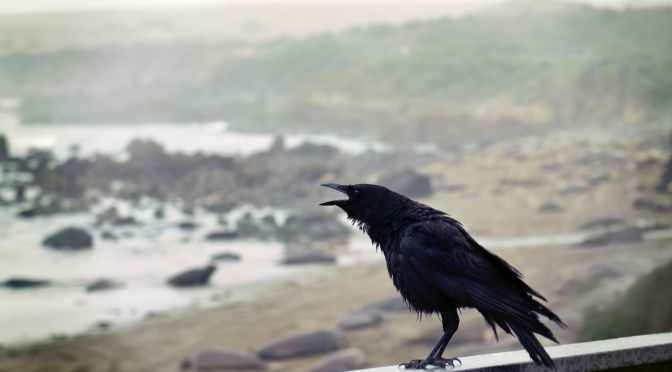
The Song of the Crow

I is Croci

I sing my name

I is not me

I is we

I is all Crow

We all croak I

We rehearse

We curse

We recurse

All thee that are not Crow

You go

We flow

We flew

Liquid as the air

One river

Called Croci

One black Crow

One black flow

We go

We sing

The singular song

Of the flow of us Crow

One in all

Our call

We is Croci

We sing our name


About The Song of the Crow

The name Croci had been in my head for ages. Once, a few years ago it just popped into my head. It seemed the perfect start to a poem about the song of the crow. A crocus is a very colourful little plant which comes up in the spring, The name Croci worked for me, as it appeared to be the singular of a plural that was crocus. I liked that a black bird could have a name of such a colourful flower. That a black bird, a carrion eater, a scavenger, a bird with a croak for a call could identify with a delicate spring jewel seemed to suggest a creature unlike it’s public image, suggesting delicacy and an aesthetic sensibility. That the name of the crow was a declarative pun was also very appealing. Like a punch line to a dirty joke.

Taxonomically the corvids are oscine (singing) passerines (perching birds) and as such have complex voice boxes. The corvids, the crows, include, Ravens, Crows, Rooks, Jackdaws, Magpies, Choughs and Jays, the most colourful of the corvids are residents of the UK but there are over 120 species worldwide. In my writing I will use crow for corvid. Corvid is our linguistic Linnaean parsing of a life form that does not care what we call it. Crow is the vernacular. I can do taxonomy, just not in poetry.

That the calls of the crow, and all corvids generally are not songful and not always of a single bird, like a nightingale, appealed to me. Given what we hear of the corvids, the eponymous singularity of the ‘croak’ heard at a distance, once you spend time close to them together, you will hear the plurality of all sorts of little whiffles, chatterings, bill clappings and sundry noises, unheard at a distance. I believe the quieter calls are meant for other crows in a social setting. They are meant for kin not man. This suggests a private life.

For this poem I wanted to mix the plural and the singular, and I wanted a certain non-binary feel, as the sexes look identical. The individual birds identity would be inexorably linked to the group identity of a flock of birds who to non-corvids look all the same. The sexes are not expressed through different plumage. This, I felt, could reinforce the embodied and lived experience of the crow as bracketed, a thing within a thing, the one in the all. That for the research into crows, brackets were used, added a certain irony to the findings. In linguistics it seems bracketing is an important academic practice. In writing poetry I let the words speak for themselves, and play with each other and talk to each other. The repeated I, I, I, followed by We, We, We, seemed to come from the words being asked to do short repetitive utterances like a crows call. Then the repetition later dissolved into clamour of lines each with a different voice seemed apt.

In writing to a page, making the words seen, I noticed the ‘curse’ in recurse. So the way the corvids are seen as pests and vilified on farmland suggested an antipathy to the vilifiers, and possibly the glamorous, performing songbirds with elaborate and colourful plumage. Croaking as cursing was a great discovery.

The shift from ‘I is…’ and ‘I sing…’ to We is…’ and ‘We sing…’ from beginning to end, again, was suggested by the words themselves, and suggested a loss of the individual into a flock. The song of the crow went from all singing together to collective improvisation. So the words, once freed from my head onto the page, improvised too. The sky is the birds stage. The page is the words stage. The experience of the birds reified and embodied in ink.

This poem emerged like I hear the lyrics and sonics of rap. In rap I love the way in performance the words in one line change the words in preceding and following lines, through meaning and rhythm. When I spoke the song of the crow out loud it sounded like code-switching, so what was given by performance, was a capacity for being multi-lingual when you are taken for being sub-lingual, speaking a restricted code. Thus those willing to attend, hear a secret code, words of hidden experience, hidden in plain sight. So the birds blackness was not lost on me. We see them but don’t see them. Jim Crow, down by law.

I hear my local corvids differently now. Attention is focussed through intention and action to make art. When I go out the door to walk I step into their home. I step out now with more deference. Respect. I attend more. I say hello.

‘Song of the Crow’ by Chris Reed (audio file)

I felt like I had the song of the crow in verse, but I needed narrative, a story, to speak of their cunning. This is my next post – Three Cursing Crows