Tag Archives: Written Word

Items about writing and literature

Croci Dug Down

The birds were busy
It was that time of year
Dancing, preening, chasing, breeding
Being pretty
Croci was busy too
Digging down
Doing dirt work
Being black coal glistening oil slick rainbow
Shifting shapes
Universal and bedecked by stars
The night sky
Constellated different at every glance
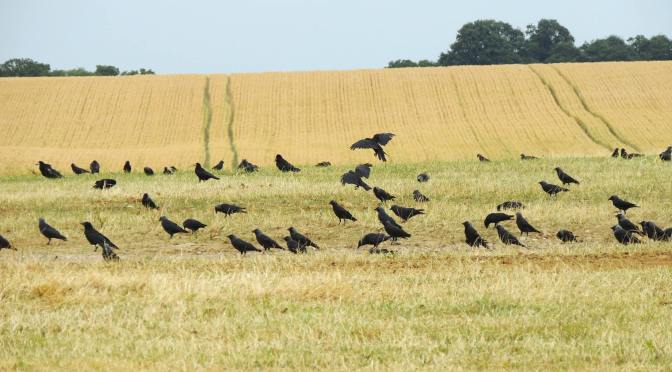
In the field digging
Heads down
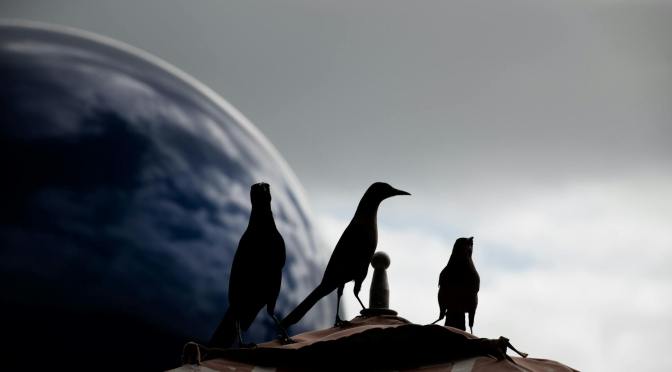
The Rooks
Barefaced
Marlin spiked
Trowel headed
Looking for some sub surface thing
Long lost

Chris Reed

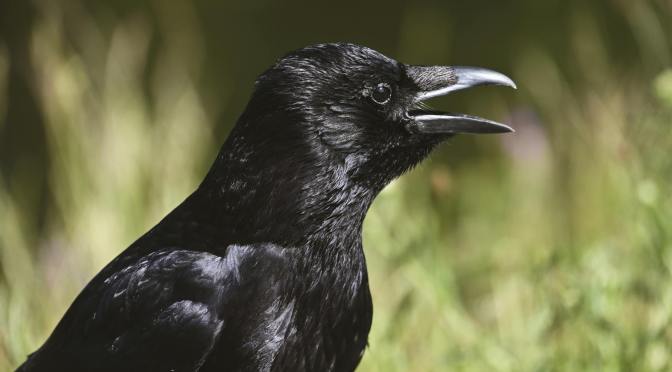
All Crows Look the Same

Through unseen eyes
Black on black
Beedy and beeding me
The unseen seeing all, unseen
That we see all the same
The one bird in the many
Thus the seeming sightless single beast
Is able to move unseen
En masse
In our world of personal sovereignty
Safe, at least for now,
As a singular multitude
Oxymoronic, axiomatic
A flock on automatic
A hive mind
Evading and
Outwitting us
Seen but unseen
Croci hidden
All
In plain sight but
All
Above our heads

Chris Reed

Three Cursing Crows

Croci the Crow cronked a cronk. A cronk is a crow call that says ‘There is that man from the car there, with a clipboard, a pencil, three cages and his bag of carrion’. The man just heard a croak and a collective set of caws returning the call around him in the woods. ‘Well,’ the man said, ‘the crows are definitely here.’ and put down his bag of carrion. The caronia carcass. The dead body. The prize. Croci had smelled it before the man entered the woods. Before he got out of his car. Croci had called the crow call ‘cawcsss’ (with a silent sss, at least to men), and as one, the crows converged, convened and conspired to steal his food.

One crow is all crows. They live en masse. No crow ever leaves the side of another crow. See one crow and you know some other crow is nearby. Each crow lives bracketed, like a word in a sentence, speaking about crows and what they intend to do. Crows calling to themselves be outspoken and literate in the wild non-human world, in the city, in the sky, on the rubbish dump, over the mountain top. Everywhere. Crows calling together to echolocate their fellow crows and hear their own call answering back, in the throat of another crow. And these crows spoke of theft and trickery, because tricksters are they all. The thing with the crow is they go with the flow, because adventurers are they all, always here but always going there. When they were away, they alway return to their nest, avoid the trap, trick away and escape and curse and re-curse the fools who tried to trick them one and all.

Croci set off the moment the bag of sweet-smelling rotten flesh hit the floor. All the crows so, set off too. All crows so landed too, in a circle around the man and his soon-to-be stolen bag of booty. Croci hopped right up to the man and his bag. Two fellow crows followed and triangulated and quartered him, hopped forth, took their third of the prize, and slipped into the cages to eat alone together in peace. They even closed the cage door, with a click and a clack and a corvidian caw. The caw is the call that says, ‘We have him. He is ours’. It is said of men, which is why man only hears this call. It’s subtext is ‘Sucker! and if crows could grin it would be said with a grin.

The man was pleased. He had to get three crows for an experiment and had planned for it to take a month or more, to train the crows with food, to trick them into the cages and carry them off to put them in his lab and test them. But the trap closed on the man the moment they put themselves in his cages, and he put them in his car.

The car was warm, and with their bellies full, the crows slept. They woke at the lab as the cold air tickled their nostrils and were put in a cage indoors on one perch, together as a three. The man went home, pleased with himself for gaining a month, for the ease with which his plan unfolded, for tricking the birds into taking his test. But all, with their far eye open so the man would see only three sleeping birds, the crows conspired and conversed. With little whiffles and shuffles of breath, imperceptible whispers and ruffles of jet black feathers, and almost silent clickings of bills, they had it all worked out. The way in was the way out. They knew…. How the cage was built. How the lock was clicked. Where the sun came from, so where the windows were. In the darkness, Croci conferred with his confederation of three. They reviewed and renewed their hasty plan made in the woods. If it was food the man thought had trapped them, it was food they would take from the man to undo his trap. They would refuse his tricks until they were fed, up to the gullet line under their bills, until he was fed up of their silence and their turned backs of sleek black feathers. For four weeks, they got fatter every day until they feared their weight would slow their escape, so then they turned and looked at him, and complied, complicitous and contrite. He suddenly found them friendly, almost apologetic, ready to do as he asked.

So off they went. Each was put in a separate cage. Each given treats for pecking at some marks on a piece of paper. Each chatting to the next. Each knowing where the other ones were. Each saying to all, what each was doing. Cribbing. cheating. conferring and sharing notes in the exam room with the answers given to the one by the one that went before. They saw and pecked some shapes like bones. Curved bones. Square bones. Cursive bones. Bones alone and in pairs, nested and bracketed in repeating patterns of self-similarity. It was easy. Funny little bones on white shiny sheets. They were the connoisseurs of bones. They were carrion crows.

They came into this world nested in a nest of other crows. Each knew their place. A pecking order from birth. Their family group bracketed together. Each a word in a crow call sentence. They partnered for life. Their partner and them bracketed for life. First single then double quotation marks quoting “I do” forever together. All chatter and clatter and calling names. All finishing each others croak called sentences. Each knowing what the other was thinking. Embedded, a single bird, in a family, in a pair, in a roost, in a rookery, in a flock, murmerating en-masse. One crow is all crows. Each lives in and through the other. Their life and living is made through self similarity. We is I is we, palindrome and palimpsest, each word uttered by the one, is covered by the rest. A three line, tree line poem.

So Croci and the crew were happy with their work. Or should I say holiday. A warm bed. Unlimited food. No predators. No men with guns. Simple tricks. Simple solutions. They made the law they lived by. Free. Rebels all. A parliament of crows. All for one and one for all. Croci and the crew knew the time and place to go. After the moon had rolled over her milky form three times, they would go at night. This was their plan. The man disappeared for two nights, three times every moon-turn. He had a shiny little bone he kept on a hook on the wall by the window. This clicked in the cage and made it open, but did not click to make it close. It remained by the window on their entering their cage. One night, after the games with the little bones on the paper, Croci landed on the man’s head and made him shout. An accomplice stole the shiny little bone when the man was not looking and put it under their wing. He went away blustering and huffing for his two days off.

On return, he found them gone. The window open and the cage lay bare. They left, cursing and re-cursing man, the fool, the sucker, the feeder, the tester, the test they passed with ease. Way too easy for minds en masse. Each bird a word in the collective prose poem that is crow life. The singular song. Of the flow of us Crow. One in all. Our call. We is Croci. We sing our name.

Begone wicked.
We is gone.

Chris Reed
Why Art as Research?

This post is a brief discussion about the descriptor ‘Art as Research.’

Like ‘Art’, ‘Research’ has many notions attached to it. The most well known one would be the notion of research as a scientific activity to seek an objective truth or empirical data. This is useful to ‘Art as Research’ but as a supportive or adjunctive activity.

‘Art as Research’ here means using art making to research your personal experience. It is understood as the intentional act of an individual to attend to something or to seek some unknown thing. You make art and attend to what you make and what happens when you make it. Whatever you find in your research, what comes to your attention, will be entirely subjective.

This approach to research as a subjective phenomenon reflects its older pre-modern form. Etymology Online best sums it up thus…

research (v.) – 1590s, “to investigate or study (a matter) closely, search or examine with continued care,” from French recercher, from Old French recercher “to seek out, search closely,” from re-, here perhaps an intensive prefix (see re-), + cercher “to seek for,” from Latin circare “to go about, wander, traverse,” in Late Latin “to wander hither and thither,” from circus “circle” (see circus).

From Etymonline

Research in the sense described above is accessible by anyone with a pencil and a sketchbook. One does not need to be an ‘Artist’, or have a PhD, or access to the Large Hadron Collider. You just need to be curious, and willing to make art, and to attend to yourself making art.

It describes art as a verb, a doing thing. It supports the idea of art making as an intentional and concerted search or investigation. It supports the idea of it being a bit of an adventure, a wandering journey where we don’t know what we are going to find. It also supports the idea of it having a circular or recursive quality. What we find in our search feeds forward into the next act of searching and finding. It also has, through ‘circus’, connections to performance.

It supports the idea of art making as a way of researching personal experience. This emerges directly out of experiential learning and the arts therapies. It focuses on the process of making art rather than the product made. With art making as an activity learned through experience, you learn to make art by making art, so too you learn to find the outcomes of your art as research by making art as research.

Given that what you find will be subjective, I cannot tell you what you will find. But most importantly, No1 in my Top Ten, you learn to make art through your experience of art making, so your art making can be used to learn about your personal experience. You learn about yourself through yourself making art. This is where the benefits lie.

Art is Anything You Make as Art

We may ask, “What is art?”

It could be….

Art as a Verb

At the core of ideas about art as a way to explore and express personal experience, this is of central importance. We are talking about working with art as a verb.

A verb is a word used to describe an action, state, or occurrence. We are focusing on art as an active state of being and doing. If you look up the word ‘art’ it is only ever expressed as a noun, the name of a thing. This means we tend to think of art mainly through it being an object, a painting or a sculpture, and not the process or the experience of making the art. For art as a noun, the act of making can get overlooked. The art object has a name, but the act of making art does not.

Could I Ever Be ‘Arting’

A person can describe themself as a ’Traveller’. This could be a description of a discrete cultural group. This could be the name a person calls themself if they practice independent travelling to remote settings. For both, their experience of being a traveller could be ‘travelling’, a description of an experience, a verb. They could say their favourite experience is to ‘travel’. But a person describing themself as an ‘Artist’ would not describe the experience of being an artist as ‘arting’. They could not say their favourite experience is to ‘art’.

Art as Change

But this factor is not lost in the world of fine art. Yoko Ono is a fine artist and was part of an art movement called Fluxus. Yoko was once quoted as saying, “I thought art was a verb, rather than a noun.” Wiki describes Fluxus as ‘…an international, interdisciplinary community of artists, composers, designers and poets during the 1960s and 1970s who engaged in experimental art performances which emphasised the artistic process over the finished product.’ The name derives from flux, a state of continuous change. An object like a painting does not change. But an artform like music or theatre can exist in a state of change. Unsurprisingly, Fluxus had a manifesto here, of which the first line was ’To affect, or bring to a certain state, by subjecting to, or treating with, a flux.’ and equally unsurprisingly included a goal to ‘Purge the world of bourgeois sickness’. Art as revolution….

I thought art was a verb, rather than a noun.

Yoko Ono

Art Making as Performance

So, given what Fluxus extolled, a performance sensibility could be applied to art making. Richard Schechner is a theatre director and Professor of Performance Studies. He asserts we can understand any human action ‘as if’ it were performance. From the point of view of performance studies the performance is the thing that happens between things, with one thing being a view of the spectator, the other being the thing viewed. So a painting can be seen to be performed as much as a play, if the painting or the play is seen by somebody. It becomes art if it is observed in such a way as some thing happens for the person who sees the painting or the play. The object does something. It becomes subjective. It goes beyond being just a passive object.

This suggests that we may make art out of anything we do that we pay attention to if we attend to it in a particular way, with a particular attitude. When we write in a journal about our experience. Or when we draw in a sketchbook some thing we saw. When we make a representation through words or image of some thing we experience, we can see our words or our drawing as art.

A Definition of Art as a Verb

It is tempting at this stage to seek a definition of art. But given a definition of art will necessarily refer to art as a noun, as an object, even if that object is theatre, a performance, I wondered for ages about a definition of art as a verb, a doing thing, an action. In the end, I figured one definition of art as a verb could simply be ‘Art is defined as anything you make as art.’ For me, this works. This renders the definition subjective. This makes the making the definition. It does not need words. What you do is the definition of what you do. This makes art recursive, a theme I will return to.

But. You may well paint a garage door with high-gloss exterior paint and call it art. And you may well be laughed at and be shown the door if you seek to sell it to Sotheby’s. However. If in painting it, you learn how to paint it better next time, if you find a way to make it be flatter and shinier in a way that pleases you aesthetically, then for the purposes of Moving Space, you have made art if you say it is art. You may have to accept that your subjective definition has little or no objective value beyond your subjectivity, hence Sotheby’s declining to put it up for sale alongside the next Banksy or Breugel. Sorry. It’s back to work for you buddy.

Art is defined as anything you make as art.

You the reader…

I think once we see art as process and activity in a state of flux, art as a noun, art as an object becomes less important. The art object as ‘Fine Art’ however, never becomes irrelevant. The fine art object made by a fine artist can become a source of ideas and inspiration for your own art making. And ‘art’ as a subjective definition, art by your definition, as a thing you make as art, may be just a garage door to someone else. Seriously, get over it. But Andy Warhol, an artist equally loved and scorned, once said, “Don’t think about making art, just get it done. Let everyone else decide if it’s good or bad, whether they love it or hate it. While they are deciding, make even more art.” I can tell you I have thought a lot about all this, but art making has tempered the value I place on thinking. Art can help you to avoid thinking too much. This is a health benefit.

Don’t think about making art, just get it done. Let everyone else decide if it’s good or bad, whether they love it or hate it. While they are deciding, make even more art.

Andy Warhol