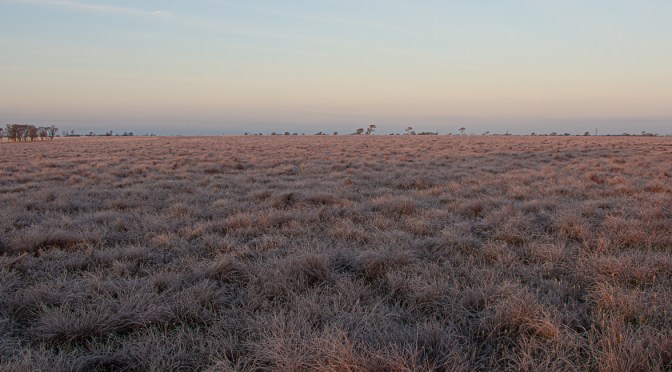
You would assume, after years of walking the moss and judging the going to be easy, that I would stop making the assumption that any going there would be easy. It would always be easy in parts. Odd dry islands of firm ground would be unexpectedly and inexplicably found. But islands they were. Passage over the moss would always be into a headwind and a rough sea, metaphorically, if one could walk a metaphor. But walking is the antithesis of metaphor. Walking is an orthodoxy of the body. A chronicle of embodiment. A footfall factual enforcement of being here now. It is guerrilla mediation.
My walking slowed to a bushwhack. I encountered bushwhacking at a BUNAC summer camp in the USA. I got a free flight, but when at the summer camp, worked for free. It was run by one Putnam Blodgett and it was run like an Outward Bound course, or so Putnam said. We hiked and paddled and did ropes courses, and bushwhacked. This means hiking but off-trail. On the trail, you could do 4 miles an hour on a good day. Bushwhacking, you would go 100 yards in an hour. You would fight through the undergrowth. The undergrowth would fight back, try and strip you first of your clothes, and then your skin, then of your will to live. It was a bad way to walk.
Other bad ways to walk included deep new powder snow, melted in the sun by day, then given a frozen crust overnight. You put your foot on the crust, and as you put your weight on it, the cold crust gives way to powder underneath, soft enough to float a hot air balloon. You can literally be trapped, your feet in snow-filled air, unable to move, exhausted, wet with sweat and the temperature dropping into night. It can kill you. This is why snow like this is best crossed on skis or snowshoes, or not crossed at all.
My way of walking now became as slow as bushwhacking and as soft as powder snow. It looked so benign. But I went up to my thighs in soft deep spindly grass mixed with what appeared like heather bushes, but were not heather, more like leather. I could barely move but was committed to one thigh-deep step at a time, like a man in clown shoes. I just climbed in. I had no choice. It made me laugh. It was the thought of the clown shoes. I went on and just put my attention into my immediacy.
On the last leg, I had, in enjoying being out of the marram grass, moved fast and had sadly foiled my own attempt at aesthetics. My line went off line. I veered too far east and had to correct, putting a slight dogleg in my Cartesian perfection. Archimedes, Euclid and Descartes would have turned in their graves. Pythagoras would have me drowned at sea. I would assure them that when walking there is no straight line. The Earth is curved. Going fast was now not an option so I could move with pinpoint accuracy, and my legs were the pins. My nautical dividers set off to the span the globe. The walk was a slow upward curve, like the curve of the earth, over a shoulder of moss and down to a stream bed. I went on hoping to make a perfect square, knowing it was impossible.
The slow walking on rough ground also has a kind of meditative quality. A walk from A to B along a path requires minimal attention and effort. This is how paths work and why humans have always endeavoured to make them. The Romans elevated the meandering well-worn path into a direct paved road and conquered the world. It is all economics of effort. If you are not exhausted by fighting your way through brambles getting there, it gives you more energy for fighting the locals into submission when you do get there. It has to do with what you attend to. I noticed that in closely attending to every footfall, I became aware of the immense level of diversity of form in the ground I was walking. The endpoint of the lack of diversity is the agricultural monoculture. A field full of nothing but a singular Monsanto-manufactured species of wheat. Unattended Walton Moss had found a myriad of ways to cover the ground.
Just in terms of colour, from a distance, it can look all brown with bits of green. But close up, from my eyes at about 6 feet, it became clear that the ground cover was all the colours of the rainbow. In colour mixing for painting, this is how you make brown. You add all the colours.
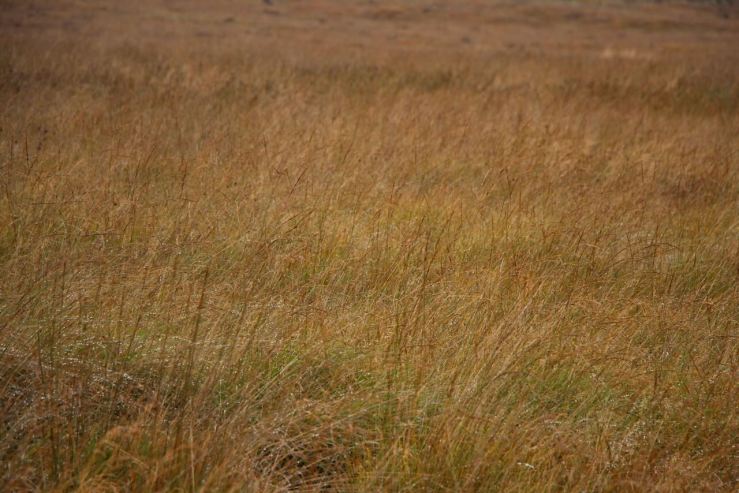

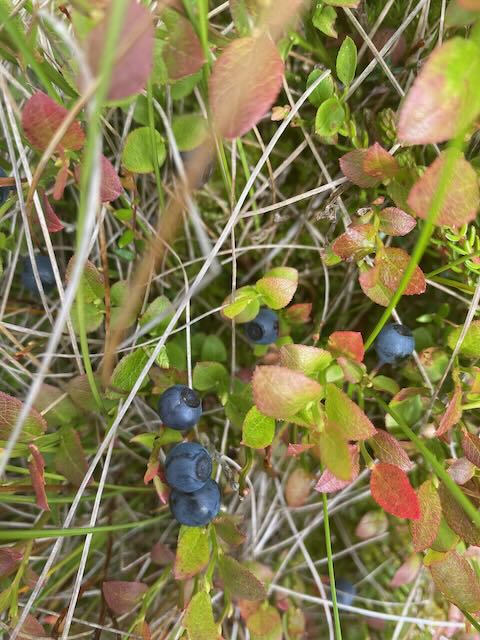

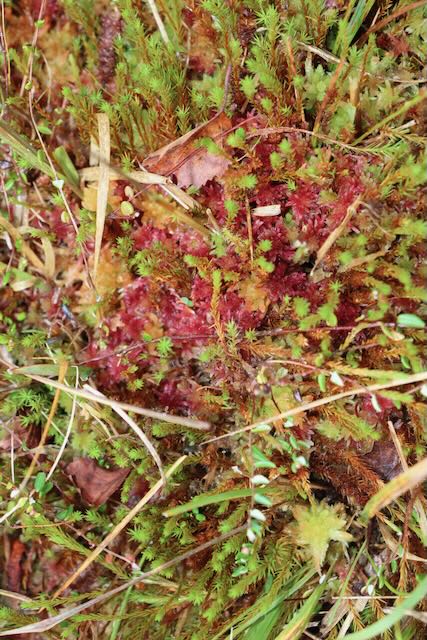
Some areas were fairly uniform over a large area, but the large area uniformity, the place seen from a distance, also reveals a myriad of forms as well as colours, at the height of a walking person. This is reinforced as that person walks over a distance. Over a walking distance, the viewer becomes aware that not only does the vegetation vary, but there exists a variety of sets of plants that cohabit. If we assume these are different communities of plants here coexisting on the moss, then this shows not only the diversity of species but also of communities. This is an indication of an old habitat.
The protracted difficulty of mobility, the place does not relent and grant you easy passage, and that also once on the moss you know this protraction will remain until you reach a road, combined with heightened attention born out of a need to concentrate fully on your footing, made the variety of form mesmerising. It added to the feeling that the place was relentless. By the fourth leg, it had me in a kind of mildly altered state. Maybe due to the fractal nature of nature here and the impact the viewing of this has on our mental state here and here, it is possible the experience did evoke an altered state. I think there is something in being in a state of heightened physical exertion combined with being in a state of mental relaxation that puts us into some sort of trance state. Dancing to a complex but repeating beat does this, as does walking in a wild or natural environment. I believe art making and attending to what you make and what happens when you make it does the same.
This experience could be seen to change how we perceive an environment. An interesting idea about perception of the environment comes from ecology, semiotics or philosophy depending on your view, (a state that to me implies a diversity of application but to others a lack of focus). The idea is that of Umwelt. In English umwelt is environment. Simply put, umwelt implies that our sensory experience of an environment is at a subjective level, our environment. A bee, a bird, a bat, a badger and a bacteria can live in a wood and have a sensory perception of said wood, but for each, it will be a different environment as each senses differently. A bee has compound eyes and senses movement visually, a bird will live by day in the treetops, mostly by sight, a bat will do the same but in darkness by hearing, a badger will sense mostly by smell, again in the dark, like the bat. The bee won’t see a tree but the bird will, the badger would not notice the tree either, but the bat would, with sound. The bacteria will respond to moisture and heat, the two things you control when you store food. Whether bacteria sense things like the other organisms is up for debate, but they respond to the environment. Three increasingly complex pages about umwelt are here, here, and here.
My contention is that outdoor and art experiences shift our umwelt, that outdoor experiences made intentionally as art shift it more, and regular experience of art making shifts our umwelt permanently. That is why many artists are mad or go mad or just generally see things that other people don’t see. The idea of the umwelt is that we all don’t see things the way other people see them, but in art making it makes this unavoidable, embodied and active. Art and the outdoors are major umwelt extenders.
The nature of the terrain was that it was very variability, its uncertainty underfoot rendered it unto my attention in a way that at times teetered towards being overwhelming. Every footfall had to be fully intentional. This is the key act of maintaining safety when mountaineering or climbing. At the end of the film ‘Seven Years in Tibet’ here the protagonist Heinrich Harrer here returns from his adventures to his son. With all he has to pass on, he takes the boy to the mountains to share his learning. At the close of the film, he reconnects with his son to help him start his journey of life. He teaches him to start adventure by firstly, and simply, attending to where he puts his feet. In a high place, this is life-preserving, but in the context of the film and the reason for mentioning it here, this is deeply symbolic.
At the start of the clip, Harrer says ‘When you’re climbing young your mind is clear, freed of all confusion, you have focus and suddenly the light becomes sharper and sounds are richer and you are filled with the deep powerful presence of life’ In many ways why this happens is because you are forced to attend to how you attend. Where and how you place your feet. In art making you also attend to how you attend. It may not be that walking Walton Moss and being forced to attend to how I attend made it art, but that in walking the way one does in adventure, a state emerges from the same root as the state that emerges in art making. Art making and mountaineering and walking Walton Moss all are predicated on attending to attending. Each and all extend our umwelt, thus our world changes as how we sense it and attend to it changes. We make our world.
How we attend is our umwelt. It makes us inhabit our consciousness as a subjective entity. Above, Harrer is describing fully inhabiting his consciousness, his umwelt, it makes his world and inhabiting it makes our world alive for us. It makes us fully subjective, we become our own subject.
At the end of my 4k journey, I felt wonderfully isolated. I had been away from a world that in no small part drains consciousness out of us with the enforced umwelt of digital media, money and labour. To quote Irving Welsh, ‘Sitting on a couch watching mind-numbing spirit-crushing game shows,’ here was absent on the moss. I was liberated.
At the end of my journey, I cheated. I acted as if I were an artist. I cheated to make an aesthetically pleasing and complete object. I wanted to make as near as I could a perfect grid square. But walking in a straight line is impossible. All straight lines are an illusion. On previous walks, I worked that out. Walking a straight is not physically possible. You go up and down with the terrain, the earth turns, moves around the sun and rotates as the Milky Way turns which moves through the universe. I used GPS to close the square mark I made on my digital media device. On the ground, I think my finish was different from my start. But my art form, my mark making, the thing children do before they do art, was complete. I went home tired, and opened up to the universe I was exhilarated.
 Moving Space