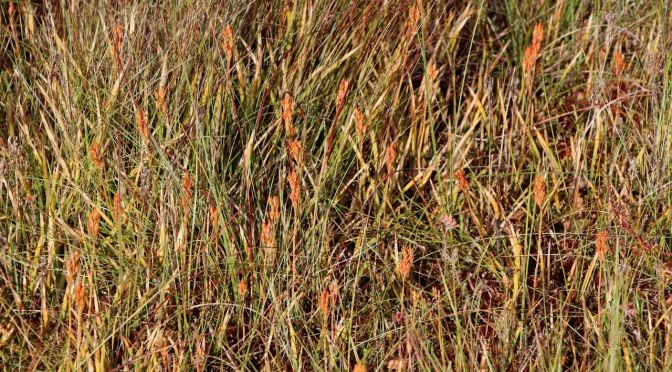
The end of the second leg and transition to the third, going south, was the half way point. Great if the going has been, and continues to be easy. Not so great if the going gets harder. The going got harder so it was not so great.
Marram grass is a thing I associate with sand dunes. Sand dunes are quite dry and sandy. Walton Moss is wet and boggy. Dune marram grass comes in clumps about 2 feet high, 2 feet high. Walton Moss marram grass grew past my head. It presented itself as huge fierce hairy monsters, pressed together like drinkers in a bar at closing time. And like said drinkers, the plants were not in a good mood. I could see that the grass thinned out in the distance but out of a desire for aesthetics, the clear area beside the grass was artistically unavailable. I had to force my way forward, in places totally blind, as the plants enveloped me. On occasion I would burst out of the grass mound and plop down into a dark pool of water the grass was sitting beside.
This added to the emerging sense in which, owing to being undisturbed for so long, vegetation generally was just bigger and more fierce that vegetation elsewhere. If the UK was once like this all over, I can see why people could live an entire life within a 5 mile radius of their birthplace. But as a place to visit, it is really, unvisited. Hadrians Wall is less that 2km away, visited by over 1 million people a year according to Northumberland National Park, but since 2015, on regular visits, I have seen under a dozen people there. One can assume that some corner of some farmers field anywhere will have had next to no visitors, except the farmer or landowner. 18 million per year people visit The Lakes just south and vast numbers of people experience outdoor spaces as crowded tourist attractions. My visits to my local sites has brought me into contact with more empty spaces than found in the outdoor places most people visit. So whilst part of this is purely practical and mathematical, more people in a space makes it less empty, it is also oddly counter intuitive. It suggest there is some logic to the idea of finding solitude nearby. In this article here ‘How to walk to England’s most remote point’ the author expresses similar feelings. The map below shows the site. It is under 20km from Walton Moss. The author says ‘Eventually my trusty Garmin settled down enough to guide us to our final destination, but it’s fair to say NY 58000 85879 wasn’t everything we’d dreamed of. When we began researching this mythical location we had visions of a remote mountain ledge at the culmination of a bone-chilling scramble, but all we found with was a sodden patch of earth, a few broken sticks, a limp stream, and 300 million midges.’ The truth is most outdoor spaces are mundane, or at least not the instagram ready hotspots we are presented with in magazine or myth or movie.
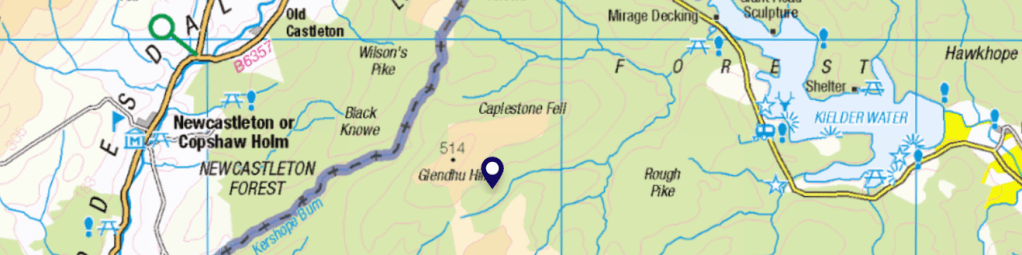
The author goes on to say ‘It’s a slightly depressing thought that the furthest you can get from a tarmacked road in England is less than five miles, but that doesn’t make looking for it any less fun.’
Maybe we have outdoor spaces all wrong. To get far from the madding crowd moving west on Hadrians Wall Walk, walk 1000 meters north. I live there. You could do it walking 100 metres north. Thats all it takes. I lived in Kilburn and found Paddington Old Cemetery here, again by walking. It was a wild, beautiful, empty space, surrounded by back yards and thousands of people. I have done a number of random walks in Carlisle. You walk and at each junction you flip coins to choose your path for you at random. It kills confirmation bias, the propensity to choose the thing you are familiar with. Thus you take the path you would not normally take. I found all sorts of things I would not normally have found, bogs, brooks, broad leafed woodland, back alleys full of new quality graffiti.
It is in this spirit that walking as art emerged. It came to confound confirmation bias about what art is and how we think about it. In the 20th Century the role of rationalism, the scientific, the impact of industry on persona and landscapes was questioned. As modernism came to value the rational, the scientific, Dadaism and Surrealism explored and valued the irrational. In a further rejection of the status quo of arts academies and galleries the Surrealists in opposition to the Dadaists made urban walking into an artform. Andre Bretton, a leading Surrealist described the walks a ‘Moving through the city becomes a means of accessing the self, as the mind and body together rewrite a traversed territory according to desires, histories, connections, recollections.’ (Waxman)[1]
Later Guy Debord and the art group Situationalists International (SI) followed up on the work of the impressionists and Dada and the Surrealists and encouraged the concept of ‘Radical Subjectivity’ through walking as a way “to discover how environments effected the behaviour and feelings of individuals and, conversely, how to make new environments that created the possibility for “a new mode of behaviour.” (Waxman) SI went on to in part, drive the riots in Paris in 1968. Art was a way of being in the world to bring about social change. SI directly influenced Punk in the 1970’s and in many ways presaged the age of the internet in a call to resist the image led world driven by global capitalism, ‘The Spectacle’ of our omnipresent on-line all the time screens full of capitalist advertising images as a ubiquitous presence in all our lives. The call was to make art as a way to make and control your own image. My image of how I encounter outdoor spaces, how walking manifests itself and my image of outdoor space has been shifted by walking a grid square on Walton Moss. That I did this as art is what facilitated that shift and served to confound confirmation bias. I has a new experience.
Debord describes the spectacle as the “autocratic reign of the market economy.” Whilst his description of the spectacle varies, in simple terms it is the thing we see on screen, TV or PC or tablet or phone. It is crafted to hold our attention that we may be available to buy or buy into the things we see, sometimes called the attention economy and surveillance capitalism. The perfect, hot, puffed up Big Mac you see on the ordering screen is nothing like the wonky, cold, flattened thing you get for real. Debord used Marxist ideas to suggest the spectacle alienates you from your own experience. What you experience is a mundane approximation of the ‘real thing’ and in an effort to have the real thing, you buy more stuff you see on the screen.
With walking on Walton Moss, I fully inhabited the real thing. There was no screen. A walking artist who has inspired me is Francis Alys here, and in a seemingly mundane act of walking here. The grid walk was seemingly mundane. I was not going somewhere. It was made difficult by it’s aesthetic. I had done it before. But as naturalist John Borroughs said “To learn something new, take the path that you took yesterday.” Approached as art, the mundane is anything but mundane. The mundanity of life becomes spectacular. Debord called this act, that of the situation, as “a moment of life concretely and deliberately constructed by the collective organization of a unitary ambience and a game of events” and as such it was an antidote to the Spectacle. It was what the Dadaists called Radical Subjectivity, a way of being in the world to bring about change, in this case a change in how I perceived the world. Experience as art not of art. The outdoors as art.
And this art went downhill and opened up. The close vegetation of the massive man-eating marram gave way to open but soft land. I walked often in the Dark Peak, Derbyshire, probably my favourite place in the world. I first encountered in in 4th year at Primary School. A school trip took us to the Gritstone Edges. We ascended a steep climb in the bus then stopped and I found myself on top of the world surrounded by purple heather and huge round black and golden rocks. It was magical. The moors beyond the edge of the Derwent Valley were flat and firm. Later in my life and further off into the moors, the going got tougher. Winding drainage gullies in black peat. But it was for most part, firm underfoot. Walton mass was softer, slower to cross. More intent on being an impediment. The Dark Peak was managed for grouse. Walton Moss would submit to no manager. If Walton Moss were to become managed for grouse, it would intercept the email for the date of shooting and tell the grouse to leave, then direct the sheep and cows to block the paths. The Moss is Boss.
After a kilometre going down and south, I turned 90 degrees to the left at the end of third leg, and set off east back to the starting point. I could not see the destination, but like on other legs, I took a bearing, lined up a way point and set off. The going looked easy. Open grassy ground over a slight curve. What could go wrong?
[1] Keep Walking Intently – Lori Waxman
 Moving Space