
A new ‘Home’ page has been added to aid navigation and curate the addition of more material.
Category Archives: Personal Practice
Chris Reed’s personal art as research practice.
This is informed by 40+ years work in caregiving, experiential and outdoor learning, the arts therapies, particularly dramatherapy and 10 years personal art as research practice with a focus on health and wellbeing.
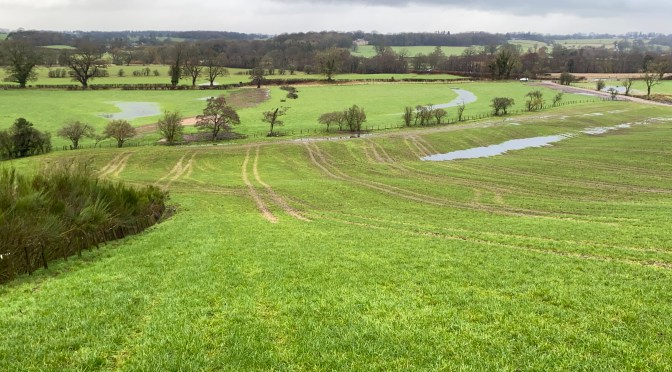
prosepoemwalk jan 1 2023
Prosepoem
Decide on left left left right today and go out of the drive turn left and left again then at next left road and path are deep under water wife said the roads were wet pass the barking dogs at scrap yard that got out and lunged at us once and turn right find first sign of accident bits of headlamp and bodywork under grass just off the carriageway then some yards on find more carry on and find whole headlight fitting in damaged tree with big scar must have been an accident is it two cars or one what was outcome see mile marker I never really examined before and it just has ten on far side and one on near side nothing else so must be a mile to brampton and ten to longtown shortly after see the grisly remains of some roadkill which I guess is what is left of a young badger just the skin then become aware of a flowing stream down side of the road that is usually dry and accompany it downhill a ways to find a broken pipe by a gate in the field suggesting more deliberate engineering but it just dumps into field which is now flooded with runoff gurgling down to the irthing further on road narrows and I loose the grass curb for my walking and get onto the tarmac but see big tractor tyre marks cutting into verge on longtown bound side and see wet field has open gate with big tractor tyre tracks so guess marks made by autumn muck spreader swinging out left to make right turn into field now close to river and do next left to find road flooded again with water both side in hollows in field and a slow clear curve of old river course on downstream side filled up with overtopping groundwater left again into field and more signs of old river route including what seem to be grassed up riverbank sandbank beside the old river flow up hill now and find a single red sand stone pebble in field on top of grass like it was just dropped there today why where did it come from who dropped it maybe it came off a tractor and see several tracks of small animals come under fence and over field then cross same fence by old style and on to the hilltop badger sett which is clear red soil and earth and not overgrown like the beasts are about at night and see little one plank bench above it like people set it up to look at the view or wait for the badgers in the dusk and see big bank with lots of clear paths most likely not from farmers stock but maybe badger roads squeeze through lined up old gates and see very new dead sheep wool pulled of her hind quarters just eyes and tongue gone into crows belly see no other sheep and farm buildings nearby then follow fence and find rest of sheep flock at field corner by style either getting out of wind or as far as possible from dead sister and they all do that shudder thing like dogs to shake off rain as bits of blue sky appear then on to road with good flow down it into gurgling drain as it is right over the partly fossilised watercourse in the lazy bottom of the shallow valley and links the brampton glacial till ridge with the irthing which only appears after rain then in other places flows overground or through broken culverts and along field boundaries see curious gouges and marks in tarmac of road which must have taken something big to do it that deep and clean then find I can do my second right and then three lefts to find myself back on road of my first right but further up near brampton by the schools so would then do next three lefts like before and be stuck in a perpetual loop like a figure of eight so decide to end it and drop the algorithm then feel a bit weird thinking what would it be like to just keep walking and not ever go home but turn right past sprappies and back to my house by same route I took to start with and get back to dry out and drink tea and recollect the walk and the glory of it’s mundanity
Reflection
The intention for this walk was to start a new year by reconnecting with my local space after a bit of a hiatus. I wanted to concentrate on the act of walking more than the act of going to some destination.
One way of doing that is to use a simple algorithm to decide the path taken. I chose to take a path based on turns left and right. I decided on going LLLR, three left turns and a right turn, for two or three iterations, and see where it took me. This idea still gives some control over outcomes. It was very wet so a wanted to stick to roads and footpaths. It is an idea used in psychogeography for urban walking, as a way to move around a city in a way that brings the walker to places they don’t choose and don’t expect. The idea is to stop attending to the navigation and attend to the senses as you walk. You find all sorts of paths you never would normally notice, and in sticking to your chosen algorithm, feel compelled to take them. In my locale I found all sorts of little unmarked paths, in Cumbria called ‘Lonnings’, using this way of walking.
The day was wet and I timed my walk to miss the showers. I took my phone to photograph anything that took my fancy. I have walked all my local paths and could work out where I would go in my head. I wanted to see what had changed since my last walk this way. There is a saying, I think from the german, that says “If you want to find something new, take a familiar path.” It was in this spirit that I set out to walk.
“If you want to find something new, take a familiar path.”
I walked and photographed whatever took my fancy. On the way I thought about how I could represent the walk when I got back. In my head I had images from old scientific expeditions. My Father in Law got the new Taschen ‘Science Illustration’ for Christmas and some of the images were a great combination of the objective and the aesthetic. See the content of this book here.
Out of my front gate I went left, then two more lefts and then a right. Then I repeated it. After two iterations I worked out that if I did another iteration I would end up in an endless loop. I set off on my third ‘right’ down the same road as my second ‘right’, then broke the pattern and turned home. The intentional act of granting yourself responsibility to relinquish responsibility for navigation is quite strange. It behoves attention. It invokes an oddly relaxing attitude. It lets you be more in the here and now. This way of walking allows you to be present where you are, rather than where you want to be. It is intrinsically meditative.
“This way of walking allows you to be present where you are, rather than where you want to be. It is intrinsically meditative.”
My phone has an app that can use GPS to map my track. On return I wanted to use this as a kind of objective account of the walk, but do some ‘arty’ thing as well. I was not sure what it would be. Maybe some kind of faux expedition illustration like in the Taschen book! I also had in my head a separate idea about a construction of card exploring the relationship between the experience and the words used to describe the experience. I will work on this and show you in another post, but with this in my head, the prosepoemwalk idea with a slide show kind of formed as I woke a day later. This is at the top of this post. It seemed to capture the dyadic experience of the being present, attending on the spot as a singular phenomenon, and the walking as an extended, linear flowing phenomenon. I liked the idea of the words and the images mirroring and complementing each other. I liked the idea of the thing I made being self contained. It shows you what happened without explanation. The LLLR ending up as an iteration was pleasing too, like it revealed a natural mathematical formula, a universal platonic pattern, in my local landscape. Very cool!
On this walk I wanted to simply pass through a space and observe it, and express my experience through some artform. Here I chose words expressed with an aesthetic which I feel reflected the experience. This action will go on to be developed in other artforms posted up here later. I am working on a kind of construction made of card and paper to develop this experience further. Exploring the same experience through different forms is part of the art as research process. Each form reveals a different thing. But I see a generalised sequence which goes we observe, we reflect, we interact and we modify, make and share. In the Taschen Science Illustration book mentioned earlier are the products of observation, the reflection is embodied through image, but the image is used to guide interaction, then modify, make and share ideas, products, processes. This walk was done in this context, to simply observe and record and reflect on the experience of the space I walked through. As 2023 pans out I want to use art making to explore my relationship with my local spaces through observation, then interaction to modification. I want to use this to develop ideas about the outdoors as art and art as research.

Looking for the New Year
Went Outside Looking for the New Year
December 31st 23:59:45 2022.
Went outside.
The garden was pitch black,
Silent, but for the sound of rain,
And the grumbling of distant fireworks.
Returned 30 seconds later in 2023.
It seems new years only arrive indoors.
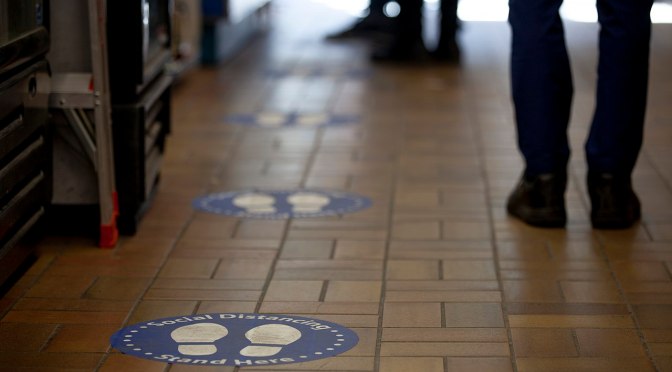
Performing Distancing
Social distancing was introduced to the UK around March 17, 2020
On March 18, 2020 I did a walking art performance to explore the then new idea and practice of ‘social distancing’.
On reflection, a year on, it is interesting that this simple act gave me insight that evening into the way that ‘social distancing’ would very quickly become normalised in society, as did the sensation of coming to avoid or mistrust the proximity of other people.
It just reinforces for me how performance and art as research may be able pre-empt experience and give insight into experiences to come, but do so through feelings, not through empirical data.
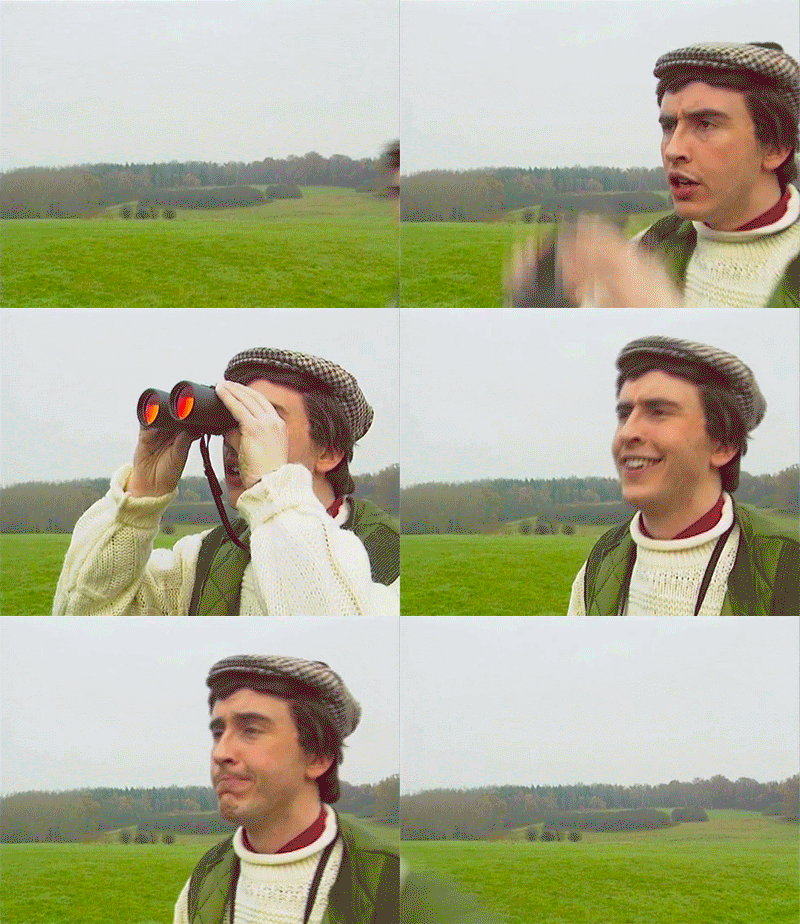
This reminds me of Cassandra, who was able to see the future, but was cursed by nobody believing what she said. She was cursed by Apollo for lying when she said she would get jiggy with him. She was cursed for lying, so the curse made her words became an untruth.
Maybe the moral is then is to not lie to yourself about what you may see, but beware that to say what you see may help nobody. And if you do speak, maybe only speak to people who see the world the way you do. Therein is the dilemma of holding your own counsel or speaking only to become stuck in a bubble. Trump and Brexit and QAnon all rolled into one.
Or maybe the moral is simply that words are not accurate representations of feelings, and interpreting feelings is an art not a science.
Below is my account of that performance written somewhere around the end of March 2020.
Performing Distancing March 18, 2020
(Written end of March 2020.)
On the basis that art and performance can be used as research, to explore and express personal experience, I wondered what would happen if I walked through Carlisle town centre maintaining 2m social distancing, but do it as performance, choreographed like a dance or with applied dramaturgical principles, and record it with GPS.
A simple algorithm was devised to work like choreographic directions.
Walk in a straight line until I was within 2m of another person, then turn away until the distance exceeded 2m, then resume the straight line.
Where I met an obstacle turn through 90+ degrees and continue in a straight line.
Limit the walk to the central shopping area.
Walk for 1 hour.
I imagined this visualised as a faux maths formula, because moving an idea between forms, like turning word into image, can sometimes reveal a new aspect to the idea.

Where P is the path of the walk, as an iteration or repeat of p, which is each leg as a straight line a-b until this is changed by meeting a person (the m is an aboriginal sign for a person, basically, the bottom mark left in the sand where a person was sitting) in which case the path p changes (the triangle) by n degrees.
The basic principle of art as research is to make art, in this case performance, and pay attention to what happens when you do.
On the 18th March I did a social distancing walk for an hour in Carlisle city centre, and payed attention to my thoughts and feelings and other peoples response. I tracked it with GPS tracker.
This is the raw GPS visualisation of that walk.
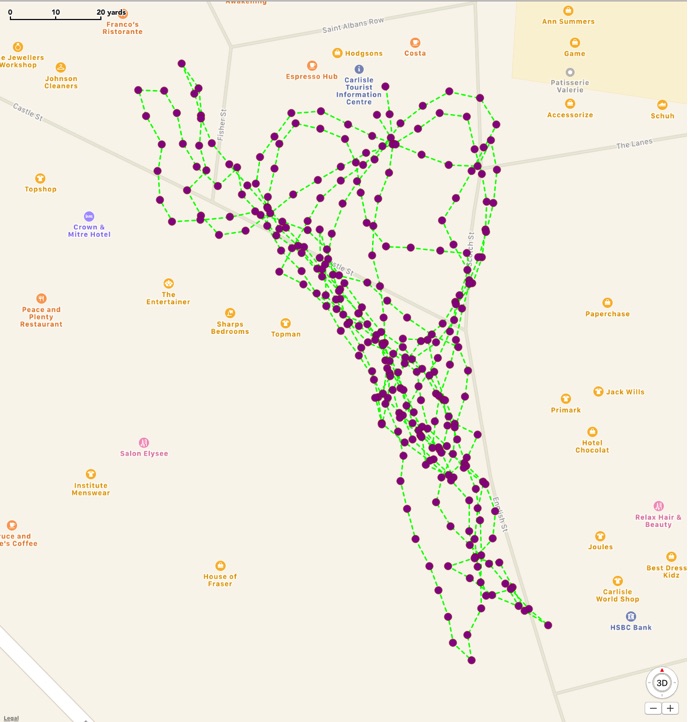
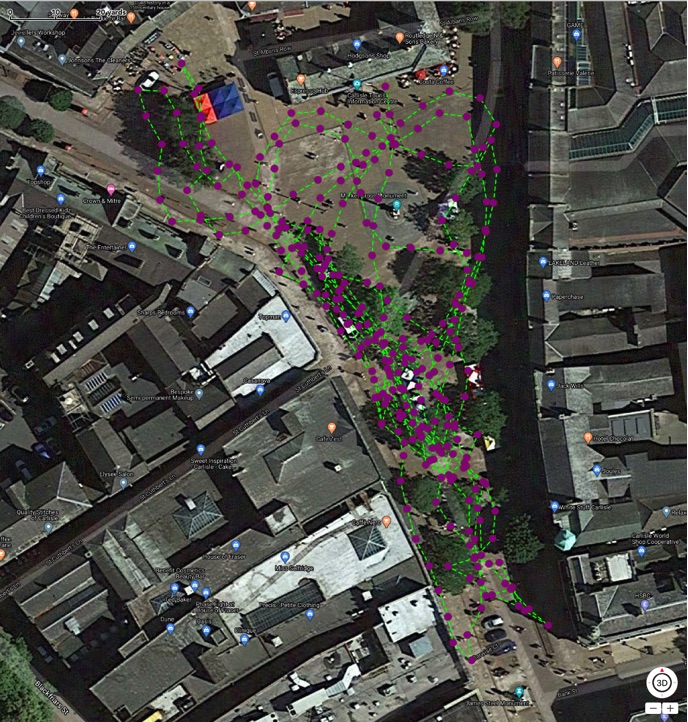
I worked with a GPS track editor and removed as many intermediary waypoints as possible to leave only turns in response to social distancing or turns in response to an obstacle, like a shop front.
I got this, edited down as three images joined together.
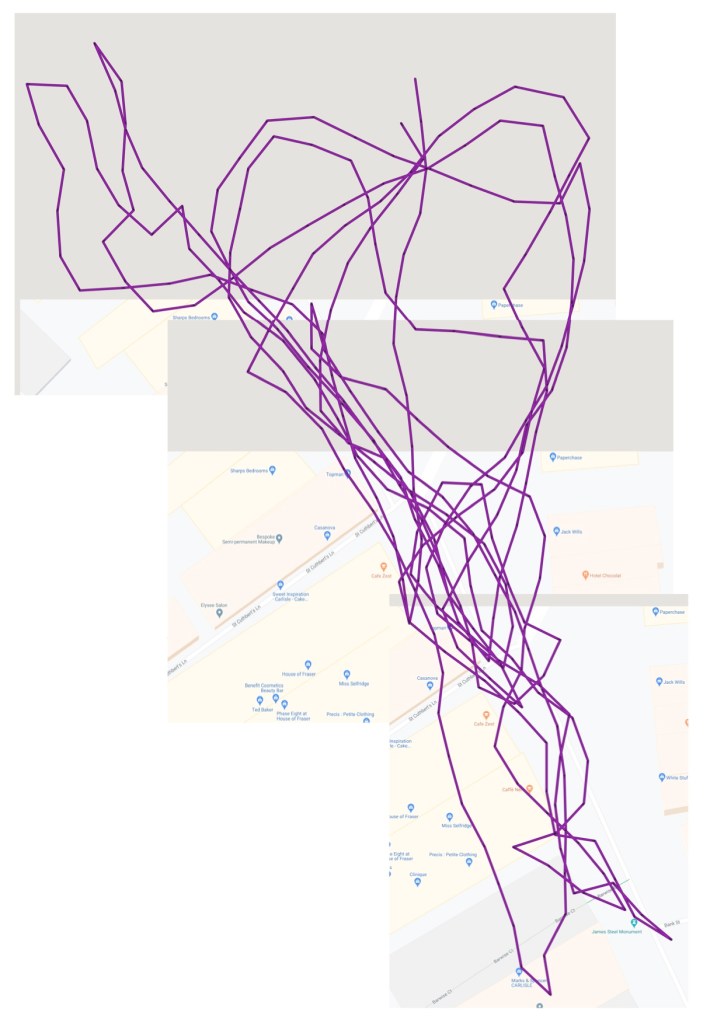
What the walk/performance did as research, was give me insight into social distancing, then a very new phenomenon.
Over the hours walk, I started to become anxious when I got close to people. As a person approached me and I anticipated the need to distance, I felt a rise in my level of anxiety. I felt isolated and distanced. I felt sad.
I was also nervous about wandering around in circles for an hour on CCTV. In the end nobody even batted an eyelid. I was utterly uninterrupted and fully ignored.T his added to a sense of aloneness.
Part of the creative process is the period of incubation, in which the creator moves away from the art making and does some other thing. On returning to the theme or the artform, after incubation, new insights emerge. The form created is seen in a new light. I noted this sadness and anxiety at the time, but on writing this, months later, another aspect of my experience of performance/art as research came into play.
I reflect now that this experience gave me insight into how social distancing would feel. Now, months later people are not rushing back to contact, many people appear reluctant to go back to the shops and the pubs and the office. This week, mid-June, the MP is now imploring people to go back to the office and the shops and the pubs. The anxiety prevails.
Also there is growing anger in the UK and clear riotous anger in the USA in some quarters of society. Today I found the following meme.
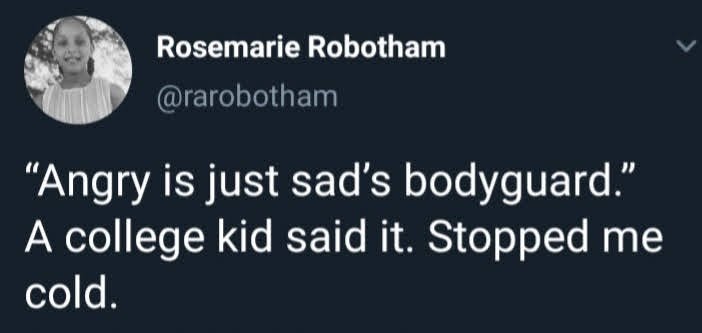
My experience of children in care is that many are angry and this is just a product of sadness and anxiety. Whilst different, both are connected to loss. Anxiety may be an anticipation of discomfort and danger, but also the anticipation of the loss of safety, the familiar, and the predictable. Our stress response is fight, flight or freeze. We have been unable to flee in lockdown, which leaves fight and freeze, anger and sadness.
On March 18, the day of my social distancing walk, the experience of social distancing was new. This art based research could not be seen as producing a clear empirical evidence based outcome, but I did experience feelings in myself which could have anticipated feelings shared by other people once the lockdown deepened in its impact. I anticipated sadness and could, in retrospect, have anticipated anger.
This work is highly influenced by the arts therapies and dramatherapy and by experiential learning. In the arts therapies, whilst art is made, the role of the artform as an end product, for sale, or for viewing by an audience, is not significant. What is significant is the experience of art making on the part of the art maker. As such it is a form of experiential learning in which direct experience of art forms the basis of learning or research in which the art making is both the mode of research and the outcome of the research. It is part research, part performance, part personal therapy, part play, part experiential learning but is never fully any of these things.
Undertaken with the intention to make this as art, invites the creative process, and as such it is unique, not in any grand way, but in a way that invokes creativity as a simple and easily available act accessible to anybody. The act that makes it art in intentionality and this intentionality can be learned.
My hope is to use this website and my own art making to show ways to learn this. We cannot all be artists but we can all make art. What this experiment revealed was simple and oddly mundane, but also complex and profound. I want to show how art making can help you explore and express your experience of the world.
Solway Walk – Map Art
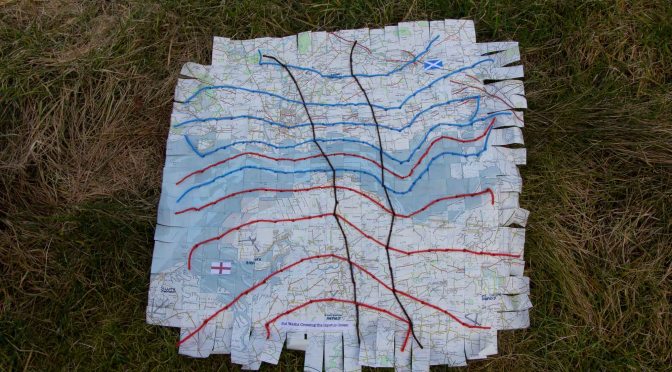
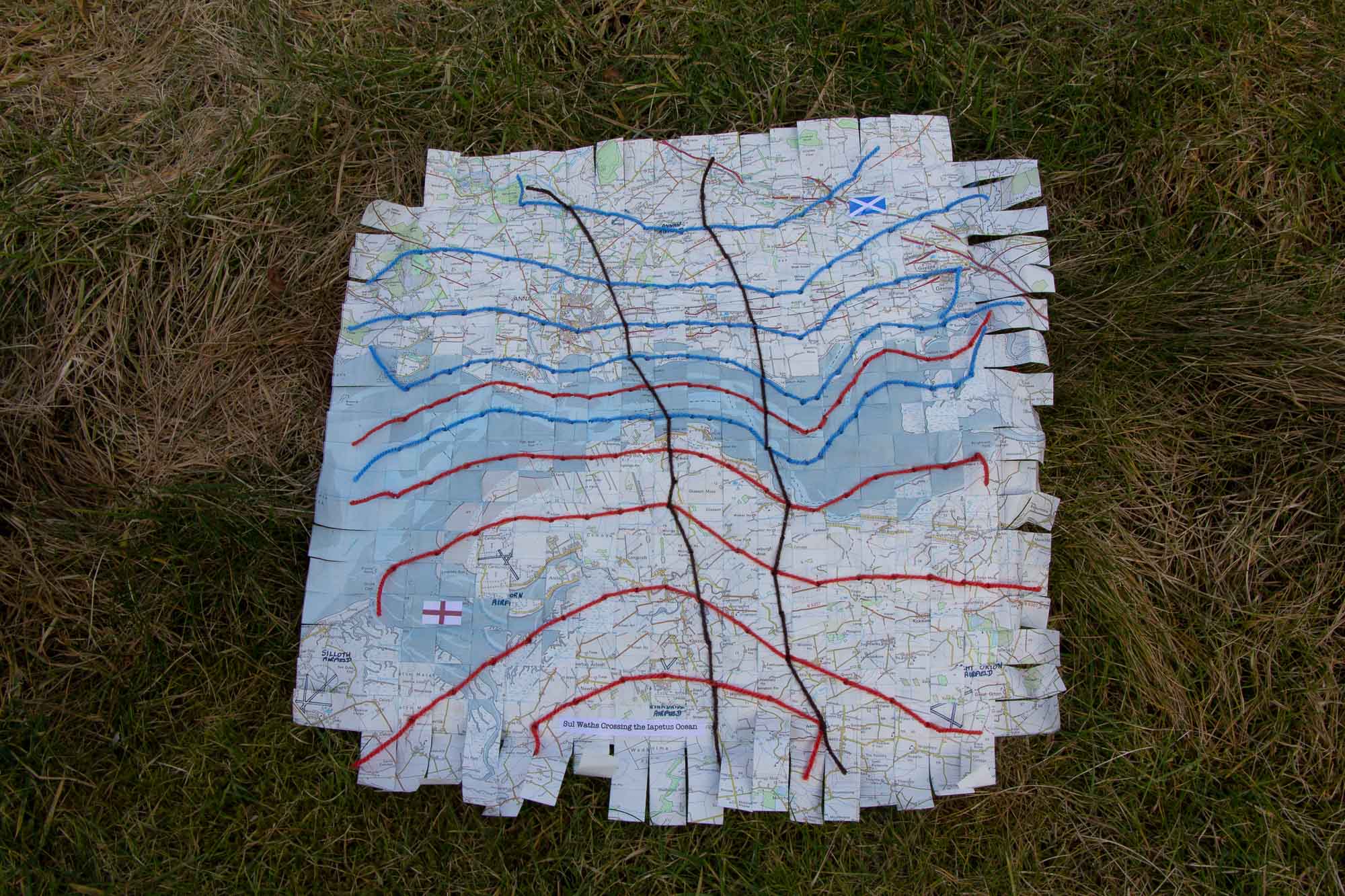
Sul Waths Crossing the Iapetus Ocean
Following on from my exploration of the Solway I wondered if I could make an object that captured the way it was a real objective place, but was open to a number of subjective impressions.
For a while I have experimented with weaving Ordnance Survey maps, with the grid squares becoming the warp and the weft of the created object. In the past it has been two different maps, but for this I wanted to experiment with two maps of the same place, but shift them so the Solway became kind of extended and ambiguous. Like it is. So I made the object above.
It will never win a Turner Prize but my interest is not in creating ‘Fine Art’, but in using art-making to explore ideas and express experience. What I wanted to express was…
- Blurring the boundary between England and Scotland.
- Showing how the Waths crossed this boundary.
- Make something that looked recognisable from a distance but changed before your eyes as you approached it.
- Make you kind of wonder what it was, a picture, a map, some weaving or needlepoint.
- Shifting your sense of time. The Iapetus Ocean was the water between the two tectonic plates that mashed together to make the Borders. The Solway is all that is left. I liked it as an archaeological object.
- To also have bits of it that were from the time it was made. I liked it as a contemporaneous object as well.
- To work with text and image and object and colour as things to stand in for something else.
Sometime I would like to return to making this as a more aesthetically sophisticated object. But as a starting point, it is a good place to start.
Solway Map 
Close up 
England 
Scotland 
The edge 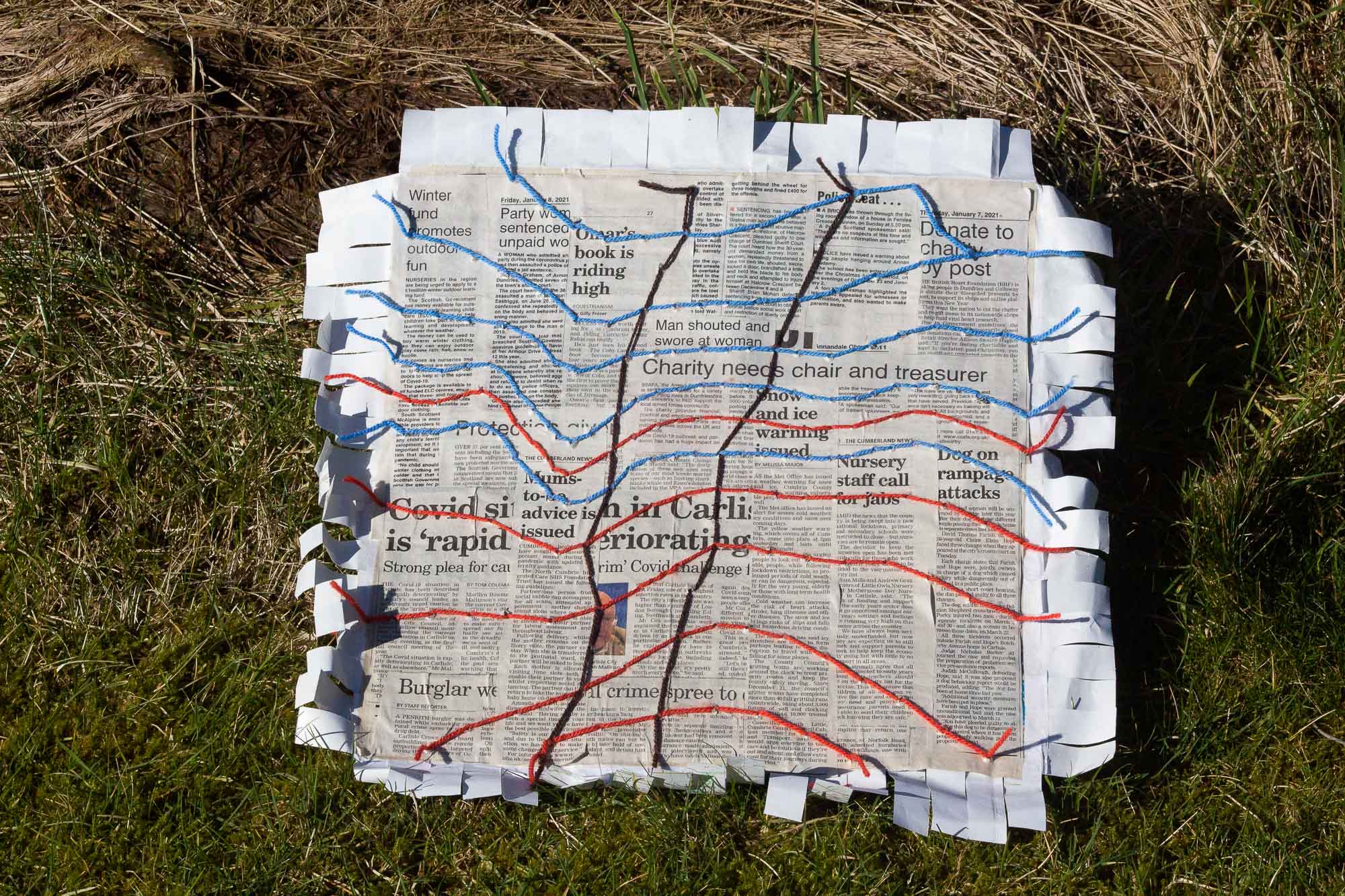
The back

enclosure / boundary
Two circular walks around a newly erected fence and the old line between cut and uncut grass.
 Enclosure
 noun
 Old French - enclos - closed in
 Similar - Paddock, fold, pen, compound, stockade, ring, yard, pound.
 An area surrounded by a barrier.
 A section of a racecourse for a specified activity or group of people.
 The state of being enclosed, especially in a religious community.
 The process or policy of fencing in wasteland or common land so as to make it private property, as pursued in much of Britain in the 18th and early 19th centuries.
 A document or object placed in an envelope together with a letter.
 Boundary
 noun
 Old French - bonde - a visible mark indicating a dividing line.
 Similar - Border, frontier, borderline, partition, dividing line.
 A limit of something abstract, especially a subject or sphere of activity.
 In Cricket, a hit crossing the limits of the field, scoring four or six runs.
 An entity demarcated from its surroundings.
 Guidelines or rules or limits that a person creates to identify safe ways for other people to behave towards them.
 Circumnavigate
 verb
 Latin - circumnavigare - to sail around
 Similar - Bypass, skirt, compass, circumvent, move around.
 To sail or travel all the way around (something, especially the world).
 Go around or avoid (an obstacle).
 Avoid dealing with (something difficult or unpleasant).
 The complete navigation around an entire island, continent, or astronomical body (eg. a planet or moon).
Map created with free public ArcGIS account.
Solway Walk – A Last Word
Walking the World
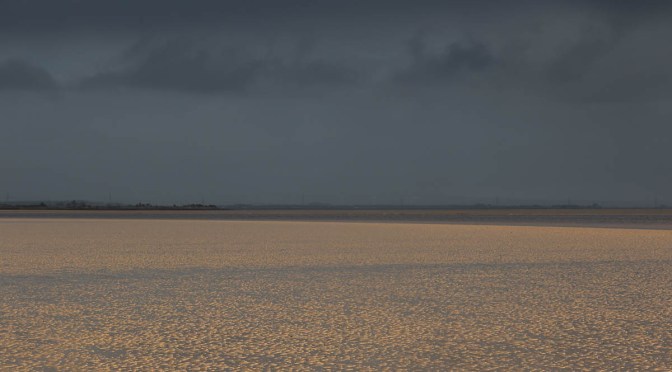
On the Solway, so flat and otherworldly
I walked and remained fixed in space.
The sea, the sand,
the storm
approaching over Glasson Moss
moved past me
as I rotated the Earth with my feet.
Looking closely
and photographing,
I moved slowly.
But on my turn and return to Browhouses
walking faster,
the same thing occured.
The white windmills in the sun
sped towards me.
The Earth turned under me
like a ball under a circus dog.
In the Renault the Earth stopped.
Feet no longer on the floor.
The pedals, a, b, c
were depressed, and the car
sped past Metal Bridge and the services,
back to Brampton and my house.
In the house, out of my boots, back on my feet
in slippers, the Earth moved again
the crockery in the cupboard
rattled and chinked with each step.
I toyed with a short sprint.
The milk in the jug
rocked
like a storm…
in a milk jug.
Teacups were the same.
Tea sloshed over the rim.
Little waves on a bone china shore.
I filled the bath and on walking from the bog
a tsunami formed.
I walked the dog round the block,
and the planet rolled in a raggedy right turn
the size and shape of my neighbourhood,
back to where she started.
I sat still at last to watch the news.
Natural disasters around the world.
Unexplained tectonic movements
unforeseen by experts, the Earth had moved.
I went to bed.
I awoke.
And it had gone.
I walked, I moved.
The Earth did not.
I retuned to the Solway
to seek the spot where it first happened,
and in it’s vastness the spot was lost.
But somebody some day
will find it.
And the earth will move again.
Chris Reed
 Moving Space