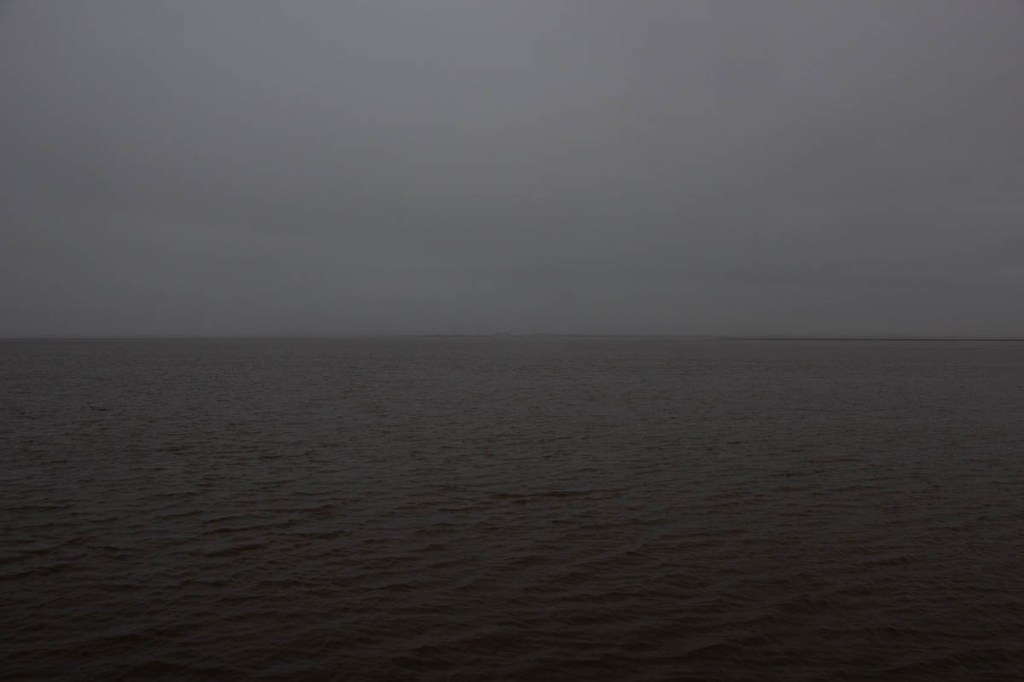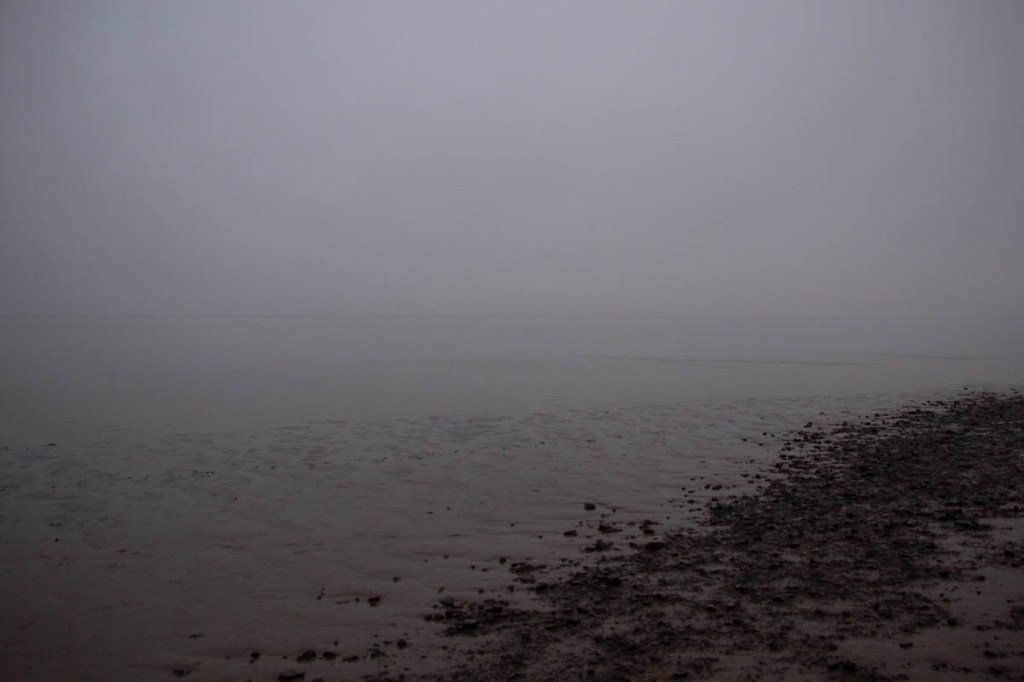
Tag Archives: Place

Items about place and how we understand it

Solway Walk – Moving On

My visit to the Solway was prompted by a need for a large space without physical barriers to explore what would happen if I walked a drawing of an model of experiential learning through the arts. In doing so my idea about my model changed.

The original model

Models are slippery things. Their appeal is that they appear to give a fixed image of a thing, but in practice whilst they serve as a very useful signpost about which way to go when you set off, the thing you find when you get there is never fixed. So the walk was undertaken as an experiment ‘to explore what would happen…’

  • learning model

What the model predicted was that a number of factors would contribute to the art making. In this case my thoughts were that source material would be Richard Long and the walking and land artists. My personal arts practice or art made included using a GPS and walking to make a mark on the landscape and experience of film making as a means of exploration, reflection and expression of experience. I drew on ongoing research and theory about the outdoors as a liminal space and art making as adventure, as a journey of uncertain outcome, and Shaun McNiff’s ideas about witnessing in the arts therapies1.

The model was correct in that my path would lead in to and out of the art making on the day and on to more art making, research, source materials and theory, and that the generic coloured blobs would be specific to the art making experience. My initial thinking after the event went to ideas about performance and the epistemic object and further trips to photograph and film, reporting this through blog posts.

At the centre of this, an act of art making and poiesis occurs. Something comes into existence that did not exist before and it is called art. It is art by convention, because all this could describe the making of a cup of tea. To this conundrum ’Why is this art?’ one asks the question asked by artist John Baldessari, “Why is this not art.” It is art because it was my intention to make art and my act was guided by research, reference to existent artform and artists, theories of art and my experience of art I made before.

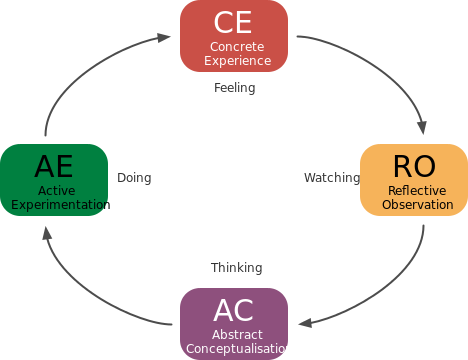
But there was something incomplete about the central concentric circle structure. I was interested in the model showing how each experience of art making occured within a loop of experience, like in Kolb’s learning cycle.
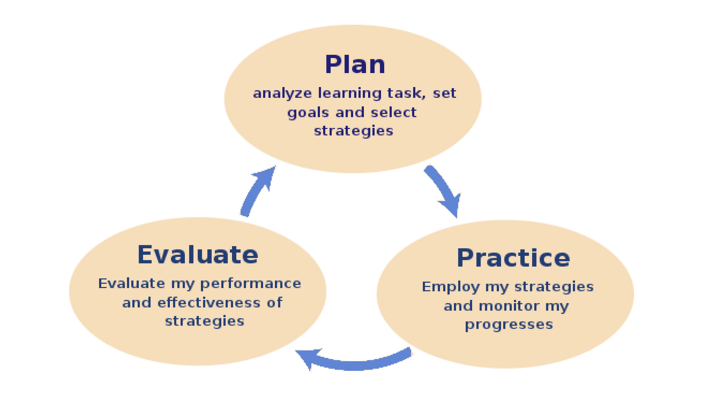
  • kolb

But like the Kolb model is an ideal form which would be expressed differently depending on the setting, the strict concentric form may vary depending on the setting. My experience of art-making was, however, that in making art I stepped away from the day to day life experience and went to a different place. This could state is sometimes known as a ‘Flow’ state from work by Mihály Csíkszentmihályi. You get in the zone of concentration and attention, of doing and the senses. But for art-making as experiential learning or personal research or art therapy, you enter a state that is similar to a meditative state, like flow with awareness. You are focussed on making art but also on what it is that you have made and what happens when you make it.

So in the model, as well as cycling through an iterative learning process, there was a linear path away from the world, into a creative state where something happens in partnership with your artform, then back to the world.

Reflecting on how the model changed

On return home from the Solway and recollecting the emergence of performance I went back to my Dramatherapy training. In a dramatherapy session you work with a basic three part structure. ‘It begins with a physical warm-up leading to the Main Event, the place where the real action is. It concludes with the ‘grounding’, returning people from the ‘Land of Imagination’ to their own everyday selves.2

During the walk recreating the drawing, the shift from walking to dancing, from recreating the drawing to improvising and performance emerged unbidden. One could say this idea came out of my imagination or my unconscious, or it was the product of a state of flow, or having danced in the past, I simply remembered something from my past related to what I was doing in the present.

So there are two things here. One is a linear journey into a place with some degree of separation from the everyday world, into ‘flow’ or ‘Land of Imagination’, followed by a return. This is a linear journey in an iterative looping cycle of learning. The other is the experience of being in ‘flow’ or the ‘Land of Imagination’. This is an experience of art making as somewhat separated from ones day to day life.

Something like this three-stage process occurs in many settings. In story and in film and theatre there is a thing called the ‘Three Act Structure.’ On one hand, this is as simple as a beginning a middle and an end or it is sometimes understood as set-up, confrontation and resolution. Many interpretations exist and there are examples to be found of its use in say cinema, but it is not without some contention. Like one article says ‘The true three-act structure isn’t a formula, it keeps your beginning separate from your middle and your middle separate from your end. That’s it.’
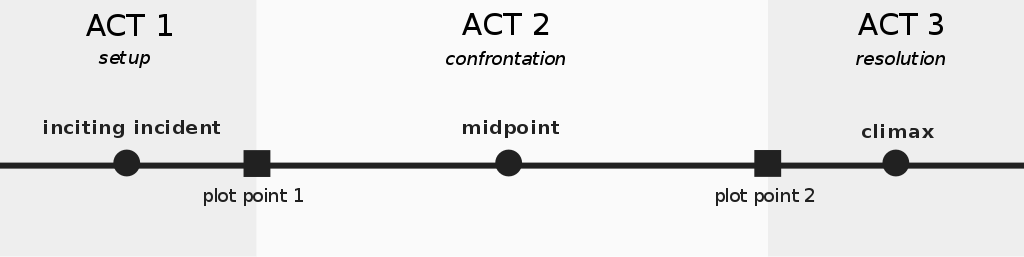
But the ‘beginning, middle and end’ could be seen as a universal or archetypal structure. For example at Outward Bound, in experiential learning, you worked with a ‘training, main and final expedition’. Your training expedition was where you taught skills, the main expedition was where you had the conflict as you got the people to move from being a group to being a team. Final was the unaccompanied independent journey.

In care, we worked with a conflict model and resolution tool called ‘ABC Charts’ meaning A – antecedent, B – behaviour, and C – consequences. Joseph Campbell’s Hero’s Journey has a specific expression and detail but is also a three-stage form, the call to adventure, the test and the return.
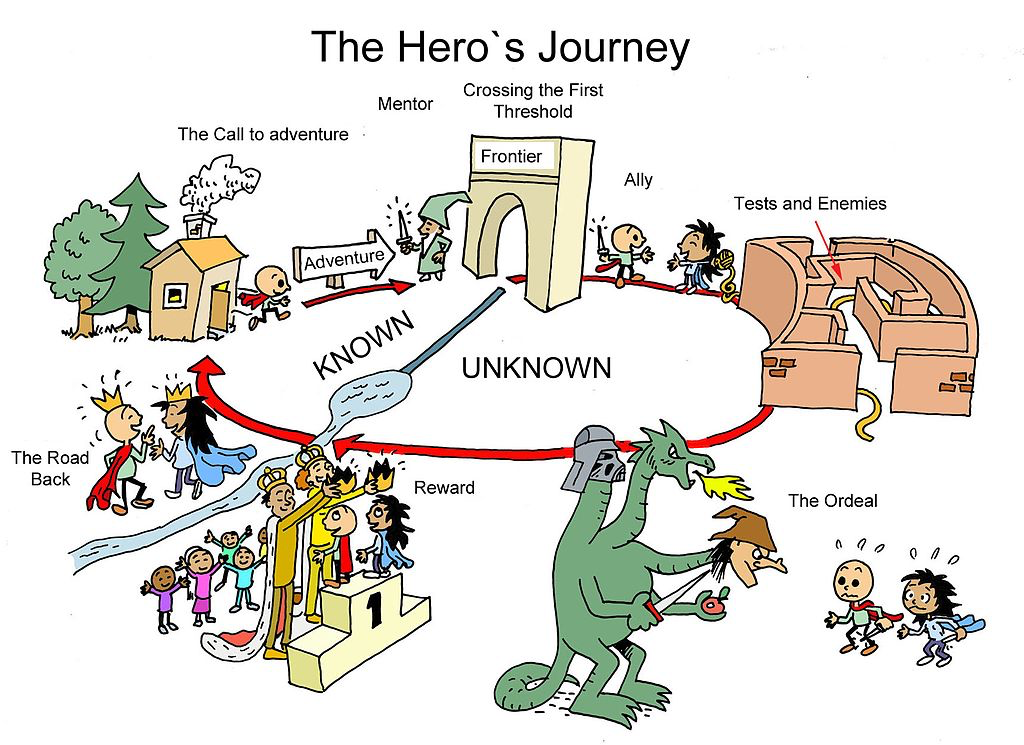
But the simple, warm up, main event and grounding of dramatherapy mentioned above can be also seen in a form described by Victor Turner and Arnold van Gennep as Rites of Passage.
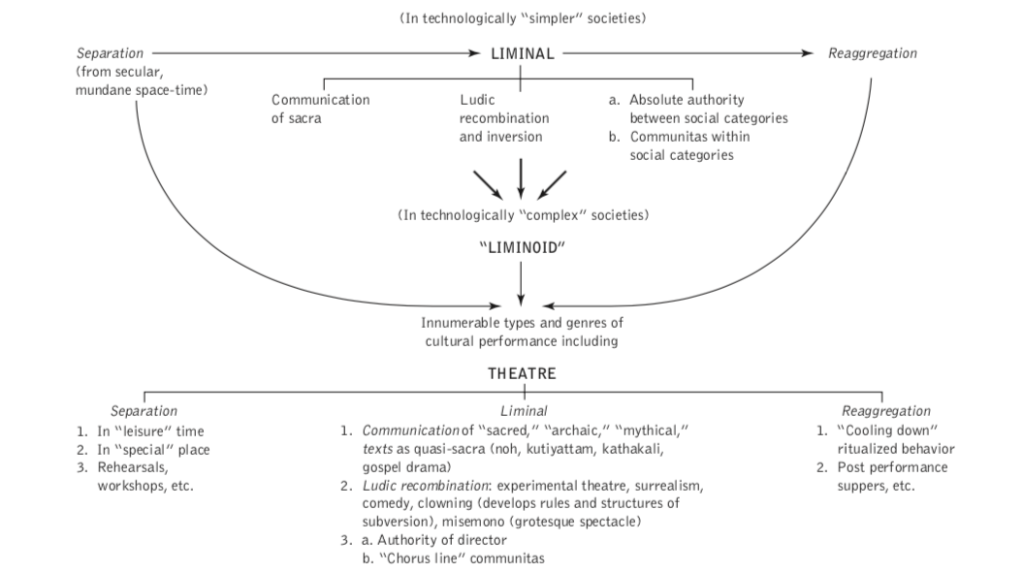
  • Turners Initiation Model

From Schechner3

The above diagram is from Victor Turner a British anthropologist who theorised the above from studies of non-western settings at the top, and western settings at the bottom. This is a three stage journey of return that is linear and cyclical and has a central liminal or liminoid space somewhat separated from everyday life called The Land of Imagination in the dramatherapy model.

Art as liminal space

My proposal is that art making and experiential learning could be understood as having some some elements of the above structure in their practice. I don’t think it is coincidental that after a while on the Solway Walk, I spontaneously rediscovered that I could do the walk as performance. This could be seen as me, albeit briefly, entering a mild ludic state.

There is a lot to this seemingly simple experience of walking in circles on a beach like an idiot. Not least the idiocy. I was being playful throughout. I was in the land of the Trickster or the Court Jester, at once playful and challenging, the one who can perform recombination and inversion.

This is also adventure. The journey between departure and arrival. The journey of uncertain outcome with misadventure available. The three part expedition cycle of Outward Bound. On a slave ship, the middle passage. The refugee in the hands of the trafficker. It is not a thing of the past.

To me there is also something in this of being in the Solway, a liminal space if ever I saw one, between two countries, high and low water, land and sea. To me this is also a state of walking. In walking you are between places, outdoors, in a state of flow, and returned to a mode of existence that predates all of the modern world.

So after a few weeks of reflection my research led me a realisation. The experience was ‘like’ a lot of things, from experiential learning, theatre, anthropology, adventure sports, performance art, and conflict resolution, to Outward Bound and Joseph Campbell’s Hero’s Journey.

This could also be applied to many arts based contexts and the model has ART FORM as a liminal or liminoid experience at it’s heart, the same as dramatherapy. But the artform that fits this experience best if what is known as Walking Art.

My exploration of my Solway walk has reached a convenient place to move on and in my next set of posts I want to look at Walking Art with a particular focus on it’s scope for promoting health and wellbeing.


  1. Mindfulness and the Arts Therapies – Theory and Practice – Laury Rappaport ed.  ↩︎
  2. Discovering the Self through Drama and Movement – The Sesame Approach. Jenny Pearson ed.  ↩︎
  3. Performance Studies – An Introduction. By Richard Schechner. Routledge.  ↩︎

Solway Walk – Human Ecology

Solway as a Means of Transport

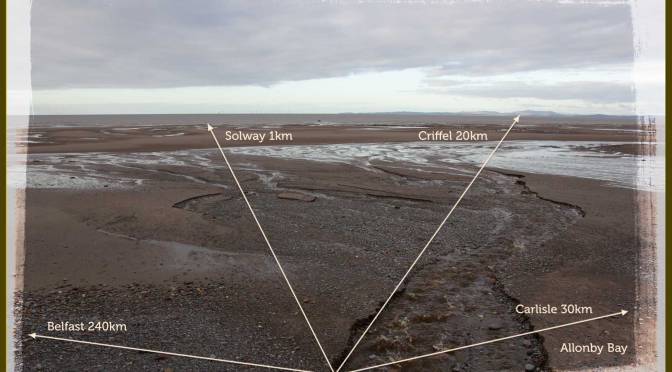
To describe the Solway, it is useful to start at the lighthouse on the Mull of Galloway, because from this point, 100 km ENE to the outlets of the Esk and Eden, and 70 km ESE to Bees Head is one interconnected system of sea, sand, rock and river called the larger Solway Basin as shown in the header image above.

But this opened up to a world beyond. From the lighthouse on the Mull of Galloway on a clear day, to the north you look towards the highlands and islands of Scotland, to the west you can see Northern Ireland, to the south the Isle of Man is clearly visible, and if you travelled due west you would arrive in Penrith, passing over Skiddaw on the way. Liverpool is south east. Dublin south west, Due south is Falmouth.

All this connected by sea passages going back millenia. Recent history would have seen highlanders removed in the clearances in the 18th century who would travel through this area from Annan waterfront to America around the same time that travellers and thinkers from France forged links and then divisions between the French and The Scottish Enlightenment. The Vikings came south into this maritime passageway, and the Romans came north. A legend with a grain of truth asserts that the Geodelic Celts came through this water from Scythia via Spain and the Fir Bolg from Greece.

Closer to home, the bit where the Esk and The Eden meet, between England and Scotland there are stories of ancient pathways of their own which give rise to it’s name. In ‘Crossing the Solway’ the writer Blindedbydazzle writes ‘Sol is common to Anglo-Saxon and Norse tongues. It means mud. The Anglo-Saxon woeth or Norse vad (or vath) … is ford. The Sulewad or Sulwath is as it was then, a way of mud.’

So before a bridge was built at the aptly named Metal Bridge, the Solway was a muddy passage way for travellers going between Scotland and England. The Wath’s across the Solway shown below are from Solway Shore-walker, another site worth a visit. The full story of the Waths is available here and a story of an actual crossing by the author is to be found here.

Where are all the people ?

Either speeding up the M6/A74 or driving more slowly round the minor roads, the Solway switches between being invisible, behind hedges and walls, or appearing spectacularly into view with an ever changing mixture of cloud, sun, water and land or vast areas which appear to be all of the above. However it is best experienced on foot. But as stated elsewhere, it is one of Europes biggest unindustrialised estuaries, and as such it is vast. The drive from Carlisle to the Lighthouse on the Mull of Galloway is over 2 and half hours, the same as to Manchester. There are an almost unending number of places to walk.

The terrain is varied with mountains and bays and sandbanks. The tides mean coastal walking varies by the hour. The flatness of the estuary also messes with your sense of distance. My partner and I walked on the estuary below Criffell and could see ‘something’ out over the sand as the tide ebbed. We went to see what it was and after a 20 minute walk, all we found was a plastic fish crate. But when we turned round we realised we were a mile from the beach. As we walked the sky moved under us reflected in the water in the sand ripples. It gives an impression of either indifference to human presence, or when the tides and weather change, a distinct sense of malevolence.

There are other wild and remote places in the borders that do this too. An article in the magazine ‘Live for the Outdoors’ puts the spot in England most remote form a tarmac road in Kielder Forest GR NY 58000 85879, under 30km NW of the Solway. The article is here. It is a land unused to people.

My wife and I went to the nearby Cristianbury Crags and found a large snakeskin and over half a dozen racing pigeon leg tags, presumed to be from the dinner table of the native Peregrines. It was an atmospheric place and after a while we both agreed it was time to go. In the car on the way home we confided with each other that we independently felt like the crags wanted us to go, at more or less the same time. This is weirdly reinforced in a 16m YouTube video of the crags below.

At the 15m mark, on departure from the place, the videographer describes what I think we felt. He says earlier that the mist seems to have followed them about and then says “The whole place is really mysterious with the clag coming through it, really eerie, like another world.” Just a few miles south there was another world, going from the head of the Solway up into the hills to the south of Christianbury.

The Debatable Land

The sparcity of population is a norm for this wild borderland. Between England and Scotland there was one a place called ‘The Debatable Lands’. Where it is popularly portrayed it is as the lawless breeding ground for the murderous Reivers. A 2020 BBC article here gives part of the story reinforcing this with the lurid reference to a decree ’..in the mid-16th Century, some 300 years into the Debatable Lands’ story: (stating) “All Englishmen and Scottishmen are and shall be free to rob, burn, spoil, slay, murder and destroy, all and every such person and persons, their bodies, property, goods and livestock… without any redress to be made for same.” While this decree was made into law, it was more of a legal “out” for England and Scotland. Neither side wanted the responsibility of dealing with the Debatable Lands; and as they could not agree on who owned it or how it was divided, neither could be held responsible for it, either.’ See a map here.

The article points out this deadly decree is 300 years into the story. In ‘The Debatable Land’ by Graham Robb, he writes about how it was originally ‘…a defined area in which no permanent building had been allowed. Animals could be pastured there but only between sunrise and sunset, and the soil was not to be ploughed or ‘opened’ in any way…. ‘Batable’ comes from the obsolete verb ‘batten’. Batable land was rich, fertile land on which livestock could be pastured and fattened up (or ‘battened’). By the 1800s, the word had fallen out of use.”1 As a teen, in Derby in the 70’s you took your food to work in your Bait Box. I thought it was a carry over from the fisherman’s bait box, but they just have the same root. The box for fodder, for the fish or the fishermen.

Ecologically this is exactly how this land should be used. It is in equitable balance with the human population. The Solway is the same. The biggest town, Annan has a population of, say 10k people. Dumfries has maybe 150k, and is connected to the Solway by the Nith, but is not on the shore. Malthus’s idea of a territory having a carrying capacity is seen as superseded in some quarters or resurgent in others. The Solway and the Debatable Lands have a low population density. Neither ids wilderness, both have a history of human interaction. I you can at least see everywhere on earth through Google Earth, or at least 98%, then there is no real, unseen by human eye, wilderness left. We all live somewhere on the urban fringe.

But part of what makes the Solway and the Debatable lands interesting to me is that to a large extent, the native population is not human. In the borders their are hotspots. Hadrians Wall runs a few miles from my house and ends at Bowness-on-Solway, the site of a Sulewath, and in the summer it is (by Cumbrian standards) heaving. But at Walton Moss (another of my stomping grounds), in the 6 years I have been going there, apart from a single busy day of hound racing, I have seen no more than 5 people, all at a distance. So who, apart from the few humans, who does live there.

Native Ecology

Natural England has a number of descriptive documents of National Character Areas. It’s summary of the Solway is extensive, available here and describes it thus…

‘The Solway Basin is a low-lying area of gently undulating low hills that grade into the coastal plain and estuarine landscape of the Solway Firth. To the east and south and across the lowlands of the Dumfries coast to the north, the lowland landscape is framed by the uplands of the Lake District, the North Pennines and southern Scotland. The area has a long history as border country, originally divided by the Roman frontier of Hadrian’s Wall, which has World Heritage Site designation, and through succeeding centuries it has been a part of the disputed lands of the English–Scottish border. The area is dominated by pastoral agriculture in rectilinear fields bounded by hedges but with increasing arable farming on the low hills. The coastal zone is characterised by a more open, wind-swept, dynamic and tidal landscape of salt marshes, beaches, sand dunes and intertidal flats along the margins of the Solway Firth and the Irish Sea.’

In previous posts the relationship between images and words and experience of place has been explored. But in terms of who lives on the Solway the Solway Coast Area Of Outstanding Natural Beauty website has some great publications with images of birds, sea-life, plants, human habitation and industrial history available by clicking here.

The Solway Firth Partnership has a YouTube Channel here and two videos below which show the range of habitats from cliffs to moorland to estuary.

And as for the people who live on the Solway, the Annan Haaf Netters know the place better than anyone. This great film from 2019 shows the Solway in it’s many moods and the fishermen catching salmon. What is to anybody else, is just a bit of sea and sand, is to the local people an intimately understood place with names and a personality.


  1. Excerpt From: Graham Robb. “The Debatable Land.”  ↩︎

Solway Walk – Experiencing place through photography

In seeking to report here on my experience of the Solway as expressed through art, what has happened is that I have come to question my understanding of how I experienced the Solway.

In some ways this was a bit alarming. My main contention with Moving Space, is that art making provides an expression of experience that is closer to the direct embodied experience than verbal or written accounts. This remains true, but on reflection the following has emerged.
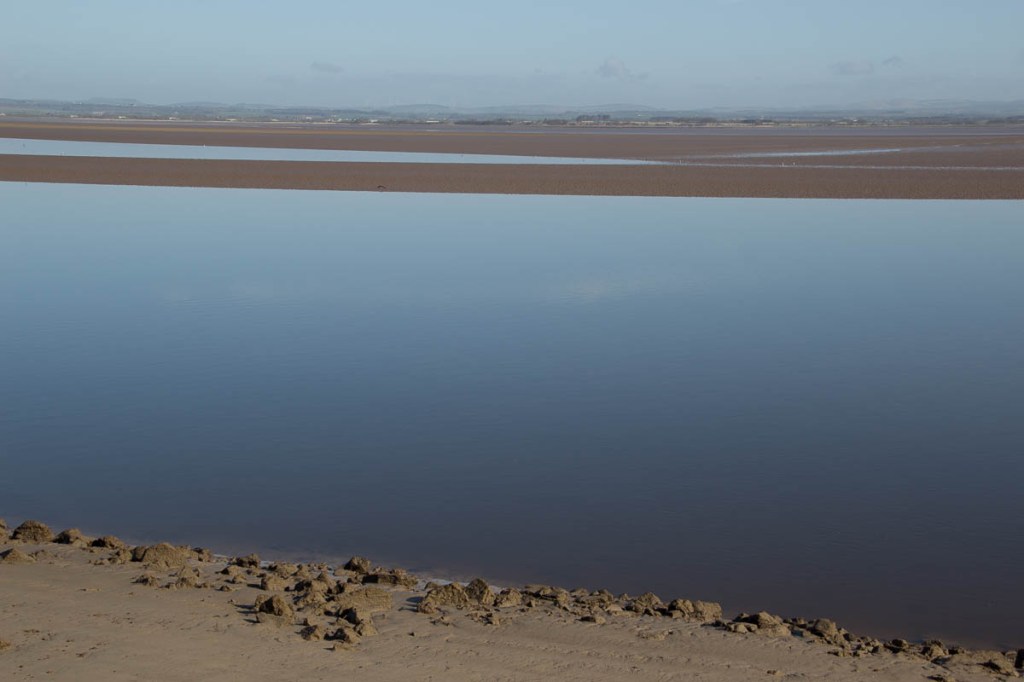
  • That whilst being in experience (as an embodied, sensed, cognitive, spiritual and durational phenomena) is encountered as a ‘normal’ seamless thing, retrospectively upon examination through words, images, and personal recollection, the shear magnitude of the simple experience of being on the Solway has dawned on me. It was also something far from normal.
  • Each artform I have worked with has given a particular account of, or path through the experience. All are valid but all are incomplete compared to the actual magnitude of the experience of being there.
  • The one bit of art making that came closest to being directly in the actual experience, was the moment I stopped walking an image of an idea and moved into performance and decided to (like KC & The Sunshine Band implore) do a little dance.
  • This is the one bit of artform that leaves no concrete artefact, like a painting, or a photographic image, of a poem. With performance there is no art object.
  • Of the artforms producing an object that I have worked with at time of writing, the film and the photography, the images of the experience that best get to how it felt, are the least figurative ones. The more abstract the image, the less it appears to depict the place, the more it shows how the experience felt.
  • But collectively, the more modes of artistic expression I explore, the more I get to an expression of the experience as a whole.
  • Whoever would have thought a one mile walk on a beach could contain so much experience.

Over this post I want to show what I made and pick some of this apart. But first I want to pick apart some art history which is pertinent to my reflections above.

History is written retrospectively and by it’s nature contains many narratives. Historiographically one narrative is that sometime around the end of the 19th C photography ruined painting. In the UK, most Victorian painters were portrait painters. People of sufficient income wanted paintings of themselves and their families that would show sufficient likeness that they could hang them on the wall and not have guests say ‘Who is that in your lovely painting?’ But along came the photograph, and apart from the time it took to expose a photographic plate, the photograph became a means of making an image of total likeness, that was available to everyone, including people who’s income was insufficient for a painting by an artist.

But a theory goes that now photography could simply and quickly make a totally accurate likeness, painting which was hitherto largely figurative became impressionistic. Photography showed the real thing, painting showed an expression of a thing. Painting became an impression of the experience of the painter. Painters went outside their studios and painted ‘En plein air’ in the outdoors. Freud explored the unconscious, artists explored surrealism, science discovered the quantum world, and suddenly we find that the observer of reality changes the reality they observe. The modern era had arrived.

So in recounting my Solway Walk and the art making that ensued I want to start by reviewing my photography on the Solway because this most easily illustrates some of the points I made above.

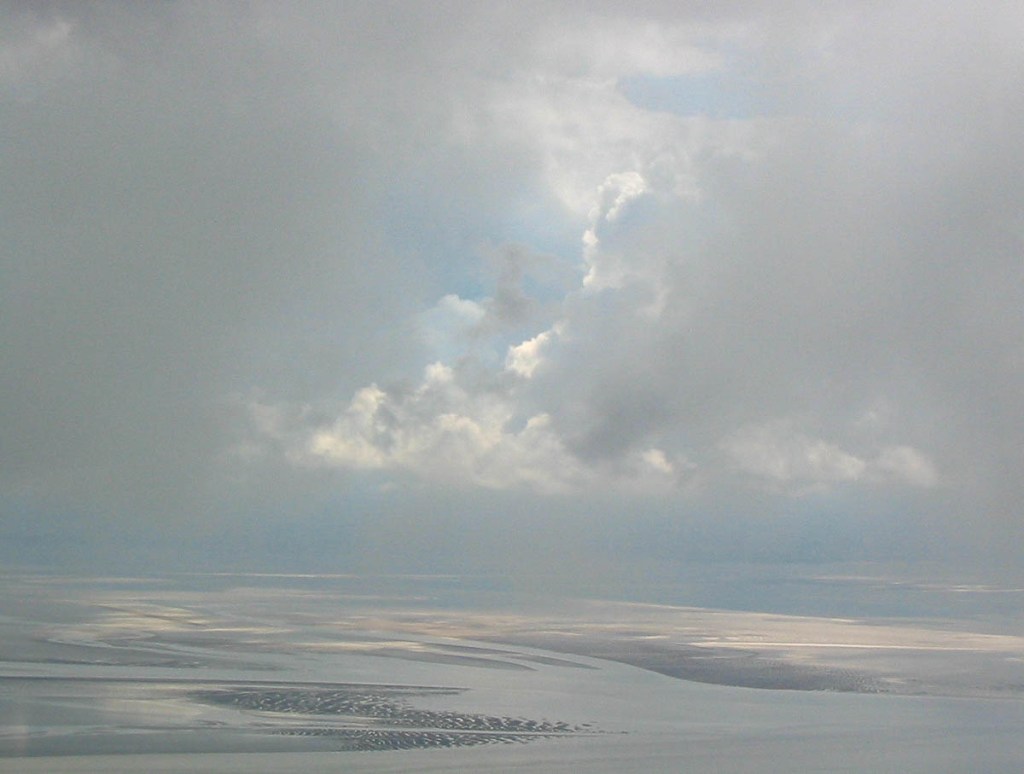
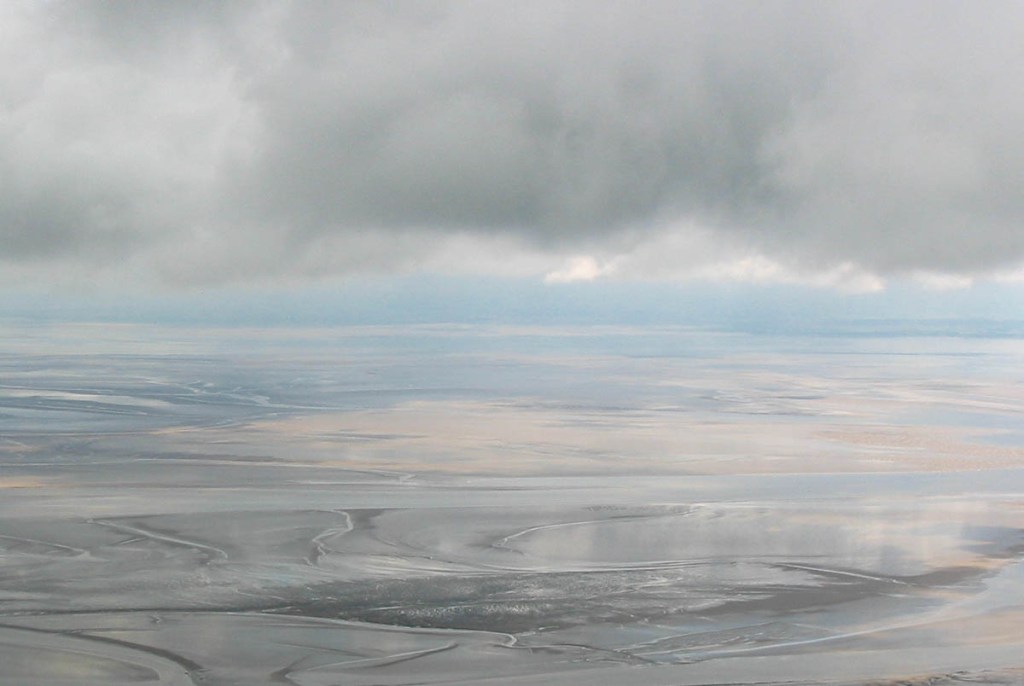
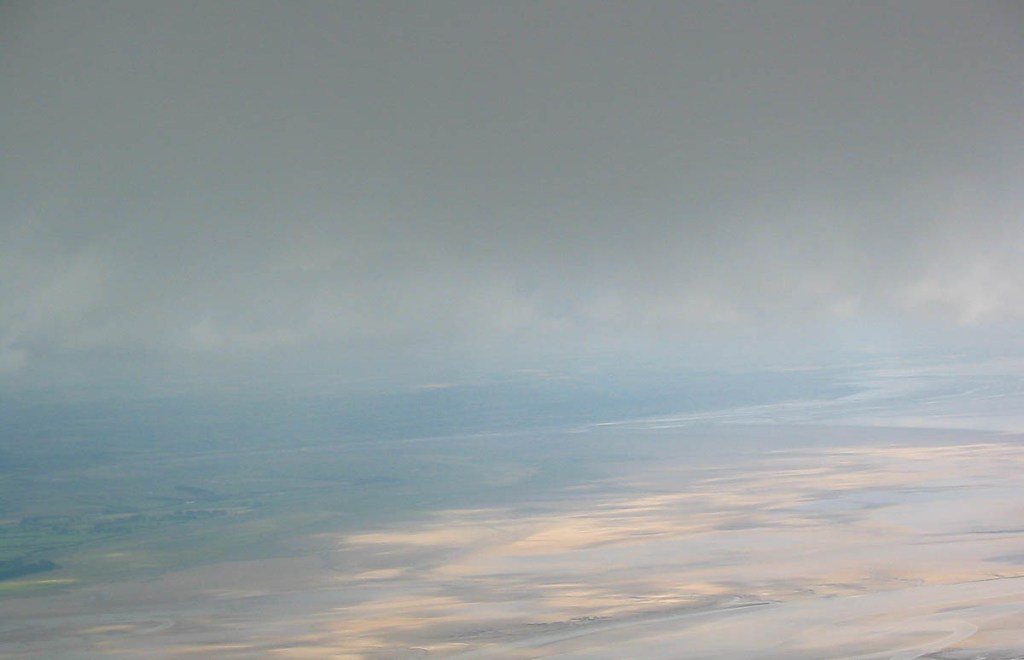
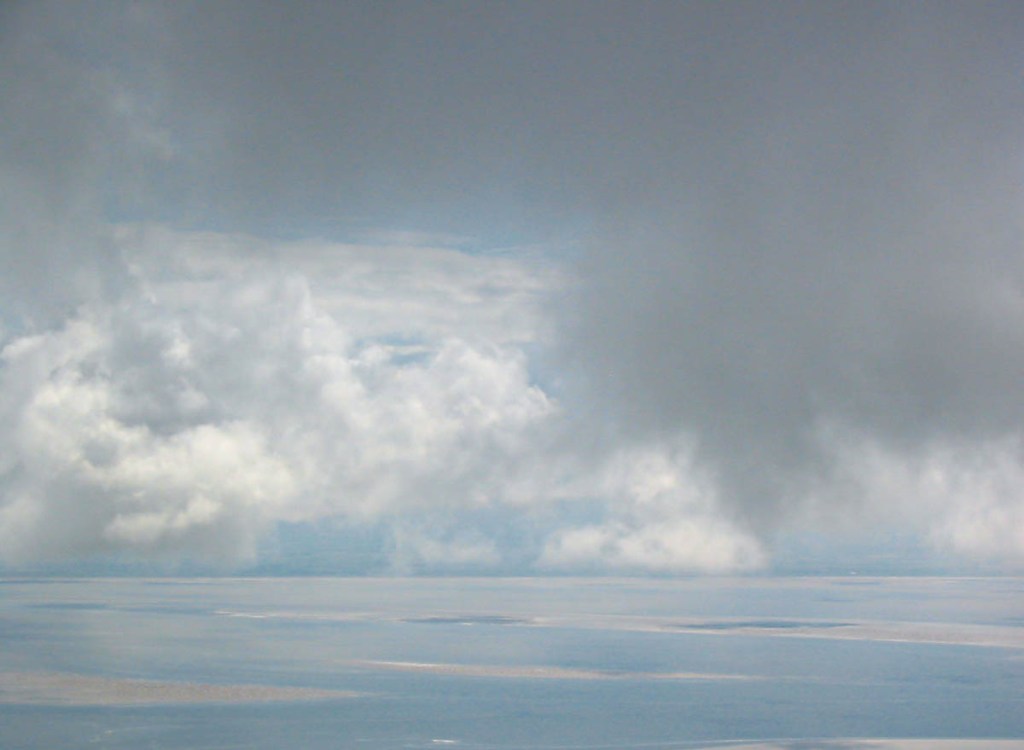
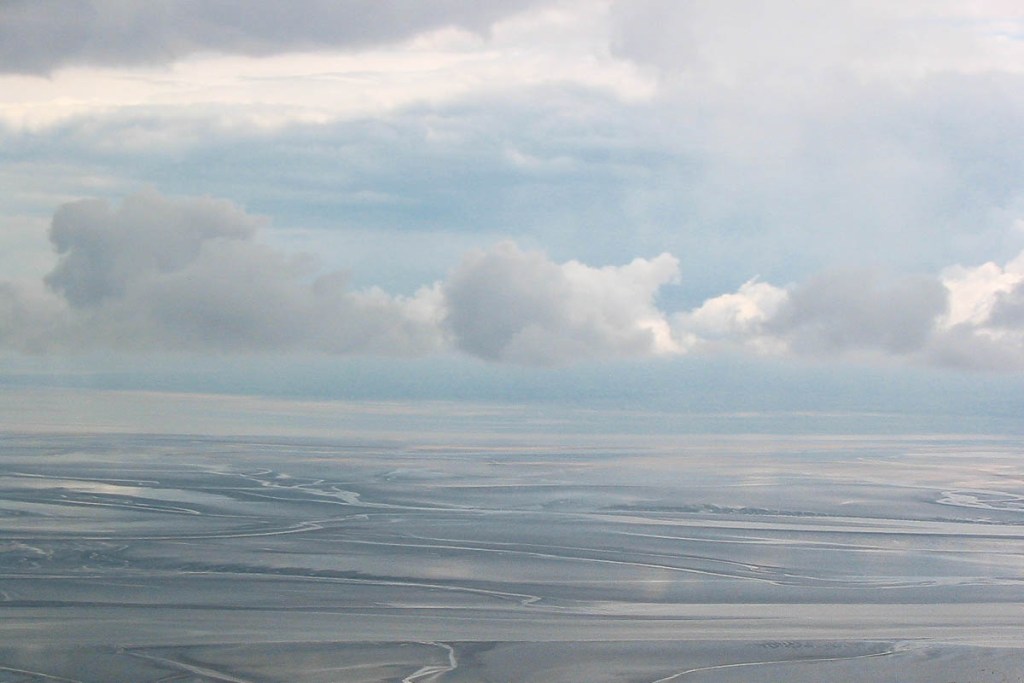
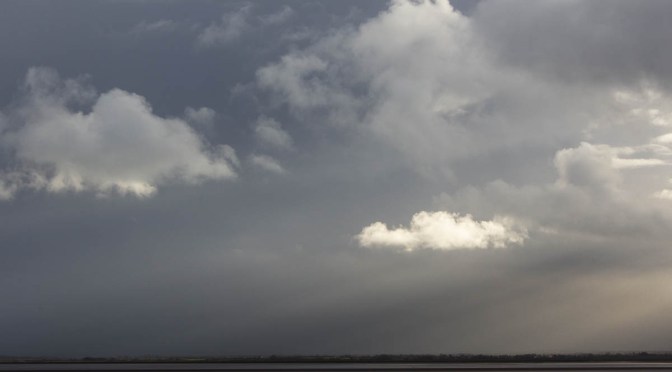
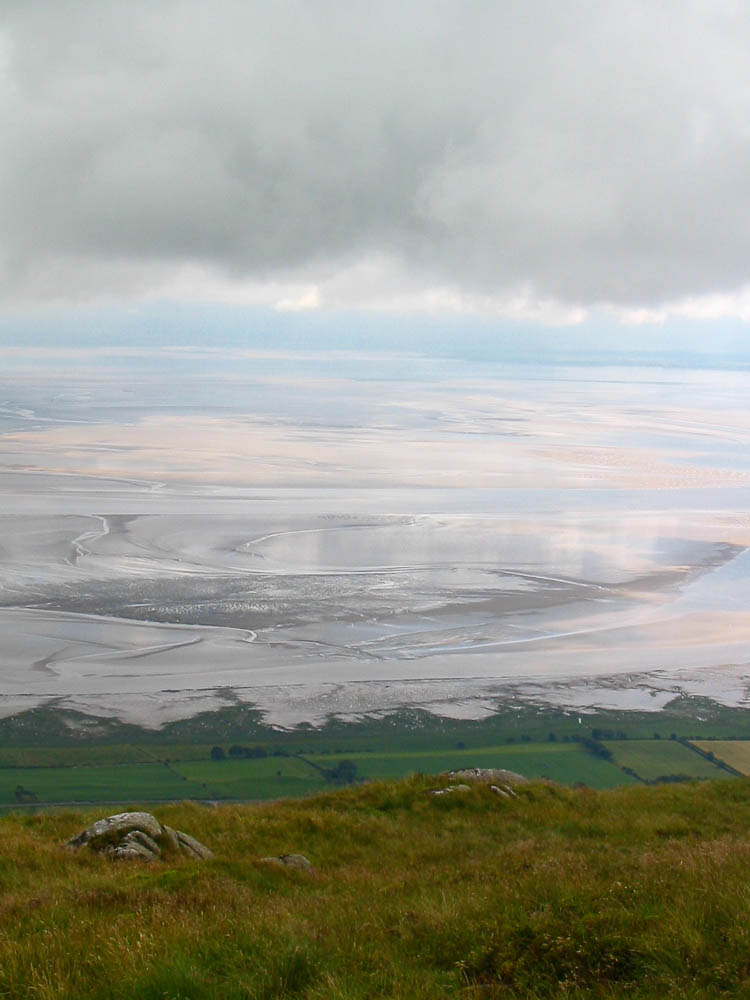
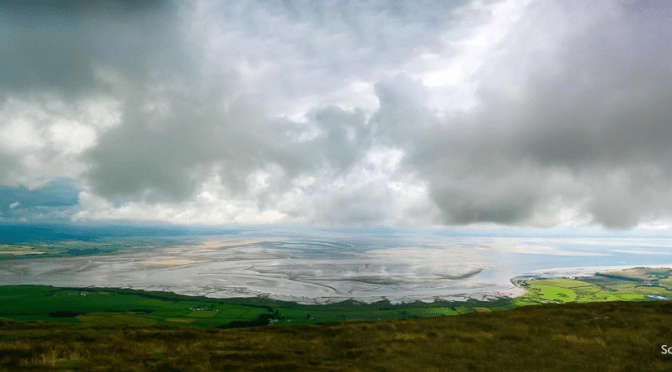
Long before I did the Solway Walk I climbed Criffel with my wife. Map here. The day we were there, the tide was out on the Solway and the clouds scudded literally just over our heads. We could see and touch the clouds around us and also see them reflected in the ebb tide thousands of feet below us. It was a mind expanding day. This impression of the Solway never left me.

To me these are very impressionistic images because at the moment we peaked Criffell, the whole place gave an impression of a place bewixt and between. The images are accurate depictions of the place. The images have an abstract quality with the sky and the cloud edge below us.

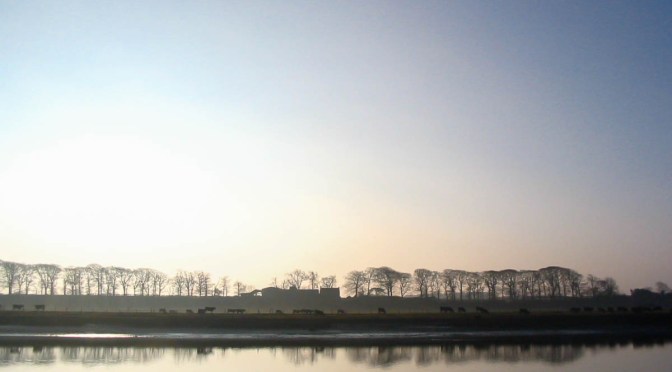
Other images of the Solway, whilst having some aesthetic merit and accurately and figuratively recording a photographic image of what I saw. They are rooted in my sense of sight, but don’t convey the otherworldly aspect of the Solway. They are conventional landscape images that show what I experienced with my eyes.

So working with images, post-processing them on my Mac with Lightroom, I find nice landscape images, because I saw nice landscape shots. But other images I took, which clearly caught my eye at the time, don’t have that nice figurative ‘landscape’ look. They show my experience, but don’t make classically photographic images.

My Amateur Photographer ‘Landscape’ eye judges them to be boring. But my judgement is that they covey my experience of the Solway as a place eternally between sky and sea, between tides, between land and water, but nobody will understand them.

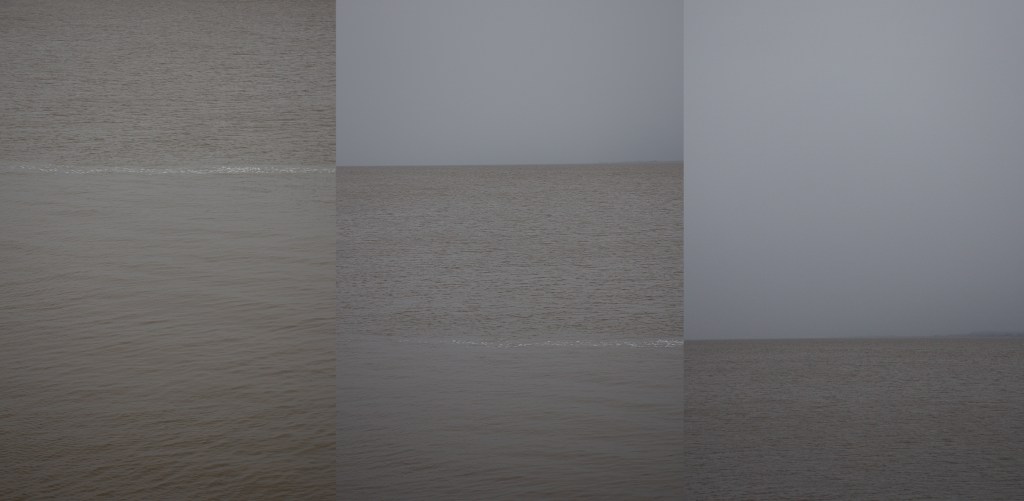
In the end I produced this image which to me most accurately conveys my experience of the Solway.

To me this conveys the idea of ‘The more abstract the image, the less it appears to depict the place, the more it shows how the experience felt.’ I put this image out and make judgement that in ‘landscape’ terms this is not an image easily understood by a person viewing it. It is not really a picture of a thing. It is an impressionistic triptych, and in some ways cubist, showing three views at the same time, like Hockney’s cubist inspired ‘Joiner‘ images. It has shifted away from a figurative ‘landscape’ image that shows what I saw, but it shows much better my experience of the Solway and a place that feels like it is always between things or many things at once.

So in terms of how art making can be used to explore and express personal experience of place, I come back to a recurring theme. There may be a tension between making art that is accessible in terms of being a figurative account, that looks to me and other people like a ‘landscape’ and more impressionistic or abstract images which mean something to me, that show my experience, but may be less explicable to other people.

Furthermore. If the performance of the dance came closest to being directly in the actual experience of being on the solway, but has the least to show, then using art to explore and express personal experience may need to have two threads. One is more personal and connected to process. Art is made that helps the individual process their own experience, but may be inexplicable to other people. The other thread is one in which art is made that is less impressionistic, but makes personal experience more explicable to other people.

All I have talked about here is my photography. This reinforces that both in terms of personal process and the production of art that is explicable to other people, working with a number of artforms may be useful. No single artform can covey experience in it’s fullest. It also reminds me of the idea of the ‘exposition’ in a previous post in which the author describes artform as embedded in a setting which includes some ‘..sharing of thinking processes and the revealing of methodology; and.. invites participation in order to enrich and expand understandings from the inquiry.’

The author goes on to say ‘One may even say that there is something inherently gentle to exposition considered as introduction, a relief, perhaps, from the obligation of being a ‘work of art’, in the serious sense of the word.’

In my next set of themed posts I want to explore what art is and use walking art as a vehicle to frame the discussion. My proposal is that we best understand how to work with at as enquiry if we work with ‘art not ART’. By this I mean getting away from an approach rooted in ‘Fine Art’ with galleries and sales and judgement on skills. Fine Art informs art as enquiry, but the work is done with art as a verb not a noun.

Relating to the intention to explore a model of art making as experiential learning then the art making is the central component but it is informed by all sorts of other experiences and modes of enquiry. Regards art making it is best understood as being playful, in the serious meaning of the word and the actions. And as such we learn from playing in many different ways.

Solway Walk – The Experience

The Experience of Walking an Image of an Idea about Art as Experiential Learning

Dubmill Point in Allonby Bay was empty and big. From the road to the low water line was about a kilometre. I chose a spot to walk in the centre of the image above, a low bank of hard sand.

Dubmill Point on the South Solway

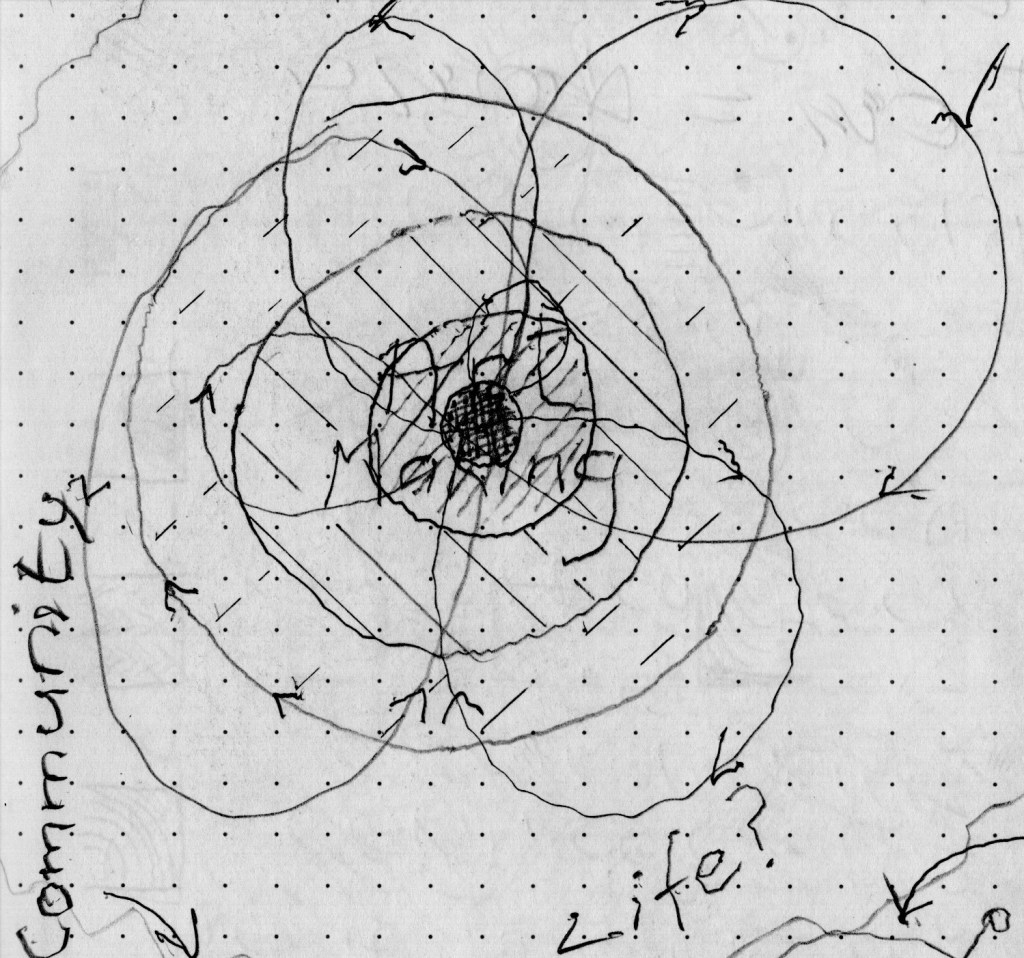
My intention was to walk the image below; my sketch of an idea about art making as experiential learning. I wanted to recreate this as a walk on the beach. I would use gps to track the shape I made, and record the walk on camera, and see what happened when I moved an idea from one artform to another, from an image to embodiment. I would walk with intention, attention and attitude. I would then write about my experience, reflect on theories and practices from the arts and learning, and see where this took me next. In my model below I would follow up this experience of art making into reflection, inquiry, reportage and further art making. I would not only walk my talk I would walk my thoughts.

art as experiential learning model

I set up my camera so as to get as much of the walk as possible without me becoming a dot in the distance. I set up my GPS and found my central point, meant to be the ‘Art Making’ part of the image of an idea. I set off walking in big loops.

Music : overdub1 by Chris Reed

As I walked it I kept seeking to return to the centre point. At first I found I lost sight of the central point. This would mean my GPS track would not reflect my drawing, so I put a marker there, a bit of seaweed and started again. I treated this as a rehearsal, an initial loop round my experiential learning model.

I set off again to recreate my drawing. I walked a line, one foot in front of the other, but by passing through the central point, I also walked in wonky looping circles. I got into a rhythm, I started to pay attention to how this might reflect art making as experiential learning. The central point became the place I returned to, but the loops took me to different places on the beach.

After a while I started to develop a kind of relationship with the central point. It occurred to me that instead of just walking the shape of the image of the idea, I could do a big slow looping dance with the centre as my static partner. I trained as a dancer and wondered why I had not thought of this before.

In the moment of being in moving as an artform, in the intelligence of that material, in witnessing my doing and the senses, it felt like this had significantly changed the experience. I found a freedom from mere representation, from figurative form, and improvised a new form. It became performance. Through this experience I learned a new thing about my art making practice.

All in all it was a quick and easy thing. It took me about 20 minutes to walk a mile. There is quite a strong tradition of walking as art and performance art in outdoor settings. These forms are interesting in that they are durational, the art making only happens when the person is walking or performing. The experience may well be documented through film, photography or other forms, but it is unlike a painting in which the artform exists after the making it. The artform is the experience. Performance based arts are very experiential and offer interesting opportunities for experiential outdoor learning. But Mark Rothko stated that the art, even a painting, is the experience.

This is something I want to explore further. If the art is the experience, and we work with the outdoors as art, the art we make outdoors can tell us not only tell us something about outdoor experience, it can be the outdoor experience. We make something that is outdoor experience. This interests me a great deal.

Doing strange things in the name of art, like walking around in circles on beach may seem meaningless, but often I find that the most important learning comes out of what seems to be the simplest most meaningless experiences, or experiences that seem to have many different meanings. Ambiguity is important.

Walter de Maria, made action-art and land-art, only available when experienced directly in the outdoors. He said…

“Meaningless work is potentially the most important art-action experience one can undertake today”

…but also

Any good work of art should have at least ten meanings.

Walter de Maria 1968

See video here

Read article here

But my intention was to use this to explore my model of art as experiential learning, and at the time what struck me was that by changing from walking the shape of an image of an idea, to performance, dancing, improvising the idea directly in the space, my model changed, and so did my idea about art as experiential learning.

The image that immediately came to mind was my life as a map with different experiences and interests, different places, other artforms made, with the artform I am currently working on as the one with the closest proximity to where I was at the time. In my next post I want to reflect and report on this aspect.

The Solway – Betwixt and Between

A Visual Introduction to The Solway

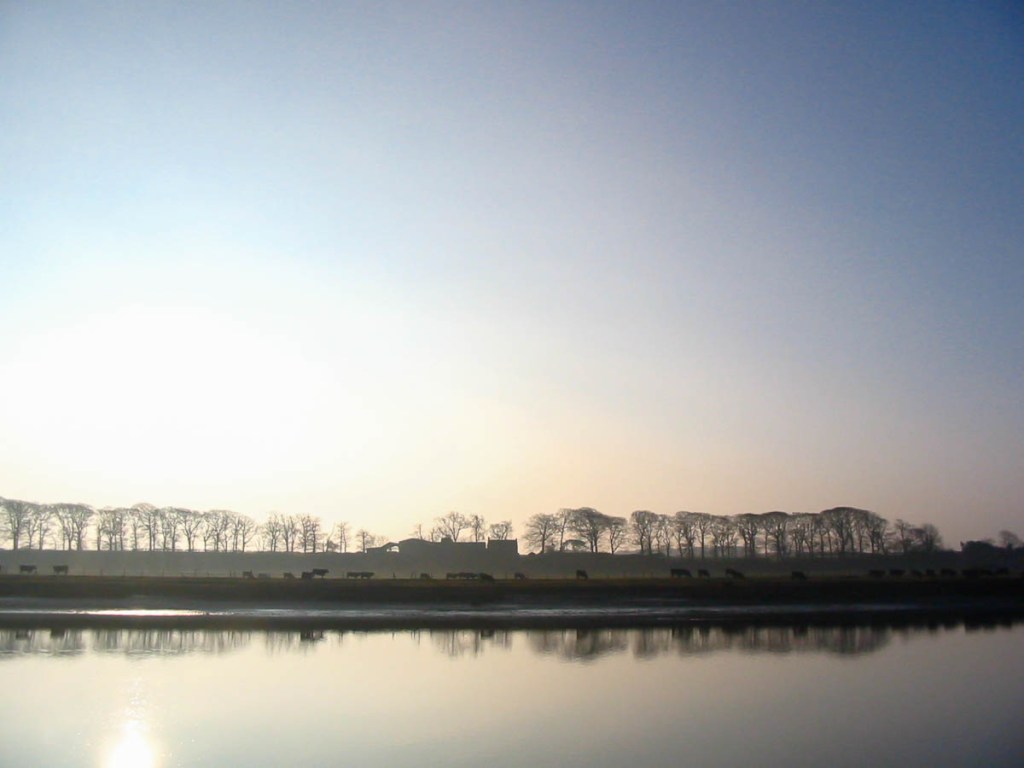
The Solway Firth exists in a permanent state of being betwixt and between.

Between England and Scotland, between sea and sky, between high and low tide, between being land and water. It belongs to nobody. It is one of the least industrialised and most unspoilt large estuaries in Europe. It is as magical as it is dangerous. To visit on foot you need your wits about you as it can change from sandbank to fast flowing seawater in minutes.

Below are some moving and still images of the Solway. More material will follow of other peoples experiences of the Solway.

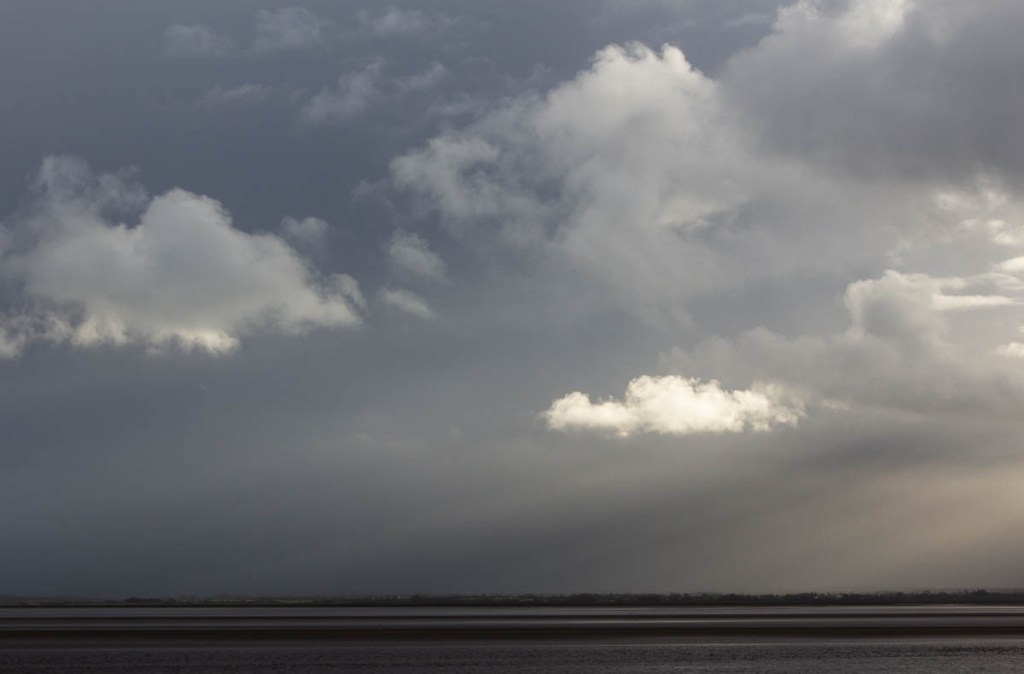
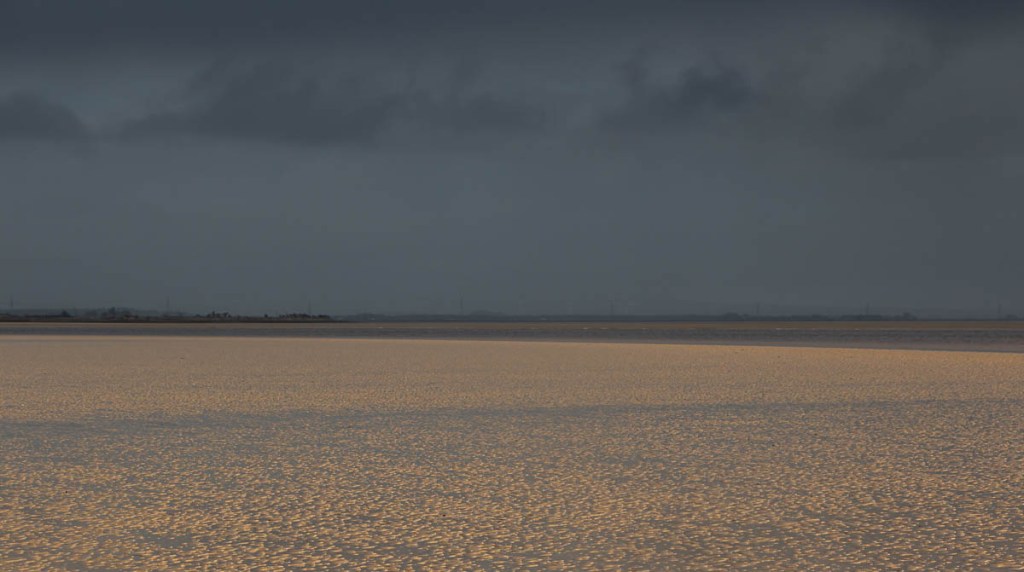
  • sky over the solway

Solway Walk – Introduction

Towards a Model of Art as Experiential Learning

On November 18, 2020, I went to Dubmill Scar in Allonby Bay, the English side of the Solway Firth, to walk. I went to walk as art. Guided by the art therapies and experiential learning, I make art outdoors to explore and express personal experience. I work with the outdoors as art.

Most of my art making revolves around a series of place based projects. For this project on the Solway, I started with walking, but walking as a creative act. Walking in the space, I try to pay attention to what is happening with an attitude of openness to experience. I seek to be in the space as an experiment to see what happens rather than be in the space as a venue for activity. The art is the experience, and the experience is the activity.

This walk needed a large space with open access and no boundary fences, and at the bottom of the tide, briefly, the Solway has a lot of walking space. The Solway does this by being eternally transitory. It is always in a state between high and low tide. The border between Scotland and England, it belongs to nobody but the sea, the sand and the things that live there. These things need no fences or footpaths. I have been visiting the Solway for years. It is never the same twice. It is a space open to possibilities, and as such, a place of creativity.

For this walk, the space was needed to recreate an image of an idea I worked on previously on about making art as experiential learning. My background in experiential learning has introduced me to a number of models of how we learn from experience. In all of them, there is an image of simultaneous movement, around a circle and along a line.

Plan Do Review Cycle

Kolb’s Learning Cycle

Using this idea and image of learning from experience as a starting point I reflected on my own art making and drew a sketch of experiential learning with art making at it’s centre to see how it might look. I wanted to move this idea between artforms. Each artform has it’s own intelligence, and shows things from another point of view. It is used in the arts therapies and is called multimodal working. It is an interesting technique. To aid with this I decided to film the walk.

things from a different perspective

As a starting point for how a model of experiential learning from art may look, I drew this.

art as experiential learning

First draft of a model of art as experiential learning.

In this model the looping line is my passage through time, through my life. The central bit is my encounter with art making. When I make art I learn something and this loops out back into my life and informs my next round of art making.

There a sort of sequence to this. I think about making art, then witness and pay attention to what I am doing and my senses when I make the art. The art form, the material of the art making has an intelligence of it’s own which can tell me something. This is an idea from artist and research Paul Carter called the Intelligence of Material (IOM). As part of this I also engage in reportage of my experience, which is what I am trying to do here. Writing and reporting helps me understand what I am thinking. In formal art based research, this is called exegesis, meaning interpreting arcane texts.

At the time I was also thinking about Rhizomatic Knowledge from Deleuze and Guattari and Bubble Charts as I felt that my experience of art making had an adimensional or three dimensional quality, hence the images at the bottom

But the bit I wanted to work with were the big recursive loops through art-making and back into life, where I did more formal research of artform, ideas, the work of other artists, theories of learning or art-making. So off I went to the Solway, with it’s big unimpeded wide open spaces, always in movement between states, and thus ripe for creativity to walk this image of an idea about experiential learning.

It is difficult to create and analyse at the same time, so my intention was to be in the space and the moment, witness what happened when I was walking as art, then reflect and report later on moving an idea from an image to an act of walking.

Generally what happens is that what I learn through the experience of art making acts like a cascade of dominoes, expanding out into inspiration to new art making, connections to theories and practices of art making and learning and insight into place and personal experience.

Over a series of posts to my blog I want to follow the cascade of ideas and art-making that will come out of the walk, then curate the posts into a themed collection of ideas, practices, artworks, a bit like a magazine. Over time I want to do a series of magazines covering different topics relating to art, experience and the outdoors.

In the next post I want to describe what happened when I did the walk of an image of an idea about art as experiential learning.

Mapping Sensation

Livingmaps Network ran an online event yesterday.

DRAWING MAPS, IMAGINED LANDSCAPES AND PANDEMIC STORYTELLING

A LIVINGMAPS WEBINAR

It looked at the impact of Covid on our lives and ways that mapping as an artistic practice could help. Quote…

‘Drawing, or perhaps more broadly speaking – mark making, is a deeply subjective tool that we can use to enter into other spaces beyond the here and now, perhaps into memories or imaginations of a possible future or as a form of visually representing emotional states.’

Lots of really good arts projects about mapping and imagination, of better futures and utopias, great and small. The idea of using mapping to express feeling and the imagination was very interesting and changed my way of thinking about mapping.

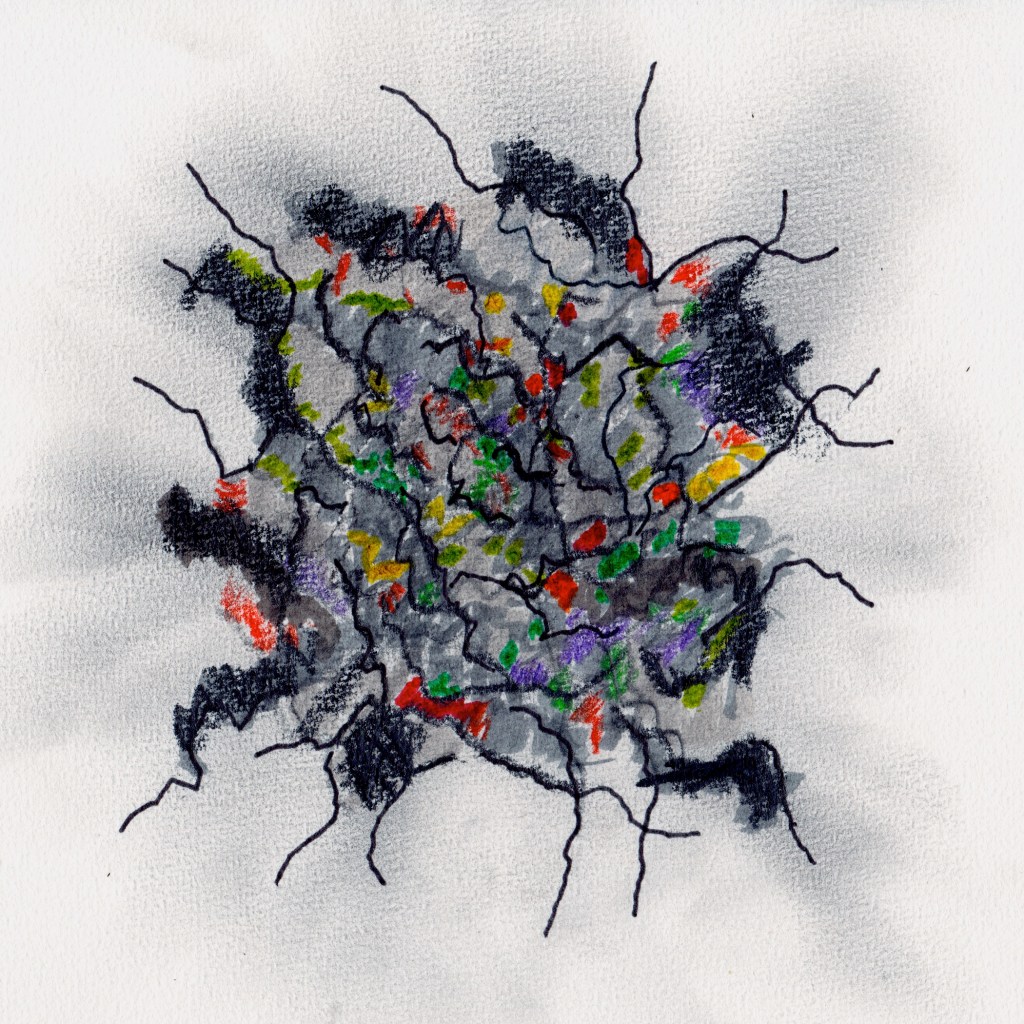
A place I visit called Walton Moss, and seek to make a subject of my art has evaded my skills for a long time. It is too big to photograph, or paint, and capture it’s magnitude. It is not particularly scenic in a classical landscape way, but is very impactful to visit. It seems to exist at two scales of sensation, the very big and the very small.

Walton Moss Sensation Map

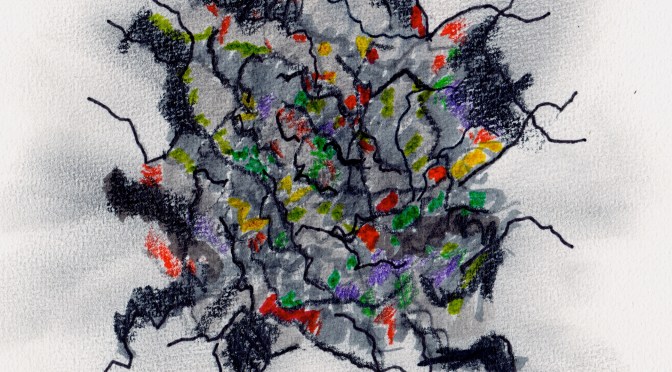
So I did the header image as map of the sensations it evokes, show above. What was useful was the way the map, as a form that expresses a large scale object through a smaller scale object worked really well. The idea of mapping feeling freed me from being trapped with figurative depictions of a magical but enigmatic place, difficult to express figuratively.

I used charcoal crayons, felt tip pens and watercolour pencils, then scanned it.