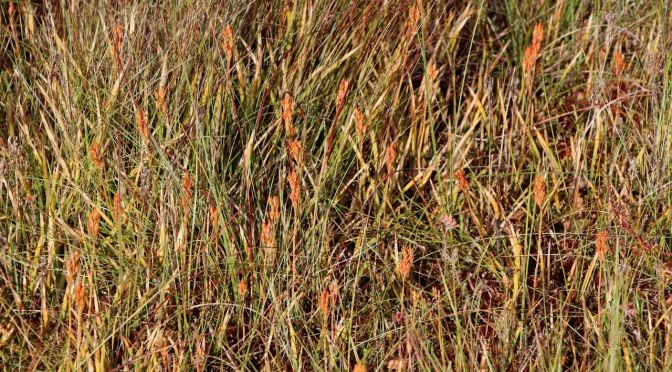
The third leg of the grid square walk.
Heading south.
Click the link below to read the article.
Regferences to walking, as an activity or as an artform
The third leg of the grid square walk.
Heading south.
Click the link below to read the article.
A YouTube podcast from Adam Zucker of the Artfully Learning website about walking as art. He interviews Ellen Mueller who wrote Walking as Artistic Practice.
Everyone knows that arithmetic is true: 2 + 2 = 4. But surprisingly, we don’t know why it’s true.
By stepping outside the box of our usual way of thinking about numbers, my colleagues and I have recently shown that arithmetic has biological roots and is a natural consequence of how perception of the world around us is organized.
Our results explain why arithmetic is true and suggest that mathematics is a realization in symbols of the fundamental nature and creativity of the mind.
Randolph Grace.
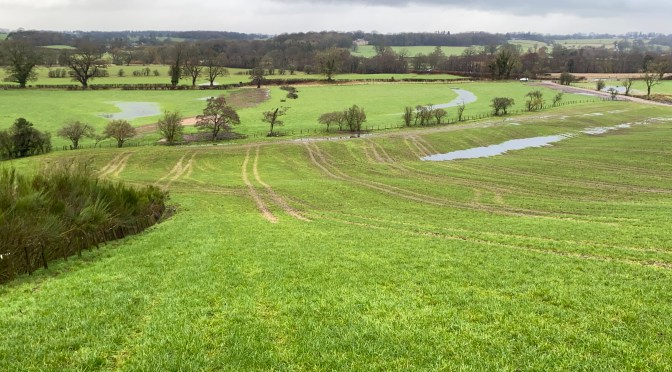
Decide on left left left right today and go out of the drive turn left and left again then at next left road and path are deep under water wife said the roads were wet pass the barking dogs at scrap yard that got out and lunged at us once and turn right find first sign of accident bits of headlamp and bodywork under grass just off the carriageway then some yards on find more carry on and find whole headlight fitting in damaged tree with big scar must have been an accident is it two cars or one what was outcome see mile marker I never really examined before and it just has ten on far side and one on near side nothing else so must be a mile to brampton and ten to longtown shortly after see the grisly remains of some roadkill which I guess is what is left of a young badger just the skin then become aware of a flowing stream down side of the road that is usually dry and accompany it downhill a ways to find a broken pipe by a gate in the field suggesting more deliberate engineering but it just dumps into field which is now flooded with runoff gurgling down to the irthing further on road narrows and I loose the grass curb for my walking and get onto the tarmac but see big tractor tyre marks cutting into verge on longtown bound side and see wet field has open gate with big tractor tyre tracks so guess marks made by autumn muck spreader swinging out left to make right turn into field now close to river and do next left to find road flooded again with water both side in hollows in field and a slow clear curve of old river course on downstream side filled up with overtopping groundwater left again into field and more signs of old river route including what seem to be grassed up riverbank sandbank beside the old river flow up hill now and find a single red sand stone pebble in field on top of grass like it was just dropped there today why where did it come from who dropped it maybe it came off a tractor and see several tracks of small animals come under fence and over field then cross same fence by old style and on to the hilltop badger sett which is clear red soil and earth and not overgrown like the beasts are about at night and see little one plank bench above it like people set it up to look at the view or wait for the badgers in the dusk and see big bank with lots of clear paths most likely not from farmers stock but maybe badger roads squeeze through lined up old gates and see very new dead sheep wool pulled of her hind quarters just eyes and tongue gone into crows belly see no other sheep and farm buildings nearby then follow fence and find rest of sheep flock at field corner by style either getting out of wind or as far as possible from dead sister and they all do that shudder thing like dogs to shake off rain as bits of blue sky appear then on to road with good flow down it into gurgling drain as it is right over the partly fossilised watercourse in the lazy bottom of the shallow valley and links the brampton glacial till ridge with the irthing which only appears after rain then in other places flows overground or through broken culverts and along field boundaries see curious gouges and marks in tarmac of road which must have taken something big to do it that deep and clean then find I can do my second right and then three lefts to find myself back on road of my first right but further up near brampton by the schools so would then do next three lefts like before and be stuck in a perpetual loop like a figure of eight so decide to end it and drop the algorithm then feel a bit weird thinking what would it be like to just keep walking and not ever go home but turn right past sprappies and back to my house by same route I took to start with and get back to dry out and drink tea and recollect the walk and the glory of it’s mundanity
The intention for this walk was to start a new year by reconnecting with my local space after a bit of a hiatus. I wanted to concentrate on the act of walking more than the act of going to some destination.
One way of doing that is to use a simple algorithm to decide the path taken. I chose to take a path based on turns left and right. I decided on going LLLR, three left turns and a right turn, for two or three iterations, and see where it took me. This idea still gives some control over outcomes. It was very wet so a wanted to stick to roads and footpaths. It is an idea used in psychogeography for urban walking, as a way to move around a city in a way that brings the walker to places they don’t choose and don’t expect. The idea is to stop attending to the navigation and attend to the senses as you walk. You find all sorts of paths you never would normally notice, and in sticking to your chosen algorithm, feel compelled to take them. In my locale I found all sorts of little unmarked paths, in Cumbria called ‘Lonnings’, using this way of walking.
The day was wet and I timed my walk to miss the showers. I took my phone to photograph anything that took my fancy. I have walked all my local paths and could work out where I would go in my head. I wanted to see what had changed since my last walk this way. There is a saying, I think from the german, that says “If you want to find something new, take a familiar path.” It was in this spirit that I set out to walk.
“If you want to find something new, take a familiar path.”
I walked and photographed whatever took my fancy. On the way I thought about how I could represent the walk when I got back. In my head I had images from old scientific expeditions. My Father in Law got the new Taschen ‘Science Illustration’ for Christmas and some of the images were a great combination of the objective and the aesthetic. See the content of this book here.
Out of my front gate I went left, then two more lefts and then a right. Then I repeated it. After two iterations I worked out that if I did another iteration I would end up in an endless loop. I set off on my third ‘right’ down the same road as my second ‘right’, then broke the pattern and turned home. The intentional act of granting yourself responsibility to relinquish responsibility for navigation is quite strange. It behoves attention. It invokes an oddly relaxing attitude. It lets you be more in the here and now. This way of walking allows you to be present where you are, rather than where you want to be. It is intrinsically meditative.
“This way of walking allows you to be present where you are, rather than where you want to be. It is intrinsically meditative.”
My phone has an app that can use GPS to map my track. On return I wanted to use this as a kind of objective account of the walk, but do some ‘arty’ thing as well. I was not sure what it would be. Maybe some kind of faux expedition illustration like in the Taschen book! I also had in my head a separate idea about a construction of card exploring the relationship between the experience and the words used to describe the experience. I will work on this and show you in another post, but with this in my head, the prosepoemwalk idea with a slide show kind of formed as I woke a day later. This is at the top of this post. It seemed to capture the dyadic experience of the being present, attending on the spot as a singular phenomenon, and the walking as an extended, linear flowing phenomenon. I liked the idea of the words and the images mirroring and complementing each other. I liked the idea of the thing I made being self contained. It shows you what happened without explanation. The LLLR ending up as an iteration was pleasing too, like it revealed a natural mathematical formula, a universal platonic pattern, in my local landscape. Very cool!
On this walk I wanted to simply pass through a space and observe it, and express my experience through some artform. Here I chose words expressed with an aesthetic which I feel reflected the experience. This action will go on to be developed in other artforms posted up here later. I am working on a kind of construction made of card and paper to develop this experience further. Exploring the same experience through different forms is part of the art as research process. Each form reveals a different thing. But I see a generalised sequence which goes we observe, we reflect, we interact and we modify, make and share. In the Taschen Science Illustration book mentioned earlier are the products of observation, the reflection is embodied through image, but the image is used to guide interaction, then modify, make and share ideas, products, processes. This walk was done in this context, to simply observe and record and reflect on the experience of the space I walked through. As 2023 pans out I want to use art making to explore my relationship with my local spaces through observation, then interaction to modification. I want to use this to develop ideas about the outdoors as art and art as research.
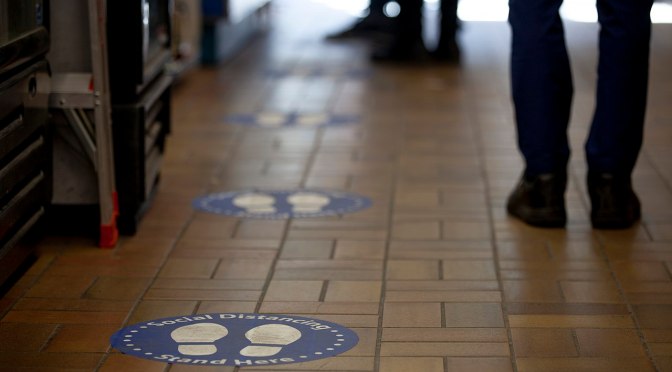
Social distancing was introduced to the UK around March 17, 2020
On March 18, 2020 I did a walking art performance to explore the then new idea and practice of ‘social distancing’.
On reflection, a year on, it is interesting that this simple act gave me insight that evening into the way that ‘social distancing’ would very quickly become normalised in society, as did the sensation of coming to avoid or mistrust the proximity of other people.
It just reinforces for me how performance and art as research may be able pre-empt experience and give insight into experiences to come, but do so through feelings, not through empirical data.
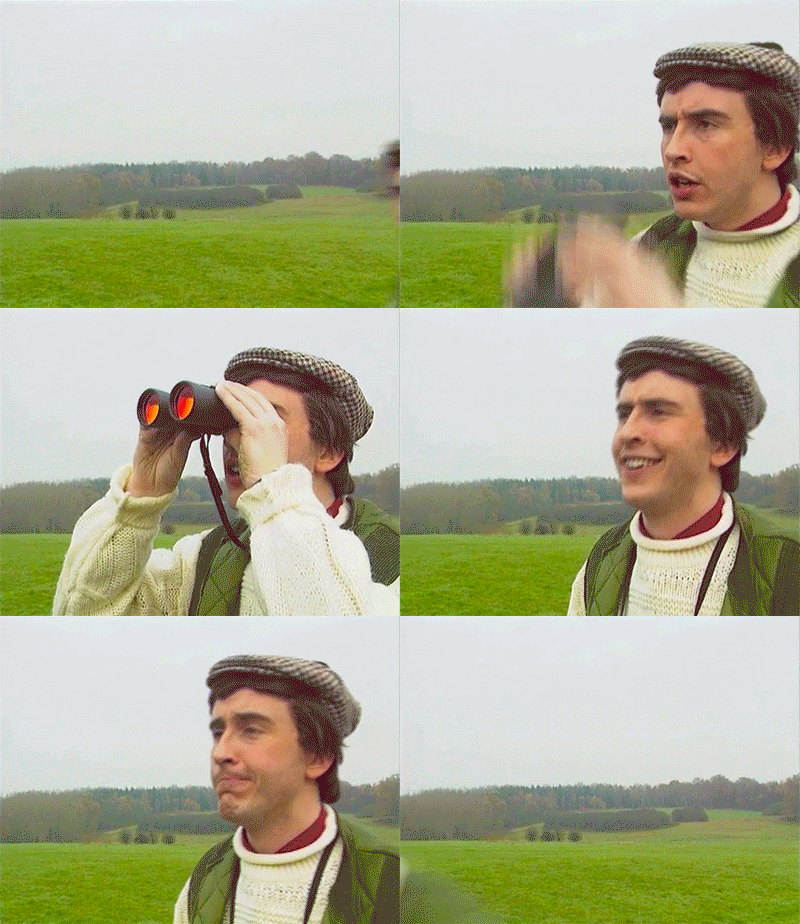
This reminds me of Cassandra, who was able to see the future, but was cursed by nobody believing what she said. She was cursed by Apollo for lying when she said she would get jiggy with him. She was cursed for lying, so the curse made her words became an untruth.
Maybe the moral is then is to not lie to yourself about what you may see, but beware that to say what you see may help nobody. And if you do speak, maybe only speak to people who see the world the way you do. Therein is the dilemma of holding your own counsel or speaking only to become stuck in a bubble. Trump and Brexit and QAnon all rolled into one.
Or maybe the moral is simply that words are not accurate representations of feelings, and interpreting feelings is an art not a science.
Below is my account of that performance written somewhere around the end of March 2020.
Performing Distancing March 18, 2020
(Written end of March 2020.)
On the basis that art and performance can be used as research, to explore and express personal experience, I wondered what would happen if I walked through Carlisle town centre maintaining 2m social distancing, but do it as performance, choreographed like a dance or with applied dramaturgical principles, and record it with GPS.
A simple algorithm was devised to work like choreographic directions.
Walk in a straight line until I was within 2m of another person, then turn away until the distance exceeded 2m, then resume the straight line.
Where I met an obstacle turn through 90+ degrees and continue in a straight line.
Limit the walk to the central shopping area.
Walk for 1 hour.
I imagined this visualised as a faux maths formula, because moving an idea between forms, like turning word into image, can sometimes reveal a new aspect to the idea.

Where P is the path of the walk, as an iteration or repeat of p, which is each leg as a straight line a-b until this is changed by meeting a person (the m is an aboriginal sign for a person, basically, the bottom mark left in the sand where a person was sitting) in which case the path p changes (the triangle) by n degrees.
The basic principle of art as research is to make art, in this case performance, and pay attention to what happens when you do.
On the 18th March I did a social distancing walk for an hour in Carlisle city centre, and payed attention to my thoughts and feelings and other peoples response. I tracked it with GPS tracker.
This is the raw GPS visualisation of that walk.
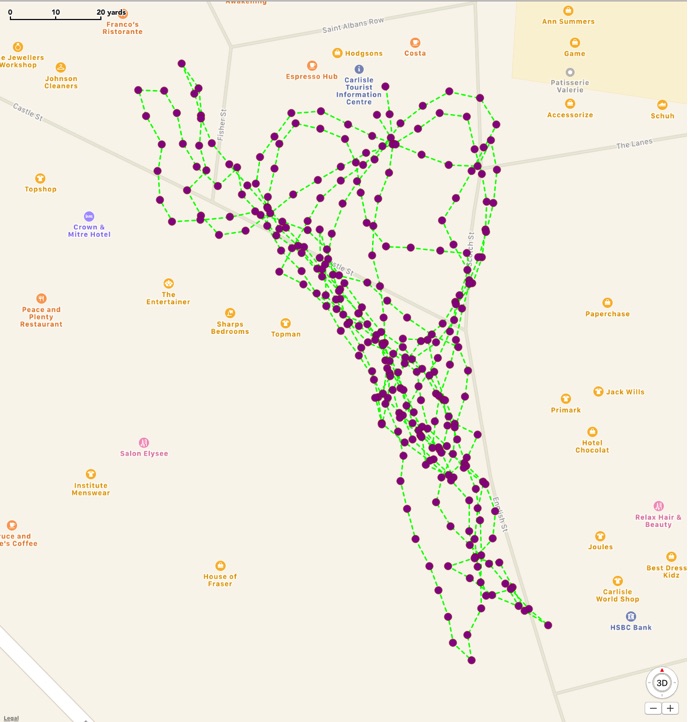
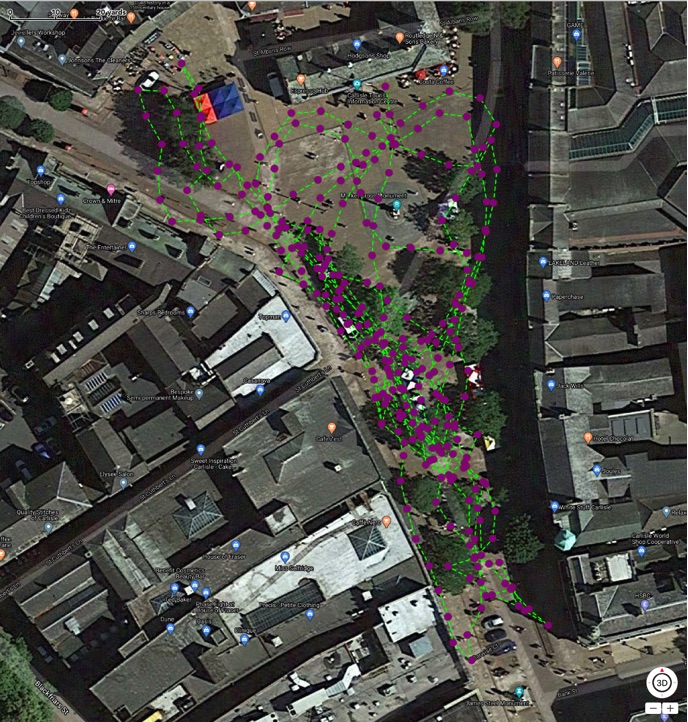
I worked with a GPS track editor and removed as many intermediary waypoints as possible to leave only turns in response to social distancing or turns in response to an obstacle, like a shop front.
I got this, edited down as three images joined together.
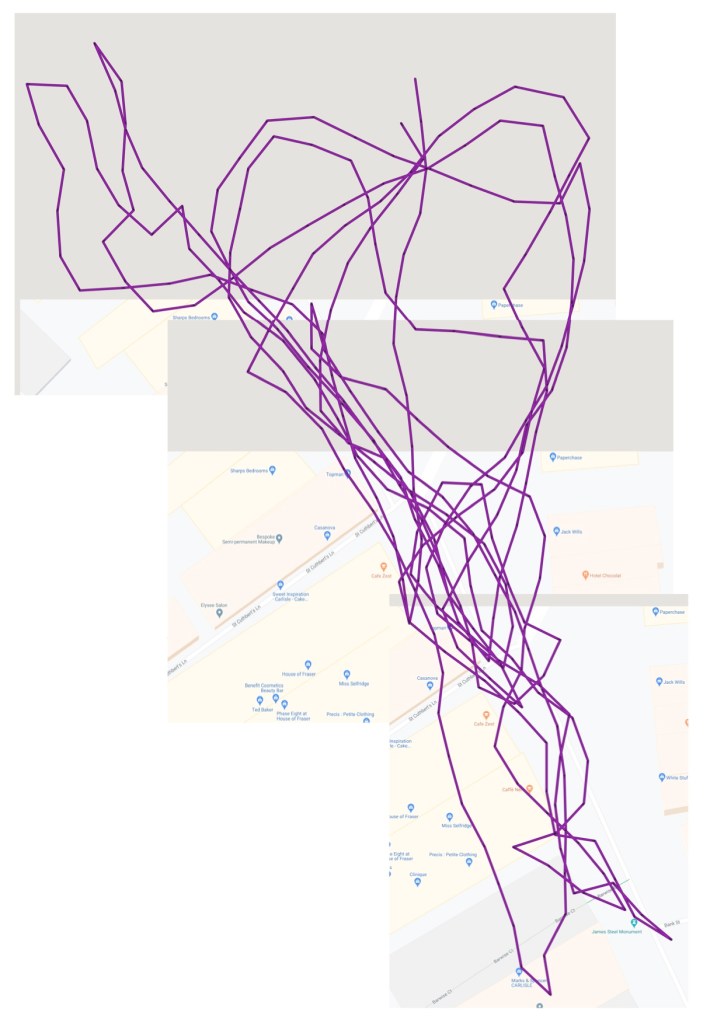
What the walk/performance did as research, was give me insight into social distancing, then a very new phenomenon.
Over the hours walk, I started to become anxious when I got close to people. As a person approached me and I anticipated the need to distance, I felt a rise in my level of anxiety. I felt isolated and distanced. I felt sad.
I was also nervous about wandering around in circles for an hour on CCTV. In the end nobody even batted an eyelid. I was utterly uninterrupted and fully ignored.T his added to a sense of aloneness.
Part of the creative process is the period of incubation, in which the creator moves away from the art making and does some other thing. On returning to the theme or the artform, after incubation, new insights emerge. The form created is seen in a new light. I noted this sadness and anxiety at the time, but on writing this, months later, another aspect of my experience of performance/art as research came into play.
I reflect now that this experience gave me insight into how social distancing would feel. Now, months later people are not rushing back to contact, many people appear reluctant to go back to the shops and the pubs and the office. This week, mid-June, the MP is now imploring people to go back to the office and the shops and the pubs. The anxiety prevails.
Also there is growing anger in the UK and clear riotous anger in the USA in some quarters of society. Today I found the following meme.
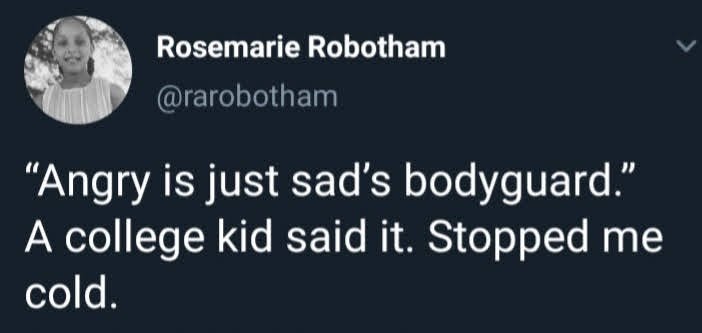
My experience of children in care is that many are angry and this is just a product of sadness and anxiety. Whilst different, both are connected to loss. Anxiety may be an anticipation of discomfort and danger, but also the anticipation of the loss of safety, the familiar, and the predictable. Our stress response is fight, flight or freeze. We have been unable to flee in lockdown, which leaves fight and freeze, anger and sadness.
On March 18, the day of my social distancing walk, the experience of social distancing was new. This art based research could not be seen as producing a clear empirical evidence based outcome, but I did experience feelings in myself which could have anticipated feelings shared by other people once the lockdown deepened in its impact. I anticipated sadness and could, in retrospect, have anticipated anger.
This work is highly influenced by the arts therapies and dramatherapy and by experiential learning. In the arts therapies, whilst art is made, the role of the artform as an end product, for sale, or for viewing by an audience, is not significant. What is significant is the experience of art making on the part of the art maker. As such it is a form of experiential learning in which direct experience of art forms the basis of learning or research in which the art making is both the mode of research and the outcome of the research. It is part research, part performance, part personal therapy, part play, part experiential learning but is never fully any of these things.
Undertaken with the intention to make this as art, invites the creative process, and as such it is unique, not in any grand way, but in a way that invokes creativity as a simple and easily available act accessible to anybody. The act that makes it art in intentionality and this intentionality can be learned.
My hope is to use this website and my own art making to show ways to learn this. We cannot all be artists but we can all make art. What this experiment revealed was simple and oddly mundane, but also complex and profound. I want to show how art making can help you explore and express your experience of the world.
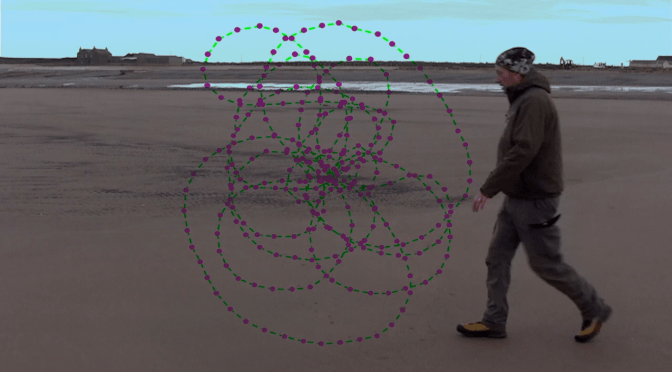
My visit to the Solway was prompted by a need for a large space without physical barriers to explore what would happen if I walked a drawing of an model of experiential learning through the arts. In doing so my idea about my model changed.
The original model
Models are slippery things. Their appeal is that they appear to give a fixed image of a thing, but in practice whilst they serve as a very useful signpost about which way to go when you set off, the thing you find when you get there is never fixed. So the walk was undertaken as an experiment ‘to explore what would happen…’

What the model predicted was that a number of factors would contribute to the art making. In this case my thoughts were that source material would be Richard Long and the walking and land artists. My personal arts practice or art made included using a GPS and walking to make a mark on the landscape and experience of film making as a means of exploration, reflection and expression of experience. I drew on ongoing research and theory about the outdoors as a liminal space and art making as adventure, as a journey of uncertain outcome, and Shaun McNiff’s ideas about witnessing in the arts therapies1.
The model was correct in that my path would lead in to and out of the art making on the day and on to more art making, research, source materials and theory, and that the generic coloured blobs would be specific to the art making experience. My initial thinking after the event went to ideas about performance and the epistemic object and further trips to photograph and film, reporting this through blog posts.
At the centre of this, an act of art making and poiesis occurs. Something comes into existence that did not exist before and it is called art. It is art by convention, because all this could describe the making of a cup of tea. To this conundrum ’Why is this art?’ one asks the question asked by artist John Baldessari, “Why is this not art.” It is art because it was my intention to make art and my act was guided by research, reference to existent artform and artists, theories of art and my experience of art I made before.
But there was something incomplete about the central concentric circle structure. I was interested in the model showing how each experience of art making occured within a loop of experience, like in Kolb’s learning cycle.
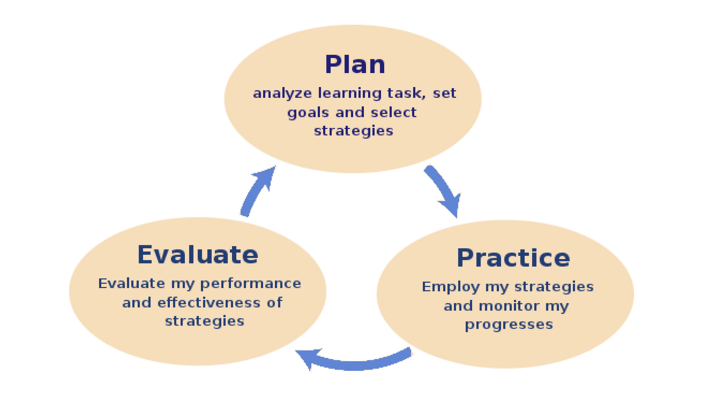
But like the Kolb model is an ideal form which would be expressed differently depending on the setting, the strict concentric form may vary depending on the setting. My experience of art-making was, however, that in making art I stepped away from the day to day life experience and went to a different place. This could state is sometimes known as a ‘Flow’ state from work by Mihály Csíkszentmihályi. You get in the zone of concentration and attention, of doing and the senses. But for art-making as experiential learning or personal research or art therapy, you enter a state that is similar to a meditative state, like flow with awareness. You are focussed on making art but also on what it is that you have made and what happens when you make it.
So in the model, as well as cycling through an iterative learning process, there was a linear path away from the world, into a creative state where something happens in partnership with your artform, then back to the world.
Reflecting on how the model changed
On return home from the Solway and recollecting the emergence of performance I went back to my Dramatherapy training. In a dramatherapy session you work with a basic three part structure. ‘It begins with a physical warm-up leading to the Main Event, the place where the real action is. It concludes with the ‘grounding’, returning people from the ‘Land of Imagination’ to their own everyday selves.2’
During the walk recreating the drawing, the shift from walking to dancing, from recreating the drawing to improvising and performance emerged unbidden. One could say this idea came out of my imagination or my unconscious, or it was the product of a state of flow, or having danced in the past, I simply remembered something from my past related to what I was doing in the present.
So there are two things here. One is a linear journey into a place with some degree of separation from the everyday world, into ‘flow’ or ‘Land of Imagination’, followed by a return. This is a linear journey in an iterative looping cycle of learning. The other is the experience of being in ‘flow’ or the ‘Land of Imagination’. This is an experience of art making as somewhat separated from ones day to day life.
Something like this three-stage process occurs in many settings. In story and in film and theatre there is a thing called the ‘Three Act Structure.’ On one hand, this is as simple as a beginning a middle and an end or it is sometimes understood as set-up, confrontation and resolution. Many interpretations exist and there are examples to be found of its use in say cinema, but it is not without some contention. Like one article says ‘The true three-act structure isn’t a formula, it keeps your beginning separate from your middle and your middle separate from your end. That’s it.’
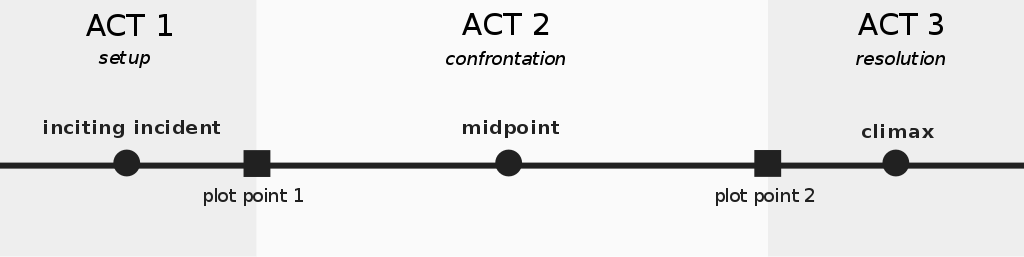
But the ‘beginning, middle and end’ could be seen as a universal or archetypal structure. For example at Outward Bound, in experiential learning, you worked with a ‘training, main and final expedition’. Your training expedition was where you taught skills, the main expedition was where you had the conflict as you got the people to move from being a group to being a team. Final was the unaccompanied independent journey.
In care, we worked with a conflict model and resolution tool called ‘ABC Charts’ meaning A – antecedent, B – behaviour, and C – consequences. Joseph Campbell’s Hero’s Journey has a specific expression and detail but is also a three-stage form, the call to adventure, the test and the return.
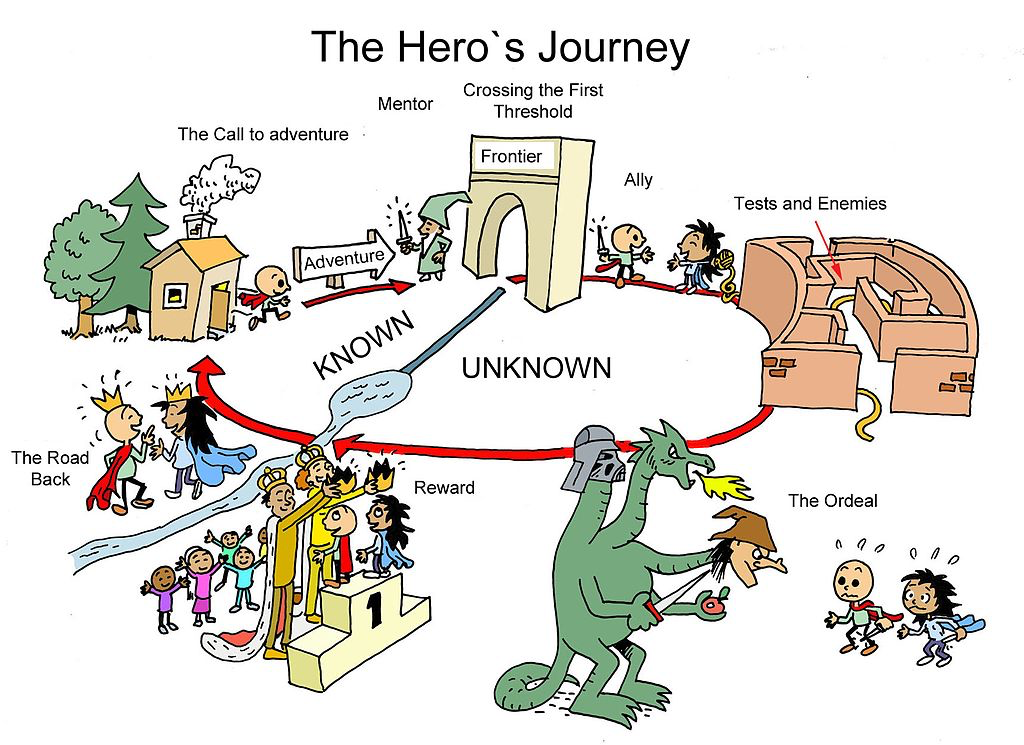
But the simple, warm up, main event and grounding of dramatherapy mentioned above can be also seen in a form described by Victor Turner and Arnold van Gennep as Rites of Passage.
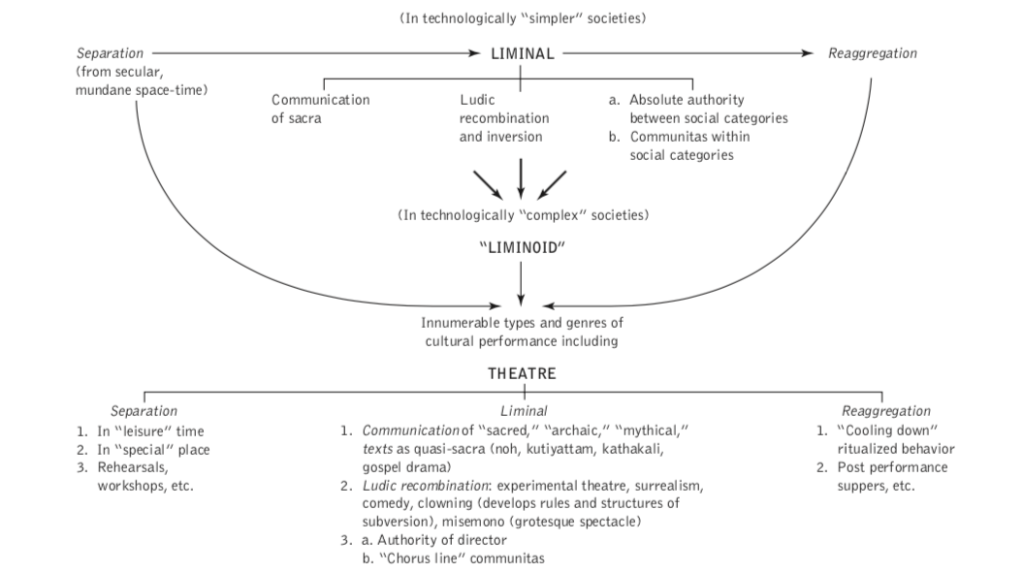
From Schechner3
The above diagram is from Victor Turner a British anthropologist who theorised the above from studies of non-western settings at the top, and western settings at the bottom. This is a three stage journey of return that is linear and cyclical and has a central liminal or liminoid space somewhat separated from everyday life called The Land of Imagination in the dramatherapy model.
Art as liminal space
My proposal is that art making and experiential learning could be understood as having some some elements of the above structure in their practice. I don’t think it is coincidental that after a while on the Solway Walk, I spontaneously rediscovered that I could do the walk as performance. This could be seen as me, albeit briefly, entering a mild ludic state.
There is a lot to this seemingly simple experience of walking in circles on a beach like an idiot. Not least the idiocy. I was being playful throughout. I was in the land of the Trickster or the Court Jester, at once playful and challenging, the one who can perform recombination and inversion.
This is also adventure. The journey between departure and arrival. The journey of uncertain outcome with misadventure available. The three part expedition cycle of Outward Bound. On a slave ship, the middle passage. The refugee in the hands of the trafficker. It is not a thing of the past.
To me there is also something in this of being in the Solway, a liminal space if ever I saw one, between two countries, high and low water, land and sea. To me this is also a state of walking. In walking you are between places, outdoors, in a state of flow, and returned to a mode of existence that predates all of the modern world.
So after a few weeks of reflection my research led me a realisation. The experience was ‘like’ a lot of things, from experiential learning, theatre, anthropology, adventure sports, performance art, and conflict resolution, to Outward Bound and Joseph Campbell’s Hero’s Journey.
This could also be applied to many arts based contexts and the model has ART FORM as a liminal or liminoid experience at it’s heart, the same as dramatherapy. But the artform that fits this experience best if what is known as Walking Art.
My exploration of my Solway walk has reached a convenient place to move on and in my next set of posts I want to look at Walking Art with a particular focus on it’s scope for promoting health and wellbeing.
Introducing Augusto Boal’s ideas about performance as a creative space for experiential learning
The act of reflection on my Solway Walk led me back to performance. Performance, like art, is a variable and often contested phenomenon. It can include theatre, dance, music, sports, business, ritual, play, performance arts and general social functioning. It can be a source of entertainment as actor or audience, but here it would be useful to connect with performance as a form of experiential learning. All art making could be understood as experiential learning as a source of knowledge, but performance has a particularly strong affinity with experiential learning as an active embodied process. My take on performance has to be influenced by my Dramatherapy training, in which a group or and individual can engage directly with performance to learn from experience.
One practitioner who works directly with performance as learning is dramatherapist and Social Activist Augusto Boal. He starts with theatre but develops it with the idea of the spect/actor, simultaneously spectator and actor. The spect/actor is performer and audience in one.
In Rainbow of Desire Boal describes theatre by quoting 16th century Spanish playwright Lope de Vega as ’two human beings, a passion and a platform’. This confirms the theatrical mode of performance as being a collective experience. In this case the ‘company’ is two, (and possibly more) persons interacting with one another. The passion is a reference to strong feelings and often suffering. Passion implies experiences beyond the mundane. Finally there is reference to the platform. In theatre this is usually the stage, as separated form the audience. Boal however moves beyond the actors and spectators as physically separated on auditorium and stage.
What is important to Boal is the act of separation rather than the form of two physically separate spaces. He says ‘The separation of spaces can occur without the ‘platform’ existing as as an actual object. All that is required is that, within the bounds of a certain space, spectators and actors designate a more restricted space as a ‘stage’,: an aesthetic space’.1 By this he says ‘In its greek root ‘aesthetic’ means ‘of or pertaining to things perceptible by the senses’’. Boal goes on ’So theatre does not exist in the objectivity of bricks and mortar, sets and costumes, but in the subjectivity of those who practice it’. He establishes theatre can take place anywhere you want it too. I chose a beach.
Boal continues ‘The ‘theatre (or ‘platform’, at it’s simplest, or ‘aesthetic’ space’, at it’s purest) serves as a means of separating actor from spectator; the one who acts from the one who observes. Actor and spectator can be two different people; they can also coincide in the same person.’ (Boal’s italicisation). The individual performer is witness to their own performance in real time and retrospectively.
Boal says ‘The aesthetic space possesses gnoseological properties, that is, properties which stimulate knowledge and discovery, cognition and recognition; properties which stimulate the process of learning by experience. Theatre is a form of knowledge.’ Here he describes theatre and performance as experiential learning. But away from the confines of theatre as a building with a stage, as a state of entering aesthetic space as a form ‘in the subjectivity of those who practice it.’ then theatre and performance as separation between actor and spectator, could be seen as having occured when I made the beach a stage, an aesthetic space, in which I was both spectator and actor. This is reflective practice.
My reflection, or my ‘review’ was live in the doing and the senses, direct in my direct recollection of the experience, reviewed by the witnessing of the camera and my seeing and editing the footage, in the production of the gps track, as a direct reflection of how I recreated an image of an idea, and how I deviated and moved form representation to improvisation. I witnessed myself in performance. Now you witness what came form my performance.
Boal offers one perspective, and there are other perspectives from other arts and performance theorists and practitioners, but in my reflection, reconnecting with Boal’s idea of aesthetic space resonated with my experience of going from walking an image of an idea to making the beach a place to improvise or perform a new image of an idea. He goes on to further develop the idea of the aesthetic space which offers some interesting insights.
He talks about how aesthetic space has a property of plasticity. It can can be anything we want it to be. ‘A battered old chair will be the kings thrown, the branch of a tree a forest…’ The Solway beach became a canvas to draw an image of an idea, then it became a stage on which to choreograph a dance with a piece of seaweed. Boal says ‘The aesthetic space liberates memory and imagination’.
He also says it offers an affective and oneiric dimension which ‘exist only in the mind of the subject… The affective dimension fills the aesthetic space with new significations and awakens in each observer, in divers forms and intensities, emotions, sensations and thoughts’. In the affective dimension the performer is in the moment and observing them self in the moment, they become spectator and actor. The affective dimension is ambiguous and dichotomatic. I think this is the bit that makes reflection on experience in situ available.
Boal goes on to say ‘Oneiric space is not dichotomous because in dreaming, we loose our consciousness of the physical space in which we the dreamers, are dreaming, here she penetrates into her own projections, she passes through the looking glass; everything merges and mixes together, anything is possible’. Which is why at the end of the walk/dance/performance I knew something had happened, but only on reflection at home did this thing that happened decompress. The act of making images of the experience helped with this. I think this aspect is the bit that makes, in the words of Monet and Rothko, the art the experience. The art form becomes a form of knowledge. The art making is research with the art made is the process and product of research.
The dichotomy of the experience is a key element. Of dichotomy Boal says ‘ This property is born out of the fact that we are dealing within a space within a space; two spaces occupy the same space at the same time.. And all those who penetrate it become dichotomous there.’ As a member of the audience watching Macbeth, I am in the auditorium and also on a heath, there to meet Macbeth. As a walker on the beach, I was on the beach but also on a canvas to paint a picture, then on a stage to do a dance. On a ropes course I am safely moving over a step across, but I am also a person who fears that may fall to their death. I want to return to dichotomy in my next posting, but from the point of view of the art object in fine art.
As a therapist Boal also talks about the effect of the dichotomy on the protagonist actor in the aesthetic space. In theatrical mode, he says, ‘..the protagonist-actor produces thoughts and releases emotions and sentiments which.. Belong to the character, that is to say, someone else.’ In therapeutic mode ‘..the protagonist-patient (the patient-actor) reproduces her own thoughts and releases anew her own emotions and sentiments.’ In the case of my Solway walk, the beach was the aesthetic space and the work done was partly about my material I brought, ie the image of an idea, but also my experience of the place as an active participant as art form and process. In all of my work and ideas about art as a form of experiential leaning, the approach is much closer to the therapeutic mode. From experience I have found this sets the whole mode of working with art appart from ideas and practices found in ‘The Arts’ or ‘Fine Art’.
Finally Boal talks about the aesthetic space as being telemicroscopic. ‘In creating the stage-auditorium division, we transform the stage into a place where everything acquires new dimensions, becomes magnified, as under a powerful microscope, thus brought closer and made larger, human actions can be better observed.’
Boal as a therapist and social activist has a good deal to say about how theatre and performance can enable spect/actors to reflect on their own experience and ‘..help the spect/actor transform himself into a protagonist of the dramatic action and rehearse alternatives for his situation so that he may then be able to extrapolate into his real life the actions he has rehearsed in the practice of theatre’.
In moving from representation of an image of an idea to improvisation of a new image and thus a new idea I believe the Solway walk did this for me. The dichotomy or ambiguity in the experience invited me to ‘rehearse alternatives for the situation’. This is a creative act, it is experiential learning, it is adventure. Creativity is a state of uncertain outcome. The journey of uncertain outcome is built on ambiguity. Art is adventure, and whilst misadventure was absent here, it is present in some arts practices and, if I got my tide times wrong, the Solway is a dangerous place. My suggestion is that art making can be an inner adventure or an outer adventure. This is a thing I will discuss elsewhere.
The key themes in this are 1) that performance is an invention of experience not place 2) and as such, by being dichotomous and ambiguous, offers scope for new experiences, and 3) the performance or art made is not just a representation or symbol of experience, it is the experience, and 4) the performance or art made can be understood as research and knowledge of personal experience. This, alongside other modes of understanding experience, offers some unexpected dividends.

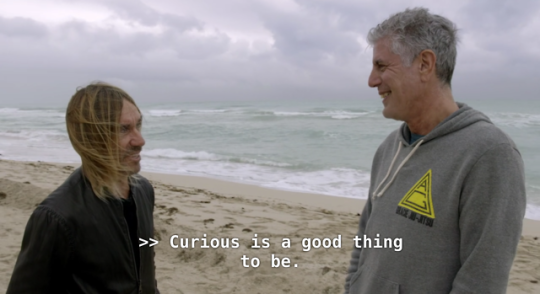
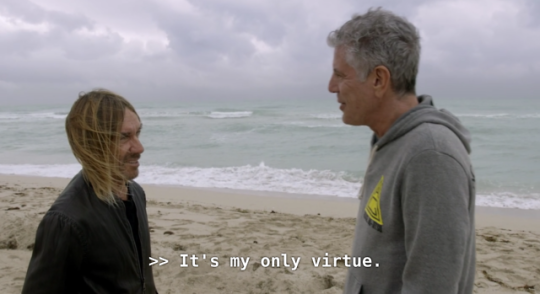
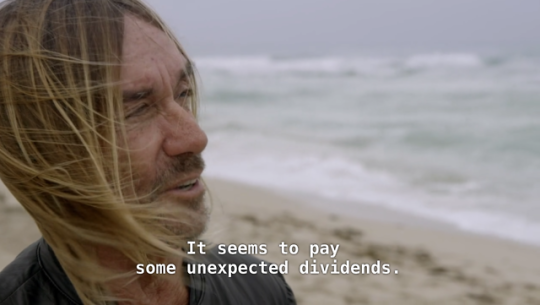
Performer, Iggy Pop on a beach talking to someone about curiosity.
In further posts the ideas of performance and art making as a transformational experiential process will be further developed. But a key theme is that this experiential process is dichotomous, subjective, situational, emergent and multi-dimensional, and no single account can describe it in complete and concrete terms and working through direct expression of my own and other peoples working practice is the best way to do this. What I present is art making as adventure, the journey and not the destination.
 Moving Space