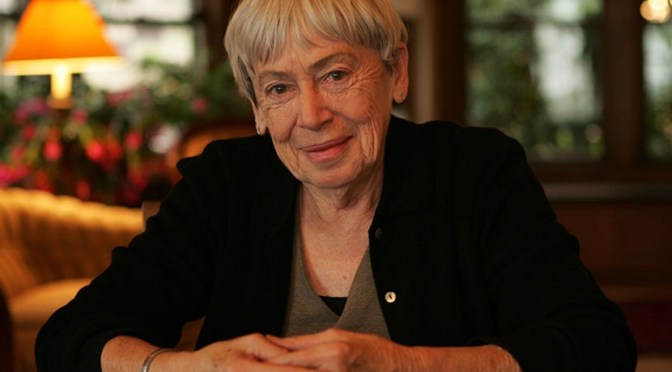
A great series of 6 videos about the life and writing of Ursula le Guin.
A number of things interested me with this video series. The description of the journey being the thing that matters reinforces the idea of art as adventure. The path is made in the walking of it to quote Zhuang Zhi. The act of making your art is inseparable from the act of making yourself.
The path is made in the walking of it
Zuang Zhi
So whilst the author published goes on to be read by others the first reader is the author herself. She sees herself on the page, her own words as subjective objects. Her life reified.
The product is important but the process of making the product, the journey, is what matters.
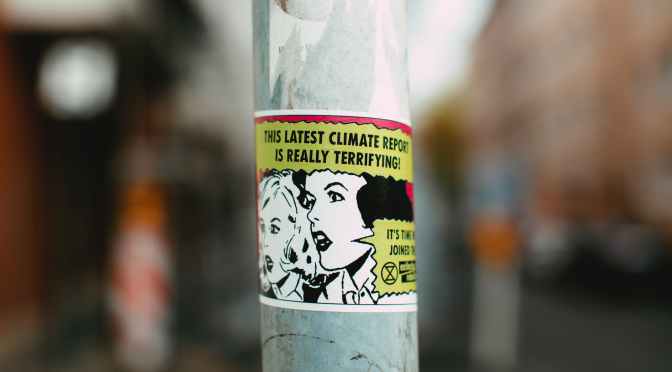
I was taken by this strapline in a news report on climate change…
“We have no choice but to take direct action to put our bodies on the line because petitions, sign-waving, and chanting—we tried that for the past 50 years and it hasn’t worked, and we’re out of time,” said one arrested activist.
A book called, ‘Limits to Growth’ was required reading for my degree in Human Ecology starting in 1979. It was published just over 50 years ago.
Limits to Growth was the first widely publicised model for climate change. It has kind of been forgotten because critics rightly pointed out it’s proposed timescale for catastrophe was missed. However it was clear that this was an estimate of a thing very difficult to predict. Change, it said, would be non-linear, ie it would get worse faster over time but the rate was nearly impossible to calculate with their early modelling. It proposed a ‘Business as Usual’ sceanario as the worst case scenario. Evidence from 2023 suggests this is the best description of what is happening now.
Part of what I want to do with my work is to use story writing as a form of personal research to explore the worst case sceanario from a factual and imaginal point of view. I started this as a series of performance peices meant to be a serialised story. In the setting planned this did not work but I continued writing. This was entirely fictive, but was informed by objective evidence. I reconnected to my degree which was a science degree, to see what had changed since the early 80’s. Sadly, not much had changed. That’s why the strapline captured me.
In fictive writing the story kind of tells itself. It has a life of it’s own and a hand in what is written. In the writing of the story. I went to a place several times where the medium term outcome was total nuclear war. Putin was dropping hints about this regards Ukraine at the time. So I took a break. I let it incubate. I wanted a more optimistic prospect. What was clear from my research was that we are taking part in an experiment, and we cannot say how it will end. This is an adventure of uncertain outcome. But this gave me hope. I wondered if a non-linear narrative might work. Could there be a number of different outcomes? This was really much more accurate.
Then my two main Mac’s died or started to expire. I stuggled to write on what other tech I had to hand. I have now replaced them and my writing can continue.
What is emerging is a story which explores as a starting point, a reality ‘as if’ the earth wants rid of us. It has a classic protagonist and antagonist. The outcome of their struggles, again in a classical form, are new forms neither of them anticipated. In writing I hope to find what these forms are. Some will be imaginal, fictional, and some more factual, except, as Club of Rome, Limits to Growth show us, we cannot accurately say what form this will takes. Except it won’t be pretty. At the end of the 4 year bachelor of science degree, on reflection, the consensus was that the shit was definately going to hit the fan. But we were young and thought we could outwit this outcome. Now I am not so sure.
By the beginning of October I want to have the story out as a series of podcasts. My intention is to use this work with art as research to suggest some ways of being that retain optimism in the face of what I do think is inevitable. Maybe accepting the inevitability of the shit hitting the fan will be the catalyst for change. My beleif is that we cannot change the whole world. The world is full of people who start their prognosis with “We all have to….”. This is not realistic. I want to get to “In order to not be laid low by this I am going to have to…” I want to see if the story can suggest some fictive ideas about how to be not be rendered depressed and useless by anxiety as individuals. To ask “What if it is inevitable. What can I do to survive?” I think this is what more people will find is unavoidable for them.
I hope to put together a kind of magazine, a collection of related posts, centred on the theme ‘End Times’. This will be put online and I hope to do a paper fanzine kind of thing with QR codes to online content. So I will be posting stuff that I hope to curate or collate into a coherent form by mid October.
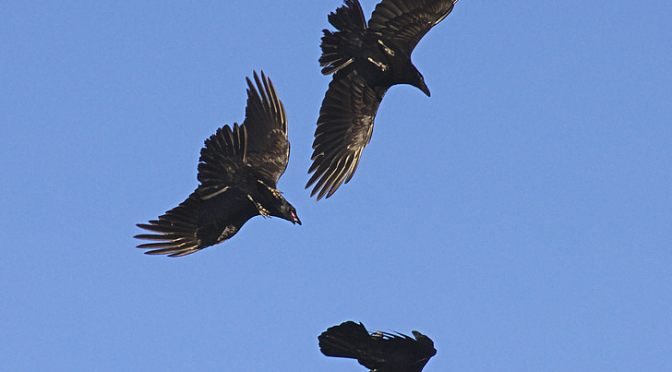
Croci the Crow cronked a cronk. A cronk is a crow call that says ‘ There is that man from the car there, with a clipboard, a pencil, three cages and his bag of carrion’. The man just heard a croak and a collective set of caws returning the call around him in the woods. ‘Well,’ the man said ‘the crows are definitely here.’ and put down his bag of carrion, the caronia carcass. The prize. Croci had smelt it before the man entered the woods. Before he got out of his car. Croci had called the call ‘cawcsss’ (with silent sss, at least to men) and as one, the crows converged, convened and conspired to steal his food.
One crow is all crows. They live en masse. No crow ever leaves the side of another crow. See one crow and you know some other crow is nearby. Each crow lives bracketed, like a word in sentence speaking about crows and what they intend to do. Crows calling to themselves be outspoken and literate in the wild non-human world, in the city, in the sky, on the rubbish dump, over the mountain top. Everywhere. Crows calling together to echolocate their fellow crows, and hear their own call answering back, in the throat of another crow. And these crows spoke of theft and trickery, because tricksters were them all. The thing with the crow is they go with the flow, because adventurers were them all. Whatever the outcome, in the end they would return, trick away and escape and curse and re-curse the fools who tried to trick them one and all.
Croci set off the moment the bag of sweet smelling rotten flesh hit the floor. All the crows so, set off too. All crows landed so, in a circle around the man and his soon to be stolen bag of booty. Croci hopped right up to the man and his bag. Two crows followed and triangulated him, took their third of the prize, and hopped into the cages to eat alone together in peace. They even closed the cage door, with click and clack and a corvidian caw. The caw is the call that says ‘We have him. He is ours’. It is said of men. Which is why man only notices this call. It’s subtext is ‘Sucker! and if crows could grin it would be said with a grin. The man was pleased. He had to get three crows for an experiment and had planned for it to take a month or more to train the crows with food, to trick them into the cages and carry them off to his lab and test them. But the trap closed on him the moment he carried the three crows to his car in cages, and put them in.
The car was warm and with their bellies full the crows slept. They woke at the lab as the cold air tickled their nostrils and were put in a cage indoors together on one perch, together as a three. The man went home, pleased with himself for gaining a month, for the ease with which his plan unfolded, for tricking the birds into taking his test. But wise them all, with one eye open so the man would see only three sleeping birds, the crows conspired and conversed. Little whiffles, and shuffles of breath, imperceptible whispers and ruffles of jet black feathers, almost silent clickings of bills and they had it all worked out. The way in was the way out. They knew. How the cage was built. How the lock was clicked. Where the sun came from, so where the windows were. In the darkness Croci conferred with his confederation of three. They reviewed and renewed their hasty plan made in the woods. If it was food the man thought had trapped them, it was food they would take from the man to undo his trap. They would refuse his tricks until they were fed, up to the gullet line under their bills, until he was fed up of their silence and their turned backs of sleek black feathers. For four weeks they got fatter everyday until they feared their weight would slow their escape, so then they turned and looked at him, and complied, complicitous and contrite. He suddenly found them friendly, almost apologetic, ready to do as he asked.
So off they went. Each put in a separate room. Each given treats for pecking at some marks on a piece of paper. Each chatting to the next. Each knowing where the other ones were. Each saying to all, what each was doing. Cribbing. Cheating. Conferring and sharing notes. Each one in the exam room passing with full marks with the answers given by the one that passed before. They saw and pecked some shapes like bones. Curved bones. Square bones. Cursive bones. Bones alone and in pairs, nested and bracketed in repeating patterns of self similarity. It was easy. Funny little bones on white shiny sheets. They were the connoisseurs of bones. They were carrion crows. They came into this world nested in a nest of other crows. Each knew their place. A pecking order from birth. Their family group bracketed together. Each a word in a crow call sentence. They partnered for life. Their partner and them bracketed for life. First single then double quotation marks quoting ‘I do’ forever together. All chatter and clatter and calling names. All finishing each others croak called sentences. Each knowing what the other was thinking. Embedded, a single bird, in a family, in a pair, in a roost, in a rookery, in a flock, murmerating en-masse. One crow is all crows. Each lives in and through the other. Their life and living is made through self similarity. There is no plural for crow in crow. We is I is we. Palindrome and palimpsest, all words overwritten and undertaken by the rest.
So Croci and the crew were happy with their work. Or should I say holiday. A warm bed. Unlimited food. No predators. No men with guns. Simple tricks. Simple solutions. They made the law they lived by. Free. Rebels all. A parliament of crows. All for one and one for all. Croci and the crew knew the time and place to shew, to be gone. After the moon had rolled over her milky form three times, they would go at night. This was their plan. The man disappeared for two nights, three times, every moon turn. He had a shiny little bone he kept on a hook on the wall by the window. This clicked in the cage and made it open, but did not click to make it close. It remained by the window on them entering their cage. One night, after the games with the little bones on the paper, Croci landed on the man’s head and made him shout. An accomplice stole the shiny little bone when the man was not looking and put it under their wing. He shut them in and went off blustering and huffing on his two days off.
He returned to find them gone. The window open and the cage bare. They left, cursing and re-cursing man, the fool, the sucker, the feeder, the tester, the test they passed with ease. Way too easy for minds en masse. Each bird a word in the collective prosepoem that is crow life. The singular song. Of the flow of us Crow. One in all. Our call. We is Croci. We sing our name.
Begone wicked. We is gone.
About Three Cursing Crows
After the short poem The Song of the Crow, which was quite lyrical, I wanted more of a detailed narrative. The Song of the Crow was performed at a performance night in Carlisle and went down well. But there was a lot leading into it, as presented on my site, and to give it out alone and unexplained was interesting. You release stuff into the world and loose control of it, it has a life then, of it’s own. For a second thing I wanted be a bit more explicable, so wanted narrative, but with a feel of how Croci expresses them-self. I hope therefore that it is more self-explicating.
In the writing, rather than the idea of Croci being the either/or singular of it, he or she, I wanted to explore a collective unsingular, a they and a them. So in the writing to avoid pronouns Croci became what we call ‘non-binary’. But like bi-sexual, the descriptor ‘non-binary’ relies on describing the thing it is by saying what it is not. My belief is that this is a manifestation of the patriarchy and colonialism, an othering of a continuum in process, splitting of a whole into an us and them. The act of not assuming singular sexed pronouns worked to make Croci become both an individual and a collective, a hive mind.
So on this basis it was clear Croci had a clear plan before the man with the clipboard entered the wood. This is the power of the trickster and Croci became trickster with ease. The Trickster exists outside the closed court and kingdom of the King and looks in, enters and leaves. This is what I wanted them to do, to take the piss really. Narrative allows the scope for more detail to make the way Croci thinks and acts more explicable.
The title was worked over a number of times. I wanted to let the title point to recursion, so as to not talk about it explicitly in the story, and I struggled. Then I wrote the simple descriptor ‘Three Cursing Crows’ and the words showed me what to do through the string threecursingcrows. This to me is an example of the intelligence of material, even down to ‘reecursing’ being nested inside a thing not about recursing. Materialising ideas makes the materiality intelligent. Things act for themselves, all we gotta do is listen and look for their performance, pay attention, with intention and attitude, be available for outcomes, but not connected to them.
‘Three Cursing Crows’ by Chris Reed (audio file)
This story was quite descriptive. For my next writing about Croci I want to get more mythical.
Two circular walks around a newly erected fence and the old line between cut and uncut grass.
Enclosurenoun
Old French - enclos - closed in
Similar - Paddock, fold, pen, compound, stockade, ring, yard, pound.
An area surrounded by a barrier.
A section of a racecourse for a specified activity or group of people.
The state of being enclosed, especially in a religious community.
The process or policy of fencing in wasteland or common land so as to make it private property, as pursued in much of Britain in the 18th and early 19th centuries.
A document or object placed in an envelope together with a letter.
Boundarynoun
Old French - bonde - a visible mark indicating a dividing line.
Similar - Border, frontier, borderline, partition, dividing line.
A limit of something abstract, especially a subject or sphere of activity.
In Cricket, a hit crossing the limits of the field, scoring four or six runs.
An entity demarcated from its surroundings.
Guidelines or rules or limits that a person creates to identify safe ways for other people to behave towards them.
Circumnavigateverb
Latin - circumnavigare - to sail around
Similar - Bypass, skirt, compass, circumvent, move around.
To sail or travel all the way around (something, especially the world).
Go around or avoid (an obstacle).
Avoid dealing with (something difficult or unpleasant).
The complete navigation around an entire island, continent, or astronomical body (eg. a planet or moon).
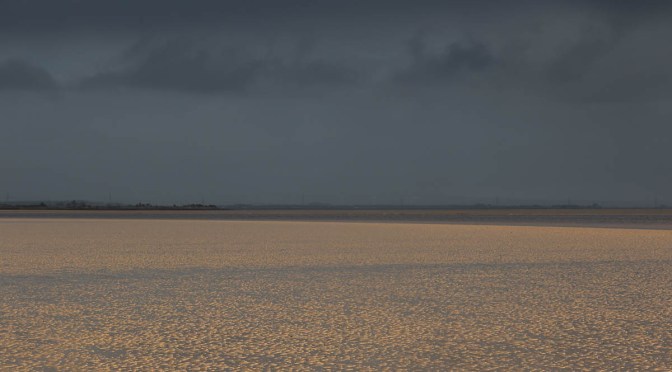
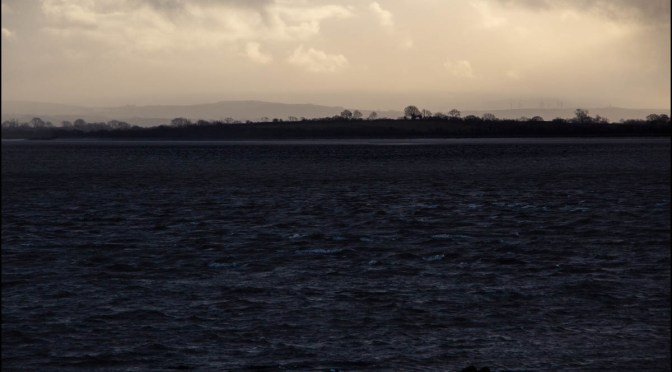
On the Solway, so flat and otherworldly I walked and remained fixed in space. The sea, the sand, the storm approaching over Glasson Moss moved past me as I rotated the Earth with my feet.
Looking closely and photographing, I moved slowly. But on my turn and return to Browhouses walking faster, the same thing occured. The white windmills in the sun sped towards me. The Earth turned under me like a ball under a circus dog.
In the Renault the Earth stopped. Feet no longer on the floor. The pedals, a, b, c were depressed, and the car sped past Metal Bridge and the services, back to Brampton and my house.
In the house, out of my boots, back on my feet in slippers, the Earth moved again the crockery in the cupboard rattled and chinked with each step. I toyed with a short sprint. The milk in the jug rocked like a storm… in a milk jug. Teacups were the same. Tea sloshed over the rim. Little waves on a bone china shore.
I filled the bath and on walking from the bog a tsunami formed. I walked the dog round the block, and the planet rolled in a raggedy right turn the size and shape of my neighbourhood, back to where she started. I sat still at last to watch the news. Natural disasters around the world. Unexplained tectonic movements unforeseen by experts, the Earth had moved.
I went to bed. I awoke. And it had gone.
I walked, I moved. The Earth did not.
I retuned to the Solway to seek the spot where it first happened, and in it’s vastness the spot was lost.
But somebody some day will find it. And the earth will move again.
An unco sough i’ the gloamin’
An’ a flaff o’ risin’ win’,
A glisk o’ stoundin’ waters
By the weirdly licht o’ the mune,
An’ the fell dark tide o’ Solway
Comes breengin’, whummlin’ in.

Whaur glistenin’ sands lay streikit
Ablow the sunset sky
Noo a wan wide sea is reestin’
An’ the yammerin’ sea-birds cry,
An’ a wheengin’ win’ rings eerily
I’ the salmon nets oot-by.
Solway Tide
by Dorothy Margaret Paulin
from Country Gold and other poems (The Moray Press, 1936)
I found a number of writers and poets who know the Solway. I want to include them in this bit about the Solway and will post their writings with links for visitors to follow. Please support these artists by paying attention and buying their writing.
Helen Cox has been writing professionally since graduating from her MA in Literature and Creative Writing at the University of York St John in 2006 . Between now and then, Helen has written editorial for TV, radio, magazines and websites providing commentary on a range of topics including film, literature, travel and feminism. The publications she has written for include The Guardian, The Spectator, Film Fatale Magazine, movieScope Magazine and Film4.Com.
Of the Solway, in her debut poetry book ‘Water Signs’ she says…
(the last paragraph is a killer)
I was raised on the edge of the Eden River, at the point where her mouth opens out to the Solway Firth. The Solway is a fault line, marking the brink where two continents once kissed and swallowed an ancient ocean – the Iapetus, a long-lost ancestor of the Atlantic. On a still day, this saline mirror reflects the jagged lines of Scotland, where martyrs were once bound to rocks and drowned, and the English saltmarshes on the other side where the last ammonites laid down to die.
On this windless November afternoon, when the frosts have yet to scratch their nails down the backs of the distant hillsides, you can almost smell the chill in the air. But despite the coldness of this landscape, and its cruelty, despite the firth’s deadly quicksand and the way it hold hands with its radioactive sister: the Irish Sea, even now there is a feverish singing in my blood. A siren call that lures me back to this shoreline.
Like these tides I know of old, I will always return.
Nearby in St Michael’s graveyard, the corpses of Georgian smugglers who pirated brandy and tobacco are buried beneath the Yew trees. Their ears unable to listen to the bells chime in the church tower. Bells stolen from Scotland by English raiders. Bells that sang to me on playtimes and lunchtimes when I was a student at Bowness-on-Solway – a school that stands just a hop, skip and a jump from the skeletons of dead buccaneers.
My old school gate is an Ouroboros; the end and the beginning of Hadriain’s Wall – an eighty-mile frontier where rebels and Romans shot bronze arrows through each other’s hearts.
Here is division, threat and death, and for the time I lived here that is a truth I was never allowed to forget.
Hiking the periphery of the firth, twenty-five years after I left this landscape behind, I watch eroding earth flirt with the dislocated jaw of the estuary. I mark progress by the hazard signs posted every half mile. Warning strangers about the merciless tides that grip and twist the Eden until she no longer looks like her true self. I am reacquainted with the silence that lives here on the outer rim. The only sound: the intermittent rattle of trucks clattering over cattle grids.
When dusk closes in, mauve clouds threaten to smother and in my bones I know I wouldn’t resist. Through the mist, an invisible hand inks the silhouettes of bare trees on the horizon. The only other witness: a creaking gate the farmer refuses to oil. He’d rather save the fuel for his furnace. For the day the hearth wolfs down his last block of fire wood, when he cannot bear to chop hawthorn bark with chapped hands in the snow.
While we walk through the last shred of sunlight, chased by the icy breath of the coming solstice memories wash up on the foreshore like fragments of old pottery and river glass, and with them some dead bodies.
Looking back over my shoulder at the expanse of silver water, I think about the yawning void between information and wisdom. By the age of ten, when my parents left Cumbria for Yorkshire, the universe had taught me everything I need to know. It took me another quarter of a century to truly understand what to do with that gift.

 Moving Space